Former YouTube CEO: The One Rule Behind Susan Wojcicki’s Career | Her Family Speaks — Silicon Valley Girl Podcast
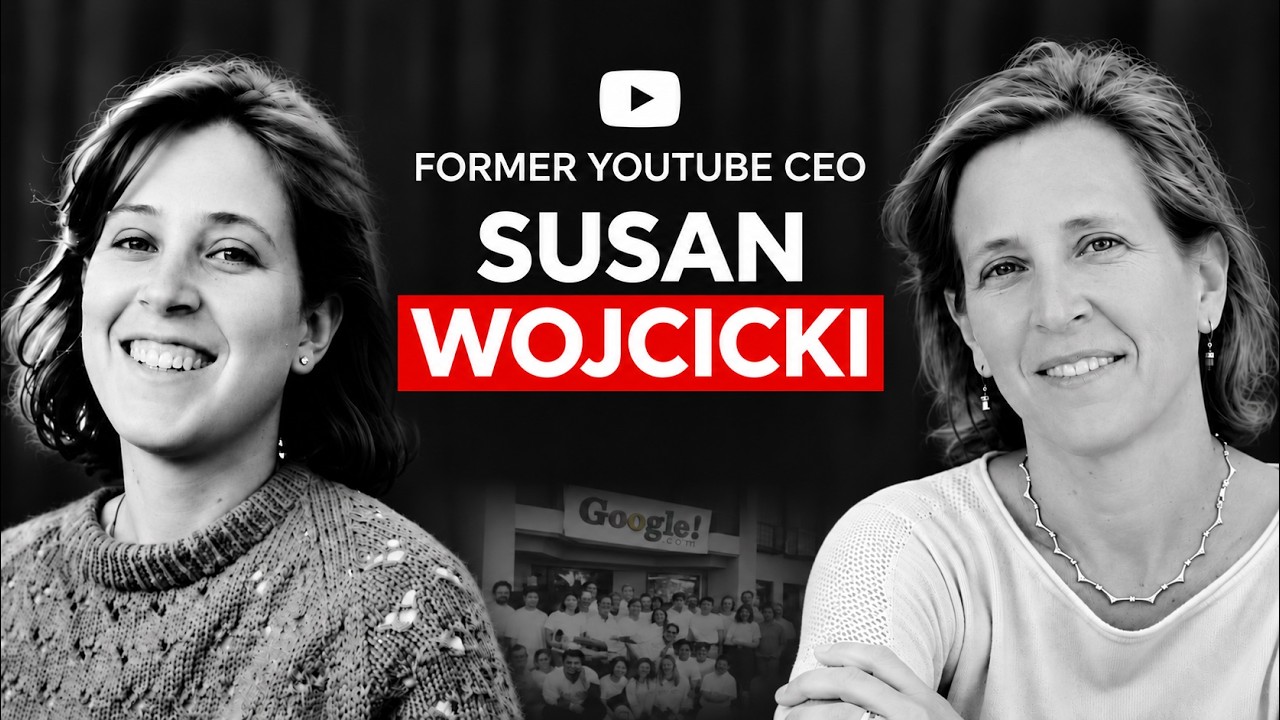
Susan Wojcicki was Google's 16th employee who rented her garage to Larry Page and Sergey Brin in 1998, later championed Google's acquisition of YouTube and served as YouTube's CEO for nine years. She was a mother of five who balanced her high-profile tech career with active family involvement and was diagnosed with lung cancer in 2022, passing away in August 2024 at age 56. The Wojcicki family, including her husband Dennis Troper, mother Esther, and sisters Anne and Janet, continues her legacy through the Susan Wojcicki Foundation's work on early detection and prevention of lung cancer.
Susan Wojcicki: When I was a young student, I remember I used to always say, I want to be a bio researcher and I want to work on cancer. I want to be something significant or make an impact in the world.
Marina Mogilko: That was Susan Wojcicki in 2017. In 1998, she rented her garage to two Stanford graduate students, Larry Page and Sergey Brin. She became Google's 16th employee, pushed for Google to buy YouTube and ran the platform for 9 years. She was also a mother of five. I saw Susan in person once and I always dreamed of interviewing her. As someone who has a career and kids, there were so many questions I wanted to ask her. In 2022, Susan was diagnosed with lung cancer. She passed away in August 2024 at the age of 56. November is lung cancer awareness month. So I went to the Vajiski family farm in Silicon Valley and sat down with the four people closest to Susan: her mother Esther, her sisters Ann and Janet, and her husband Dennis. We talked about Susan's life and about how technology and AI could help people catch lung cancer earlier. Let's start with one story that you can share that will show people who Susan really was. Dennis, can we start with you?
Dennis Troper: Susan, first of all, was an incredible mother. If there's one thing I can tell you, it's how much she spent her entire adult life focusing on her kids. It was something that we cherished together so much that at first we wanted to have one kid, then we wanted to have a second kid, and we ended up with five kids. It's very unusual.
You would have had more. But the thing is, despite her being so busy with work and all these responsibilities she had in her professional life, she spent so much quality time with the kids and focused on them, making sure that work doesn't get in the way. This comes across in many different kinds of stories—from her yelling at me that I'm not paying attention to the kids when I should be, to taking them to events so that the kids can experience some of the work that she was doing. It was just her number one focus.
Marina Mogilko: Janet, she was your oldest sister. Was there something she taught you that you were still doing?
Janet Wojcicki: I think that Susan was always the guiding light. We both looked up to her in terms of how to structure our home lives, our personal lives, even our interactions with each other. I feel now—we actually had dinner together last night, Ann and I—and I feel that sometimes when I think about how close we are and what good friends we are, I think Susan is still here on many levels. And part of that closeness reflects how she saw sisterhood and how she was.
Anne Wojcicki: I traveled a lot with Susan. We had a lot of work events, events like the Oscars. And it was always really fun with Susan. We'd go to the Oscars, but at the end she was always just such the sister. We'd stay in a hotel room together. And what was fun, and I always love these stories about Susan, she wasn't seeking the glamour. For the Oscars, I remember calling Susan and asking, "What are you gonna wear to the Oscars?" And she's like, "I don't know. I'm gonna go to Macy's." She was like, "Listen, at the end of the day, who cares? It doesn't matter." What was fun with Susan is she was always very real and very grounded. She wasn't distracted by the fact that she had this celebrity life and was surrounded by a lot of celebrities, but she never took herself too seriously.
Marina Mogilko: Esther, were there any signs from early on that she was going to be a great leader?
Esther Wojcicki: Well, yes, there were many signs from early on that she was going to be a peacemaker. It started very early with Janet. Janet was a very early talker. She was very directive. Even at the age of 12 months, she knew exactly what she wanted. And fortunately for Susan or fortunately for the whole family, Susan was able to help Janet compromise. I remember one of the most dramatic experiences was getting dressed. Susan was wearing something and Janet wanted to wear it. Can you believe she let her wear it? She took it off and gave it to her.
But then after that, I decided it was a real drama every morning. So I bought two of the same outfits. Then when Anne came along, we had three of the same outfits. There were no more conflicts in the morning. But she was a really good arbitrator, negotiator from early on. Isn't that interesting?
Marina Mogilko: Talk to me about being a leader of YouTube and having five kids, especially for all the moms watching who are trying to make career and family work. Any tips?
Janet Wojcicki: What's interesting is she would mention to me that her skills at home and her skills at work were synergistic—one translated to the other. Being good at work, those same skills really helped her manage at home.
Anne Wojcicki: I think Susan was also very practical. I remember her telling me, never do a work dinner. Those take a huge amount of time. You can probably get it done in 30 minutes. It's not worth the effort. Be home with the kids. You need to have that structure—always be home. Someone wants a meeting, don't do a work dinner.
Marina Mogilko: As a working mom, is it possible? Are you doing this? Are you home?
Anne Wojcicki: I'm home. I try to be home a lot.
I mean, in general, you can usually suggest a lunch or something earlier. I do think it's hard. You miss out on other events that people are doing. But I think Susan was pretty good and strict. I remember even when Google went public and I don't remember which child had just been born, she didn't go to the IPO bell ringing. She was like, I'm staying home. Susan was good about priorities. Every Saturday morning there was tennis, there was swimming. Susan didn't miss these events. When she went to the World Economic Forum, her only tweet one year was her breast milk on the outside counter and she was like, "Look, no freezer, no problem." I remember thinking, "Wow, any other insight, Susan?"
Dennis Troper: She really had to ruthlessly prioritize in order to just get things done. And she applied that principle not only at home, but mostly at work because she could be working 24/7 otherwise. She had no choice and she was really good at it. When we got this place, it was not really a farm. It was just empty land and we converted it into a farm with the help of some botanists who are really into farming. We ended up creating a place that, if you look around, is very lush and very beautiful. And this is all Susan's idea. We went to Santa Cruz one day and she got little chicks of different types. The guy at the store would tell us that they would yield different colors of eggs.
Marina Mogilko: Yeah, there it is. Can you see?
Dennis Troper: It has a feather in it. Yeah. Great. I'm so happy that we found one. During the spring, we bring the kids to plant and to help with the new crops that we're putting up.
Marina Mogilko: Esther, what advice were you giving Susan about raising kids?
Esther Wojcicki: Basically the same thing that is in the book. She did a lot of that. She trusted her kids to do a lot of things independently. She always respected them and their opinions and ideas. She followed that without even thinking—that was just her way of functioning. She would always ask kids what they thought: "Do you like this or do you want to do this?" She was not forcing them to do an activity that maybe they didn't want to do. She gave them a lot of independence. And Susan was always a very kind person, a kind child. She was the kid in the class who would talk to the kid who didn't have any friends. You have to remember that her dad, my husband, was a scientist and he used to talk all the time at dinner about different scientific things. He really had an impact on them being interested in science.
Dennis Troper: During the few years that she lived with her cancer, we used to go a lot to Stanford Medical Center. But on the way there, we many times stopped by our oldest daughter's lab. She was a researcher while she was studying at Stanford and Susan loved going there. She was so proud of Janina, my daughter. And now Janina is working at a biotech startup on cancer-related stuff. So it just proves how much she got from Susan.
Marina Mogilko: I wanted to talk about her diagnosis. How did she tell you about it and what, knowing what you went through, what would be your advice to families who are experiencing this now?
Dennis Troper: We were at a conference that summer and at that conference she was not feeling very well from her hip. She felt some pain and was thinking it was something that required stretches or yoga or just something that was temporary, a temporary pain that would go away. After the conference, we stayed on for a couple of days where she could relax and stretch and do some exercise and swim. And after that one week, her pain was still there. It hadn't gone away.
Janet Wojcicki: She got an MRI. I remember seeing her. She came actually to my house to pick up my daughter for tennis and I saw her in the car and she said, "My hip's been bothering me."
I didn't really think anything of it other than I thought she'd have it checked out.
She looked a little stressed out. But then later, I forget when it was exactly, but she texted me and said I have bone cancer. And I was like, what do you mean? What kind of cancer? Be specific. And she says, it just says metastasis.
Dennis Troper: What I can tell you is that it was extremely hard for Susan to take on that news. And from that point on it was more about what to do next.
Janet Wojcicki: I just want to emphasize though how, and I think this is the case for a lot of families unfortunately with lung cancer, and this is the role also thinking forward and what we're hoping to do with the foundation is that when she was diagnosed, other than the hip she had no symptoms, no cough, no fevers, nothing, and her disease was extensive. It was everywhere.
Anne Wojcicki: And Susan was very proactive with all of her screening. She went to the doctor regularly. She did her blood work. She did her mammograms, colonoscopies. She was proactive with her health. And I think that's where I remember Susan always saying it was never on my radar. If I had known I could have done a chest CT. I could have done a scan. All these things. Lung cancer.
Janet Wojcicki: Nobody ever said that was even something that was possible. I look at the photos in my house now still of her. It just doesn't seem real. She looked so good. She didn't even have gray hair. She didn't look stressed. She had beautiful skin.
Dennis Troper: With lung cancer, if you actually catch it early it is highly treatable. But once it's metastasized in stage 4, it's too late. Afterwards, we started looking more closely at the statistics and it is incredible how lung cancer is the number one cancer that kills people more than prostate, breast, and colon combined.
It's a problem that really needs to get tackled because if you're able to catch it early it is treated.
Marina Mogilko: Most people think lung cancer only happens to people with a history of smoking. Up to 20% of the people it takes have never smoked. Worldwide, it accounts for one in five cancer deaths. More than breast, colon, and prostate combined. Three out of four cases are found late when fewer than 10% of people survive. Found early, it can be cured. A scan could catch it sooner, but eligibility depends on smoking history. So about half of the people diagnosed never qualified.
Anne Wojcicki: It was such a crisis. We all have, and Jan and I particularly have a background in healthcare. I actually had worked in GI and lung cancer when I was at NIH as a researcher, but I knew a lot of people in lung cancer. And ironically, Susan's one of her roommates in college, her senior year, actually had gone to Vanderbilt to study lung cancer in the non-smoking population.
Marina Mogilko: You started with Susan, the study to connect DNA with lung cancer.
Anne Wojcicki: We did. We started a community with 23andMe. Anyone who has lung cancer can join for free. We give you a free 23andMe kit and we have a number of surveys asking people to answer questions about their background and about their lung cancer. One of the issues in healthcare, in lung cancer or any other areas, is just getting enough data, enough people that you could potentially recruit, and particularly data matched with medical records. And so that was one of the things that Susan first looked at. She's like there's minimal data sets. There is no big lung cancer data set. Can we just create that? I think that's where in Silicon Valley, with the power of social media, the power of community, how do you drive the awareness and bring everyone together and say let's create the world's largest lung cancer community online? It's what one of the priorities of the foundation is about—understanding why there are causes causing lung cancer, and then how do you prevent it and find it early? Screening is one of those mechanisms. You can get a low-dose chest CT. It's right now really just recommended for people who were heavy smokers. But there are obviously people who are at risk, like Susan, and never smokers where it's rising. The number of people now that I know who are never smokers who have lung cancer is just shocking. So I do think it's an urgent public health issue to figure out: are you doing screening and how do you use the blood tests? And so the foundation's really focused on those two areas—can you do the appropriate kind of screening and blood tests?
Marina Mogilko: So in an ideal world, how does preventative care look for lung cancer?
Anne Wojcicki: I think in an ideal world, you're doing regular screening. How do you do a low-dose chest CT and then use AI to predict what your 5-year likelihood of lung cancer is? That's the type of screen that could become viable. I think at some point you'll be able to do a blood test that will look at your blood for all different types of cancers and see if you can find it at stage one. The goal really is to find it at stage one. Right now they're not quite sensitive enough for stage one, but I think those opportunities are definitely there.
Marina Mogilko: What will it take for the health system to start screening people early on?
Janet Wojcicki: I think even now the low-dose CT screen, the population that it is recommended for, there's low uptake, and part of that is because of the stigma surrounding lung cancer. Smoking has been so stigmatized and anything associated with lung cancer. But of course, anyone who has lungs can get lung cancer. No matter who you are, you shouldn't have this stigma and fear of actually getting screening. This impacts both patients as well as physicians. Physicians also aren't always having the appropriate conversations with patients. The screening modality that we have now, the low-dose CT, is underutilized in the patient population that really needs it, given the volume of cases. Lung cancer kills the most people, and we don't have anything right now for that large group that is getting impacted.
Marina Mogilko: That's fascinating. I think raising awareness is part of your foundation's mission and you're starting a YouTube channel, which I think is just such a perfect moment because Susan had been the leader at YouTube for nine years and I'm proud to be part of a creator advisory board. What are you hoping to achieve with this? What kind of stories are you going to tell on that channel?
Anne Wojcicki: The most important thing is the awareness. Anyone with lungs can get lung cancer. And I think that we want to have stories of optimism, stories like the pope. It's a great story. He got screened. He had surgery and he's done. So how do we get the people who need screening? How do we get that for them? How do we engage people in research? Every single person has the opportunity to contribute. We want every single person who's newly diagnosed with lung cancer or who has lung cancer to get a kit, to spit, to join that community. We want to do that. We want to inspire people that research is coming where we're going to be able to detect it early, but it requires investment into research. It requires us working with the science community. It's inspiring because it's coming and there are these opportunities. I think that we see both the tragic, which is more and more people are developing lung cancer, but the optimistic, that people can potentially detect it early, cut it out and be done.
Marina Mogilko: I wanted to wrap up with some advice to people who are listening who have been dealing with health issues. What would you say that should be proactively doing now with all the advancements that we have?
Anne Wojcicki: There's such spectacular advances with people being able to leverage AI tools and get insights into it. And so one of the things that was complicated with Susan is the blood tests, the genetic tests, the medical records. It's a lot of work to keep track of everything. I am really inspired by how you can take a picture of your genetic results. You can take a picture of your medications, your blood values. The beauty of AI is that it's patient. It will easily tell you, okay, here's what these things mean. These are other questions you can ask your AI. Say, make sure that you're always giving me five follow-up questions. I'm going to a doctor's appointment. Tell me what are the five things I should ask for? I do feel inspired by this opportunity for people to at least get that information about themselves and what does everything mean? What do your lab tests mean? What does your genetics mean? And get the right questions. What should you walk into your clinician's office with? What is it that you should be asking and expecting?
It's like you have a lot of counsel in your pocket.
I also encourage anyone who can go in and record the conversation, record it, because then you can transcribe it and then you can keep track of it. All of that is happening now.
Marina Mogilko: I wanted to ask if Susan taught you a lesson, Esther, something that you're keeping with you now.
Esther Wojcicki: I think the lesson that I learned from her is that no matter what, you still have to keep going and have an optimistic outlook. When she first found out, she said, "Well, I have only 9 months to live." But then she was more positive and she's like, "Well, there's things I can do and perhaps I can le—"
Arn, longer." So her attitude of trying everything and including, she was doing a lot of things to make herself happy. She was a very artistic person. She liked making pottery and she just spent more time making pottery, more time on art projects, more time with the kids. So I have to admire her for doing all these activities that she loved and wanted to do in spite of the fact that she was facing this dire diagnosis. A lot of people just give up. Don't give up. Do things that you personally enjoy doing. I think it helps you live a higher quality life and perhaps it's not as dire as you think. I'm sorry that she didn't have the treatment to actually extend her life even further, but she definitely worked in that direction.
Marina Mogilko: And it's fascinating to see how much work she's done to help everybody else now in the world dealing.
Esther Wojcicki: Well, that was her goal. She's like, maybe I'm gonna suffer from this and I might die from this, but what can I do to make sure that other people don't have the same issues, that I can make their lives better, that I can help them survive. So that's what we're doing here with the foundation, with everything that you're doing.
Marina Mogilko: I totally get a feeling that Susan is still here because whatever you were describing how she was so inclusive and she was thinking about everyone with the YouTube channel with the foundation. It is her spirit.
Anne Wojcicki: Well, I don't know if you feel this way but I often when I'm talking about Susan, I start talking like her. Do you have this? I can do it so well that you feel it. You're like, "Oh, I know exactly." Even when Susan would say, "Oh, lung cancer." If I know lung cancer, it's just like her. She is around and again we're sitting in her yard with her dogs who are running around and Dennis and when
Marina Mogilko: she, a few weeks before she passed, she told you to do something meaningful.
Do you think the foundation is what you're going to double down on?
Dennis Troper: Most definitely. Yes. Of course. I have completely switched my careers. I'm focused on philanthropy 100% of my time both with the foundation and also at work. I've been at Google for 23 years and my last three years have been at Google.org which is the philanthropy arm of Google working on very meaningful projects in addition to the foundation. So the combination of them, it's all about her point was when she said do something meaningful. We need to know we've done a lot in our professional careers. It's time to help the community and that's what I'm working on.