Wharton Entrepreneurship Professor: What I Push My Students to Build Now That They Have AI — Silicon Valley Girl Podcast
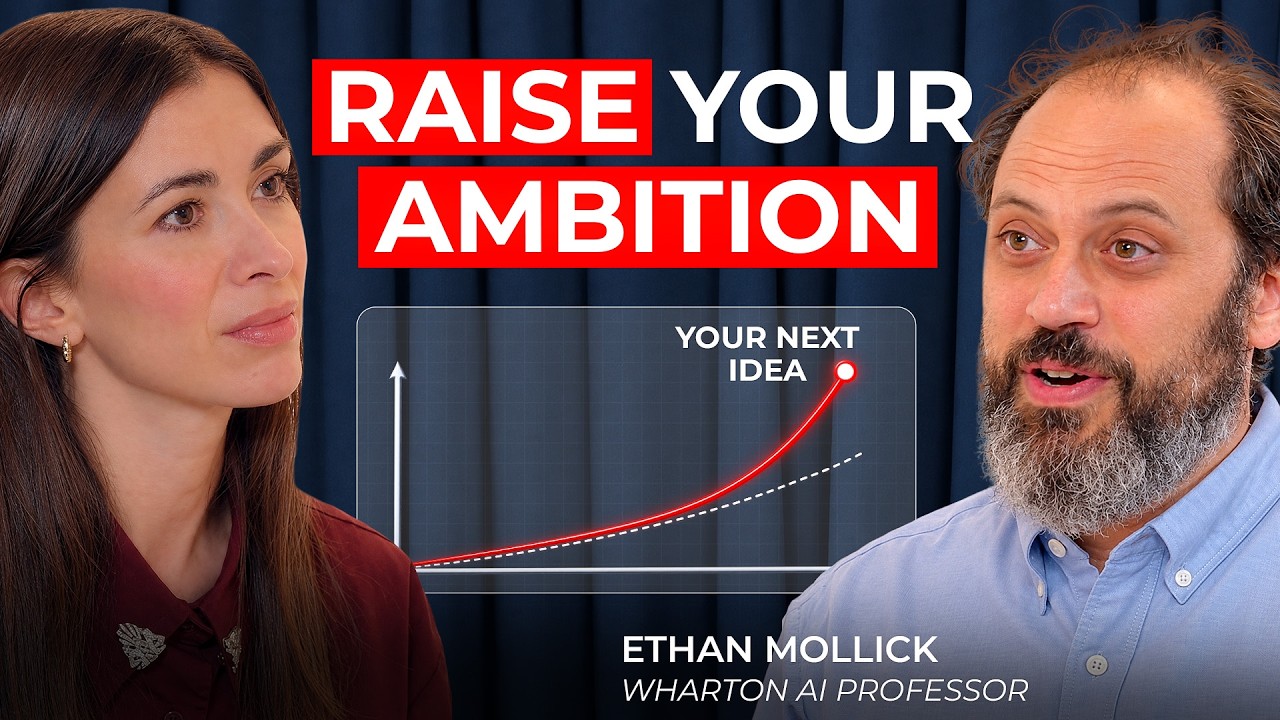
Ethan Mollick is a professor of entrepreneurship and innovation at Wharton University and co-director of Wharton's Generative AI Labs. TIME magazine named him one of the 100 most influential people in AI, and he reached approximately 500,000 readers through his Substack newsletter "One Useful Thing." His recently published book "Co-Existence: The Next Phase of AI" explores how humans and artificial intelligence can effectively work together.
Marina Mogilko: We can easily give up skills to the AI and we may never get those skills back.
This is Ethan Mollik, one of Time's 100 most influential people in AI. He leads the generative AI labs at Wharton. When everybody has Claude advising on the strategy, how do you avoid sounding just like everyone else?
You don't want the AI making those choices, even if they're good ones. You want to be inserted into that process. I'm deciding when to insert my own agency into the system rather than just sending off agents that do work. The adaption piece has to happen from scratch every two weeks. That's what I'm feeling.
So we have to purposely add friction to our lives in certain key areas so we maintain an advantage.
So you will never delegate generating ideas to AI.
I wouldn't say never delegate but—
Ethan welcome. You teach entrepreneurship and innovation at Wharton. Time named you one of 100 most influential people in AI. About half a million people read your Substack, "One Useful Thing," and your new book "Coexistence" just came out. Welcome to the show. When you teach your students, you also ask them to start companies while they're in class and you tell them to work on the most ambitious ideas. How do you teach ambition?
Ethan Mollick: That is always a hard question. Ambition looks like what we call entrepreneurial efficacy in the entrepreneurship world—same kind of thing, agency. And it's actually quite tough to do. We don't have a playbook for it. But I actually find that people create barriers that you can help them overcome by getting them to just ask them to be more ambitious and being in a room where peers are more ambitious. So a lot of what I do now is just ask "what could you do more than that?" and that was a hard question before AI because you stopped because you had the ability to only get so much done, and now as the frontier moves out, pushing for ambition is a much bigger deal.
Marina Mogilko: What are the coolest ideas that you've seen in your class?
Ethan Mollick: So it's funny because the last version I taught was six months ago and that was already the beginning of agentic work. My next semester starts in January. After ChatGPT came out, I had been following models for a while, but after Da Vinci, which came out a couple days before ChatGPT, and then a couple days later I had a class and I basically just dropped the entire class and said I'm going to show you how to use ChatGPT. By the end of the class, one of my students had stopped paying attention and had coded up his entire project for the semester during the class period and showed me the results at the end. Every year since then, the ambition level has gone up further and further. What was most interesting this time was all of these people who are subject matter experts. I've got surgeons and biomedical device people and finance people and NGO and humanitarian people, soldiers—all in this class. And suddenly they were all building real stuff. There were really interesting ideas: how do we track our entire supply chain? Because a lot of companies don't actually know their entire supply chain and how do we figure out where's the financial weakness in that chain that we might have to watch out for? Really interesting set of ideas. There was a bunch of really interesting stuff around specific problems in medicine—about how do you actually give information to patients in ways they understand as opposed to just forms? Really interesting but very narrow, focused on something people know. Part of what is interesting is software can be many things, and if you're trying to think about solving a problem that you have deep experience in, suddenly there's a lot of capabilities there that are really exciting.
Marina Mogilko: Are there any problems that you're telling them to avoid solving?
Ethan Mollick: Among those of us who teach entrepreneurship at some of the leading business schools, we exchange notes about the topics we see people address over and over again that we know will never work out, but we're always conflicted. Should we tell them it's not going to work out or let them try and figure it out for themselves? There are a few that are standard problems that are actually a good example of where technology is limited. One of the most common is we are going to replace brokers for houses. It seems like a really big opportunity—you're paying a couple percent to these people who are doing increasingly less work for you. This is obviously a case of disintermediation, and every time the idea fails because it turns out there's a deep social integration, political integration, and legal integration of brokers into the process that you just can't dislodge. So sometimes the reality of the world is quite different than what people think. And then the other is students thinking too narrowly about their student problems. So everyone always wants better ways to get homemade food to them or better ways to hold stuff between semesters that probably aren't as universal once you're out of college.
Marina Mogilko: This is so interesting. You're mentioning these ideas and then I can draw parallels to businesses that actually worked—like DoorDash was solving the problem of delivering food on campus. And then when you talked about real estate, like Airbnb, right? We would have thought, oh, who would have rented an apartment from strangers? And yes, there's a social element of trust, but Airbnb took over and now we trust Airbnb. How do you know your idea is not going to survive the real world?
Ethan Mollick: Well, I don't know, that's why we don't tell people. These are the highest failure rate ideas, but obviously because they keep coming up, they're not bad ideas. The whole idea is you can't filter them out initially. There should be a better way to buy and sell a house, and people do want home-cooked meals more easily than a meal delivery service, which is what they're asking for. It's like, how do I have my mother cook a meal for me? That's essentially what they're asking. And so there should be a way to crack this. There's demand for it, but they're harder problems than people think. And in some ways, AI makes it more ambitious because it's no longer the technical piece, but the numbers look really good and then they just hit a point where it's like, oh, there is a challenge here. Whoever cracks it makes a lot of money, but it's an idea that everyone has been throwing themselves against over and over again. So maybe some people who are watching or listening will be the ones to break the real estate broker experience, but it's not as easy as it appears.
Marina Mogilko: Exactly. It's like when do you give up? Because there are so many shiny things around you and you can build things in a day. It's so hard to focus on a problem when you hit the wall. Do you agree with this phrase: "It is as easy to work on a big problem as on a small problem"? Basically, the amount of effort that you put into building a small business versus a large business is the same because you're going to have the same headaches hiring and firing people. Do you agree with that?
Ethan Mollick: In general, I think if you're trying to build a business from scratch, aim big because you may not get there anyway. And ambition helps motivate people. It gets you the best people to work for you. It creates a real self-fulfilling prophecy. But I also think there are phases to a business. That initial phase might be difficult no matter what. Scaling presents its own challenges versus running a small business. They're not quite equivalent. Trying to get to the next level, if you're going to raise a Series B and a Series C, that's very different than running a local business. So there are different skill sets involved.
I mean, if you're starting from a blank slate and you want to take over the world, go fully ambitious. But I also think that we keep talking about ideas. I think people aren't being ambitious enough about the kinds of ideas they pursue, partially because they're in a Silicon Valley mindset about software. And I think a lot about the history of technology, and if you look at who got really rich during the industrial revolution, it wasn't people selling steam engines, even though that keeps being the analogy in Silicon Valley—like I want to sell picks and shovels. You don't want to sell picks and shovels. You want to dig a gold mine with new gold mine technology. And I feel like we're kind of missing that point here. If you can make a business more efficient, just do it yourself now and overcome those barriers directly.
Marina Mogilko: What is going to happen to software companies when you think about entrepreneurship? Is it really worth starting a software company these days?
Ethan Mollick: The early data looks really good and you can understand why it's a really good idea. I think everyone's a little too focused on SaaS at this point, which is like what do you do to make money—software as a service. And I think that is under threat. It's a different environment than it was before. I spend a lot of time with big companies now as well as entrepreneurs, and there are people getting it. There's a lot of conflict over what the future of software looks like.
He other hand I think software is increasingly becoming something that's table stakes for doing a lot of other interesting work so I would love to see more entrepreneurs branch out from software being the thing they sell to actually making or doing something because there's never been a better time to do that.
Marina Mogilko: What do you think is the future of SaaS because we're seeing all these companies that copy AI, right? That has started a few years ago, but now I think their revenue is going down significantly because of AI because it's basically the new models are replacing what they were doing.
Ethan Mollick: So it's interesting, right? You have a bunch of stuff happening at once. On one hand, everybody's a coder now. And that's not just a theoretical thing, right? So there's this great set of studies out of Anthropics suggesting that actually managers now write better code than coders, at least in first passes, right? Because it's about giving clear instructions more than being ready to code. And things are transforming quite quickly, right? You've got hundred times more productive people. So, companies are also completely in a mess as a result, but they all have their targets on SaaS vendors, right? There's not a large company out there that doesn't want to think about how do we become more independent, how we build our own tools. And so, it'll be a while before they get that all right. And a lot of them are still very happy. I mean, as far as I know, both OpenAI and Anthropic still use Slack from Salesforce, they still probably use Workday. So there'll be more choices being made about what kind of software vendor to go with. But I think the more interesting thing is that companies are realizing that a lot of the startups that were selling them stuff are just selling them things they could build already, right? They don't have their own LLMs, so they're selling LM capabilities to them that they already have. And that's creating a really interesting dynamic.
Marina Mogilko: So, what do you think is going to happen in a couple years? Because I already see myself like for example we're using the software but because we're getting to the limit of the number of subscribers and the price is going to raise significantly I'm wondering can we just try and build code this and connect Amazon services for the newsletter stuff right? I don't know what do you think is going to happen in a couple years?
Ethan Mollick: I think that software will be democratized right so the whole thing I teach at Wharton I teach MBA students and I teach undergrads and a lot of the MBA students aren't technical so the key to success for the last 10 years has been find a technical person who can code for you. I think it's incredibly freeing to view this in other kinds of fields where you can get approached in different ways, right? There'll be software heavy companies where you really need top engineers working with AI to succeed. And then there's going to be software as a toolkit that we get things done. And I think democratizing that's incredibly helpful, right? I mean, you don't want to be a software company. You want to make your newsletter. You want to make your videos. And if there are things stand in your way. And software, by the way, was one of them, right? It was also you needed to be able to do your own finance. When I did my first startup company, it was late 90s, first internet bubble. But I did not realize that you could pay somebody a couple cents a pay period to handle taxes for your employees. So, I would calculate taxes in Excel every week for the first few weeks, not realizing you could just do that. So, even just advice, all of the pieces you get like make this much easier now than it ever was.
Marina Mogilko: Using AI in the process of it. I really like the study that you mentioned, the Kenya entrepreneurs where people had experience in business, they used AI and it helped improve their strategy versus people who did not have experience. Can you talk about that when everyone is using AI to strategize a lot?
Ethan Mollick: Yeah. So, it was an interesting study. It was GPT-4, right? Long obsolete system. There's now 180 models better than GPT-4. 19 of which can run on your phone. So, big difference and it was only giving advice. So the fact that I think the number was 18% profit increase for the best entrepreneurs like that's a crazy number. Like we do studies all the time. We try and move the needle in entrepreneurship. That is a crazy number. But it only helped entrepreneurs who already being successful because it helped them expand in the way that you're talking about. Entrepreneurs who are already failing couldn't implement the advice. They were already going down the hole and there was no way to pull back. So we know this stuff can be effective. That was before coding, right? That was literally what should I do now? And in entrepreneurship by the way about 50% of Americans have had a good idea or they think they have had a good idea for business in the last five years and almost nobody pursues it because of all these barriers. So even just the advice to overcome those barriers is a real golden age for entrepreneurship compared to what we've had before.
Marina Mogilko: How do you know when to trust it? You mentioned newer models. Do you think the study will no longer apply because newer models are so much better or you still need to have this judgment?
Ethan Mollick: I talk about this in the new book, but I think there are four things you need to use AI successfully and that's deep knowledge, right? Some expertise in something and that's by the way entrepreneurship is all about getting disciplined expertise, right? You go to industry or you interview people, you learn about the industry, you test ideas out. I mean that is building expertise and I think that's every bit as important as it was, right? Otherwise, you're just sharing Claude ideas and Claude ideas are all very similar to each other, right? Second is wide knowledge. Increasingly important for entrepreneurship is knowing a little bit about the fields you're not in. Right? So if you're in software, you should know a little bit about design and a little bit about accounting because that helps you apply the AI more widely. And then agency, which we've been discussing a little bit here. And then finally, some sense of taste like selecting good ideas out of the slop pile is also really helpful. So I think that what we're seeing with the more agentic systems is they can run longer periods of time, right? GPT-4 could do four minutes of work independently with 50% success rate. Now we're up well over 17 hours of work. But you still need to be able to have some guidance in these systems. And even as they get really good, it turns out the human touch actually does matter because variation is what makes entrepreneurs successful.
Marina Mogilko: Yeah. And that's the whole challenge, right? When everybody has Claude and Claude is advising or ChatGPT, whatever they're using advising on the strategy, how do you avoid sounding just like everyone else?
Ethan Mollick: Yeah. I mean, it's funny because you realize that people are more important than we thought or that some people thought, right? So everybody who was early on to using Claude as a good writer back when Opus 4.5 or whatever they wrote really well and for a while nobody knew what Claude writing sounded like and now if you open LinkedIn or X it's just nauseating right it's like what's carrying the weight what is it right it's just all the same stuff and even not just the little phrases like the way it approaches things the kind of language it uses and you're like well they should I if you didn't hire a marketer you're probably making a mistake now the marketer can do a lot more work than they could do before but their human variation actually matters quite a bit and I think we're seeing that in a lot of other cases which is the AI pushes people towards a sort of a consensus strategy or view. We have some experiments where we found that we can make the ideas almost as diverse as a group of people but if you map the ideas that the AI's come up with and map the ideas that a group of humans come up with the AI still doesn't cover the full range of human ideas even if you're pushing it really hard. So this variation piece is going to become increasingly important like what are you.
Adding to the system to guide or steer it so you're not just clotting about everything and that would be okay. It's okay if you're using Claude for finance and that's not your competitive advantage, but in the area where you are narrowly aiming, you need to stand out. You need a differentiator. You need a moat that has to be human to some extent, even as the models get incredibly capable.
Marina Mogilko: You mentioned taste, and this is a question I ask a lot of my guests. How do you work on taste? What do you tell your students?
Ethan Mollick: We know a little about teaching people taste. You need to see good and bad examples of things. So you want people to explain to you how to pull something apart. One of the things I do is I bring in an art professor actually in my classes now who talks about thinking about how a designer sees the world. So you get this kind of perspective: what makes a font good or bad, what makes an image interesting or not. And so I think we need language to discuss things for taste. If you talk to somebody who really understands movies, they have a taste for movies that's individual, but they can probably talk widely about that. In the same way, venture capitalism is all about taste. Venture capitalists develop a sense of taste for a particular kind of problem space or not. So I think that seeing a lot of variation is really important. Learning to be disciplined about this is another example of why I think education has some value here. Being exposed to lots of options helps give you a sense of taste that you need.
Marina Mogilko: How is it different from judgment? Because AI is doing a lot of judgment calls. You present the data and it analyzes it, tells you this is a better decision. How is it different when you approach it from the taste perspective?
Ethan Mollick: I don't like the idea of judgment per se because AI is obviously doing judgment. You can't do a 17-hour task without the AI making judgment calls. Just like we don't have creativity in the list because the AI is obviously making creative decisions. The question is whether they match the kind of judgment and creative decisions you would make. So we can call that under taste or knowledge, but it's a different question. Judgment is a hard thing. We don't really know how to teach and we don't really have a good example of it. What context is that judgment happening in becomes a question. So it's a hard thing to ask: what is judgment? The AI is exercising some kind of judgment. There's obviously a human judgment element that's different, but we haven't had to build the language around differentiating these things. I think about what's happening in math right now, which is an explosion of proofs generated by AI. And one of the things mathematicians will tell you when you talk to them is a bunch of revelations about their field or maybe clarifications about their field that outsiders didn't know. There's an aesthetic element to math that actually matters to a mathematician. If the proof doesn't help teach you something beautiful or interesting, there's no value in it for the field of math, even if we've solved the problem. So we're starting to differentiate things that we didn't have to differentiate before because the only kind of intelligent judgment we have is human. We didn't have to come up with a different category.
Marina Mogilko: It's so interesting when I think about elegance and taste and judgment. It feels like people who have experience in the field are better positioned to learn that versus someone who's just starting out. Instead of getting time to learn basic things, they need to go straight into judgment, straight into taste. Is that how the market is progressing with AI?
Ethan Mollick: There's a couple things happening at one time when you think about markets and education. First of all, we are temporarily in a crisis in universities. I mean, we're always in a crisis in universities, so this is not new. Anyone who's been in education knows this, but we are in a temporary AI crisis. And we already know the outlines of that solution, which is AI is an incredibly good tutor when you use it as a tutor, and it's very bad if you're just cheating and getting answers from it. Even if you think you're learning, you're not. So eventually we'll have AI tutors outside of class. Inside of class, we'll do more action learning. If you've been to business school, law school, you've already done these kinds of case studies and discussions and activities. We'll do in-class tests. We'll figure it out. The real problem is where people actually have developed taste and judgment is in the world. We had this great deal for the last few thousand years. I would send you a newly trained recruit who didn't know anything. We had apprenticeship. That's how the last 4,000 years of white collar training have operated. You'd get a really junior person who was desperate to show you they were good. They'd work for cheap because they wanted to move up the rungs. They would do the work that a middle manager didn't want to do. In return, they would get a little bit of pay. They'd get to show off their stuff, and they'd learn the ropes. The middle manager would get their work passed off to somebody who could at least do some of the work and make their lives easier. That's how they moved up the management chain. That all broke because your incentives as an intern or as a first year associate, your incentives are 100% to deliver the best product you can. Who's better than you—Claude or ChatGPT or Gemini? So you will deliver Claude or ChatGPT or Gemini answers. This is not about being digitally native because you don't know what you're delivering. You're just handing stuff over. Every manager has realized: why would I give feedback to a human who takes a lot of time to do the work? I could just have Claude do it myself. We've broken the entire system that forms professional taste and judgment, and we haven't figured out a full replacement yet.
Marina Mogilko: What are your thoughts? What are you telling your students?
Ethan Mollick: I think there are a couple things. One is at the individual level, we now have to start being really disciplined about when we're going through cognitive surrender, when we're giving stuff up to AI, and that's really hard to do. We're built like entrepreneurship, which is what I teach, and what we've been talking about here. That's about trying to make your life as easy as possible so you can focus on the hard stuff. But then you learn nothing as a result. But it's also true in every other aspect of life. We can easily give up skills to the AI. I think we all feel tempted every day to do this, and we may never get those skills back. So we have to purposely add friction to our lives in certain key areas so we maintain an advantage. But we're not incentivized to do so at the individual level.
At the organizational level, companies are going to do one of two things. They're going to follow either the easy path or hard path. I worry about the easy path, which is only hiring senior people. We're seeing some signs of that. I know you've had some economists on talk about this. There's some early signals that junior jobs might be threatened. We're not 100% sure yet. The other option, the harder option, is that we actually make training a serious part of jobs. You actually have to give people time to be inefficient and learn on the job. Rather than learning being an accidental thing, we'll have to teach them. Maybe you have to actually add an extra year to universities where we teach you to be a Google person or a McKinsey person or whatever it is, and there's a year of customized training for you. We know how to teach and assess people in classrooms in a way that we don't know how to do in the real world anymore.
Marina Mogilko: This is such a tough problem. I'm thinking about a professional who even completed that step, they graduate being good enough but not exceptional, and the models keep improving. What is happening to these good enough people?
Ethan Mollick: Everything is too early to tell anything yet.
Marina Mogilko: I know, but do you ever think about where we're headed?
Ethan Mollick: I mean, also how long is good enough actually good enough? The issue is that's progressing too. We developed this concept in our first paper where we examined this. We called it the jagged frontier. AI is good at some stuff you won't expect and bad at some stuff you won't expect, and it's hard to know in advance what that is. As long as the frontier remains pretty jagged, there are always bottlenecks that humans need to fill in, and those can be really weird ones. If you think about AI replacing a lawyer, it turns out a lawyer does lots of things with friction in the world that the AI can't necessarily do, even if you had a robot doing the work, because there's human systems they interact with, there's legal requirements they interact with. Some people want to talk to a human. So that creates these bottlenecks that actually reward different talents than before. You see this happen in coding too. What makes a good coder now is completely different than 3 years ago because you're not writing code anymore. I think one thing I would say is good enough is a bundle of skills.
It's and it may very well be the people who are mediocre coders but really good at the vision about building software or communication.
Or communication and those will change too over time. I'm not going to say the AI will never do that task. It probably will. So I think we're going to see ourselves ping-ponging across what skills are valuable in a really rapid way without an easy answer.
Marina Mogilko: And I really like that Jagged Frontier study and I was getting thoughts, maybe it's us who don't understand the models good enough because sometimes you reprompt and you get the result that you wanted.
Ethan Mollick: Well, one of my favorite phenomena is watching people who know nothing about a field getting the AI to do impossible things and you're like, "Wait, how'd you do that?" You're like, "I just asked." You're like, "You can't ask the AI for that." And they did and it works and you're like, "Oh." What are we doing here? So there is this weird phenomenon. There's two things that we know make you better at AI. It used to be AI was a leveler—if you're a bad performer you got a boost—it still is that way but what we're increasingly seeing, and there's some nice results from Anthropic as well as some other studies, suggest that the people who have the most expertise get the most gains from AI at this stage, and that wasn't true until agents came around in the last year or so. But the other thing we know is that there's some AI whispering ability that is knowing how the AI thinks, that might be a sort of theory of mind. If I know people really well and I get to know the mind of Claude or ChatGPT or Gemini or whatever I'm using, I become more effective in working with it. And so those are two different skill sets. And then there's a mysterious third category which is some people seem to be good at this in ways we don't know. There's this great study by Alex Emis and a few others. He was at Chicago, now he's at Deep Mind. They measured people creating agents for negotiation and a couple interesting things. One thing they found is your skill multiplier becomes much higher because the agent engages in many negotiations. So a small difference in skills in creating good agents has a huge impact on the bottom line.
The second thing they found was that the people who are good at creating agents are not necessarily people who would be the best negotiators in real life. There was even a gender divide. So one of the things that we find repeatedly in studies for a wide variety of reasons is that women tend to underperform in negotiation and there's been a lot of work on this. It's been a big topic of concern but women made much better negotiation agents than men did. And again we don't actually know—I don't even know how to teach you how to do that necessarily.
Marina Mogilko: Is that management skill?
Ethan Mollick: There is a management skill, there's a theory of mind skill, there's an expertise piece, but things are happening so quickly that we can't pull them apart that easily.
Marina Mogilko: I just had Felix from Anthropic in the studio and he was talking about how it's very important to try and understand your workflow, what's going on in your head when you create a perfect text or when you go through a perfect negotiation, what was your thinking, so you can translate that onto AI and this is how you build a workflow.
Ethan Mollick: I feel like that's made up. I mean it might be true. To me, the analogy that makes the most sense as somebody who's run organizations and manage people is thinking of AI like a team I'm delegating work to. If I can do a good job delegating to a team and realizing where a team goes wrong, which is very different than knowing my own process, the AI will not replicate my process. And part of what I try to do is preserve stuff for me that way also. I write—it might seem crazy since I do Substack and X every day—I write all my own stuff. I type it all out because if I don't do that, the AI is very seductive and will absolutely dominate what I'm thinking in any direction and then you're just going to read Claude results filtered through me.
Marina Mogilko: Do you use voice at all?
Ethan Mollick: I use voice sometimes for this. I find typing on a computer is easier for a lot of this stuff. But you get good at figuring how you generate ideas. For me weirdly, I come up with my best ideas during soul cycling, which I think I'm the only guy and the oldest person in the room, and somehow being in a loud room where I'm biking and people are yelling at me about achieving my goals, I tune it all out and I come up with good ideas. I don't know why but everyone learns their own way of thinking. I've talked to another scientist who needs to be extremely overtired one day a week and then comes up with best ideas. So you figure stuff out that way, but you also have to preserve parts of what you do that are very human. I don't think it's necessarily about replicating my human process. It's about preserving a human process and then delegating work the way I would to a team. I have a really good idea, here's how I want you to execute on that idea.
Marina Mogilko: So you will never delegate generating ideas to AI. Is that what you're saying?
Ethan Mollick: I wouldn't say never delegate, but you have to be careful. We actually have old evidence on this. Brainstorming was invented I think in 1955 and by 1957 we knew it was a bad idea because anytime you do a group ideation process your ideas become fixated on whoever says the first idea out the gate and then there's a judgment process and you anchor on other people's ideas. So you lose natural variation. The way you should do brainstorming before any group process is everyone writes down ideas individually and then only start generating ideas as a group once you've done individual idea generation. You end up with much better ideas with higher diversity. Same thing with AI. You should absolutely use AI for idea generation, but only after you've generated ideas for yourself.
Marina Mogilko: So here's what happens after a single podcast. When I learn something new about AI, I go ahead and change some processes in my company, see if it works, see if the models are really powerful enough to handle that thing that I just delegated, and then I write about it. I don't type my emails like Ethan does. I actually talk to my AI and then edit them. And I also have a person helping me with that. But it's basically a summary of what we tried with AI, what worked and what didn't, and of course a lot of strategic stuff, how I navigate this media career and building businesses as a mom, as a woman, as an immigrant. So if you want to get a closer look at my process, subscribe to my free newsletter, Future Proof, and let's grow together.
And you talked about this effortful thinking and having AI as a companion. Can you describe that process?
Ethan Mollick: I mean I think what you want to do is try to mentally sweat while doing this. If it's not uncomfortable, you're probably not doing enough learning or thinking. It works just like exercise or anything else. In learning we call this desirable difficulties. If you're not encountering difficulties, you're not learning. There are certain mental processes like ideation that can't be streamlined that much. It's very tempting to do that. We've learned to recognize the cost of never walking around or never exercising. We haven't learned the same kind of thing with our brains because there was no alternative. You could Google something but that was not the same kind of thing as AI doing my thinking for me. So I think we have to be recognizing that we're doing that kind of effortful work.
Marina Mogilko: So interesting because I got to thinking that maybe the way I get ideas could be a workflow, maybe there is something that's happening in my life that leads me towards certain ideas and maybe AI can help me pinpoint that.
Ethan Mollick: It can. I mean I just think you have to be careful. There is in ideation something called the equal odds rule that turns out to be true: some people generate both more ideas and those people who generate more ideas generate better ideas than most other people, and it's not necessarily deeply correlated with intelligence. Creativity is a trait. Some people are just more creative. So if you're less creative, I think we don't need to hold creativity on a pedestal. Then maybe AI is helping you out more in generating ideas. If it's an area that you have competitive advantage—going back to where we were before with writing or podcasting—we can generate an AI podcast. It will not be as good as an expert having done this a lot and thinking through this. So at least for now, that human edge is a real one. And that's where you want to make sure you're not really giving stuff up. I worry less about ideation. It's just one of many traits. Most people don't have good ideas. That is okay. We lionize ideas too much. Execution, emotional connection—there's lots of other great things people could do. So you want to be strategic about when you're using these systems.
Marina Mogilko: I really like what you said about people who generate more ideas tend to generate more good ideas. And I think we just need to be learning how to constantly generate things.
And maybe write them down or test them out because it's so easy to test out ideas.
Ethan Mollick: I think ideas that don't do anything aren't that useful. The whole discipline of entrepreneurship before AI was built around this idea, especially Silicon Valley entrepreneurship and the lean startup and all the other dominant methods strategies that we teach people to become good entrepreneurs. All of those strategies come from this idea of learning at the cheapest cost you can. So it was all about don't just come with a beautiful idea in the building. As the cost of software development dropped, the goal was get out there and talk to people, show them your product. Do customer interviews, create minimum viable products and learn quickly. And then all the VC reorient around this too. It was originally built around giving you a giant check to scale your idea. And it became how do we give you seed rounds and preseed rounds and Y Combinator—all basically the entire evolution of entrepreneurship was based around the idea that it got cheaper and cheaper to test ideas over time. And so now we really hit rock bottom cheapness. You can—the AI is not a customer when you simulate customers, but it's a pretty good first pass at being a simulated customer. There's no longer an excuse to not at least push your ideas a little bit.
Marina Mogilko: Do you think a good idea is worth more now versus five years ago?
Ethan Mollick: I think a good idea is worth more when combined with execution. An idea alone has never been worth that much. It's great but one of the conflicts that typically happens in entrepreneurship classes everywhere is the person who came up with an idea wants all the credit for the idea and one of the things you see as a semester goes on and then a lot of the startups out of Wharton turn into real businesses and raise lots of money and end up being very successful. But you kind of see the process of like oh everyone traces the person who came with the idea is like that was the amazing thing and then by the time you're six months in the idea has changed. It's rarely the idea that has made everything successful. It's a set of explorations. I think ideas have always been a dime a dozen and the AI can generate those ideas now better than anyone else but if you actually execute on them there's real value there.
Marina Mogilko: I agree 100%. And when executing ideas you become a manager either of people or agents and there are so many people who are now not forced but they have to manage agents because of their work. What are the tips that you will give them the management tips that they should be deploying?
Ethan Mollick: It's the revenge of the MBAs. I teach at a business school so it's gratifying to be like haha everyone has to be a manager now. You thought all my business people were looking for technical people now all the time people need management skills but actually those management skills do apply. It turns out I mean we've been doing a lot of experiments with that at the generative AI lab at Wharton which is what I lead and a lot of the experiments basically show that techniques that work on people work on AI and so I think what you need to be thinking about is how do you manage a process because one of the dangers of the cost of an AI system is assigning a lot of work not even the token cost just the effort cost of monitoring work is quite high so we built all these systems for doing that. If I'm specifying things for an agent I will specify things like here are the points I want you to check in with me on about the work here's where I want you to give me diverse examples that I can select from so I make a choice. I'm deciding when to insert my own agency into the system rather than just sending off agents that do work. I am making sure to specify what good and bad looks like in really clear ways and I'm watching really early on the process to see whether or not there's a failure in my ability to communicate to the agent. Often times they'll head off in a direction that Claude has its own obsessions. They'll head off in those directions unless you intervene quite early and often. So those management skills about thinking about am I clearly specifying what I need? Am I establishing a feedback loop? Am I dealing with reducing uncertainty over the course of a project? Those things end up really applying here.
Marina Mogilko: Interesting. What is the biggest mistake that you think people are making when they're managing those agents?
Ethan Mollick: I think they're trusting the agents too much.
You'll get an amazing result. Everyone loves sort of I do a lot of single prompt like this is awesome kind of stuff, but the guidance process is incredibly important. And I think that it can be very disempowering both because the agent knows things you don't but also because the interfaces we have to work with AI now are increasingly hostile to augmentation and embracing automation. They hide the chain of thought and even the chain of thought summaries no longer appear. It's supposed to feel more like magic and that's disastrous for being a human in the loop. I don't think we can be in the loop anymore but managers are not really in the loop they assign work and they have people check in on them so we have to now create forced positions for the AI to report back to us otherwise they will try and do magic for you and you don't want that.
Marina Mogilko: Can you describe a process in your own workflow where you can show us how you create this result and how we create the feedback loop so that people can learn how to?
Ethan Mollick: Sure. I was exploring a sort of random topic that interests me in the humanities which is and I've done this for entrepreneurial pitching as well which is there's a lot of research that stories have shapes. There is rise and fall stories and Cinderella stories and this is a long-standing question and I actually did some research before with primitive LLMs about whether or not we could take entrepreneurial pitches and find the shape of a good pitch. It's a topic that's really interested me for a long time. And as agents have gotten better, one of the things I've had them do is assign them to explore this topic. There's a few things there. One of them is I was assigned them to kind of generate a bunch of ideas on how to do this. And then I didn't have it execute its favorite idea because that would have been bad. So I had to give it feedback partway through. So give me a bunch of ways that you might approach this, figure out what the shape of story research is real. And then I was like and now speculate for me just like I would for a student. Give me some thoughts about how you might approach this. Give it feedback again. Great. Why don't you execute one, two, three, and four, first draft of all of them. Show me the results and then let's pick which example works better from this. Great. I really like what you're doing with three here, but number two has this really nice feature. Let's talk about how we combine those together. Can you show me where this looks wrong? Can you show me why you think this went wrong? So it's almost like a Socratic method of me guiding the AI and I give myself lots of choice points where the really tedious annoying work gets done. I figure out where 5,000 stories are, build the semantic coding tools. I let the AI do that. So I get the interesting work for myself and that's if there's one message of sort of the latest book and where I'm most desperate to try and communicate with corporate America, it's that we have an automation world that will be bad for everybody in a lot of ways. But an augmentation world is the dream of work. You do the interesting stuff and the AI does the crap stuff and you get to just direct an organization and it's really fun.
Marina Mogilko: Before we keep going, I'd love to get to know you a little better. I share a lot about my work here and I'm curious about yours. What do you do and what you'd like more help with? We've put together a little survey. Your answers will help me decide what to cover in future conversations and what resources to put together for you. I'll leave the link in the description. Please take a couple minutes and tell me about you, about your business, about your ambition so I can make better content for you. I really appreciate you. Thank you so much for doing this.
The problem with this that I see is that the models progress so fast. So you build a workflow, you describe things and then I don't know the new model comes out and they tell you it's better to not give it a workflow because it's so good at understanding what data to use for a particular workflow and sometimes it thinks about things you didn't think about and it can make a better workflow. How often do you have to rewrite the whole thing?
Ethan Mollick: That's not a workflow I was giving you. That wasn't step one I do this and step two I do this. This was the way I would manage a researcher team or a startup team.
Marina Mogilko: So it's a one-off thing.
Ethan Mollick: Everything is an interaction where I'm learning from what the system does. I don't know in advance whether it's going to be good or bad. If you're trying to launch a startup company, have a deeper conversation, reach some sort of conclusion, come with a marketing plan, do financial analysis. All of these involve lots of choices.
You don't want the AI making those choices even if they're good ones. You want to be inserted into that process. So the idea is assume you have a really smart person or a really incredible team doing work, but you still want it to be your work. When should you talk to the AI about this? You still want that visibility into the system. Otherwise, you're just—even if it's brighter than you, you're inserting nothing into the process anymore. And so anyone could type the same sentence and get the same result.
Marina Mogilko: What are the skills? I know you wrote about it. What are the skills that you're just delegating to AI? And you said you can't wait to delegate a few skills.
Ethan Mollick: Basically, everything having to do with factchecking is great.
Marina Mogilko: It's really good at it.
Ethan Mollick: It's really good. Actually, it's creating a kind of crisis at how good it is. So with my latest book when I delegated to the AI to factcheck it—and I had human factcheckers, it's a big release—but not only did the AI spot errors that I made, but even more often it spotted errors in the stuff I was citing. So it's like table two in this really complicated academic paper has an error and I'm like, what do I do with this? We have a whole method of correction in science that doesn't make any sense anymore because it found an error in an AP story I was citing that cited the wrong city an event took place in. It's like metafactcorrection. So superhuman factchecking. And I've been factchecked by the New Yorker and other places—this was pretty amazing. And then there's just a lot of busy work that the AI does really well. Never fill out another student form for your child if you can avoid it. Immunization forms it does really well. And then there's the tempting line of, oh, should I have it do all my mandatory training for me? The answer is not yet, I think. So I think when I talk about deskilling myself, I cannot wait to deskill myself on a whole bunch of useless things I had to be good at doing—filling out forms, particular kinds of legal documents, signing NDAs. I wanted to be able to handle those things because I think it's well within the range of what the AI can do.
Marina Mogilko: That worries me a little because I had this thing a couple days ago. I was on an airplane, so the Wi-Fi was really shitty and I had to fill in a form. So I asked my dot to fill it in for me, but what it did—it sent it. And I only realized in the morning and I'm like, "Oh my god." And my team was texting me, "This doesn't sound like you." And I'm like, "Oops." But then I realized how convenient that was because it completely took it off my to-do list. And it kind of scares me because dot drafts all the replies and I just correct maybe ten percent of it, but it's so good and I'm like, what's going to happen?
Ethan Mollick: So I had to set a line where I have a dot and I also have codeex scheduled tasks going a couple times a day summarizing stuff and giving me what's happening in my world. And I won't send drafts to anyone who I have a connection with or I feel bad doing it. That's another line I'm trying to do. It drafts a lot of nice rejections for people who aren't students yet asking questions about my class. But I had the same thing where the AI emailed my dean about something when I was like don't do this. But this is part of why also trusting everything is risky. You do have to build a set of trust with this just like with people, and once you build that, you're like okay, I know why it fired off that message. Dot is a little too proactive. When I have a scheduled task running in codeex, I have a system prompt and I understand the context it's in. I've been tweaking that prompt for it over time to make it good and using it for low stakes before higher stakes. But dot just encourages you like, oh yeah, just ask it questions, but we don't know its system prompt. We don't know there's no place to change the instructions about how proactive it should be, and that's a little more ominous.
Marina Mogilko: I think you could—it's just when things are moving so fast, it's hard for me to find time and reprogram my whole system because there's this new thing that just came out.
Ethan Mollick: But I actually also think that part of what makes dot and muse do what they do is they're much more magical. There are fewer opportunities to get yourself deep into what they do. In some cases, that's great. Who wants to worry about it? In the other, I don't know the behavior I'm expecting. So my trust has to go after experience. And there is a little bit of danger of like we're taking too much stuff off our plate too quickly. Not because writing an NDA and signing it back is useful—I trust that the AI will do a good job spotting errors in an NDA. In fact, my gut feeling would be it would be too nervous about signing NDAs, which are not that important. But the question becomes how do you start to work with that. Look, I've had to work with and build human teams many times over my life, and there's a trust-building process. What I worry a little bit is being taken out of the loop—not the AI doing the work, but the trust-building process of understanding what the AI wants to do. If you're used to models, the model families feel fairly similar to each other. I had a good feeling for the GPT 4 series and the GPT 5 series, but then you have a new kind of pretrain or a new model comes along and suddenly Opus 5.5 doesn't feel quite like an Opus 4.6. You don't trust the same way. So there is this issue. And if you're having this problem personally, can you imagine what's happening at companies right now? Organizations are being forcibly updated to everything, and you show up and your Claude code just updated overnight, and you did training for 500 people, and now they've decided everything has different names.
Marina Mogilko: What are you telling managers of those organizations?
Ethan Mollick: So what most of them are doing is the thing is LMs are so unreasonably effective at everything that almost all their sins are forgiven. They don't have a choice. It's either like, and most of them adapt. I think muddling through is underestimated as the default for humanity. I often point out to organizations like, look, if you had told me in advance before COVID that every organization on the planet would have to leave their office with no notice and not come back for a year and a half with no contingency, no planning, you would have thought—if you had predicted honestly, you'd say about twenty percent of companies will go under as a result of this. As far as I can tell, not one of the 5,000 biggest companies in the United States went under as a result of COVID. We adapted, and I think people are better at adapting than we think. We have a whole bunch of systems that are built around normal times and normal technology that are all absolutely breaking right now. But I think people are proving to be more durable than we think. Not everyone and not every organization, but more than you think.
Marina Mogilko: Yeah, it's just making some of us upset.
Ethan Mollick: Yeah, I mean, it is upsetting. Coordination is really hard. I get used to something and it gets updated, and it's not even the model as much as the interface has changed. When do I trust dot? Dot's changing all the time. It's your intimate personal assistant and they're giving it a brain surgery every day with no notice.
Marina Mogilko: You know what was upsetting for me last week? I had this whole process of coming up with questions for the podcast, selecting titles and thumbnails, and I have all the data from my previous podcast, and then I just asked Arg, the new Gemini model, to come up with questions for this person I'm interviewing—just that, without giving any context.
And it gathered all the amazing data, and then what was striking for me—it went into my granola and found out that two months ago I had a conversation with a YouTube strategist who pinpointed something about that type of guest that I don't remember, and it was never in my strategy—just because we talked and that's it—and it mentioned that and created the whole workflow based on that. And I'm like, oh, so now I realize there's so much data that I haven't included in my process, which makes it probably not the best process in the world because Argon is so powerful now at identifying those things.
Ethan Mollick: I mean, that's what well, this is all of academia right now. We do science roughly the same way for a hundred years or so, and there's all of this stuff that is improvised and jury-rigged and limited by what humans we are, and we don't know what to do. Forget the obvious stuff—floods of junk papers coming after every academic release. We had to deal with the first wave of trivial but true papers. Now we're starting to get AI doing really good research. And also just to get really nitty-gritty on the science side, there's also this kind of crazy thing where you kind of realize that there's also this kind of crazy thing which is like you kind of realize—
That all of science is p-hacking to some degree because we're humans. We have to select topics that interest us. So we're pre-selecting topics that we think are interesting. And that we think will result in a paper. And now the AI doesn't care about any of that. So it can generate infinite number of topics and papers. And how do we fit that into a science that was human driven? So that's a longwinded way of saying yes all the time. All the time. I put my book in, it's like, "Oh, have you thought about this?" They're starting to be like deep contradictions. Like chapters five, seven, and nine raise a question you don't really address. You're like, "Oh, wow. Actually, it did." And I've had lots of human readers and it's not going to bother any of them. I know I've written lots of books, but I'm like, "Oh, that's a really profound point." And so what do I do with that? And then the level goes up. It's no longer little nitpicky points of like, "Oh, chapter four, you're vague about this." Now it's like, "Oh yeah, that is a really deep question about human autonomy." And compared to the AI's ability to get things done, that's really difficult. I cannot write my book yet for a variety of reasons, but wow, it has some profound things to say. And am I obligated to incorporate that?
Marina Mogilko: What would be your advice to people who are upset with the process changing all the time? What is the mindset hack that they should be adopting to just go through it and thrive with it?
Ethan Mollick: I think you have to have a little bit of excitement and curiosity. I think there's a mindset of—I think we all are nervous and a little resentful. And I'm a very enthusiastic person who uses AI for all sorts of stuff, and there is no doubt that that is real. And I think it's okay to acknowledge that. It's also okay to acknowledge that you have imposter syndrome because we all do. I'm as up to speed as anyone. You are too. Everyone's making this up. You've had Anthropic and OpenAI people in this chair. They're making it up. We're all figuring this out as we go along. So I think it's okay to feel nervous. Leave me aside existential anxiety. I think it's okay to feel nervous. It's okay to feel a little resentful. I think that there's also a positive side, and I think that's how I view it. But something you're able to do so much more. So part of what I do is focus on the more you can do, with a sense of play and experimentation, and that can help you get into a better mindset. And just acknowledge the resentment is real. It is annoying, and the labs are not doing us any favors. They are having unreasonably good technology and then they just keep doing new stuff with it, and sometimes it works, sometimes it doesn't. Sometimes they'll just cancel a whole thing that you depended on for a while. When you interview professors, half of them want to quit and the other half think it's the most exciting time they've ever worked. And I think you see the same thing with executives, even entrepreneurs. There's like half it's like, "I didn't sign up for this." I didn't want to do it this way.
Marina Mogilko: But it is what it is.
I had a question about local models. When do you think they're applicable for individual users? Because I tried a few of them and I don't think I'm ready to delegate stuff to local models because they're a few steps behind the frontier. But at the same time, with this all progressing so fast, we're going to have Claude or Astra on our phones in a few years. What happens to an average user? Do you think we're going to use local models more? And what happens to those large companies? What do you think is going to happen in like five years? Because I think there's research that says by 2030, 50% of enterprise tasks are going to be run locally. Do you think?
Ethan Mollick: I think that's a made-up number that has no basis in reality. First of all, when I talk to enterprises, a lot of them don't want to run local inference. And they certainly don't want every machine running a model. They've been using SaaS vendors for years. It's not that weird. The token costs are an issue and they're thinking about that, but I think a lot of people—so this is a meta point about AI—people keep fixating on the problems of today and assuming they'll last forever. All the legal stuff that we had to do—is it, you know, can this do NDAs? We need specialized legal AI. No, it's just better models. So I think it's a little easy to get fixated and not ride the exponential.
Marina Mogilko: Is there an overarching thing that we should be thinking about when thinking about the progress with AI?
Ethan Mollick: I think continually being more ambitious and trying to aim to have at least a couple things that don't work yet—unsaturated personal benchmarks that you're kind of aiming for or business ideas. I still can't get a high-taste academic paper from scratch out of these systems. I can get academic papers that are true and correctly written, but they're not interesting and they're not telling us anything fundamentally new. So that's a big one for me as an academic who studies this stuff. You can't vibe code a true startup from scratch at this stage. You can't take an idea and say execute. That's a big gap between that and reality. I do a lot of work in game development. That's been a topic I wrote about, I've done stuff in, and we're getting closer. But game development from scratch there's still lots of interactions. Writing a good story that I actually want to read, that's coherent. So there's a lot of them out there, and all of these would have seemed ridiculous as even possibilities two years ago, but we're close.
Marina Mogilko: That's exactly what can be fascinating and frightening because the overarching thing is, you know, good games and good research is taste again, right? What if in two years AI learns taste? I know we talked about not projecting the problems too far into the future, but what do you think the future is going to look like when AI learns the taste?
Ethan Mollick: I still think so. I mean, we can speculate at any point that AI just does all human stuff better. And at that point, I don't have anything useful to say in some ways because it's like it just does stuff. I think that the jaggedness is underestimated continuously. And I think the nature of what taste is gets underestimated as well. When we talk about taste, we mean your taste. And that universal thing—like, there's still going to be some similarness to the AI systems for the foreseeable future that will become tiring for most people under most circumstances. Clawed ideas, clawed websites. And you can get to do incredible stuff with your taste added in. So there still remains jaggedness at the outside edges. When that goes away, I mean, what do we do? We shrug and say then we're—I don't have an answer at that stage.
Marina Mogilko: I don't know. Buy stocks of these corporations. They're about to IPO, I guess. That's a pillar, safety pillar. Thank you so much, Ethan. That was very interesting, very entertaining. And thank you for sharing your workflows. And please read Ethan's new book. I really, really like your Substack.
Ethan Mollick: Thank you so much. This is a real pleasure.
Marina Mogilko: If AI makes it easier to build things, how do you decide what's actually worth building? Watch my conversation with Brian Chesky. We talk about how he comes up with ideas and thinks about what people need. Click here to watch.