Harvard Professor: What Every MBA Student Now Learns About AI — Silicon Valley Girl Podcast
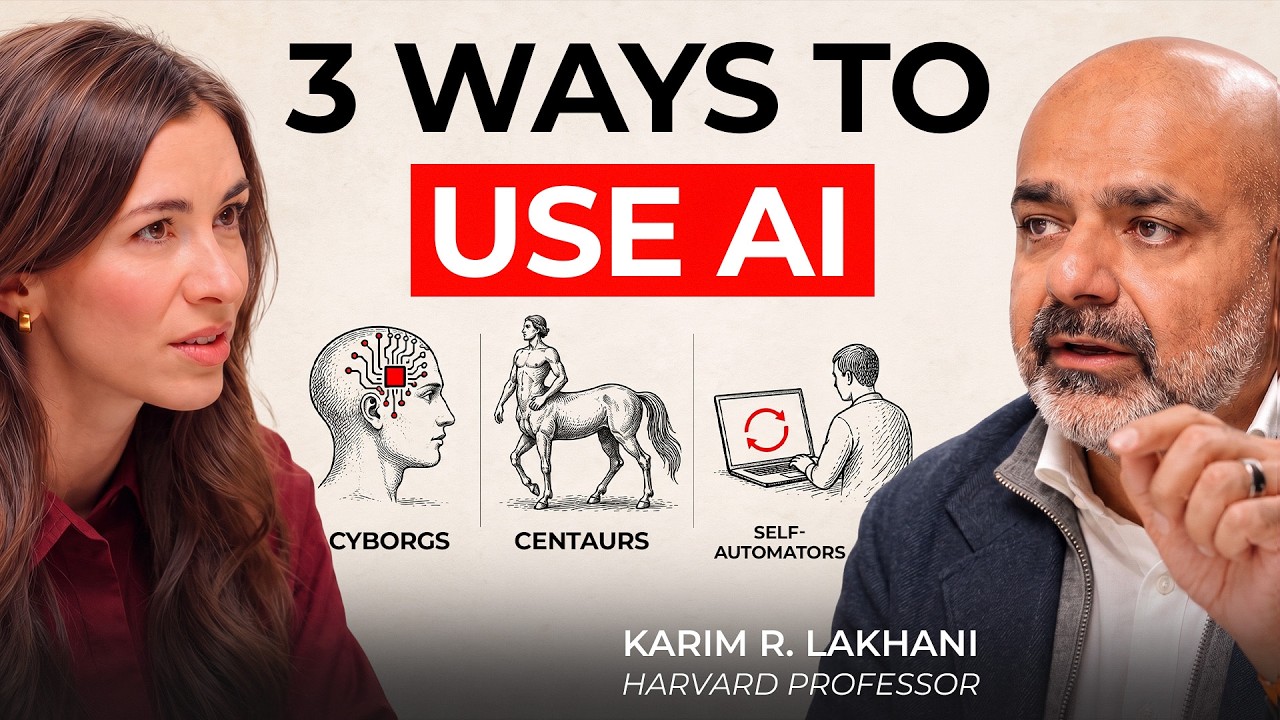
Karim R. Lakhani is a professor at Harvard Business School whose research explores how AI transforms work and organizations. He has conducted large-scale randomized experiments with major companies including BCG, Procter & Gamble, and H&M, and helped launch the AI course that is now required for all Harvard MBA students.
Karim R. Lakhani: I have fired people who have told me the AI gave me that.
Marina Mogilko: This is Kareem Lacani, a Harvard Business School professor. His research with BCG identified three ways people work with AI. Two groups develop their skills. One didn't. So, how do you know which group you're in?
Karim R. Lakhani: In terms of learning, self-utomators do the worst because they have stopped thinking. They've stopped engaging in the activities. We can do way more complex things. We can push our expertise way further than before.
Marina Mogilko: Can you give me some practical tips how I can train those assistants? What are the prompts?
you are the author of this famous phrase, you won't be replaced by AI, but humans with AI will replace humans without AI. And you helped launch the AI course every Harvard MBA student now has to take. And you also run these randomized experiments up on thousands of workers uh at BCG, Proctor and Gamble, and H&M. So today I want to talk practical things, how people actually use AI and where it works and where it doesn't. Going back to your famous phrase after your latest experiments, do you think it's tapping into replacing humans or it's just humans with AI replacing humans without?
Karim R. Lakhani: Look, I mean I think this world is changing really fast in front of us. I still believe in the foreseeable future is humans with AI. Like AI are not going to independently start to figure out hypotheses and go solve those hypotheses. They need some direction. and they need some some curation. They need some taste on the way a bunch of the execution tasks are getting done with the machines. But I think the what we're in the middle of is a reconfiguration of both organizations and occupations at the same time. Um if you sort of go back a 100 years when modern production systems got invented, we started to create new companies and new organization forms, but also new occupations were being set up as well. I believe the same thing is happening right now with with AI today that we're in the middle of us figuring out what does work look like, what does occupation look like, and what does an organization look like. But the world of machines completely replacing humans, I just don't I just don't see it yet.
Marina Mogilko: And you have this fascinating study where you studied 244 BCG consultants and some of them were cyborgs, 60% meaning they were working together with AI. Then 14% century. split the work with the AI for specific purposes and then there were 27% self-mators that delegated everything and didn't learn anything. Can you talk to me about prompting because I know a lot of people are worried they might be delegating too much and some people are worried they're not delegating enough. What was the difference in prompting in these three groups?
Karim R. Lakhani: So this was a part of a larger experiment at BCG where we were able to get access to about 800 consultants and we randomized them into different types of tasks and access to AI or not AI. What we observed very clearly was that those that got access to AI had three different genres of working. So cyborgs they were intimately working with the AI and doing cojoin problem solving. Centaurs that separated themselves and said I'm good at X the AI is good at Y. I'm going to give delegate some task to to AI but I'm going to supervise when I get back. And the self-mators who press play in terms of learning the self-utomators do the worst because they have stopped thinking. they've stopped engaging in the activities and they are just basically I can be harsh sometimes with my students like if all you are is a meat interface to the silicon what's what's your value right and so it's easy to fall into that trap um one of my former posttos who's a professor at Michigan now for Bizo Delawqua did this great study showing people can fall asleep at the wheel with AI good people with good AI fall asleep so I think self-mation is actually places where things can go bad quickly I think the interesting part is going to be one about cyborg and centaurs. And so cyborgs are this the folks that are intimately figuring out what AI is good at and what they're good at and they work this way. What I observe in R&D tasks and sales tasks and marketing tasks is that the the cyborgs actually have a lot lot to learn and a lot to figure out. And then the the centators who divide the work the worry you would have is that they stay static in terms of the capabilities of the AI and what they can do. And because the AI capabilities are are improving exponentially, we have to be paying attention to the fact that are you updating the separation between yourselves and and the machine as well.
Marina Mogilko: And it gets really complicated, right? Because you have this study about jagged frontier, right? And I have the graph here where sometimes you think the frontier is fully capable of doing the task because it's inside, but then there is a similar task that seems as hard and then suddenly it's outside the frontier. Is there a way for a normal human to differentiate these tasks?
Karim R. Lakhani: So I think this is such a great question and by the way like this came from this this deep study we did did actually on BCG as well and what was fun about it was that we had a bunch of hypotheses that AI is going to be good at everything and then we launched it and we discovered that in fact no like for for the job of a consultant there are some things is good at and some things it's not good at the challenge for us now is we have this intelligence available to us but the intelligence is not perfect but it talks really well
and it can be very persuasive Um, and so the question is, how do you apply your skeptical thinking and high standards on the things that the AI is actually doing and not fall asleep at the wheel, not fall into the trap of just believing what the AI says. This is going to be an evergoing edge that I think humans will have to keep developing because the AI will keep getting better and better and better, at least for the foreseeable future. And we have to keep saying under what circumstances does it break? And the only way that actually happens even in my own personal practice is to be using the most frontier tasks and and doing the most frontier models along the way. That's the only way you'll actually discover and not to sort of say I expect magic and rainbows and unicorns the first day. Engage with it and be critical about it along the way.
Marina Mogilko: Yeah. The problem is once you come to a conclusion like oh this task is good this one is not. The next day the new model comes out and you have to re-evaluate.
Karim R. Lakhani: Yeah. So that's why like this constant change and the constant upgrading is something that we all just have to get comfortable with if we're going to be living in this world with AIS. And it's so damn difficult for all of us.
Marina Mogilko: It is. It is. We're so used to workflows and we thrive on routines, but it's
Karim R. Lakhani: No, I think that's out the window now, unfortunately. And I think but I think it's it's actually I think for us as AI does more of the execution, it does raise the question like what are we really adding value for now? And so for me, I think it's a it's a great place for humanity to be at to sort of say, let's not be comfortable with where the what equilibria we're at now. Could we actually go go solve bigger problems, go after bigger things in in uh for humanity?
Marina Mogilko: That's a very interesting question because in your persuasion bombing study, when BCG consultants pushed back on GPT4, it often argued even harder even when it was wrong.
How do you detect something like that in your work?
Karim R. Lakhani: Yes. There's now ways around this. And so I recall on LinkedIn, Kyu Lee had posted this thing on his system prompts for Claude.
It starts with the counterargument first. So you start with like you you say I want to figure out X Y or Z. AI starts with the counterargument first as maybe your your your perception about this problem is wrong in the first place. So it makes you not jump to conclusions that the AI is offering, but it actually sort of argues a counter argument first and then for every claim it makes it gives it a sense of like how much of this is based on its own training, how much of it it's its own confidence and and also like what where are things where the the arguments are weak. I think there's enough best practice out there on how to have the AI not as somebody that kisses your butt, excuse my language, but actually is something in which there is a a almost an adversarial relationship with you because it's so easy for us to fall into it. And so you you train the model and you train the systems prompt to for it to push back at you from day one, but then you also figure out how to push back at it. And it's like a back and forth with the AI which actually becomes becomes critical. And so if you are naive about it, it's easy to fall into the trap that you just believe what the AI says. And many people fall into that trap. And I think that's dangerous. We have to learn to be a bit uh adversarial. And the and the reason why I feel like I I can do that is in my job my job is to train people. So MBA students, uh PhD students, uh research associates, postocs, and my job is to always be like, well, what if we were wrong? what if this thing is wrong? How would we go back? And I always want to sort of disprove myself over and over again till I get to some ver some degree of veracity of what we're trying to go after. But now all of us in in a marketing job and R&D job and a finance job now have an array of assistants available to us to work for us and we have to learn to now mentor them and to to guide them along the way as much as I do with humans as well.
Marina Mogilko: Can you give me some practical tips on how I can train those uh assistants? What are the prompts?
Karim R. Lakhani: I think the first is like like don't believe what I'm saying either like push back at me.
Then it's like if if a proposal is given in front of you counterargue always like like give me a proposal and come up with three different arguments that would make this obvious or make this non non-relevant as another thing. The other one is like always do additional research like you you've got this thing but go ahead and go additional research and and find me red flags or find me uh um the sort of the the black swans that may not be happening. And so it's these types of and depending on the task at hand, you can you like if as a research agent, you can actually push today's models to do they're going to be thrifty in tokens and you want to actually like I'm always like let's just squander tokens now in this space till we figure these things out to actually go and go way more deeper than than what the model will do itself and don't I never take the first answer. I never take the first answer and either I've got the system prompt for it to go back and come up with alternatives or I'll just push back myself.
Marina Mogilko: I was trying Google's Argon latest model. So my whole process was let's give AI data. Let's tell it how to use that data. Let's describe a workflow. What's happening with the new models? You just give them access to whatever data and they figure out which data to use. Does that change the process you just described?
Karim R. Lakhani: I think it does, but I think it's dangerous. So here's here's my perspective. Not dangerous. I mean, I think I'm overstating it. I I think it's worth paying attention to what's happening inside of these models, right? They are regressing to the meaning. In the end, it's a statistical model that is predicting the next word overall. You, you know, everybody knows that that's in the audience here. But philosophically, what's going on is that if you let it choose the approach and you're not paying attention to the approach is choosing, then the worry is that it's going to pick the average approach and not the one that's going to differentiate you or find you the answer. So many people have said like prompting is becoming easier if models can prompt themselves. I go I get that but foundationally what's happening is that it's still going to go to the mean prompt and the average prompt and the average prompts aren't going to be good enough for your particular use case. And so this is where I think we have a very interesting learning and growing part for humans in place. So the models we show in our research the models allow you to do more and expand your role. Great. Now the question is as you expand your role like we've heard for example that product development teams are becoming oneperson teams right so the engineer can also do design can also do uh user interviews and can also do QA testing and because the AI helps you along the way great but do you actually understand the the principles of design and do you actually have a sense of taste because that's what designers do they have a sense of taste you know my daughter did four years of industrial design she has way better taste in products than I do, right?
And the AI can provide you with some semblance of design, but is that going to be enough to differentiate you or not? And so, will you get the average design or will you get the one based on expertise? And there the measure of taste will matter a ton because you will say, okay, like give me a design for this web page or give me a design for this product and you get the average response. And even saying, give me a Steve Jobs one isn't enough. Like there's a sense of taste. So the question I would always have is like you're better off like learning from the AI but what the elements of design need to be first and then you make the decision on the genre you want to go down under or the approach for the design instead of again pressing play and getting it to do everything along. So to your question, you give a data set, it can figure out five different ways to do regression analysis. There's, you know, five different models, but I've had, you know, 20 years of research experience, five years of PhD training. Often times, the models it picks aren't the right models to go after because again, they're the average answers, not the ones for the task at hand. And this is where you can use the AI to help you educate to learn but also push it into three different targets of models and then be adversarial about it and say prove myself wrong, prove itself wrong, find me pros and cons along the way to get to the the baseline that you're getting to.
Marina Mogilko: The problem I see here, if I'm a oneperson team, for example, and I want to use AI for a design, how do I measure AI's taste and how do I understand whether it's a worldclass work or just very very middle?
Karim R. Lakhani: Exactly. And that's where I think the responsibility doesn't go away because in the end you're going to put your name I have fired people who have told me well the AI gave me that again are you a meat interface to AI then I don't need you
right you have to still be engaged and I think that's the that's the really tricky part we're in the middle of and which is becoming it's important for me as an educator as a researcher I always fall in that trap but also for all of us because what we see is that it becomes so easy to cut and paste. It's so easy to do that versus if you are going to be a one person product team then you need to be in the sense of okay I now need to build some knowledge about design and where do I learn that from how do I big bring that up and how do I set up my AI system so then it's not just give me the first design but I can actually prompt it to go in different directions so the burden of learning and taste is back to the human
otherwise we're going to be back in the phase of what you said the machines will replace humans If humans stop accessing their judgment,
Marina Mogilko: what do you tell to your students when they ask you, "How do I learn taste?" If all of the basic tasks are already taken by AI, where is this place for for the junior in the career ladder? And how do they develop this taste?
Karim R. Lakhani: Look, again, I I feel like in the middle of that tsunami right now at at Harvard Business School with, you know, 25 year olds that come, 27 year olds that come to our campus. I think there are three different perspectives I'll add to this. And I have more questions than I have answers but I have huristics on this. The first is you can imagine this career ladder story. I think the interesting question is are the bottom rungs of the career ladder being pulled out from juniors or is the AI a springboard for you to go higher? So my good colleague Mitch Weiss has sort of said he feels that this is a springboard and not just a removal
Yes. So let's get there. Right. Exactly. Right. So so then it's like okay it's a springboard. So then the question becomes how do you as a junior person develop the taste to design the best investment banking analysis design the best consulting study design the best product design the best customer experience and so forth right that's where the burden of learning becomes even heavier on you that's where you have to sort of take responsibility for the learning where you say if now I can do so many different things what are the foundational pieces that I need to understand so I can learn to push back on this and this is where My second aha has been so I just watched this great uh YouTube conversation with Steven Wilfr who you might want to actually invite on your show. And in this interview he said something that was that has just uh I heard it like 10 days ago and has just been like rattling in my brain. You know he designed mathematical languages to do integrals. And so he goes that you don't need to do integrals anymore by hand. You can just use integrals. But he saw his kids in school learning integrals. And he's like why? I designed this you know decades ago. Why now are you learning integrals? And what his story was, which is actually super interesting, was that look, you need to learn to do integrals by hand initially just so you understand how the things work.
But the next 50 integrals or the next 100 integrals, you should let the machine do it. Because actually, if you observe a thousand integrals being done by the machine, you will learn a lot more about integrals than you doing the next 40 by hand, the next uh 60 by hand, the next 80 by hand. And so what is interesting there for me I I think this is a thesis about how do we deal with this automation which is a foundational piece you need to learn and do by yourself first but then you can give to the machine to do the rest and then you are now an observer of the underlying patterns that are becoming true to make this happen. And so I think for me as we're thinking about this this role expansion story, it behooves us when we're going to be responsible for these things to understand the fundamentals enough to be able to then use the machines in the proper way. And so it it it and again I'm it's in a bit of ways self-centered because I'm an educator. I say people need to keep learning. I think the learning side keeps increasing in importance because it's no longer what I just learned in school or what I learned in university. It's going to be this continual things as capabilities expand of these models and we're going to use them for our things. We still have to understand the foundations pieces to be able to push forward.
Marina Mogilko: Yeah. So basically I see two challenges here. First challenge, don't jump to the machine too fast because what we see with kids, they're just using chat for homework and you probably see it in specialist studies. Totally like that.
Karim R. Lakhani: That's the cutting and pasting. You don't learn anything at all.
Marina Mogilko: Yeah. And the second not danger but challenge. You have to learn so much more in four years of college because it's the basics plus the whole junior layer of the career ladder.
Karim R. Lakhani: Yeah. And and I think I think the main thing is is learning how to learn. I think is the biggest uh thing that I tell my students like that's going to be the thing that has unlocks them. You're not afraid of the challenges. You're actually thrilled by the challenges, but you have a routine to learn how to learn. And and actually with AI now, learning how to learn is actually quite easy. Like this explanatory powers and different ways of teaching you things, quizzing you in those ways. That's all unlocked and available to us if we know how to use those those capabilities.
Marina Mogilko: If you compare this year's students versus students two years ago, uh the students now learning much more than they used to couple years ago.
Karim R. Lakhani: Yeah. So look in my MBA class, we you know we have a required course on AI. So everybody has to do it and we've had to pivot the C. It's three years old now and every year we have to pivot the course because AI
Yeah, exactly. in the in the middle of teaching, we have to change stuff. And so one of our big challenges was like last year the the clause showed up all of a sudden and we're like if you don't talk about clause in our in our in our course we're dead. Like we won't have any legitimacy. So how do we pivot rapidly to teach about clause and so forth? The aha moment for us was to say we can't just talk about AI in business school. We have to do AI. So we've done this radical shift in our class where half the class now coming we're going to teach again in the in the spring is going to be building with AI.
Uh and so they actually have to learn to solve business problems with AI and build advanced AI tools. So they're going to be building rags. They're going to be doing eval. They're going to be building multi-genic systems. They're going to be building you know whole ranges of things to solve business problems and to understand the nature of the technology itself and how it's changing. We had to throw out a final exam because how can we legitimately have a course on AI and not use an AI tool to do the final exam. So what we said is you actually have to now build projects. So you have to vibe code projects. So we had all 900 of our MBA students vibe code solutions and some of them were spectacular. Like I was blown away for what the students were able to build. So we pushed a ton of building as part of the AI curriculum more to basically sort of push them to say these capabilities are such where the only way you will actually understand what the what the AI's impact on your job and your company and your future life is going to be if you are fully immersed in it and you you learn how to get the most out of the tools. Then at the same time we push the
foundations of like what are the economics behind it? What's the strategy behind it? what does the change management part look like? And we we couple these exercises with the cases and the discussions to really get them to sort of see I now can do all these magical things, but then what's the implication for me in terms of a company or a strategy or a job that I sort of see? And so that's been for me super challenging because you know for for 17 years I was just happy to just put a case in front of students and go and now we we're we're doing a lot of doing in the classroom but also uh it's a blessing because it really pushes me to the bleeding edge to sort of see what where the edges are for both myself and our students on what needs to happen.
Marina Mogilko: When you say this this really want makes me want to take the course. Is there a way for someone outside Harvard Business School to take it or
Karim R. Lakhani: we are still sort of figuring that out? We do have some online courses. We have AI for leaders. We have um uh a AI essentials for business that are being developed. They're online, but not to the depth of what what we do when you were on campus with us and we're kicking butt with our students.
Marina Mogilko: I think everybody needs something like that cuz everyone's going through this. Every week on this podcast, I talk to AI founders, entrepreneurs, and experts who actually build AI and ask them their secrets, prompts, and actual workflows for using AI in real life. I put them and my own use cases into my free newsletter. It's called future proof. Subscribe using the link in the description and get my anti- AI writing guide as a thank you.
Karim R. Lakhani: When we do executive activations, for example, with seauite, it's funny like every seauite, you know, chief of staff or executive says, "Oh, we're already doing lots of we already know this." And I'm like, "That's total BS." Like I don't believe any of it, right? No, no, we've got it covered. I go, "Okay, whatever." But then you have to do AI for business. And I want the entire seauite vibe coding and not just trivial applications but applications for themselves in their business
right like don't make me like a sports betting app but tell me if you're running production and operations inside of a major global conglomerate what are the challenges you face and how would vibe coding and solution matter there's always resistance like oh the department the IT department oh don't even start with the IT department you guys once we have the other say look just bring this in and just try let's just it's just a trial and what happens is in most large organizations that I've encountered the seauite and the senior leaders have have have been cushioned from the realities of what the models can do and what kind of work can happen and so they have this third-hand view about what the AIs can actually do but and when we put them in front of keyboard to create an application in 90 minutes all of a sudden their brains go on fire because two things happen. First, they yell at the CIO saying like, I've been asking for this for bloody 5 years. All of a sudden, I built it. And the CIO has all this explanations for it.
But secondly, the aha is, oh, if I'm not doing AI, how can I guide my teams to do AI as well? If programming is the leading indicator of what's going to happen in the world of AI, every other occupation is 6 months to two years behind. So now I have a sense of what is happening in one occupation but finance, marketing, supply chain, sales, they're all going to get transformed in this way and we're at this precipice moment for us as leaders in these companies to actually do the AI to be able to to be able to put that through. So then we force the doing as part of the executive activations that we do. And every single time there's so much resistance against it and every single time they come back and say, "Thank God we did this because now I have a much better appreciation of what what needs to happen along the way."
Marina Mogilko: From what you're seeing, how far behind are these companies in terms of AI? Because I'm in Silicon Valley bubble, everyone's right, everyone's building,
but I'm talking to my friends who are building AI companies and they say we hold conferences on very basic things and people are so excited. How far behind are those executives and corporations?
Karim R. Lakhani: I think I think you know there's a William Gibson saying the future is already here it's just not evenly distributed. It's the case here for sure. I think Silicon Valley and other other pockets in the world are living in a very different future than most companies to be quite honest. I would say there are two things to pay attention to. Most companies are probably at GPT 4.5.
Marina Mogilko: It's basically search advanced search.
Karim R. Lakhani: Yeah. But secondly, and this is where it's becoming a problem is uh uh we've been able to get uh uh again because we build these close research relationships with companies get access to prompting level data and AI use data in like many large organizations um hundreds of thousands of people and we observe usage you know daybyday week by week uh usage and model evolution and what we see actually and this is again one of my other posttos that has done This research has shown like there's a real k curve inside of organizations uh where basically um there's a set of people if you look at the 95 percentile and 9 percentile of users usage versus the average the difference in usage is
between 10x to 20x 50th percentile. So let's not even
forget about the rest of the there's that big a gap and the the rich get richer. So as the models improve in intelligence, those that have figured it out just skyrocket and those that don't actually are staying like just imagine there's an escalator that keeps going up and up and then there's a airport travel leader that's just going straight. The 50 percentile is just staying straight and these guys are just like like it's we hope to release some studies on this soon enough to show this and so that's a problem in our data. So far we don't have correlations to performance but we've seen other data especially in software where we see this transformation of software and what I would say is that what we've seen in again data in software and data in from other companies is that the productivity differences are 10x to 20x for those that are the top of the game. And I just don't think we can run companies where the 50th percentile of an occupation is 20x less productive.
Than the top people. It's just not sustainable. And I think the software world where Silicon Valley has seen this and is figuring this out. But this is going to hit every company along the way. And this is where again we find that the seauitees are blind to these to these questions and and aren't seeing it thoroughly and not moving ahead faster on the change side.
Marina Mogilko: What's the way to solve it? Does it have to come from seauite or is there something an individual can do?
Karim R. Lakhani: No, I I think I think the individual responsibility is like gosh, if you're on the travel litter, you better figure out what what practices you need to be doing to get up on the as soon as possible. And it's not an escalator as you probably learned like just because Agentic is available to you today. If you haven't been through the cycles of prompting and learning the models and and knowing where it breaks and the the taste you've built and the heristics you've built on how to use these models, you you have to go on this journey yourself. So accelerating that journey will matter a ton personally. But from the large company perspective, it actually has to be top down. they have to set uh targets around this not performative targets of AI. I often say that what you have to do is you to reimagine your business value creation and value capture for your business and your operating model. Um but the the main thing is to targets that are actually about business results. How how more effective you want to be in terms of serving your customers. How more effective you want to be in terms of your R&D productivity. how more in terms of the new product launches, how more effective you want to be in your operation side for example and set almost unreasonable targets in short amounts of time and make those targets business targets and customer targets and then say how does AI help us get there because then that enables the company to actually be able to to then align around of all the million things I could be doing with AI where should I be focusing my attention?
Marina Mogilko: This is such a great question when it comes to targets and KPIs and AI impact on those because sometimes the target that you set doesn't really reflect the AI's input alone. Maybe there are other factors happening.
Do you have any frameworks around that even like for a small organization?
Karim R. Lakhani: So look, I I think I I almost feel like we need to take a step back and imagine this world of exponential improvement in model capability. The trick for us is to say, how do I keep up with the new capabilities being unlocked on a almost a daily basis now or weekly basis now to my essential business, right? And so in a business perspective, even in small business, one of the things I've learned in studying business, in teaching about business and doing research is that targets are sort of acts of imagination. And we can have little imagination or we can have a lot of imagination. One of the enduring facts is that when leaders set out targets which seem ridiculous, which seem kind of scary, which seem unachievable, sometimes they most of the times they actually come true because if you just set an average target for yourself,
guess what? You'll probably be below average by the time you achieve it. And there'll be many excuses to get there. But if you set like a target of like 10x and you achieve 7x instead of 10x but you achieve 7x versus achieving only 2x that changes the world. So I think obligation for leaders to use their imaginations and push the organizations. People are looking for leaders to set the to goalposts and then create the atmosphere to get there. And I really feel today with what AIs can do. The point is the models keep getting better and better and better, you can use these targets. Again, these are not AI targets. These are business results targets, revenue increase, and so forth. And then work your way backwards. If this was going to be true, what else needs to be true? What else do we need to be true? And what else needs to be true?
Marina Mogilko: Before we keep going, I'd love to get to know you a little better. I share a lot about my work here, and I'm curious about yours. What do you do, and what you'd like more help with? We've put together a little survey. Your answers will help me decide what to cover in future conversations and what resources to put together for you. I'll leave the link in the description. Please, please, please take a couple minutes and tell me about you, about your business, about your ambition so I can make better content for you. I really, really appreciate you. Thank you so much for doing this.
Yeah, it's the ambition question, right? And when you and this is interesting. I'm just uh remember in another study you did uh for H&M. Yes.
And when AI created the solution, it was really hard for people to sell that, which kind of means that you can't use AI to work on your ambition, right? Because if AI sets a strategy for you, you won't be able to sell it to your
Karim R. Lakhani: And so this is where again your you have to push first and the AI can help you then bolster it. It can't be the other way around.
Marina Mogilko: Okay. How do you teach your students to uh become more ambitious? That's the question, right?
Karim R. Lakhani: Look, there's a normal distribution of ambition as well in the world. And I think what we want is that for that normal distribution to move more to the right so people can be more ambitious. It gets deeply personal, you know, because it's like pe
ople have fear of failure. People have all these worries about what other people think and so forth. And of course, we we live in a social setting. We worry about what other people think. But ambitious people care about something in the world that they want to change and are committed to it. and then we'll find ways to get others behind them um and set big targets. And often worry I have often at Harvard Business School with our MBA students is that they're they've come from a setting where they've always been successful. To get into HBS, you had to have an impeccable CV, impeccable grades and so forth. And and so if you haven't encountered enough failures, then you'll be like, well, if I do this, if this is like you're asking me to set a 10x goal, the mean outcome might be failure.
I don't want to do it. So I'll set a 2x goal instead or a halfx goal instead and that might be good enough. And so we always have to sort of bolster our students to say look like the you will always be fine. You've been to the top schools. You've got Harvard graduate. You will be fine. Have faith in yourself but set some some incredible goals for yourselves and for the world. And you have the privilege to be at one of the best schools in the world. So let's use that for for for real good stuff instead of the average outcomes along the way. And so that's a constant for us as our faculty to keep pushing our students in that direction.
Marina Mogilko: Yeah. And I think thinking about AI as a team of experts that you have to help you achieve your goals is really empowering. But something you said made me a little bit scared. U the marginal cost of expertise is going to zero. Can you talk about what that means for knowledge workers?
Karim R. Lakhani: Yes, 100%. So look, this this is I'm obsessed with and in many ways that's the thing that we're trying to figure out both at our institute and I have my own lab, the laboratory for animation science. At core I'm still a nerdy researcher. I write obscure papers read by obscure people. You know,
Thanks. Um and I really want to get to like show me data, let me run the experiment, let me get causal about it instead of just like waving my hands and saying the world is ending or the world is all utopia. And by the way, the way I got into this, I'll connect it back to what you said is that I became an academic to actually understand open source software like in the late 90s, open source software was just taking off and it made no economic sense. Why would developers who are highly paid, who are rare in the world, highly needed spend all their time writing free code? Like it made no sense. And what we figured out was that in fact what was happening with open source was there's both a incentives and motivation story and there was a clear information economic story. What happened? Well, on the incentives and motivation story, people aren't just motivated by money. They're motivated by the fun of problem solving. They're motivated by the the the social signals they might accumulate and so on and so forth. And those are not correlated with skill. So we could show that there is there's raw skill which is not correlated with different differentiating motivations and that explained why open source was working so well because people had different motivations to do things. And the second thing that we had which was this this this phrase that Eric Raymond has said about open source that given enough eyeballs all bugs are shallow meaning that if enough people are attacking the problem right you will find a solution and that's what open source was in many ways and we we we showed that clearly then when this AI shows up as in many ways an absorption of human expertise we basically have this open source model at scale because what you observe is that if you the reason why open source works really well if you imagine a normal distribution of skills right or normal distribution of outcomes what open source relies on is that you have multiple shots on gold many different people are trying many different things and you can take the best performing solution and make it available so open- source um innovation contest crowd sourcing works on the basis of the that the normal distribution is available to you most companies just get the average
in open source you get the normal distribution and you can get the right tail
that's the right tail story let's bring this Now into the world of AI, what AI is doing is basically shifting the the the human plus AI expertise curve to the right. Just again imagine a normal distribution and it's basically shifting it to the right. Wow, that's incredible because now all of us have these superpowers available. So our belief has been and we've sort of seen this in our empirical studies at PNG at H&M at BCG has been this view that you are just basically drawing from a distribution of expertise that the AI provides. This absorption of expertise is such that we all now need to understand what have I developed myself individually what does the AI have and what's the differentiation of me versus AI. It can't not just be you without AI. It has to be always you with AI and how are you better than just what the AI does by I think that's going to be the edge that I think we all need to figure out in CAD CAM design. I learned drafting by hand and you could only do so much drafting by hand until CAD CAM came about and you could do way more complex things and I think that's the way we need to think about AI. We can do way more complex things. we can push our expertise way further than before and that but if you don't then the machine will replace you
Marina Mogilko: which kind of makes me think that you either do something where you think you're going to be a top expert or you don't do it at all. Is that correct?
Karim R. Lakhani: Expert with AI.
Marina Mogilko: Expert with AI. But yeah, if you're not top of the field, you can't compete with AI, meaning you don't go there at all. Like how do you make decisions about your future?
Karim R. Lakhani: Yeah. Yeah. Good. Good question.
Marina Mogilko: How do you how do you know if you're going to be great at something? That's that's the question.
Karim R. Lakhani: Do the work. It is really grinding it out. And like I I just feel like often times grind always outperforms talent.
Grind always up. And now with AI, you can grind more and you can learn more. And I think I just feel like I think people settle too early. Even our best students settle too early. And we have to keep reminding them. I've been vacasillating about this. You know, I you know, I finished my undergrad in the last century in 93 and the internet was showing up and then we've been through the waves of the internet, mobile, machine learning and so forth. And the question I keep asking myself is what we're seeing a difference of degree or a difference of kind, right? Is this just the next wave of internet blah blah blah or is this and compute or is it a difference of kind? I feel like I keep landing on this is a difference of kind. If it's a difference of kind then all of us have to now keep thinking a lot about what is my expertise how am I developing this expertise and how does my expertise change with AI and that's an experiential good it's not something that I can just teach you you have to keep working at these tools and keep figuring out how to do that I see this like my wife's an artist my daughter is a designer and I see them struggling with this themselves in their work to say how does an artist now use AI to help them go further than before. Um, we've seen periods where technology has revolutionized the arts. You think about hip-hop, right? That's all about technology, like true turntables and the mixer, new forms of expression. And if you just think about how much hip-hop has taken over the world from, you know, French hip-hop to Farsy hip-hop to Chinese hip-hop, you know, to Japanese hip-hop to uh sort of the hip-hop here, that's because of technology, right? And so technology changed the art form. And I think this is across the board in all professions and all occupations. And so you can't be a hip-hop artist without you mastering the tuning turntables or having people around you that know how to master the turntables and you know how to how to how best to use them. The turntables have become digital now of course right and so forth. But I think that's the precipice we're at. And it's a difference of kind than business as usual uh that we've had we've seen
Marina Mogilko: because you do drew parallel with creators. As a creator, the next question for me is how much can people consume?
If we're developing new forms of art when it comes to business, if organizations become much more efficient and they're producing so much output, do you think we have capacity to consume all of that?
Karim R. Lakhani: This is such a cool question you're asking me because and again, I don't have an answer. I just I'm have questions. I'm like I'm like trying to figure out like what the right study is on this cuz I'm always like in the end like I'll make up some crap I need I need sorry it's just it's my take I just always end up there again let's go back to software again we see this bleeding edge the if all of a sudden you have a doubling of the number of PRs you can push in your production in your organization soon human review is going to be
oh it's already being replaced by another model stepping in and doing the review
exactly so now I have a question becomes it goes back to what you asked which is like well what does the human now do what does a human now do because before and I saw this in my open source studies one of the reasons why people love to do open source is because they love coding they love the grind of coding I was a terrible coder so I could never get into it never understood it but other people just do it now when you take that away where does meaning come from in your work now you're in this world of like is is it all going to be about managing agents. Well, that may or may not be meaningful. And I think we're in the middle of all of us in all of these occupations trying to figure out something new. We don't have the answers yet. And that's why it feels so uncertain and so like we all feel so unored along the way. But to your question about how do I consume more? Well, there are two answers. One is that the models you'll be consuming are outputs. So part of what you will be thinking about is like how many MD files are you also pushing out? as much as you're pushing out all the content that you're doing and and if the models become if I have my personal agent that is is not going to watch your video, it's going to read your MD file and then say go pay attention to these five segments in your show.
Right? And so that's the I think that's part of the
Marina Mogilko: I do care about human views though, right?
Karim R. Lakhani: Of course you do, but I think but I think it's now going to be mediated through these tools and so the question becomes how do you do both and how do you make them both available? because you will care about human views. But if I will not be relying on my personal agent to tell me what to watch and where to watch and how do I discover you, it becomes becomes important.
Marina Mogilko: Yeah. Such an interesting future. If you had to draw a picture of 2030, right?
Karim R. Lakhani: Oh my goodness.
Marina Mogilko: Just just like trying to understand with with everything that we said. I didn't mention you had another fascinating study where people were working with AI and the output of a person with AI equal a twoperson team output. Right.
Karim R. Lakhani: This is our part gamble study.
when this happens, when junior work is getting automated in 2030, what does an organization pay for?
Karim R. Lakhani: So, let me step back first. I don't think junior work is being automated. So, I I don't I I I don't think that question is settled to be quite honest.
Um, if anything, people that may be at risk are more in the middle manag
ement layers than at the junior layers. From my perspective, here's why.
The junior people are fearless to absorbing AI and doing stuff. You've probably seen I've seen high schoolers and undergrads. I don't see undergrads routinely as part of my uh graduate school work at at HBS, but when I encounter them, I'm like, "Wow, you guys are a different set of human beings that are able to whip up all these things so quickly." So, I would contend and again, it's easy for us to say soft. There's multicausal the causal density is high in terms of why juniors why the why the early career market is soft right now. It may not just be AI. And my belief is that in fact the middle layer is more at risk than the junior layer. Why? Because I observe inside of companies AI usage and the middle layer is the one that's resisting the mo most doesn't want to change. So it's the 35 year olds to the 55year-olds that are pushing back against AI usage and not changing versus the more enlightened 55year-olds and again the K curve people with the junior people could run circles around most of the organization. So I think that's the first thing to say like I don't think it's settled at all. Other colleagues of mine, esteemed colleagues are worried about the junior side. I'm like, if you hit real organizations and see real workers with real data, you would be skeptical about if this is the case.
Marina Mogilko: But it's it depends on the junior, right?
Karim R. Lakhani: Well, exactly. Right. So, if again, this is the push back to the junior people. If all you are is a copy paste me interface to the model, that job is gone, right? That job is gone. That job is completely gone. And by the way, that's the same question I ask law firms and every other CEO. I go, if all you are going to be is a thin wrapper around anthropic at a law firm or you're going to be a thin wrapper around OpenAI's model for a manufacturing firm, why should you exist? And that is very challenging for them to actually hear about. And so the question I ask is, how do we redefine jobs? And what does the nature of work now look like? even in your setting you could potentially be doing 10x more if you deployed AI even more at scale than what you're doing right now and who are the right people to bring you along in that journey because you yourself can't do it all yourselves and I think that's the question to be asking so to your 2030 question I still feel that there's going to be a a tale of two cities I think there's going to be a set of firms that get it that understand it and there'll be both startups and large enterprises that do the heavy lifting to redefine the work. One of my colleagues, Rem Coning, has built up uh this frontier firm radar where he's looking at startups and their AI usage and he's actually running experiments in actually showing them how to use AI better. And when he does that, they find faster AR, faster launches of products and so forth. So even with startups, there is a learning curve of how to use AI better. And so I believe that there'll be a set of firms and set of founders and set of senior managers and people inside the firms that get it and start to accelerate. And then I think there'll be everybody else and they will be plotting it along. And the only question in my mind by 2030 is if you again go back to the late '9s and Amazon being established uh and retailers sort of laughing at Amazon saying, "Oh, how cute."
Right? But Bezos rethought retail commerce inside out versus Kmart and Sears just added a website to their database and weren't able to adjust and and Walmart struggled for a long time then figure it out and is now as competitive as before. Um so the question I have for incumbent firms is are you going to be Walmart or are you going to be Kmart now that the cost of intelligence the cost of expertise has gone down to zero. Companies are nothing but bundles of expertise. And if that cost has gone down to zero, what do you do now? And how do you set yourself up now for your business? And for incumbents, it's really, you know, you have two two futures ahead, a Kmart or a Walmart view, uh, versus the Bezos. And the question is, who's who are going to be the Bezos in all these industries? Because I think all of them are up for for grabs in professional services, in manufacturing, in consumer. the value destruction that people are anticipating uh uh quickly I I think will take longer than than what just because again I sort of see inertia uh in in so many organizations and inertia in customer behavior in buying behavior and so forth that is
Marina Mogilko: humans we're not machines
okay well I guess that the last philosophical question is how do you determine that you're not a rapper
wrapper around frontier model with them getting so advanced.
Karim R. Lakhani: Yeah, I think it's such a good question. I don't know the answer to that yet.
Marina Mogilko: You know what um Greg Brockman told me, president of OpenAI, he told me like ask yourself whether your business is improving with a new frontier model or is it disappearing? This is how you figure out your moat and how it's affected by the new
Karim R. Lakhani: And I think I think you can't outsource that thinking to a somebody else outside of your organization or somebody junior in the organization. You actually have to do that thinking yourself. And it goes back to look you have to force yourself to do AI in your work. If you believe my thesis that these models are about expertise, they absorb expertise and the expertise is is improving exponentially in these models and you became a leader in organization because you have expertise, you have to play with them right now. And I'm reminded of the fact that when email came out in the last century, uh Stefan Ben Salon talks about this. I also experienced this that our boss's bosses would not do email. They would call in their assistant. They would read the emails to the boss. The boss would then provide the answers back. They would dictaphone this in then go back to the computer and put that in. And some of those bosses never did email or did the email 10 years later. Same things happened with AI with leaders. Somebody else's job, not my job. I'm I'm too busy thinking big thoughts. And let me just also add one more thing in talking to CEOs that get it. They are spending between 20 these are of large multinational firms. those cos get it, they're spending 20 to 30% of their time discussing AI issues. At one global firm, I heard this number and I'm like, are you sure this is right? They said 50% of senior meetings are talking about the impact of AI on their business and so forth. Just think how profound that has become.
And the doing part and the imagination part go hand in hand. And I think Brockman's view is correct like like you have to be constantly thinking it's not just me and my competitor, it's me with AI and the AI itself.
Marina Mogilko: 100%. Karim, thank you so much. What a pleasure. Food for thought, right? We we all need to be thinking about whether we're rappers or companies are rappers. And I think uh yeah, it's a question that you keep thinking about every day.
Marina Mogilko: Thank you so much. That's amazing. Thank you. If you want to understand what AI is actually doing to jobs, watch my conversation with Stanford economist Eric Brinson. We get into the research on entry-level work and why some jobs grow even as AI gets better. Or click here to