Top UCSF Doctor: How to Actually Use AI for Your Health — Silicon Valley Girl Podcast
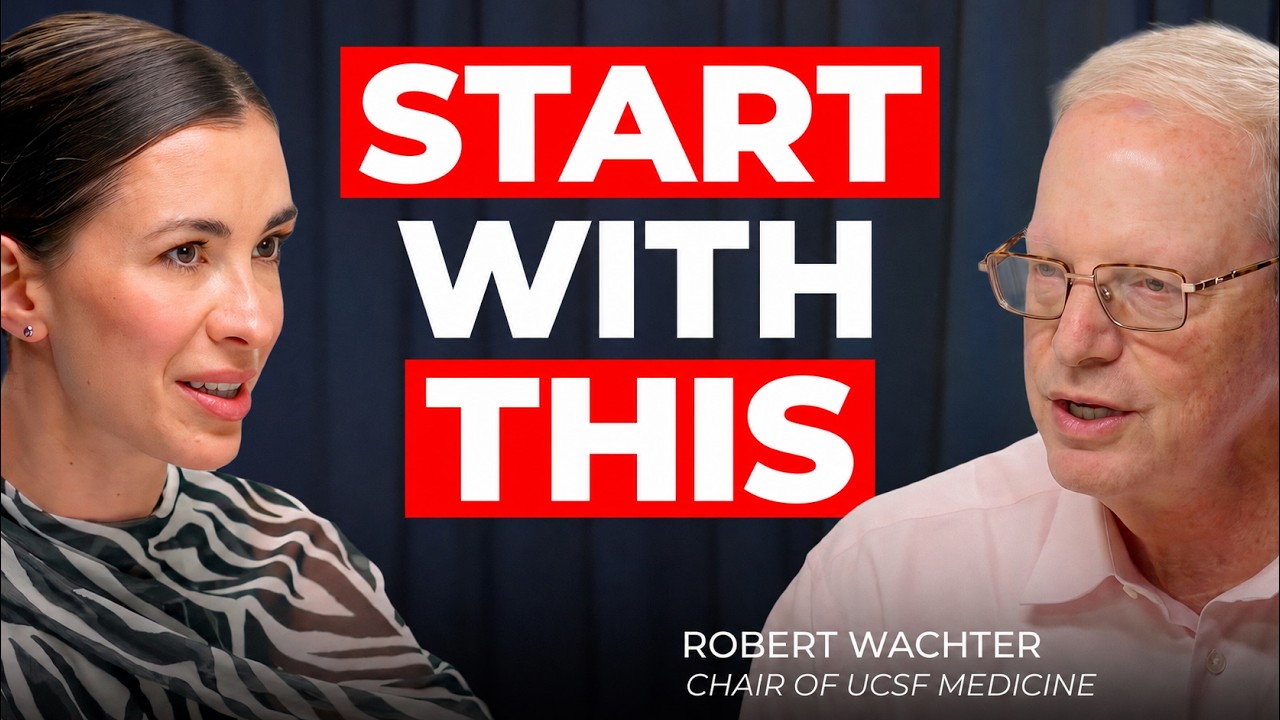
Dr. Robert Wachter is the Chair of the Department of Medicine at UCSF, overseeing 1,000 doctors, and has practiced medicine for 40 years while continuing to take hospital shifts. He is the author of the new book A Giant Leap: How AI Is Transforming Healthcare and provides perspective on the realistic integration of AI into medical practice based on decades of clinical experience.
There's no question if the AI gets to the point that it's right 90% of the time and the doctor is right 75% of the time, then you really don't want the doctor in the loop.
This is Dr. Robert Wachter. He runs the department of medicine at UCSF, a thousand doctors. So, I asked him how to use AI for my health and when to call a doctor instead.
I think the AI curing cancer, curing Alzheimer's is probably the most hyped, overhyped area of AI meets healthcare. A lot of companies have a really strong interest in getting you just gave them an extra $100 million, they'd have it done by next week.
And what is the right way to ask questions? You don't want the human to follow the protocol. And this is exactly what AI does.
To me, the two main dimensions here are what are the most common and what are the most serious and those are two different answers.
There's this huge debate going on whether we'll need doctors in 5 years. There was just this paper by Venard Kla and his son where they were arguing that doctors can even make it worse. Can you talk to me about it? Will we still need doctors in 5 years? What's going on with AI and healthcare?
In 2016, Jeff Hinton, the founding father of generative AI, gave a speech in Toronto and he said, "We should stop training radiologists now because it's obvious that within 5 years we won't need any." And I can tell you at UCSF today, the medical system I work in, we can't hire radiologists fast enough. So predictions and Venasla has been predicting the demise of doctors since 2012 and not yet. And I actually don't know any unemployed doctors. So I think that AI will expand the capacity of doctors to do more. I do think there are certain things that doctors do now that AI could do and do well and maybe at times better. And if you take radiology which is the field that's probably most threatened by AI if you think about it it's looking at a collection of digital dots and comparing them to a pattern and yet it has not replaced radiologists yet. So within 5 years there will definitely be doctors. Within 20 years, I could see a world where you're getting a decent amount of your healthcare from AI, but I still think you're going to want a doctor telling you that you have diabetes or cancer or holding your hand through difficult times or making the judgment about whether you do or don't need surgery, those sorts of things. Where I think things are very interesting now is the AI is good enough to be useful and not perfect enough to be entirely trusted.
So, how good is the AI these days? Because there was another research showing that AI without a doctor is actually more precise and when you have a human in the loop that can suggest some thoughts about what the diagnosis should be then AI can make mistakes. Can you talk to me about that?
Research is clear I think that there are times now where the AI is so good that if the doctor is the human in the loop at the end that they can screw things up. There's no question. And it's logical. If the AI gets to the point that it's right 90% of the time and the doctor is right 75% of the time, then you really don't want the doctor in the loop because they're more likely to degrade the performance of the diad than improve it. The problem is there are a few different problems but a big one is when these studies are done they are often taking a case distilling it down to its essence and feeding it into the AI tool. What I mean by that is if I saw you in the office I might learn 200 things about you today. You tell me you have a headache or you have a rash or your stomach hurts, but I also have your past record and your past record says you have had diabetes or asthma or you have a family history of something or you recently traveled to Russia or you name it. The act of doctoring is a very big and pretty complex thing that I do that patients can't, which is take those 200 facts and distill it down into this is a 30-year-old woman who comes in with a history of diabetes and high blood pressure who has a headache that's lasted for 4 hours. She's on this medicine, that medicine. What do you think is going on? The patient doesn't really know which of those 200 facts are the salient facts to put into the bot. And in a few studies where the same tool that I find really useful, patients have used that tool and gotten the wrong answer because they often really have no idea what to put in the tool. I think I can see a world where you're getting your cholesterol treated, your blood pressure treated, your urinary tract infection treated by AI, things that are really pretty straightforward and pretty algorithmic. I think a lot of it will be and probably should be replaced by AI. I think it'll be more convenient. It'll be less expensive. On the other hand, I was on clinical service at UCSF last week in the hospital taking care of wildly sick patients. And my average day was talking to three different family members of an elderly father who had metastatic cancer trying to decide do we keep going or do we pull the plug, or similar issues like that. And I'm trying to think could you imagine an AI having that conversation with the three family members sitting there looking them in the eye holding their hands hugging them. I think there's a lot of medicine that's like that that's too complex and too emotional. So the answer like most complicated questions can be somewhere in between and it'll change over time as we get more comfortable with the technology.
And you wouldn't really trust AI with a complicated decision. And you still want to talk to a person and I actually wanted to push back a little on cholesterol. As a person who has high cholesterol, I talked to all the doctors who follow the protocol but my instinct as a 36-year-old who is being prescribed something to take for the rest of her life was to look for a doctor who would say oh actually there is something else you should consider. So I found those 10% of doctors and now I'm sticking to them because you don't want when you're interacting with a human you don't want the human to follow the protocol and this is exactly what AI does—just follows the protocol and you want a human element. But what AI offers now is this democracy and access to healthcare. And as a mom who has questions all the time, I really appreciate having an AI assistant. I used to pay for a service back in Russia where I have a doctor on demand and it costs $60 there per year. Per year and you text a doctor anytime per minute. Here it would be impossible. But now I don't have to pay for that service because I have ChatGPT and I have this system and I want you to talk to me about how anyone can build something out for themselves so they can get initial consultation with their AI. So what I did is I took all my labs for the past six years put them into Perplexity, took my raw data from 23andMe and all the things that doctors said. So whenever now I go to a doctor—to see, I don't know, the heart doctor—I will create a PDF for that doctor with all my labs and I will ask AI do I need to ask for any more labs to update anything and what questions should I be asking my doctor. And if I have a medical question, I ask AI then it sees all my labs and my genetics and it gives me the answer. Do you think it's the right setup? Does that eliminate false positives and false negatives? At least for some fraction.
Everyone's talking about AI productivity like it's about doing more at work. Honestly, my version of productivity is doing less at home. I don't want to remember that Thursday is pajama day or Friday they have this and that class and someone needs a new costume by Monday. So, here's how our house is going to run this year. This is the Nori family hub. It sits in our kitchen and it holds everything—the calendar, the meals, the shopping list, the kids routines. My favorite part is that I can talk to it because when you're in the kitchen, you're probably cooking. Your hands are dirty. You're listening to a podcast. And we also have a nanny coming in for a few hours after school for some pickups, drop offs, and homework. And she sees the kids schedule right there with all the activities and the addresses. So, she can see exactly where the kids need to be that day. And she doesn't have to ask me. And when something changes, I just say, "Hey, Nori, at ballet class at 4:30 p.m. this Thursday, I can assign the pickup to our nanny." I can remind her 30 minutes before she needs to leave, and I can also add pack leotard and ballet shoes to Emily's routine that afternoon. What makes Nori different is that it's powered by AI, so I don't have to tap through a bunch of menus just to organize something. I can talk to it naturally, even with a longer request, like moving science class, reminding my husband to pick up the kids, and adding something to our shopping list. And Nori understands what I mean. So, I love trying new recipes, and I find them on Instagram. And the coolest thing is you can copy a reel from Instagram, send it to Nori. It's going to tell you all the ingredients that you need and create a shopping list for you. All of it stays in the same place as the weekly plan. Nori can also remember things that matter to our family like allergies, food preferences, and everyday routines. So, its suggestions become more personal and actually useful over time. If you want to assign different people to different tasks, you can split the dashboard by person and you can see what each family member is responsible for. By the way, you can create to-do lists for your kids and once they finish things, they can earn stars and the stars turn into a real reward they pick themselves. That's what makes Nori feel less like another screen and more like an AI assistant. Designed for the whole family. So if you want to try it, I'll leave the link to Nori in the description. And now let's get back to the video.
I don't think we've come up with any technology or human brain that can eliminate false positives.
I think the bottom line is these tools will do a better job of giving you customized answers if the more they know about you.
But is there a problem when they have too much information and they start emitting facts just because there's already too much context?
There's a concern about that. It was interesting. I was talking to the chief medical officer of OpenEvidence, which is the tool most doctors use—there's a very specific GPT built for physicians called OpenEvidence—and the chief physician is actually in my department. I was saying, you know, right now when I use it, it's mostly me picking up my phone or using a computer and putting in the facts that I know about the patient in a kind of distilled form like I did before. I said, well, shouldn't it be able to read the entire medical record? And he said something I thought was interesting and quite important: yes, it will probably be better, but it's not a slam dunk. It may be that there is so much information, and often conflicting information. I mean, the problem is if you look through your medical record, it may say your medication list is this in one place and this other thing in a different place, and it's got to be reconciled. So he said there's no slam dunk that more information is necessarily better. But as the tools get better at sifting through the information and reconciling it, then there's no good reason that knowing more about you shouldn't help it make better decisions. I think that risk is relatively small and getting smaller.
And the problem is one of the ways we use AI in our world is one out of five patients—patients who are older and sicker than you—one out of five patients has a medical record longer than Moby Dick. I don't know if you remember Moby Dick from high school, but it's 600 pages long. So the idea that in the two minutes that I have before I see you in the office, I'm going to be able to read 600 pages of records is impossible. So the AI now can summarize that, does it quite accurately. And whether that is going into AI's judgment about what's going on now or I can just use that summary as I hear about what your new problems are, I think that's very useful.
I think what you set out for yourself seems reasonable, and more and more of the companies are creating the capacity to have you say, "I want to download my health data," and here we've looked around and we see lab results, we see some of your medications at CVS, your blood tests at Quest. It looks like you did your genetics at 23andMe and here's your medical record at UCSF in our Epic system, and you decide what parts you want to have come in. I actually think I would tend to want most or all of it in there in order for it to make the best decisions about me.
And what is the right way to ask questions? Because from what I understand, if you assume something like, "Oh, I have a rash. Could it be this?" then AI is biased to agree with you. Is that true? And how do you ask a question?
How I ask questions is I do it like I do a Yelp search. I want it listed two different ways. I want it listed by ranking, and then maybe by distance, by how far I'm going to travel. To me, the two main dimensions here are what are the most common and what are the most serious. And those are two different answers.
If you come in with new back pain, and I say, you know, here's a young woman who comes in with new back pain for the last few days because it began when she was lifting one of the kids, and she doesn't have any pain going down her leg, she doesn't have any fever, has no history of cancer, et cetera, et cetera, it will probably say this is probably musculoskeletal back pain, it's possible that she ruptured a disc, et cetera. Then I might say, "And what are the worst things this could be? Or if I'm wrong, what could it be that I will regret not knowing about?" And then it'll give you a different set of answers.
Because that is how doctors think. When I'm seeing you in the office or in the hospital, there's a part of me that's thinking about what are the likeliest possibilities, and then there's a part of me thinking about what are the worst things this could be that I want to be sure I don't miss. And for common complaints like back pain, headache, sore throat, belly ache, my questions to you are often designed to look for what we call red flags. Red flags are basically: if you take a hundred people with new back pain—I mean, we were not designed very well, our backs are really kind of screwed up. If you take a hundred people with back pain, 99 of them are going to have a benign form of back pain and it'll get better with time, some Tylenol or Motrin and a little bit of rest. And one of them has lurking something nasty. There could be an infection, could be a tumor, there are a bunch of nasty things. And my questions to you are mostly around: do you have anything triggering me to think that it's one of those bad things?
Now the problem sometimes with AI—and the problem when patients use these tools—you said I use it sometimes to question the doctor, you know, why didn't you order this test or that test. It sort of depends how it's tuned. Because if it's tuned to say, "I want to be sure that I never miss anything," basically practice defensive medicine, it may say every person with back pain should get an MRI. Because in that universe of people with benign back pain, there probably is one who has something more serious. The problem is getting an MRI on all of them is, first of all, kind of crazy expensive. And we're going to find more false positives than true things. Because if you look, there have been studies looking at people's backs. If you do X-rays on people of a certain age, the X-rays always show stuff. We all have degenerative disease of our backs. And so you end up with a problem we call incidental—meaning we find something, but it's incidental, we weren't looking for it. But now this thing, we got to do another test looking for it, and it turns out to cause more harm than good.
And so it's difficult for patients to fully weigh that part. What I have learned to do in practicing for 40 years and going to school is not just all of the things it could be, but here are the bad things I'm worried about, here are the questions I'm going to ask, and maybe a basic lab test or two to increase the probability or lower the probability. If it's below a certain point, I'm going to say that's not what you have, let's assume it's benign. And then once in a blue moon it's not. And usually those people come back a few weeks later saying, you know, I did what you said and it's not better. Okay, it's time to get a scan.
Those are very tricky decisions for regular people to make, and fairly tricky decisions for AI to kind of weigh those things appropriately.
So basically, when you ask AI, can you list the most common thing and the most dangerous things? Then you ask it to ask you follow-up questions to help make a decision, or how do you decide which column to trust? But at the same time, thinking as a patient, I really understand how busy doctors are, and for myself I want all kinds of tests, ideally, to figure out if I'm healthy or not. I was just listening to Ray Kurzweil. He predicts the future as well and he said something: if you've survived till 2032, I think is his year, then every year you live, you will be adding an extra year or even more to your life just because aging is a mathematical problem, and by 2032 we'll solve it and we're not going to die. We might die from accidents but not from health-related issues.
People have been making predictions like this for a long time. The complexity of humans is overwhelming. Is it sufficiently overwhelming that AI can't figure it out and can't ultimately understand us at a genetic and microbiologic level to be able to give us answers? Like, here's the medicine that will prevent you from having cancer, or here's the lifestyle change you could do to live forever?
It's possible. I think AI curing cancer, curing Alzheimer's, is probably the most hyped, overhyped area of AI meets healthcare. Doesn't mean there's not real promise there. I'm very excited about it. I think when I look at what it takes to find a good drug—let's say immunotherapy for cancer—it takes too long. And part of what takes too long is there's a lot of trial and error, a lot of stumbling around. It takes six months to sort of look at the cancer and figure out its profile and then find a drug that might target it. That's something that we might be able to do in a few hours now. It's remarkable. But you still then have to try it. I don't think we're going to get to the point anytime soon—maybe, you know, never is a long time—anytime soon where you've taken the whole process of finding an effective drug for cancer and taken it from 10 years or 15 years down to a month. You still then are gonna have to try it maybe in new AI-generated models. Great. Maybe that shortens the time. You still gonna have to try it in humans to be sure that it works and to be sure that it's safe. And I don't think we're going to be bypassing those stages really at our peril, because there's plenty of things that have seemed super promising in the test tube, in the lab, and animal models.
Models etc. and then when we use them in humans, it's "Oh, no, this thing doesn't work." Or "No, this thing can kill people." So I just think this is an area where there's an undue amount of hype because a lot of companies have a really strong interest in getting you and me to believe that they're on the cusp of curing cancer and if you just gave them an extra hundred million dollars, they'd have it done by next week. I'm hoping it would be great. I think it's going to take longer than that. I think this one's harder than it sounds.
But what about prevention? If we detect cancer early on, most of it is treatable. Does AI help with that?
We'll see. I certainly hope that it will. I think we're seeing some early evidence that for example in breast cancer that if you can figure out that someone has an early cancer before we see it on a mammogram or a cat scan or an ultrasound, that if you then take it out or do something else to help prevent its growth, that can prevent terrible things from happening. There's certainly areas in cancer where we have learned that early diagnosis makes a huge difference. Whether it's you get a colonoscopy or you get a test for colon cancer, if you can find early evidence that your colon is developing a precancerous lesion, we know that if you take it out you can prevent a lot of colon cancers. Not all of them, so there are some that slip through the cracks, but I think you can imagine a world where for a number of cancers, for a number of other diseases, that early detection leads to some action that then prevents terrible outcomes.
But there's a whole lot of medicine where today we don't have that connection. Can AI help us find those links?
I think so. But sometimes people extrapolate from the examples that are real where early detection really does make a difference in long-term outcomes and say that's got to be true for everything because it makes sense. You can see why people would think that. But there's a lot of parts of medicine where at least so far we haven't proven that link is there. And I hope we get there, but we're not there yet. Every week on this podcast, I talk to AI founders, entrepreneurs, and experts who actually build AI and ask them their secrets, prompts, and actual workflows for using AI in real life. I put them and my own use cases into my free newsletter. It's called Future Proof. Subscribe using the link in the description and get my anti-AI writing guide as a thank you. Do you think we'll get there in our lifetimes?
When you look at the progress we've made in AI and in science in the last 5 to 10 years, it's staggering. The things that we can now do for cancer that we couldn't do before, the things that we can do for heart disease are not new. The mortality from heart attacks and heart failure has gone down by I think over half in the last 30 years.
Still number one, but massively less than it used to be. Some of that is less smoking, and increasingly it's going to be better control of weight, which is mostly medicine we've got to decide—people just decide if they want to take it or not, but it works. But a lot of it is cholesterol treatment, blood pressure treatment, stuff like that. So I don't see any good reason that we're not going to continue making the kinds of progress we've made, assuming we continue to fund medical research and assuming that our society makes rational decisions about their health and their life.
What do you think about kids who are born now?
It's currently around 80 years or so. I think it's so hard to predict because there are going to be so many other threats. I think the threats of climate, the threats of rogue AI, there's a lot of other competing threats that are going to fold in there. If you're just talking about their health, if all of those other threats—war, all that other stuff—wasn't there, then I suspect that it won't be unusual at all for people to live to 100. In order to get better than that, I think it's not going to be a matter of early diagnosis and prevention. It's going to be some fundamental understanding of the aging process that we don't have now.
You can prevent all of the cancers and then you're going to die of heart disease. You can prevent all the heart disease, you're going to die of cancer. There's always the next problem. And there is this senescence. I don't have any disease that I know of that's going to be rapidly fatal. But I can tell you that every part of my body does not work as well as it worked 10 years ago. And at some point, even if you prevent cancer, heart disease, etc., I'll get more and more decrepit as my joints wear out and everything wears, which is just a biologic process of aging that we have not figured out.
I hope so. These all seem like there's something going on in our cells that's causing them to age and wear out. I wouldn't have said 10 years ago that we could take a shot or now a pill and lose 20% of your body weight. It's remarkable. I wouldn't have said 50 years ago that you could take a medicine for cholesterol and lower it significantly and that would lead to a marked decrease in the rate of heart attacks and strokes. None of this is impossible. But when you hear statements like, if we're going to do this—I was talking to an organization that tries to map the cell and they say once we map the cell we're going to solve all diseases—do you believe that?
No. I just think that there's a long history of people saying once we map the human genome, we're done. We got it all figured out. We mapped the human genome a long time ago. We have not gotten it all figured out. It turns out there are a few diseases where it's clear that there's a genetic defect and if you could somehow fix that with CRISPR or whatever, maybe you can cure, say, sickle cell. But most disease is much more complex than that—much more multifactorial. And then even if we figure it out, if these cures cost a million bucks, we're going to then have to figure out who's going to pay for this.
There are daunting political and economic problems that lay onto all of it. We have medicine now. Someone, I see patients who are 80 years old who have cancers that they would have died from before and now we have some sort of cell engineering therapy and it may work really, really well and it costs half a million bucks. We can't afford to have decent public schools and we have homeless people in the streets. These are complex balancing tradeoffs that we're going to have to figure out. I think we're going to make progress in all these things and I hope to be proven wrong. But as I've watched medicine over the last 50 years, this is not the first time that people have said this stuff is magic. It's going to cure everybody. People are going to live forever and it's all good. I think we're going to make progress, but history would say it's probably going to be incremental progress rather than magical progress.
Is there something that you see right now that is promising to you?
I think that AI in healthcare is super promising in part because it will allow us to practice medicine better. I think there are a couple of things. One is it allows me to take all of your data and match it against what we know is the best treatment for you. A lot of times in medicine we don't do that. We don't take advantage of the latest knowledge to give you the best treatment. And I think that is super promising. I think precision medicine is something that's been around the corner for about 25 years. Precision medicine meaning right now I see a patient with high blood pressure, I treat them with drug A or drug B. It may be that neither drug A nor drug B are going to work because of their genes. It's actually they are going to do better on drug C. Right now we don't really have a mechanism to know that. I think in the future AI is going to help us sort that out and then embedded in our clinical decision support systems. I can remember drug A or drug B. I can't remember that you need to be on drug Z. But I can remember it if AI is embedded in my system and it says I've looked at her genes or proteins or whatever it is and it turns out for her this is going to be the best treatment. Or even her blood pressure is high, but based on the rest of her profile her risk of heart disease is actually quite low. You don't need to treat her blood pressure even though the guideline would say blood pressure above this number you should treat. So there's a lot of that that is super promising. In healthcare generally, I think the weight loss drugs are remarkable. I think that's something—who would have guessed 10 years ago that someone who is 20 or 30% overweight could take a drug? The drugs are getting better and the problem is you have to be on them for life, at least so far. But it's true for your blood pressure medicines, your asthma medicines, or lots of other things that we do—your diabetes medicines. And then I hope on prevention that AI makes a difference too, not only in the kind of prevention that we talked about—figuring out early detection of breast cancer or colon cancer, etc.—but also in helping as a coach. A lot of medicine is I see you in the office for 15 minutes every six months and I tell you that you should be making certain changes in your life.
Exercising you should be careful about your weight and I have no mechanism to reinforce that. But now in a world where the AI could be guiding you and learns what kind of guidance works best with you particularly, I think that's very exciting. I think there's a lot to be optimistic about. I'm just not someone who buys the idea that this is magic. I could be wrong. I hope I'm wrong but I absolutely see lots of opportunity for incremental but very real progress in almost every part of healthcare and also just making the system less maddening.
You mentioned building an AI coach for yourself to help you with health and I think a lot of people who are watching, some of them believe and I tend to believe that someday we'll figure out the agent problem hopefully it's in my lifetime, how can I set up the system to help me live longer and healthier lives? What questions should I ask it? What prompts should I give it?
It depends on your perspective about that. I come at this more from a medical perspective where I am thinking about what are the things that we know and have been proven to lead to less disease, better prevention. And it might lead you to things that feel really low bore, like reminding you to put sunscreen on every day or to wear a hat, or to get exercise, or to modify your diet in a certain way. But I think it would also be checking your record against your preferences, against your own medical history, against your family history to try to come up with a customized plan for you. That is not only how you should live your life vis-à-vis exercise, stress, diet, but also making sure you're up to date with the appropriate vaccinations, making sure you're, however you get there, that your blood pressure is controlled, that your cholesterol is controlled, that you don't smoke, etc. The things that we really know are associated with not just longevity. I don't think anybody has as a goal just a number but this idea of health span that you are as healthy and as functional as you can possibly be for as long as it can be. And I think the tools now have the capacity for you to say here's what you need to know about me. Here are my preferences. Here's the way I like to operate. Can you develop a plan and then remind me of the things I need to be reminded of at the appropriate time? That's easily doable now. It's not that hard to create that.
What about the scale of it? Because there are people who are pushing really far like they're doing Proton scan every year. They're taking a bunch of supplements. They're only eating organic. What would you say, like how much incremental progress does that give to your health?
I think the answer is that the data are not as compelling to support pretty much all of those things as the impression that people have about them.
Which I, all of them are completely understandable. I mean, how can it be that going in and getting your body scanned and it finding stuff that's potentially useful can't be a good thing to do, particularly if the scan is benign, if there's no radiation? That just sounds so logical and it may turn out to be that that's true. And we can all, if you do enough scans in people, you will come up with the anecdote of the person who got the scan. It found the early cancer.
It happens. It turns out I'm stuck being a scientist. And it turns out that studies of that to demonstrate that if you do that, if that is the practice across an entire population that you have saved more lives than you have cost are really hard to come by. And you might ask, how can that possibly be? Only good can come of this. And the answer is this problem of what are called incidentals. For every real true finding that is actionable and that doing the action leads to saving someone's life, you'll probably in many cases have more than one finding that turns out to be yes, it's a growth and had you not discovered it you would have died of it when you were run over by a bus when you were 90 years old. It was never going to cause a problem, but now you know about it and so now you're going to get a test and now you're going to get a biopsy and now you have a lot of that. And you know, it's not necessarily so. You can imagine as the scans get better, as the AI embedded in the scan gets better, it then knows that that thing that it sees, well I've seen a thousand scans of that and it always turns out to be benign and you do not need a biopsy. But today we don't have that. So in some ways the extra data, which I think for most people just seems like how could that be bad to learn more about my body? It's just so logical. I completely get that. But it turns out I see the ravages of what happens when you do that and then you have, oh, we got to track this down. We got to track that down. We need a biopsy. We need to remove it. Turns out it was benign. Turns out you had a complication from the procedure taking it out. I see a lot of that. With diet, there's a lot of it that's completely logical. Some of it actually is proven. Some of it is not. Some of it is vibe, is impressionistic. Of course, a better diet should make you live longer. On average, it probably does, but I think for a lot of people, you've got to decide, is it worth it? I mean, how much pleasure do you get from it? My friend Zeke Emanuel just wrote a book called Eat Your Ice Cream where he kind of went through all of the things that people do and looked at the ones where there really is evidence that it really makes a difference in your health and longevity. And it turns out that a lot of the stuff that you should do are the things your mother told you to do. I mean, they're kind of basic things. Even if it turns out that having a drink every now and then is net harmful, and the data seem to be leaning that way, it's a big change from 10 years ago where we thought having a drink a day was a good thing. Zeke would say, "But if that drink every few days is part of your being social and going out with friends, then that may actually be as beneficial as the harm from the drink." So I think these things are just more complex than people think. And at least my own philosophy is, I want to try to eat healthy, exercise healthy, all that, but I'm also paying some attention to what does the science tell us, of what do we know is true versus what feels like it might be true. If it feels like it might be true, you're not sure, but it makes you feel better and makes you feel healthier and great.
Basically, whenever I have a guess now about what I should be doing, I should ask Perplexity, which is the best of research. Look at the research, see what's the incremental change for people like me and then decide whether the effort is worth it?
That would be the way I approach it. I think people could look and say well you're too locked into this old way of thinking and there's other ways of thinking about the world and that the evidence is biased. No, you're not going to find a whole lot of evidence about nutrition. You'll find a lot of evidence about drugs and not a lot of evidence about nutrition. Also it's reasonable to ask if you're querying Perplexity or Gemini or GPT about the evidence. It's reasonable to wonder and worry, is the evidence biased? Yes. There's a ton of data about does this drug work. There is not a lot of data about whether this diet change works in part because the system is structured to spend a whole lot of money because there are companies that have stake in it researching drugs and not a whole lot of money researching diet changes. Even if you say I want to stick with the evidence in making my decisions, I think it is reasonable to say, maybe there's not a lot here about something and you know, my diet change, if it feels like the right thing to do, it's probably not going to hurt me. But the absence of evidence doesn't necessarily mean that the thing doesn't work. It may just mean we've underinvested in studying it.
I think my last question here is looking at the data that you're seeing, do you think there are any diseases that will be cured with AI in the next 5 years or will have a significant change on in how we treat them?
In cancer? I think there's a lot of promise. I think we really are coming to a very much deeper understanding, fundamental understanding of how cancer works, the role of the immune system and I think we were getting there anyway. But the ability of AI to sort through a number of promising developments and pinpoint for this particular cancer this kind of approach is more likely to work. I think that's very exciting. The areas that's the most frustrating now to me, we're so close in a lot of neurological diseases including Alzheimer's where I think we've got a much deeper understanding of what's going on and yet have not yet cracked the code. And if you think about it, the GLPs give me some hope because I would have said 10 years ago, how are we going to crack the code of obesity and here are these medicines that really are working mostly on your brain to change your hunger response in a way that for the most part is relatively benign. I mean, it turns out the side effects aren't awful by and large and at least so far these things seem pretty safe. So I think these are problems that seemed intractable and through science and research we've come up with answers. So I think AI will speed that along. It will also I think help the clinical trials process move faster which is often the limiting factor.
In our electronic health record. Now we can have a tool that's baked into the electronic health record that is scanning everybody's record to say, "Oh, this patient is eligible for a clinical trial." Maybe not even at UCSF, maybe it's a clinical trial at Duke.
And so the ability to match people with trials to get them enrolled so that we can learn better, faster. I think we're going to be learning much more from the existing information that we have in our data that we've never been able to see the patterns that really were right in front of our eyes. So I think there's a lot to be hopeful about. Will it lead to a cure for cancer or cure for Alzheimer's? I hope so. I'm a little worried about making that prediction because I think you're taping this and you could show it five years from now.
Not in the next five years, although you just never know. Some of these breakthroughs just happen and it was a combination of this breakthrough, that breakthrough came together and all of a sudden you had something that was pretty magical.
Let us hope. Thank you so much for this.
My pleasure. Thank you for having me.
If you've ever asked ChatGPT a health question, watch my conversation with a Stanford doctor, Jonathan Chan. We talk about how the way you ask can shape the answer and where AI can be useful and where it can go wrong. Click here.