DeepMind Veteran: How to Find the Next Big Opportunity in AI — Silicon Valley Girl Podcast
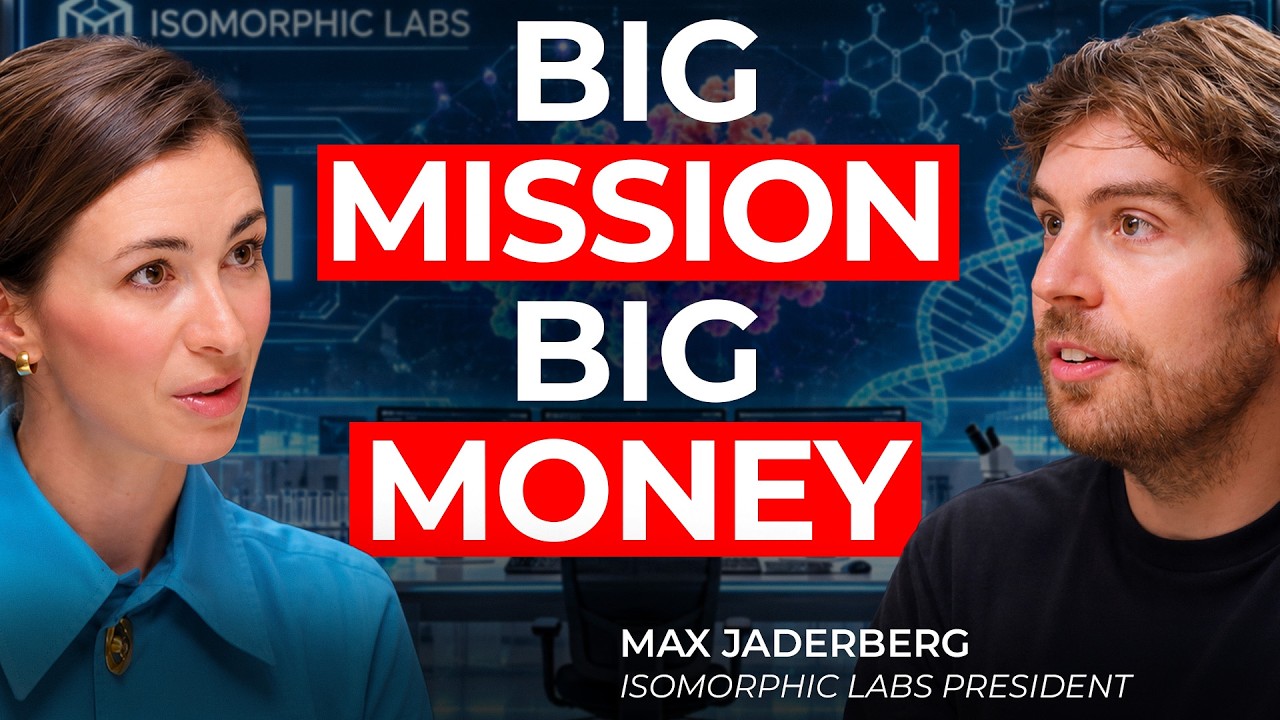
Max Jaderberg is an Oxford-trained AI researcher and president of Isomorphic Labs, a company founded by DeepMind's Demis Hassabis to design new medicines using AI. He spent significant time at DeepMind working on core deep learning algorithms, computer vision, generative models, and deep reinforcement learning, and contributed to landmark projects including AlphaGo, AlphaStar, and AlphaFold 3. His background spans from early ImageNet research to developing foundational AI models for biology and chemistry.
Max Jaderberg: With AI, I believe you need that big ambition and that biggest mission possible.
Marina Mogilko: This is Max Jaderberg, an Oxford trained AI researcher whose startup was acquired by Google. He helped develop Alphafold 3 and is now president of Isomorphic Labs, founded by Demis Hassabis to design new medicines with AI. So AI can generate a lot of hypothesis. How do you know it's actually worth pursuing?
Max Jaderberg: Instead of having to screen experimentally through hundreds of thousands of different designs, we can make 20 or 50, and then we go into the real world and actually make these molecules and test them out and see if they work.
Marina Mogilko: So, when do you think we're going to see the first drugs designed by AI at a pharmacy?
Well, it turns out—Max, welcome to the podcast.
Max Jaderberg: Great. Thank you for having me.
Marina Mogilko: So happy to have you. You're on an amazing mission to solve all disease with the help of AI. Can you talk to me what have you seen inside your work that made you believe that this is all possible?
Max Jaderberg: Maybe I'll rewind to say a bit where we began and where we started to see that this crazy mission of solving all disease is one we can actually go after. My background has been in core AI and core deep learning development. I started my research in computer vision and things like ImageNet, how to train these big networks to get computers to see. I spent a long time at DeepMind working on all the general algorithms, new architecture design, early days of generative models, language models and deep reinforcement learning. Through that I was working on these really hard challenge tasks like AlphaGo and AlphaStar. We were able to solve these impossible challenges again and again. We hadn't got to AGI yet, but it was very clear that we had this new technology with AI that was able to do very different stuff. We started to think, okay, well, what should we really use this for? What could be the impact on humanity here? At the same time, we started seeing the AlphaFold results internally at DeepMind starting to come to fruition. This was an amazing project of trying to predict the structure of proteins, which is a very hard and fundamental task of science, and we could start to see these results emerging of this AlphaFold network starting to get really good. This led to a real conviction that you can actually train AI models that generalize in the space of biology and in the space of chemistry. No one had really shown that before. I think that proof point of AlphaFold really allowed us to take the leap of faith to say, hey, we're at the right stage of the development of AI to really start something in Isomorphic Labs to go full force towards using this to really solve human health. We really think about solving all disease as that core mission for us to go hard behind.
Marina Mogilko: So from this AlphaFold moment to solving all diseases, what has to happen?
Max Jaderberg: AlphaFold isn't the solution to making medicines or solving diseases. It's really that proof of concept that a solution could exist. To actually make a medicine to help solve a disease requires so many different things to come together. It's not just one problem. It's like a dozen really tricky problems that come together. That's why it's so hard to actually make medicines. It takes quite a long time—10 years to go from conception at the moment to a medicine for patients, and the failure rate is really high. About 90% of medicines fail through development.
Marina Mogilko: Because we don't know how they're going to react, how the proteins are going to react with the molecules, and this is where AI is helping as far as I understand this.
Max Jaderberg: Yeah, there's so many different dimensions that come into play and which are hard. Yes, how do you actually go about solving that disease? What usually protein target do you need to go after? What's the fundamental pathway and little molecular machine in the body in the cell that you want to go in and modulate to make the disease state better? Can you actually make a molecule that's good and that works in the way that you intended? If you take that molecule as a drug, would it actually get to the right part of the body? Will it be safe? Will it have toxic side effects? There's just such a long list of things that you need to design for and need to understand. The solution from an AI perspective and a model perspective is not just one model. It's like a whole collection of AlphaFold level breakthroughs. We think about maybe half a dozen plus AlphaFold-like breakthroughs that we have. They need to happen to then come together into one holistic drug design engine.
We've been working really hard over the last 5 years on just systematically going through those half-dozen plus AlphaFold-like breakthroughs.
Marina Mogilko: But have you identified them?
Max Jaderberg: We know what those should be. We think about okay, we want to make medicines in a new way. What are those core superpowers, those superpower capabilities that if you could just give this superpower to a chemist, to a drug designer or a biologist, it would radically improve our ability to make medicines? We can really identify what those are. That comes into things like understanding how cells work and different parts of disease biology work, how to design different aspects of designing molecules, different aspects of understanding human toxicity, and then we can just go systematically after those to create those superpowers. We've identified those and we've been building the models towards that.
Marina Mogilko: How is AI helping you achieve what you want?
Max Jaderberg: It's really on two fronts: the understanding front and then the ability to design new medicines front. To make a medicine you need to understand the disease biology first and foremost. Biology is a really beautiful and complex beast. There's just so much complexity. We know such a tiny proportion of what there is to know about the science of biology and disease biology and how our cells work, and crucially, if you have a disease, how that changes the normal function of cells. We use AI and create these models—these are like foundational models of biology—that help us understand how these systems work. They can help us understand how different proteins and the different building blocks of life—proteins, DNA, RNA—how they all fit together, how they form pathways which are the signaling mechanisms for cells. If you have a disease, how that changes how these pathways operate and therefore gives us a clue into how we can go in and fix the situation. That's one side of the equation: to understand how we work, how cell biology works, how disease biology works. The other side of the equation is how do you then design an intervention to that? So that's a medicine, and a medicine is something like a molecule like a small molecule you could take as a pill, or something called an antibody or a peptide that you inject. How do you actually design a molecule that will go and modulate your biological system as you intended to solve that disease state? AI is helping on those two fronts really strongly for us.
Marina Mogilko: I'm trying to understand from the business perspective because what you're describing looks like very long-term research. How do you break it down into business goals and how do you know when to commercialize what you're doing?
Max Jaderberg: Great question. When we started the company, we didn't want to go and sit in a dark cave and work away on the core engine and models for a decade and then pop up with the solution. We're ready to commercialize this. The whole idea was to from day one be developing the core technology, the AI models, the platform, and then also from day one be able to really try and use this for the real hardest commercial problems. Very early in the company, we were doing real drug design—not just work that we instigated ourselves, which is really important, but also going out and looking for the best people in the world, the best pharma companies. We signed partnerships with them where they brought us literally the industry's hardest problems. You can't mark your own homework. You're really held against the top standard of the industry. That was tough, but it really forced us to develop our models and our AI drug design engine in a way that's going to really speak to true commercial problems. That started our commercial footing very early on in the company. We think about two aspects of how we do drug design. We do internal programs making medicines that we instigate ourselves. We fully fund ourselves and own all of the IP around, and we'll develop these molecules ourselves. We also work with partners to do this in partnership. That builds two different commercial models that work really well together.
Marina Mogilko: Do you have a business framework when you look at these new technologies? How do you know they're ready to be commercialized? When do they leave the lab and become a product?
Max Jaderberg: In general, I think this is different industry to industry. You can think about something like self-driving cars where you have to get to 99.99999% accuracy before it's safe enough to deploy and it's actually a commercial product. In the space of drug discovery, we're actually not very good. Before AI, we're not very good at predicting how good a molecule is going to work. The status quo of the industry is a very empirical process. It's trial and error in the lab process, which means that actually you don't need to have perfect predictive power before you can create real value, scientific value on your drug discovery programs. So we really think about what is that level of predictive accuracy that really changes the game for drug designers and helps us unlock problems that other people wouldn't be able to work on. And so when you hit that level of accuracy, and that level of accuracy actually doesn't need to be very high, it can be just a significant delta above what the rest of the industry might have access to. You can then start using that internally. We have this framework where we're doing this core frontier AI model development. We have lots of benchmarks and evals that act as proxies for how good these models are. And then we just aggressively translate these onto live drug discovery programs to see that they work, and make sure that as we're making progress on our internal benchmarks, our static benchmarks, that translates into real scientific breakthroughs and therefore economic value on our live discovery programs. And often times you can see that you're making progress on your machine learning benchmark and it's not translating into reality. And that's because there's a disconnect between this proxy of your machine learning benchmark or your eval and the real problems. You have to go back and redesign your leaderboard and your evals to better reflect the real on the ground situation.
Marina Mogilko: It's interesting how do you manage your ambition? How do you think about that in this space?
Max Jaderberg: It comes back to making sure that we actually have the scope of ambition that's large enough, a business model that is expansive enough so that we can rationalize huge investment into our ability to create new models and to create this drug design engine. This is really back to the beginnings of the company, really trying to assess what is that big market potential? What's that potential impact for patients that could be? And how much of that can be realized differently now with AI? And that helps underwrite this amazing amount of investment into the core modeling and the core science, which we then can have faith will translate at the end of the day.
Marina Mogilko: How do you stay true to your mission when the goal is so ambitious? Have you ever had periods when you know this is not working out, the technology is not there yet?
Max Jaderberg: Our mission is crazy. You know, "solve disease." It's pretty audacious. We say that with a straight face. We really feel and mean that mission. We know it's not going to happen overnight. So we're honest about that. We also frankly, it's not going to happen just within the four walls of Isomer. But I believe you need that big ambition and that big, the biggest mission possible because if you start reducing what you think your scope of impact can have, you start building out the company in different ways and you start designing different goals that don't quite match that ambition. But then saying that this mission is too big for any one person to just hold in mind. How do you translate that into the day-to-day? So in my head I think about a mission tree. You have the big solve disease mission. Okay, what's one level down from that? Okay, well, we need to be solving the way we make medicines. And then on and on and on. So we think about missions throughout the company, even down to every individual. I want every individual to have their own personal missions that when you put these all together are speaking to our top level solve disease mission. And then thinking about okay, what are the milestones, the practical milestones that we can start to measure that help us test, okay are we still on this path? Are we pushing hard enough? Do we need to be doing something different?
Marina Mogilko: This is really fascinating. I was just talking to Greg Brockman, co-founder of OpenAI, and my key takeaway from that conversation was he told me we have to be working on our ambition because AI makes so many things possible. And something that you just said, if you have lower ambition then the company works in a completely different way and you start solving for smaller problems. So you have to have that northstar. So if you have any tips for the darkest days for founders when they're on a big mission but everyone around them is doubting and maybe even research is not proving that they're right. What can they tell themselves and what can they do?
Max Jaderberg: First of all, I think that's why it's important to actually have a mission, to know what that is and to have spent the time to rationalize that and be like, "Yeah, okay, I can fully get behind this and just drive hard on this." For me personally, the Isomer mission is one that I can just dedicate my life to and have no regrets behind. Doesn't matter how hard it is. I think you have to translate this into signals of life, if that makes sense. So you don't go too crazy. You're trying to pursue something really big that's going to take a long time. What are those little goalposts? Even if they're artificial.
I'll give you an example. We had this particular modeling task and it was one that we've had there since the beginning of the company and we set this like crazy ambitious quantitative target. You need to hit 80% accuracy on this particular benchmark. And by the way, the world is only 10% good at it. So it feels so out of reach, but it's still a very tangible number. And day-to-day you can see climbing 1%, 2%, 3%. So you're moving towards that. It still seems very far, but you can see progress against that. And actually as you compound this year over year, you can actually start to reach these things. So I think always trying to translate that—we try and translate these really big qualitative ideas into just something quantitative. Even if it's slightly artificial, it can help focus teams, focus the mind in just a very gamified competitive way. We literally call these leaderboards. And it doesn't matter what part of the company you're in, you've got your quantitative goal that you're trying to grind towards.
Marina Mogilko: I love that. That's very practical advice.
Do you think there are industries that are ready for an AlphaFold moment, like biology had, when you're looking around?
Max Jaderberg: Yeah. So outside of biology, I think there's a lot of opportunity to find places that AI can now be applied and that still require an AlphaFold like moment. So what does this look like? We have all of this amazing advancement on our core LLMs, our reasoning agents. These help us understand data and reason about the world in the way we do, but starting to far surpass us in terms of intelligence. If you think about the biology space, that could be just like a human biologist will look at the data, look at some experimental data and try and draw conclusions from that and hypothesize about what experiment can be done next. Now these reasoning models are able to do that and starting to maybe even outperform people in doing that. But can they actually predict what the experimental outcome will be itself? Can they simulate the real world? Maybe not. Maybe not at this stage. Maybe one day they'll be able to train the models to do that as well. So I think there's going to be a lot of applied AI domains where the reasoning models will come up with hypotheses or help you understand and analyze the world, but you still are bottlenecked by going into the real world and poking the real world and trying to see what the response of that is. It's doing a physical experiment. That's the case in biology. It's the case in material science and almost like any form of physical design work that you're doing. A lot of spaces of engineering. And in those cases, in those domains, there's an opportunity for AlphaFold like moments, i.e. the ability to create these AI models that simulate part of that physical world so that instead of going and doing the physical experiment you can poke your model instead and see what the response is. It's very complimentary to the LLMs and reasoning models.
Marina Mogilko: And how do you know that the model is not ready to solve that yet? Have you ever had a situation where you have this idea but then you look at the model and y
You realize the technology is still a decade away from solving it?
Max Jaderberg: I think a lot of that comes down to what data is available. Machine learning AI only works by training on data. I think you have to start by looking at what is this predictive capability that's needed and what data is there that might have some information content inside of it that could speak to helping predict that thing. And if you don't have much data or the data is very noisy or it's very low dimensional, there's not actually much signal in this data, then there might not be actual scope with given the current data to make a lot of impact on this modeling task. And that could also be an opportunity for people because then you should actually start thinking, well, what data could exist to unlock this problem? And I think there'll be many problems in this space where if you look at the current data that the world has access to, it's quite small, doesn't have the right signal, it's too noisy. But maybe there's a new piece of data generating technology or way we can collect data or generate new data that could then suddenly unlock new domains that haven't been unlocked before.
Marina Mogilko: So you think the models are powerful enough that they can do way more than we're able to achieve just because we miss the data layer?
Max Jaderberg: I'm a deep learning maximist. I think we have the algorithms that can solve almost any problem. We have the compute now. We have just an abundance of compute. Of course, everyone's compute constraints, but there's so much compute available. So it really comes down to if we have the algorithms, we have access to compute, we've got amazing people that can put this together, then we need to make sure that we have the data. And a lot of these amazing applied AI potential domains are limited by the data that's available to train on.
Marina Mogilko: That's a business idea and that's where we see a lot of businesses emerging collecting data and making sure it's accessible to those models.
When you hire people with no biology background, who are good at AI, what exactly are you looking for?
Max Jaderberg: A mission like ours—solve disease with AI—it's a really complex problem. You need to hire people from lots of different disciplines. For better, for worse, there exists no world expert at solving disease or making drugs with AI because this field hasn't existed long enough. And if someone maybe claimed they're a world expert at drug design with AI, they're probably using a technology that we don't use internally. It's something outdated. So we believe that we have to hire the best people of their respective disciplines. The best AI scientists, the best AI engineers, the best software engineers, the best chemists, the best biologists, and the best clinicians. And then bring them all together and ask them to start speaking each other's language and working together because those intersectional people haven't quite yet existed in these new spaces where AI is coming to these. And I think this will be true for quite a lot of industries, which means that we encourage hiring people who are just the best AI scientists and engineers. They've got no life sciences background. They don't know anything about making drugs, but they have to be willing and curious and open to learning this space. People who end up being fantastic AI scientists and engineers or fantastic chemists and biologists tend to be pretty smart people who love learning. I think a lot of these fields are quite learnable by other people. As people come in, they learn about how to make drugs, they learn about how AI works. And then internally we create this interdisciplinary type of scientist or engineer. And actually there's another benefit that comes from that. Not just hiring the best people, but you get people looking at another discipline or another scientific field or technical field from a completely new perspective because they're naive to it. And so you almost by accident get this first principles type analysis and thinking for these domains. And that's exactly what you need to do. You need to do that first principles type thinking to build in these new spaces.
Marina Mogilko: And I think this is how hiring for top companies is happening these days because you can't find someone for that job with five years of experience just because it did not exist. And you mentioned you're looking for people who know how to learn and who are curious. Is there a question that you ask them to figure out if they're the exact type of person?
Max Jaderberg: I asked them, honestly, talk to me about learning a new field or when did you operate in a space that was completely new to you? How did that feel? How did you approach that? I try and see how people think in that way. I ask people very honestly about where their technical work failed and how you learned and figured out the solution to that. So I start to try and get people to recount and talk about what their past experiences have been like in these really uncomfortable learning situations where you feel everything's going over your head, you don't understand the world around you. How did you feel in that moment? What did you do? And where did you get to?
Marina Mogilko: Max says his team brings together specialists from different fields and looks for people willing to learn from one another. And learning fast is one of the skills I keep hearing about from people building AI tools. I went back through my conversations with leaders at Replit, Anthropic, LinkedIn, and Microsoft AI and found seven skills that came up again and again—from framing the right problem and checking AI's work to learning as the tools change. I put the first list in Future Proof, my newsletter. You can read the newsletter and subscribe through the link in the description. It is free.
Talk to me about using AI at work. So AI can generate a lot of hypotheses. How do you know it's actually worth pursuing?
Max Jaderberg: You're doing drug discovery. You're trying to make a medicine. You're trying to design the next iteration of a molecule. AI can come up with—choose your large number—like thousands, millions of different hypotheses for next designs. Which ones of these are good and which ones are bad? You don't want to test necessarily all thousands or millions in the lab. So instead, we build a complementary set of models which are these simulation models, these world models, virtual lab models that allow us to predict what the response will be if we actually make these molecules and put them into the lab. So we think about some models—generative models and design agents—that come up with new hypotheses and designs and ideas. And then other models that are like virtual lab models that we run on a computer to refine those and whittle those down to just the very best that we have the highest confidence will be good in the real world. And then we go into the real world and actually make these molecules and test them out and see if they work. That's the really time-consuming and expensive part of it.
Marina Mogilko: What's the percentage of those successful tests? Run me through those numbers.
Max Jaderberg: This is one of those core internal metrics for the different parts of the pipeline that you want to see get better over time. It's at the point now where instead of having to screen experimentally and go through hundreds of thousands of different designs, we can make 20 or 50. And there's such a high percentage of hits of experimental success there that we can get rid of the old style of just testing many molecules—thousands of designs. That's the thing we track internally. As we make advancements on our core model benchmarks, we want to see that translate into that real experimental success rate. The higher the experimental success rate, the less experimental time and iterative experimental time you'll need. That's quite different from trying to do a lab-in-the-loop style. We actually want to bring the real world onto a computer as much as possible.
Marina Mogilko: This is interesting—how the researcher's job is changing. Do researchers still generate hypotheses or do you think AI is so good at it now that the researcher's job has changed?
Max Jaderberg: I think it's changed, and it's changed whether you're an AI researcher or a chemist. I can give examples on both. If you're an AI researcher, you used to propose a hypothesis of a change of a model and then implement that and run the experiments and see if it works. Now we're seeing more and more auto-research happening where an individual AI researcher is not proposing an individual idea. They're proposing the design space of model changes and the goals of that idea. I want to increase the efficiency or throughput or accuracy with this sort of flavor. And the agents and models are coming up with the ideas and then running the experiments on that. As a chemist, it's a very similar thing. Before, you wanted to make improvements on a molecule design. A chemist might be drawing out the molecule on a whiteboard and starting to change individual atoms, coming up with different design hypotheses themselves. Now a chemist or drug designer is instead defining what's that design space, what are the goals of my next round of design? And that defines an objective for our design agents. And then the agents are working autonomously to do all the individual designs and come up with the next iteration.
Marina Mogilko: That's really fascinating, and apart from design—
Igning what's your personal AI stack to run your productivity?
Max Jaderberg: I have a whole host of different agents running across everything. We use a lot of Gemini internally and all the different models. One example that's been mind-blowing for me is the analysis and visualization of data. We have lots of different operations going on, and now with this agent stack you can plug in all of your company data across your different programs and start to tease this out and visualize it in a way that normally would require an amazing designer next to you. Instead, this can be driven purely by me as someone running the company. We use a lot of Gemini and pretty much all the models, including open source.
Marina Mogilko: I read that you have some drug design agents that run for two to four days consecutively. Is there something about prompting them to trust them to run for so long?
Max Jaderberg: This is the result of a lot of research. We have an amazing research team in this space of how do we create these design agents. This comes together in terms of the prompt, the harness, and how we define success as these agents run.
Marina Mogilko: How do you define success for an agent?
Max Jaderberg: This is less about accuracy. It's more about defining the goal space of the agent. What is the agent trying to achieve in something like drug design? I think this is common for a lot of design problems. There's not just one quantity you're trying to achieve. There's probably a whole host of different properties that you're trying to achieve. So getting the agent to understand—okay, what are all those different properties? What's the goal space for these? A lot of these properties are in conflict with each other. You might be pushing up property A and getting really good results, but as a result, property B gets worse.
This isn't a greedy optimization process. This is an open-ended search and optimization process where you need to be able to explore and exploit. It really goes back to core reinforcement learning ideas.
Marina Mogilko: And how do you decide which problem you're going to automate with an agent? Is there a framework where you're thinking, "Okay, I repeated this five times. Now it's time to really sit down and build something out."?
Max Jaderberg: You have to be really eval driven and leaderboard driven in terms of development. It's very easy to fool yourself with agents at the moment—oh yeah, look I can just automate this thing with agents and isn't this great—but is the result good? Is it saving you time? Is it creating more scientific value or economic value down the line?
So it's really important to actually have your evals, your leaderboard of what does good look like, how do you codify that. If you're lucky to work in a verifiable domain, this might be strongly verifiable on a computer—you can determine whether the agent is right or wrong. In the space of biology and drug discovery, this isn't really verifiable on a computer. So it's a lot softer in terms of understanding if an agent is doing well or not. But trying to get down your evaluation benchmark for every different part of your agent system and then really evaluate—are you making progress here? Is this getting better? Is this agent actually doing better than the human would in this scenario? Is it working faster than a human would? Just actually starting to empirically measure this, and then you can direct your development time into the right part of the stack.
Marina Mogilko: Before we keep going, can I ask you a small favor? If you've been enjoying this conversation, I'd really appreciate you subscribing. It's a free way to support me and the team behind Silicon Valley Girl and it means a lot to us. Thank you.
What part of your work haven't you automated yet and you think you will never automate?
Max Jaderberg: That's a really good question. I spend a huge amount of my time talking to the different people around the company and managing the humans in our company and behind our amazing mission. I think that's something I don't think is automatable at the moment and probably shouldn't be automated.
Marina Mogilko: I think sometimes you have a 20-minute conversation and it changes your whole strategy and the way you think about the field.
Which is why I started this podcast.
Max Jaderberg: I think these models can come up with so many amazing hypotheses, but you have to think—okay, what is the real bottleneck resource? Even as these models get to AGI, it's going to be human attention time, physical space. These are the limiting resources that are never solvable.
Marina Mogilko: Another bottleneck that an old man mentioned—we had this creator Q&A and he was asked about using AI to cure cancer and he said we might see something already next year curing some type of cancer, but the bottleneck will be the FDA. Do you agree with him?
Max Jaderberg: At the moment, and rightly so, it takes time and a lot of evidence to get through the regulatory process to make sure that you've come up with an amazing medicine and can actually start testing this on people in clinical trials. You have to go through the regulatory process with the FDA, and that's really important because you have to have patient safety first and foremost in mind.
At the moment, this takes time to collect data on all the different animal models and all the different data points required to convince the experts that this molecule looks like it should be safe in people and maybe it'll work for this particular disease area. Only then can you start a clinical trial and actually test this on people. And then even with all of that data beforehand that goes into approving the clinical trial, 90% of drugs fail in the clinic because there's some unintended side effect or toxicity. When you start these clinical trials, you have to start quite slowly. Initially, you do what's called phase one trials before phase two. Phase one trials are all about figuring out if your molecule is toxic. Can patients tolerate a decent therapeutic dose of this medicine? You have to start really small and gradually work your way up. That takes time, but it's necessary to protect patient safety.
It's that way because we're not very good at predicting how well these molecules are going to work. We don't know the mechanisms. We can't predict the toxicity. We do these animal models for toxicity, but these animal models are only about 30% predictive of human toxicity because a rat isn't a human. We see a lot of opportunity to actually improve how good we are at understanding what these medicines work. Over time, ultimately, I think everyone—us, the FDA, patients—everyone wants to get amazing new drugs to patients who need them as quickly as possible and as safely as possible. As you start to prove out the evidence that we can do this a lot safer and with a lot more predictive power, that should spur change in how long this takes and how quickly we can get these drugs to the patients who need them.
Marina Mogilko: So when do you think we're going to see the first drugs designed by AI at a pharmacy?
Max Jaderberg: At a pharmacy, I don't know. It takes time to get through the full process, but I think there are a lot of amazing things being designed at the moment. We're starting to see some things entering the clinic that have touched machine learning in some way. We're working really hard on our own pipeline of fully AI designed drugs and getting those to the clinic as quickly as possible.
Marina Mogilko: What's the most exciting for you if you can share?
Max Jaderberg: We have some really exciting programs in the space of oncology—different types of cancer—also immunology and inflammation. Really trying to look at some of the core drivers of these diseases and whether we can start to change how these core drivers work and, of course, how they get mutated or changed in disease states. This is really exciting to see the progress.
Marina Mogilko: Which patients do you think are going to benefit first from the drugs that you're developing?
Max Jaderberg: It's too early to say which ones will hit the clinic first. What I can say is we're pushing so hard on getting these first potential medicines to clinical trial to start seeing that impact on patients. We have some really promising stuff. Touchwood, all of our data keeps progressing as it does and we're really excited about this.
Marina Mogilko: Okay, keeping fingers crossed. I recently heard Ray Kurzweil say you have to live to 2030 because after that every year you live is going to add more than a year to your life because technology advances. Do you believe in this concept in general?
Max Jaderberg: I think we're going to get so much better at designing new medicines, at understanding disease so much better. I don't know exactly what the rate of that progress is going to be, but I think there's very much something in this. Fast forward 10 years, 20 years, 30 years—the way that we're going to understand disease is going to be completely different.
I think how we think about solving disease is going to be radically different. Even thinking about how to understand the onset of disease, how it works and therefore preventative measures before the disease manifests itself into a really critical state should be very different. That's going to require us to understand so much more about how biology works and measure everything about us. A lot of pretty much all of the medicines that are out there and that we use is one molecule for the entire population of the world.
But disease is so nuanced and it manifests itself in different patients in very different ways and you can imagine with AI there's going to be so much more opportunity to understand each individual case for patients much better and then on the other hand design a much more bespoke solution for these patients. So I think we'll see a track towards much more personalized medicine, much more focused on individual cohorts of patients even down maybe to the individual itself over time.
Marina Mogilko: Can you make any timeline predictions around that?
Max Jaderberg: We should be seeing this change now over the next couple of years as these new waves of medicines start coming into the clinics. They should be able to tackle diseases in new ways. We and other people in the industry are trying to go after these new targets as we have this better way to engineer molecules and engineer new medicines that's going to open up new frontiers of things to work on. So I think even over the next 10 years we should be seeing a big shift in the types of medicines that are available for patients. Over this decade I think we're going to really start seeing that shift.
Marina Mogilko: That's fascinating and I wonder what's going to happen to our life expectancy and what will be the next bottleneck.
Max Jaderberg: You can think about there's obviously very advanced stages of disease that we want to rectify. But then there are a lot of diseases just associated with getting older and that's afflicting our quality of life and that's before you even talk about trying to reverse and live longer. So I think there's a lot of near-term opportunities to really improve our quality of life and that's before you get into things like longevity and trying to reverse age of organs and specific things.
Marina Mogilko: Give advice to someone who really wants to work on AI for science in the next five years.
Max Jaderberg: I think don't neglect learning science itself. Even as AI gets better and is able to produce so many hypotheses, where do we focus this compute? We still have a finite amount of compute. We need to think about what are the core scientific questions for your respective field to ask? Where do we actually focus all of this amazing intelligence and explosion of intelligence with compute that's coming? What questions do we ask? I think still really truly understanding the fundamentals of science and the mechanisms behind that is going to be imperative and then just be really creative and aggressive with adopting agents and all of AI around the space.
Marina Mogilko: It comes down to asking the right questions and it really reflects how research works. It's knowing which question to work on.
Max Jaderberg: The process of answering those questions that's going to change. That's always been changing as new technology comes. But what questions to ask, where to focus your finite resources—whether that's human time, agent time, wet lab work—it's going to have to be focused somewhere.
Marina Mogilko: Do you think it depends on the amount of knowledge that you have acquired? Does it depend on your taste, the quality of questions that you're asking?
Max Jaderberg: I think taste is a real thing. I actually talk a lot about this internally about research taste and I think that is a function. Your research taste is your ability to filter to what questions to ask and filter quickly to what could be some good ways to tackle answering those questions. And I think that research taste comes from experience and that experience helps you build your intuition and your understanding of the domain. You choose your favorite scientific domain or area of maths, engineering, science. These are really complex. A lot of that complexity is almost too high dimensional to hold in its true state in your head. So you come up with mental frameworks and intuitions to help you navigate that as a scientist or an engineer. I think that's the thing that needs to be built up through hands-on experience and exposure to these fields. And also I think there's a lot to be said by keeping generalists enough. I'm a generalist scientist engineer. I love that and I think there's a lot that you can learn, you can take from other areas of maths and science and apply elsewhere. It's often those crossover ideas that work really well.
Marina Mogilko: Building frameworks teaches your brain to understand what's going on and put it into simple words. I think it's a really great skill for the AI world.
Thank you so much. That was so much more than just curing diseases and I'm keeping fingers crossed for your mission and hopefully in the next few years we're going to see a great effect of AI on healthcare.
Max Jaderberg: Thank you so much. Been such a pleasure.
Marina Mogilko: If you've ever asked ChatGPT a health question, watch my conversation with a Stanford doctor Jonathan Chan. We talk about how the way you ask can shape the answer and where AI can be useful and where it can go wrong. Click here.