Robinhood CEO: How to Build Wealth in the AI Era (Before It's Too Late) — Silicon Valley Girl Podcast
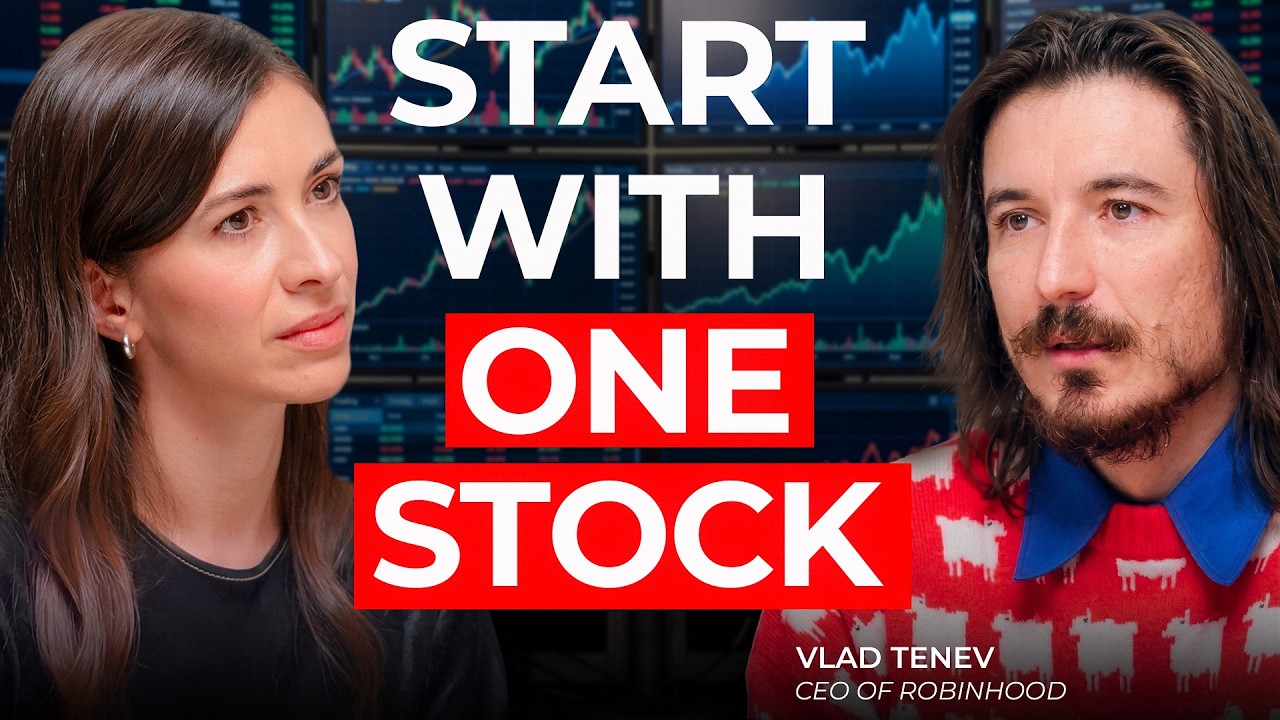
Vlad Tenev is the co-founder and CEO of Robinhood, a financial services platform that has democratized stock market access for over 28 million funded customers. His mission is to make buying stocks as accessible as ordering an Uber. Prior to Robinhood, Tenev's early life in Bulgaria during hyperinflation gave him deep insight into the importance of investing in quality financial assets for wealth preservation and economic stability.
Vlad Tenev: If a company goes public at a valuation of 1 trillion, to get that thousandx return, it would have to reach a valuation of 1 quadrillion.
Marina Mogilko: You see all the billionaires that emerge because of AI, and they're like, "How can I participate?"
Vlad Tenev: So, the earlier you start, the better.
Marina Mogilko: This is Vlad Tenev, co-founder and CEO of Robinhood, which has over 28 million funded customers. His goal was to make buying a stock as easy as ordering an Uber.
Vlad Tenev: So many of the innovative AI companies are still private. There's a good chance that an entire generation could be left behind of these gains.
Marina Mogilko: 9 days after we spoke, Anthropic went public at an IPO valuation of about $1.5 trillion. Can you tell them what's the smartest thing they can do about their future financial lives?
Vlad Tenev: Ask your parents to buy you a little piece of the companies that you care about.
Marina Mogilko: Do you think it's still a good time to invest in all the AI stocks or the market is overheated?
Vlad Tenev: Well, I'll tell you that.
Marina Mogilko: My investment journey started in 2020 when I had my first daughter and I discovered a book by Tony Robbins called Money in my apartment building back in San Francisco. I was listening to Graham Stephan's podcast and you've been on their show at the iced coffee hour. This is when I started investing and it was during COVID that I got my first chunk of stocks via Robinhood. So thank you for enabling access to the stock market via an easy app.
Vlad Tenev: It's amazing to hear. My investment journey started pretty young and I guess one of the things we both have in common is we come from Eastern Europe. When I was growing up, the economy and the system in Bulgaria collapsed and we had hyperinflation. The year before I left, which was 1991, the inflation rate was something like 130% per annum and in the US when the inflation rate got to between 5 and 10% people were panicking. Imagine 131% and then a few years after I left, the inflation rate in Bulgaria was the highest in the world: 1,700% per annum. They were adding zeros to the currency faster than it could be printed basically.
My grandparents at the time—there was no Robinhood, there was no functioning stock market. You certainly couldn't invest in US stocks very easily. So they stored their wealth in copper cookware in a closet in their apartment in Varna, Bulgaria. I think I just grew up very early with this understanding that investing in high-quality financial assets could be the difference between a stable life and not. And on a societal level, encouraging that and making it easier could be the difference between a stable society and one that is very fragile.
Marina Mogilko: I want to really focus on investing in AI in the first part of this conversation because I feel like people don't understand what's going on. These companies are going public at a $1 trillion valuation. We saw SpaceX which is actually down from being up 19% on their first day. Now it's only about 5% over their IPO price. Do you think there is way more potential to grow?
Vlad Tenev: I think your point is definitely a good one. You look back at Apple or Amazon or Microsoft. You had these companies that went public at valuations of hundreds of millions. I was just listening to a podcast on Home Depot. Home Depot went public in the early 80s at a valuation of I want to say 50 million.
If you bought that stock in the IPO and held in the public markets, you could see 1000x return. And obviously if a company goes public at a valuation of 1 trillion to get that thousandx return in the public markets it would have to reach a valuation of one quadrillion, which maybe I'm not going to say it's impossible but you're starting to get into the aggregate size of the entire global economy at those scales. Those are some big numbers. There's obviously still growth in public markets. You can find it. But a lot of the growth is increasingly in private markets, which is one of the reasons why we're working to solve this problem with Robinhood Ventures, which gives exposure to high-quality private companies to individual retail investors on Robinhood before they go public. That's one of my big crusades. One of the things I'm very passionate about.
The Robinhood's real origin is to take what the wealthy have enjoyed and benefited from for a long time and democratize that and make that available to the general public. It started out with stocks and access to options and just easy access to these asset classes, but increasingly the wealthy always find ways to get better and newer things and they're very innovative as a class of people, which means our mission really is never done. There's always new stuff. Increasingly, that's private markets. And so one of my crusades is to democratize private markets, which Robinhood Ventures is the first step in doing. I think we're basically the only ones that are trying to tackle that challenge and come up with a real solution in the US.
Marina Mogilko: I think it really addresses the problem where there's so much fear around AI because people can't participate in it. They see all the headlines: AI is taking my job. I know AI is changing everything. And you see all the billionaires that emerge because of AI and they're wondering how can I participate? So for me the solution was I just buy Google stock because it's easy, it's on the market and they own part of Anthropic and they invested in SpaceX. What would be your advice to people who are trying to participate in this?
Vlad Tenev: I think there is not a great solution up until Robinhood Ventures, but I'll put Robinhood Ventures aside because I don't want to be talking my book. That's what we're trying to solve with it. So many of the innovative AI companies are still private and you have this revolution which really started in 2022. It hasn't been going for that long—it's about 4 years since ChatGPT came out and it ushered in this new renaissance in AI. 4 years is a very short period of time to go public. If we don't find a solution to this and if more people don't start doing what we're doing and innovating in the private markets frontier, there's a good chance that an entire generation could be left behind of these gains.
The other solution, which we're also a big part of, is 529 Accounts. It's actually wide-scale philanthropy. The 529 Account program gives stock to every newborn. Everyone under the age of 18 gets a 529 account. Michael and Susan Dell contributed an extra $250 to lower income zip codes. Then you have some other philanthropists. Over 60 million children have 529 accounts now and around 25 million have funds invested through Michael Dell and others. If we can get more companies and more wealthy individuals to sponsor their communities, sponsor their states or their schools, I think that could be another vehicle of giving skin in the game to all of these children.
Marina Mogilko: What do you think a person should do if they want to build wealth with AI? What are the steps—connecting your accounts, figuring out your portfolio? What do you think is a good mix?
Vlad Tenev: I mean, I think the great thing about the 529 accounts is it gets you knowledgeable about the markets from theoretically age zero. You have a reason to learn about investing because you have this nest egg that's growing and compounding for you. I think outside of that, generally learning to invest and learning about buying stocks—the US equity markets have been the largest engine of wealth creation in human history. If you look at why some people have done very well economically over the past few decades despite wages being relatively stagnant, it generally comes to US equities exposure and more time in the market really makes a big difference. So the earlier you start, the better.
I just encourage people to start by just buying a stock, going through the motions of becoming an owner of a company that makes products you care about. I think that's the most direct way to get started. And then over time, if you keep up with it, obviously you can get arbitrarily sophisticated with these things, but I think it starts with just buying a single stock. For a lot of people, that just lights a spark.
The sooner you do it, the younger you do it, the more you have time to understand how everything works. I remember I bought my first stock when I was 13. It was a company called 3Com, which made the Palm Pilot, which was the first personal digital assistant. My dad had come home from the office and he had this Palm Pilot, and he didn't really use it, so he gave it to me to play with. I was so convinced that this device was revolutionary and that the company that makes it was a good company that I bought the stock. This was right before the dot-com bubble burst. This was maybe my one really smart move in that era and I learned so many things.
3Com ended up spinning off Palm. So I started with one stock and I ended up with two stocks. I got the shareholder materials in the mail asking me to vote on these corporate transactions and I actually read them as a 13-year-old. I didn't have too much distracting me. And then I understood what it meant to be an owner and a shareholder of this company. I'd say a lot of the things that followed stem from that moment, just buying a single stock.
Marina Mogilko: You really start small to build the mindset regardless of how much money you have. I want to describe my setup to you and I want you to evaluate it. So I have connected all of my accounts to my chat GPT and Claude, everything that I use. First, can you comment on the safety of it? Because a lot of whenever I post about this, people are like, "Oh, how do you give access to all the AI apps to your accounts? Aren't you worried? Is there any threat to my accounts if I connect them to all these apps?"
Vlad Tenev: I don't want to say there's no threat. I think that the main thing you probably have to worry about is just the security of your information. How that's being used. It doesn't have to be intentional, but they could lose it. A lot of companies have been unfortunately suffering breaches recently, and I'm sure Claude invests a lot in cyber security. So, not to say that you're more vulnerable, but I think some paranoia about your information is warranted. But in terms of are they going to go rogue and start trading on your behalf, I think a lot of these models just do what you prompt them with. So unless you're developing some sophisticated automated trading strategy, I probably wouldn't worry too much about that.
Marina Mogilko: So I gave access to all my accounts and asked to build a strategy. So I have a financial adviser who does a very conservative strategy and then I have a portfolio that I manage myself and I invest in what I believe in. I'm mostly in Silicon Valley, tech stocks, a lot of Google, but I execute everything manually. So Perplexity would send me an update of the top stocks that dropped that day that I'm tracking and tells me how much I should deploy. And I just saw you have this agentic feature. So talk to me about how I can improve my setup and what people can learn from all this. Is it too complicated for a normal person or what is the best way to set this all up?
Vlad Tenev: You can try Robinhood agents which is rolling out. So I'll tell you the history of our agentic trading offerings. Our first thing that we rolled out was Agentic Trading called Robinhood Agentic Trading and Agentic credit card. It's basically two MCPs, model context protocol.
Marina Mogilko: It's basically like an API connected to your Robinhood account.
Vlad Tenev: It's the ability, like an API that allows for agents like ChatGPT or Claude to connect to Robinhood.
The two use cases were you can connect to your Robinhood brokerage for trading or to the Robinhood credit card for making autonomous purchases on your behalf.
Marina Mogilko: Oh wow. Like shopping for you.
Vlad Tenev: You can shop it safely. And actually in both of these cases there are by default the ability to approve transactions. So you can set it up where you have to approve every trade that is being generated. And for agentic trading, it's in a segregated account. So the agent basically oversees a dedicated account rather than your main Robinhood account. The way we started at least is you have to just move money into that account in order for it to be available for the agent. The MCP will let you see all the accounts in a readonly way but for the trading it has to be in the dedicated agentic account for now.
Marina Mogilko: And I basically tell it buy me these stocks on the days that they drop.
Vlad Tenev: You can do a strategy like that. One of the really exciting things that we're working on is what we call agentic loops. If you used Claude or Codex you're probably familiar with this. There's the loop command where you can get the AI model to run a set of instructions on a regular basis. So you can say like every day at 7 am I want to check my portfolio, run these sets of steps. And for programming, these agent loops have been very useful and we're bringing them to trading where you can say in the morning check the markets, look at my portfolio, execute a strategy, suggest some trades and then you can do them for rebalancing as well, tax optimization.
A lot of people are using it for tax optimization. They're implementing these tax-aware strategies and then we're looking at what people want and making it easier. There's a lot of similarities between agentic trading and writing computer software. So I think these two things are going to converge and I would think about the same tools and improvements that are coming to the coding agents that will make it easier to create better software. There's going to be analogous tools that will come to Agentic Trading to make it easier to create new trading strategies. In the same way that computer programming used to be the domain of sophisticated programmers but now Claude and Codex have democratized that and made it so that anyone can be a programmer. My belief is that our tools will make it easier for people to become traders and you won't need to be a specialized quant person to create a sophisticated strategy. We'll make it easier and easier for people to do that just by talking or typing into their agent.
Marina Mogilko: What would you say is the prompt that people should be using to ask AI to help them build wealth?
Vlad Tenev: That's an interesting question. I think that a lot of people's first attempt when they come across these services is they'll put something in there like "I want to make money" or "Tell me how to make money and execute something."
Marina Mogilko: Get rich without working.
Vlad Tenev: Yeah. Make no mistakes.
I'd like to maximize money earned per hour worked. Please do that for me. I think the problem with that is, taking my analogy of software, it would be the equivalent of like "Make me an app that makes me a lot of money" and you'll probably end up getting something quite generic.
Maybe it'll make you some agentic coding app.
Marina Mogilko: It should at least ask you follow-up questions. What's your salary? What are your goals?
Vlad Tenev: The problem is that the people that put prompts like that together don't generally want to answer a bunch of follow-up questions. If you're the type of person that's like, "Make me money," and then you get 13 questions, it tends to be the people counterintuitively that write extremely complex prompts up front that are the ones that want to customize everything and are cool with the questions. This is definitely a design challenge that we're working towards. If everyone is asking the question of just "trade and make me money" with no input, I think that it's very unlikely that there will be alpha in those strategies. Probably not now either. I would doubt that there's even if there's some alpha now, probably not for very long. It's going to become a competitive domain like all others where it'll be driven by the uniqueness of your prompt, whether you have some insight that you want to record in the model or what data you plug in.
Marina Mogilko: I think this is more sophisticated because I think people when they buy their first stock, they have no idea what they're doing. But the question is like how often, how do I diversify, and we have this powerful tool that can build this out for us and Robinhood can execute all of that. So what would you say to those people who are just starting out on this journey of being an investor, not a trader?
Vlad Tenev: So what I'll tell you is I think that if you just want to invest and you don't have a specific strategy in mind, then we have a great product for that and it's not agentic trading. Maybe there will be some convergence of those products over time, but we have a product called Robinhood Strategies which you can think of as like an "invest my money" button. You answer a couple of questions about your risk tolerance and when you'll need the money and how you'll react to a big drawdown in the markets and essentially you put money in this account and it's invested autonomously on your behalf without you having to make decisions or type prompts.
Marina Mogilko: Does it do dollar cost averaging for you or just doing this straight away?
Vlad Tenev: You can do a recurring deposit into this account and have that over time.
So you can do that. We also allow recurring investments on a per stock basis. If you want to manage it a little bit more yourself and you want to say invest in a particular ETF, $100 every week, we'll let you do that. As far as agentic finance goes, I think there's basically two products that are very different that have product market fit and that customers clearly want. One of them is agentic trading. But agentic trading I think is most useful to people that have a certain strategy. If you want to be a quant and you have a quant trading strategy in mind, but you don't want to spend the effort.
So, agentic trading is a very good fit for that use case. And then there's a product on the opposite side of the spectrum that I don't think anyone has done an amazing job of yet, but I think it will be done. And basically what that looks like is a financial controller. This is something that sits on top of all of your accounts, and it can look at all of your financial activities, including what you're spending, how your money is allocated between retirement, paying off your credit card bills, and maybe other accounts like discretionary trading. It knows your income, and it's like a router and an advisor that tells you you're spending too much here, you're misallocating in this account, you should actually move from this account to this other account. So, call it a controller, call it agentic banking or private banking, but I think something like that there's a need for as well.
Marina Mogilko: Can you build this? I think what I built is pretty similar because it tracks all of it and just tells me, oh, you want to buy more Google since we're talking a lot about Google, but you own this ETF that actually has Google as well. I think you're overexposed. So, it does this tracking. The thing is when I was prompting this, there are so many strategies that were advised by my CPA or financial adviser and AI did not think about them and I want to make sure that AI proactively suggests strategies telling me are you thinking about your daughter's retirement? Like the product that I ideally want is a proactive product that looks at it and suggests tax strategies, suggests investment strategies. Do you think it there's like a user can build this on top of Robinhood with an MCP connection to Claude or ChatGPT?
Vlad Tenev: Yeah, I absolutely think it requires a lot of work. I think for a very sophisticated user that knows how to build AI applications, it can be done and that's why we rolled out Robinhood MCP in the first place. We wanted to see what kinds of things people are building themselves. But I think for the mass market, people will not want to do a ton of prompting. And so I think that's where Robinhood agents comes in. It's where we take some of these things and make them even easier to use because right now I think what it sounds like you've built is a homegrown agent that connects to all of your accounts and runs some queries. Maybe it's using loops and it's running them on a periodic basis. The problem is you have to do a lot of work to give these agents the right context and tell them what to do and a lot of that work can be done for you. But because these are general agents, they're not really trained with the idea of making transactions, financial transactions on your behalf.
Marina Mogilko: Vlad talked about agents that check your portfolio and run tasks on a schedule. That same idea applies to your business, too. I learned this the hard way. I had to rebuild our AI setup multiple times. So, I put together a 30-day plan based on what my team and I have built. From organizing our files and setting up AI projects to creating agents that run recurring tasks for you. You can get the whole plan for free through my newsletter, Future Proof. Subscribe using the link in the description and I'll send it to you. But I'm always thinking like with the next generation of models that are maybe now trained on investing and are built to invest, could this be just wiped out from the market? It's basically how do you look at new features and how do you look at software businesses these days with AI?
Vlad Tenev: Well, I think a lot of people thought that the models were just going to replace everything and that there was not going to be a successful app that wasn't a model. But I think you're seeing a lot of examples of apps that aren't models that are picking up great amounts of traction. I think it's clear that products make a difference and there's opportunity for innovation at all layers of the stack.
Marina Mogilko: So you don't think software is dead?
Vlad Tenev: I don't think software is dead. I think software will become much cheaper to create. You'll have a lot more software that's out there competing for attention. So, I don't think it'll necessarily become much easier to create a powerful product because everyone's going to have access to these tools, but I think we'll get better and more powerful software.
We're already starting to see that.
Marina Mogilko: Do you think overall we're experiencing a bubble going back to investing? Do you think it's still a good time to invest in all the AI stocks or the market is overheated?
Vlad Tenev: Well, I'll tell you that our customers are very optimistic, very bullish about the future. So, just this past Friday, we had our largest day of equities trading in our history. We've had some pretty big equities trading days, but the market dipped and our customers saw opportunities predominantly in semiconductors and AI adjacent stocks and they bought the dip very aggressively. So if we look at our retail customer base, there's definitely an optimism about the future and a belief that this technology and the ecosystem around it in terms of chips, memory, infrastructure, all of that is closer to the beginning than the end of the cycle is what I'd say.
Marina Mogilko: I wanted to film a real with you with my 5-year-old daughter if you could give her financial advice.
Oh, great. Okay, come here. Okay, question. I have a 5-year-old. She's going to be seven tomorrow.
Can you tell them what's the smartest thing they can do about their future financial lives? Any financial decisions they can make today?
Vlad Tenev: Oh, that's an easy one. So, the first thing you got to do is ask mom and dad to open up a Custodial account for you. Has mom opened Custodial accounts for both of you? It's a good place to start. So, we designed this app. It'll show you how much money you have in your Custodial account and it's like a piggy bank.
Marina Mogilko: Instead of buying toys, you save it.
Vlad Tenev: There's a little pig with gold coins in it and every time you do something nice, mom will, you should ask mom to drop $10 into the Custodial account and then the piggy will fill with more coins. You can put up to $5,000 in the Custodial account every year. And then when it's 18, it's yours. So, it's like the piggy bank opens and then you can invest the money yourself or spend it, but probably invest it. Yeah, I think that's good step one. But then you can ask mom and dad to tell you about what it means to own a piece of companies that make things you use. So, you guys, do you guys watch Disney Plus? Have you heard of Disney Plus? What about Netflix? Do you know Netflix?
Okay. Well, there's a company that makes Netflix, and that company started out very small, and it became much bigger. What about Tesla? Do you know Tesla, the car?
Yeah. So, that's a company, too. So, do you know that you can buy a car or buy Tesla things, but you can also buy a little piece of the company. So maybe you can ask your parents to buy you a little piece of the companies that you care about.
Marina Mogilko: What's your favorite company?
I took care of Google for you.
All right. Thank you. Some financial literacy advice for a 5-year-old.
Vlad Tenev: But a Custodial account is a good one. I see that piggy bank. My daughter loves seeing the money drop into the Custodial account. Now she asks me if she can see it again.
Yeah, I think we've done a nice job gamifying the contribution experience.
Marina Mogilko: Another great way to make money in this AI era is to create a company. And you mentioned in Vanity Fair that you want hundreds of thousands of single person unicorns.
Yeah. So if you were to start today with I don't know $5,000 and AI agents, what would you build?
Vlad Tenev: I think that there's a lot of areas that AI intelligence still hasn't touched very deeply that are very important. I mean let's look at healthcare for instance. We have so much intelligence, so much progress has been made in coding and making it easier to create software but the experience of getting health services, you know end to end whether you're going to a hospital paying insurance or doing direct to consumer healthcare hasn't really been touched. And I don't think there's anything inherent in that that makes it difficult to reimagine with AI. I just think that the low hanging fruit, the things that are easier to automate, which are software engineering, happen first, but then you'll see diffusion through all the sectors of the economy. So think about healthcare is one, but it's not the only one. I mean, anything physical and robotics, there's very little that's actually happened in robotics. I mean, there's a lot of prototypes, but you're not seeing robots building our houses or doing construction. And I think the next 10 years will be how can we take this intelligence that we've built and that's predominantly digital and apply it to all of these domains that haven't been touched by it yet.
Marina Mogilko: What would be your advice to founders today? I'm talking to a lot of builders and what I'm seeing is that compared to even like 5 years ago, you have to run so much faster. I remember somebody said to me, "It's not soil, it's lava they're running on, but if you run fast enough, you can make it."
Vlad Tenev: Well, I think that for a while with any new technology, speed is an advantage. I mean AI as a technology will make you move faster because basically it's free to create code now and so much of the actual underlying substrate between creating a company in Silicon Valley has been how quickly can you get software out and can you produce.
it in a way that works and deliver it to customers. The production of software has gotten cheaper and I'd say if you're not thinking about how to automate your entire software development life cycle, you're probably not going to make it in this new era. If you're writing code by hand, it's probably going to be very difficult. Not impossible. I think that there's some part of building a successful product that's actually identifying a human need and making sure that you actually solve that human need. And I don't think that has been automated yet, the discovery of that process and the customer. But I think it's going to be much more difficult than it needs to be if you're writing code by hand. So I don't think anyone serious is writing a large portion of their code by hand at this point.
So then what's the next step? We're creating all this code. How do we make sure it works and it does the right thing? I'd say most companies that I talk to are still reviewing the code by hand and testing it in a very artisanal way. But what you're going to start to see, I think you're seeing it in the best organizations, but I think it'll start diffusing everywhere is reviewing and testing and deploying the code will be automated as well. And so then every employee starting with engineering becomes a 24/7 employee. And I think the ones that do this first most effectively will have an advantage. But with anything that'll diffuse and in a few years if you don't do this you'll be at a disadvantage and then it won't feel like you're moving fast. It'll be like this is just the pace at which things are moving and it'll reset the new equilibrium.
Marina Mogilko: Before we keep going, can I ask you a small favor if you've been enjoying this conversation? I'd really appreciate you subscribing. It's a free way to support me and the team behind Silicon Valley Girl, and it means a lot to us. Thank you.
How have you changed as a founder in the past couple years?
Vlad Tenev: I think that the thing that's been great for me with AI is I can get closer to the individuals doing the work. I think the challenge that people running big organizations like Robinhood tend to have is as you get further away from people doing the work, there's more layers of diffusion. So before you couldn't really see what each individual person was working on or doing because it was impractical. If you had 5,000 people, you're not going to spend time reading all of their code or seeing what they're doing. But now with the AI tools, you have the ability of doing that. So you can get information and actually you can close the gap and see exactly what everyone in the organization is doing. So for me, I've always been a founder that likes to be on the front lines actually doing work. And it's been really amazing because it's allowed me to connect to the actual work being done much more directly. So I've been writing code, contributing code. I have my own agent skills. I have my own bots that are running. So what I've told everyone at the company is I want you to be a 24/7 employee. And ideally, you can do this while still sleeping. So you shouldn't be awake 24/7, but everyone is going to be a manager of a team of autonomous agents that are working 24/7. And if you're already a manager, that's unfortunate because you're managing two teams, your human team and your team of agents.
Internally, I like to be on the front line of all of the AI tools that we use. So it started out a couple years ago being agentic coding tools like autocompleting lines of code. Then it became agents that are writing diffs on your behalf. And now what we have is agentic teammates that join your tools and they join your company Slack and you can actually give them jobs and they go and actually iterate until they're done on the jobs and we're seeing those pop up and that's the domain we're in now.
Marina Mogilko: Oh, by the way, how many features have you dropped last year?
Vlad Tenev: I think so far this year it's between 20 and 30 new products.
Not just little features. We're not talking about changing a button, but major new categories.
Marina Mogilko: And how is this number different from a year ago?
Vlad Tenev: I think it's more than double a year ago and more than triple two years ago. So our pace certainly has increased.
A big part of that is AI. We can iterate through ideas faster. One of the difficult things is all the plumbing and infrastructure behind all these services, moving money, creating new accounts. I know there's probably hundreds of different account types in brokerage and financial services. So I think the team's done a nice job turning these into repeatable recipes for agents to crank on. And yeah, I think we've noticed in engineering especially big continued gains from all the AI tooling.
Marina Mogilko: Can you give me some fun examples for a knowledge worker? What is a 24/7 agent? Maybe a marketing team?
Vlad Tenev: For a marketing team I think it's a great example, and by the way I don't think we've nailed the use case in marketing yet. But what I would think about doing is if you're creating an ad, rather than having five or six different variants that go to five or six different audiences, can you do 17,000 variants, all personalized to the specific audience?
Marina Mogilko: And can you automatically post them and run the ads?
Is that something that you've been able to achieve?
Vlad Tenev: We've been experimenting with this. Yeah, and I think we're not all the way there, but one of the goals is to automate advertising and marketing. We've run a bunch of AI ads. And yeah, what was interesting was at first it became like every time the models get better and we try AI generating ads we're really excited at how humanlike they look but every single time we've done this a little bit of time passes and we see that humans can actually start telling the difference. Like when it first comes out the new model they look really humanlike. They're indistinguishable, but then a couple weeks pass and everyone can tell.
Marina Mogilko: Yeah. It's like with trends. There's a new trend, two weeks later it's no longer a trend, no one's interested.
Vlad Tenev: And I think humans are very perceptive about these things. So we found that video doesn't really work as well as images. I think it's within reach of the current models to make static image assets in a wide variety of different combinations and test those.
Marina Mogilko: It's fascinating with this 24/7 agent. How can you tell if it's making your employees more productive versus just spending tokens 24/7?
Vlad Tenev: Yeah, I mean you have to look at the output metrics and not just cost which we try to do ourselves. For coding so every team has certain output metrics that you track to make sure that you're actually making progress. Before token spend was a huge input, it was headcount. How do I know that this team is actually being efficient with the additional headcount that I'm giving? And you don't want to get into the trap of just giving teams that aren't doing well more headcount even though that's what a lot of people do. You want to reward people for being as lean and efficient as possible. So for coding, I think it's pretty straightforward. You of course track your AI usage, but you also have to track how much code is being outputted. PRs generated by engineer, but of course you don't want to just count that because what if it's crappy bugridden PRs. So you have to have some measurement of the defect rate. So you can look at number of production incidents per PR or commit or some variant of this. And then you also don't want to incentivize people to just generate a whole bunch of tiny little code changes so that they fluff the metrics up. So there has to be some measurement of throughput. So I think that's the holy trinity in a sense. You look at amount of code, you look at correctness and you have to look at latency and throughput like how quickly is it going through the pipeline and how big each change is.
Marina Mogilko: I think it's a really fun task thinking about what tasks can you do 24/7 because I'm thinking about maybe my AI agent that my team can talk to all the time to get my feedback because I'm the bottleneck in our company with all the reviews. That could be a really fun task to execute on.
Vlad Tenev: Yeah. And you can have your agent. The thing is you don't have to get rid of the human review.
Marina Mogilko: I think human review is still a first read from the agent.
Vlad Tenev: But the human review can be more meaningful. You can review bigger and bigger chunks and your agents can actually help you process what would have otherwise been a large amount of information and dissect the things that are most salient. You mentioned marketing. Marketing has metrics too. You're looking at your payback periods, your lifetime values, your cost of customer acquisition. And so you can run a really easy experiment to make sure that AI-driven marketing is outperforming the non-AI-driven. You can almost have two sets of campaigns, some that are AI enabled and others that aren't. Then if the ROI isn't higher in the AI enabled one particularly to justify your token spend I think that's an indication that maybe it's not having as much value for you and something needs to be tweaked or changed.
Marina Mogilko: Going back to your founder mode, you mentioned that you fired your old self. Can you talk about this transition and when it happened and why?
Vlad Tenev: Yeah, back when things were a little bit more of a struggle
For Robin Hood, I remember the year 2022. We had gone public about a year prior. We had just done a couple of rounds of layoffs. Our stock was on a downward slide. It had gone from $75 a share a month after IPO, a valuation of something like 65 to 70 billion, all the way down to below $7 a share. So we lost 90% of the market value in less than a year. That was very rough. An exercise that I found very useful to me was imagining that a really good stereotypically good CEO was just brought into the company by the board of directors and they had to make a decision about what to clean up. I think the value of this exercise was in letting go of decisions that I'd made in the past that I was still holding on to. I think for a lot of people it can be difficult to reverse decisions that you've made in the past because they have this innate fear of being inconsistent with themselves which can make it hard to reverse policies.
For instance, remote work's probably a good example. I announced that we were a remote first company I think in February of 2022. It became pretty clear that that was not a positive change pretty quickly. But a lot of people at that time were telling me it's really hard to reverse this because people move to places once you say this and make this change it's a one-way door. You can't go back. All the other companies are hiring remotely and so we're going to lose out in the war for the best talent. All of these excuses. But then I thought to myself, well, let's say I was gone and some new person came in, someone that's really tough CEO. Probably one of the first things they'll do is bring everyone back into the office. And nobody's going to bat an eye about that because it's a new person coming in. You expect them to make changes, make fundamental changes in everything.
I think why do people that are already in power avoid making fundamental changes. It's this desire to not contradict your past self or to seem inconsistent. So I think the value of that exercise is in letting go of that. And what I found is the fear of appearing inconsistent is a false fear. It doesn't matter. I always try to remind myself do the right thing and if you've done the wrong thing in the past don't let that prevent you from doing the right thing now. Obviously if you're just flip-flopping all the time then there's probably some issue there but I think most people they dwell on one to two reversals and I think the occasional reversal is totally necessary.
Marina Mogilko: I went through the same change when I was pivoting different brands like especially personal brands right you're talking about one thing but then suddenly you're talking about a completely different thing it is definitely a great skill to master.
Vlad Tenev: I change my personal brand all the time. Sometimes I have short hair sometimes I have long hair sometimes I have facial hair and a fun sweater.
Marina Mogilko: Another question that I'm really curious about and I think it's very useful for new founders—I was just talking to LinkedIn CEO this week and he mentioned that founders are up 50% on LinkedIn so people are starting their new businesses. You talked to some amazing founders like Mark Zuckerberg, Elon Musk, Mark Benioff. What are the top things that you learned from them that you're using to build a company?
Vlad Tenev: I think each of them has a slightly different style. I think there's things that you could learn from each of them. Elon Musk for instance is very much like get into the details and do the work yourself. And explain to people the why of things. You have to make sure that you can explain to people why they're working on something really important and why it's important for it to be done quickly. Mark Benioff is very different but I'd say equally interesting. He manages his company through values in a very interesting way. He has a set of values and you know most companies have values and they're just posters on the wall. Customer success, integrity, safety and reliability, compliance—they'll have them. They'll say these things are important. Mark has this structure where basically everything ladders up to the values. He calls it V2MOM. The values essentially turn into the annual plan and he can tell you okay for this value customer success I'm investing this percentage of my headcount this many billions of dollars and so this is how much money I'm putting behind this value. So he basically is constructing this edifice that all goes down to the values of the company which I thought was very interesting and I tried elements of that. I found that it didn't work for me to copy that, but instead I'll take bits and pieces from all these people that resonate with me and try to incorporate them into my leadership and general life repertoire.
The thing that I've realized about myself is if I'm in front of the company or in front of a person or a team, I have to believe the things that I'm saying. So the company's values, the company's priorities, the things that we work on have to match the founder's priorities because if they don't, if the company values are different than your own values, if I'm at all hands or on stage and I'm talking about something that I don't believe in, it probably won't be authentic by definition. People can tell. And the worst thing is if I keep doing that, I'm going to feel terrible about myself. What am I doing? I'm just saying all this stuff that I don't necessarily believe in. I don't buy it. So I think there has to be full alignment between the individual founder leader's values and priorities and the company and authenticity depends on that alignment. And actually I think being a good leader depends on that alignment.
Marina Mogilko: You also run Harmonic. So you have two companies.
Vlad Tenev: Well to be clear I'm executive chairman of Harmonic. So I don't manage the team but I am a founder and very close to the team there.
Marina Mogilko: How do you think about focus? Have you ever thought it might be distracting you from the main product?
Vlad Tenev: I think it is different because Harmonic has a great CEO who's running the company and I think my job there is a little bit different. It's how can I help this company through hopefully the wisdom that I've picked up through running a bigger company and taking it through some trials and tribulations and emerging multiple humps and troughs and emerging the other side stronger than ever. I think there's a lot of wisdom there. And I also have a passion and interest in mathematics and computer science which I think is helpful. My career—well it wasn't really a career. I was in school before starting Robinhood and I was studying mathematics and doing a PhD. So it was very close to the things that I was doing when I was a kid. It actually is helpful in both directions. So it's not just taking my Robinhood knowledge and applying it to the startup but the other way it gives me a vantage point of okay what is a frontier AI lab that's at the bleeding edge of AI and formal verification how is that working and what lessons can I take from this very different environment and impart them to Robinhood.
I think a lot of people get into this trap of if you're running a big company, you got big for a reason. The things you're doing are working and maybe you have less incentive to look elsewhere and look at how other smaller companies are doing things. I think it turns out right now smaller companies, startups that are just getting started are building completely differently. They haven't had to do the transition from humans writing all the code and doing all the processes themselves to AI agents mediating these processes. They'll start with the AI agents and they'll start building very differently. So it's helped me the other way too by letting me see what it looks like at small scale to build with all of these tools and I think that's helped Robinhood tremendously just being able to not just see how a big company works and iterates at scale and impart that to a smaller startup but also seeing how a small startup can work and execute and do model training, reinforcement learning, software development and take some of those learnings and apply them to Robinhood.
Marina Mogilko: Okay, let's wrap up with advice for someone who wants to start a company today. What is the mindset they should be adopting that's going to help them through these turbulent times when everything's changing every single week?
Vlad Tenev: I mean I think that moving fast is generally a superpower because if you can move fast then that also lets you throw away ideas that don't work more quickly.
I think the trap you want to avoid is failing slowly. Your first idea might not be the right one. Certainly when I started Robinhood, my co-founder and I rejected lots of things that were bad ideas. Maybe they weren't bad ideas, but they just weren't as good until we got to the right product, the right experience. I think being able to go through and iterate quickly was very helpful because if we had spent 5 years rejecting an idea then you just run out of time. Speed is important. I think that a lot of people throw the word agency around, which is funny because you're using agents now, but personal qualities of agency are important.
Covering through obstacles, I think, are very important. A lot of founders that I run into today almost get distracted by the rate of change. What I see is too often they're just pivoting and changing their ideas all the time. Oh, I tried this one thing, didn't work, or it's harder than I thought.
Let me just drop it and go to another thing which seems a lot easier. Well, then of course you get into it and you realize that other thing is also hard. Maybe it's just hard in a different way. And then if the ones that are lucky come to the conclusion that everything is hard, maybe in its own way. You also have to have the dogged determination to push through things that are hard and be able to distinguish: is something hard because it's a bad idea and it's not worth it, or is it hard and I can just push through it and get to the other side and I'll be in a place where there's not 500 other people copying me. Being able to distinguish one from the other I think is more of an art than a science.
Marina Mogilko: Thank you so much, Vlad.
Vlad Tenev: Thank you for having me.
Marina Mogilko: If you enjoyed this conversation, watch my interview with Wharton Professor Ethan Malik next. We talked about how to actually manage AI agents, how he gives them instructions, when he makes them check in, and the biggest mistake people make when they trust them too.