Interview·July 28, 2026·62 min
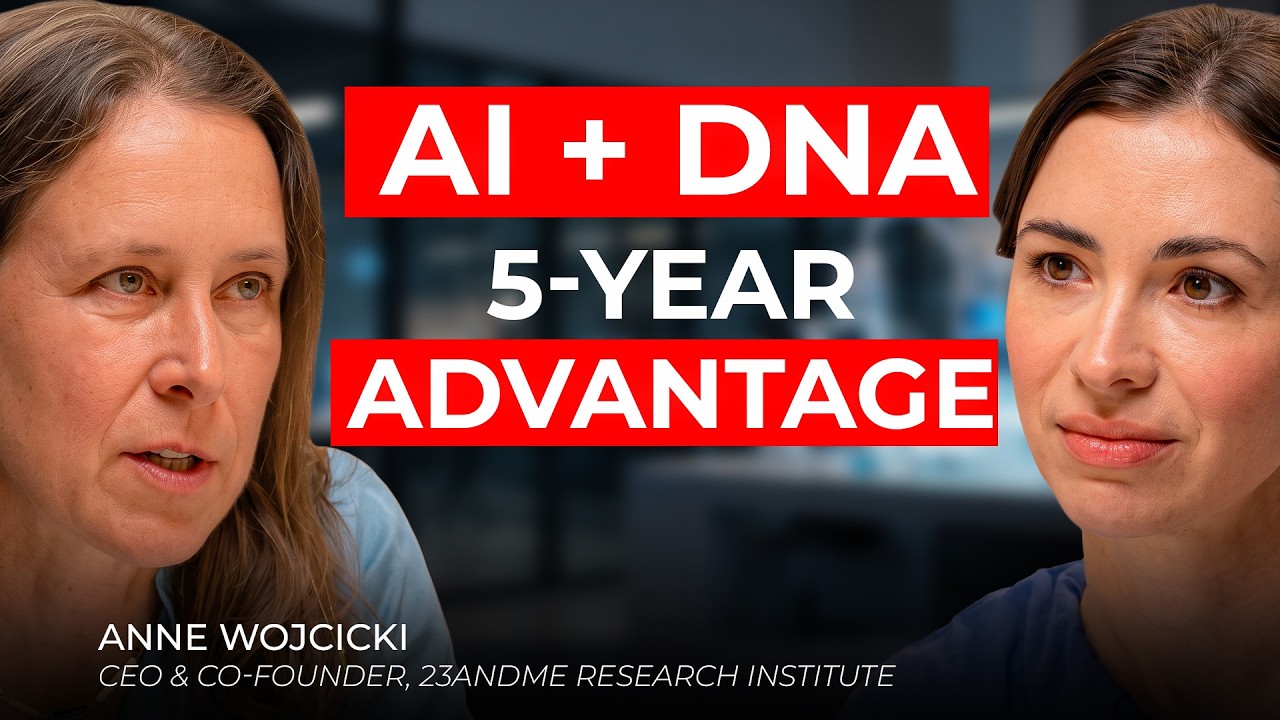
Stop Disease 5 Years Early: AI + DNA Playbook With 23andMe's Founder Anne Wojcicki
TopicsHealth and science
In this episode
Anne Wojcicki, co-founder and CEO of 23andMe, discusses how AI combined with genetic data can now predict and prevent disease years before symptoms appear—something doctors couldn't do five years ago. She explains that the healthcare system is fundamentally built to treat disease rather than prevent it, making it the individual's responsibility to leverage genetic information and wearables to manage health risks proactively. Wojcicki breaks down the difference between monogenic risk factors (like familial hypercholesterolemia, which Marina has) and polygenic risk scores, showing how genetics and environment interact differently for different conditions—cancer is 70-90% environmental while some conditions are heavily genetic. She describes how AI can now integrate genetics with medical records, wearable data, zip code information, and blood values to create truly personalized health interventions, using her mother's pre-diabetes management with a CGM as a concrete example of this approach working in practice.
Key takeaways
- The healthcare system pays doctors to treat disease, not prevent it—individuals must take responsibility for understanding their genetic risks and using AI tools to intervene early before symptoms develop
- Monogenic risk factors like familial hypercholesterolemia override environmental factors and require medical intervention regardless of diet, while polygenic risk scores show where you fall on a bell curve and can be significantly reduced through lifestyle management
- AI can now synthesize genetics with wearable data, medical records, blood values, and environmental factors (air quality, water quality) to create personalized health recommendations that were impossible just five years ago
- For conditions with high environmental causation like cancer (70-90%), genetic testing identifies which people need proactive screening and lifestyle modifications, not that genetics doesn't matter
- Personalized medicine through pharmacogenetics can determine which specific statin or cholesterol treatment is right for an individual rather than applying one-size-fits-all population-level treatment protocols
Chapters
- 00:00Intro
- 00:55What AI + DNA can do today that a doctor couldn't 5 years ago
- 01:27Why the system pays to treat disease, not prevent it
- 02:00The cholesterol gene no diet can fix (Marina has it)
- 04:36Genetics vs. environment: how much can you actually control?
- 06:11"I'm 36 and don't want statins" — is there another way?
- 07:24The best health prompts to put into your AI right now
- 08:42Ad
- 09:52From 14 million to 100 million: training AI on human DNA
- 12:07What happens when we can predict cancer before it starts
- 13:16Connecting your wearable data to your genes
- 14:34The environmental factors quietly raising your risk
- 16:22Why small daily movement beats everything
- 17:22The one food society agrees is bad for you
- 18:20What changed for Anne after losing her sister Susan
- 22:52Why the next five years could be transformative
- 24:14Who should get genetic testing — and why no one should be surprised
- 26:39Baby KJ, CRISPR, and editing disease out of your genes
- 28:08A reality check on biotech, drug discovery, and the FDA
- 30:00The top things to do for your health after watching this
- 31:57Full-body MRIs, chest CTs, and catching things early
- 34:23Founder mindset: playing the 10+ year long game
- 38:00Rebuilding a town: community, kids, and downtown Los Altos
- 41:08"Did you ever think about giving up?"
- 43:59Her biggest lesson from the hardest year
- 46:56Having a baby at 45 and doing it her way
- 51:28Hard rules as a working mom
- 54:01Two ambitious founders, one marriage (on Sergey)
- 57:43The smartest thing you can do for your body in 2026
Transcript
Anne Wojcicki: Every single person can benefit from genetic information and use that to modify and prevent disease.
Marina Mogilko: This is Anne. She built 23andMe, a genetic testing company that provides ancestry breakdowns and health predisposition insights. More than 14 million people have used its DNA test, helping build one of the world's largest genetic datasets. Then it all collapsed. Her board resigned and she lost her company. 2024 was a brutal year for you with bankruptcy and having to buy out your company. Did you ever have thoughts of giving up? I thought about it a lot.
Anne Wojcicki: Because if everything is pointing in the direction that things are not going well
Marina Mogilko: But after winning a court approved auction, she bought the company back and turned it into a nonprofit. Now she's working to combine DNA data sets with AI to help people catch disease before they feel it. What can AI plus DNA do now? What a doctor couldn't do.
Anne Wojcicki: Years ago. You can pull in your medical record, link all this then with your genetics and understand where you could potentially intervene today and
Marina Mogilko: change the outcome. From all the data that you're seeing, what do you think of the diseases that have the best chance of being cured or treated in a different way in the next five years? I think a couple things. One, My audience really loves using AI for everything. What can AI plus DNA do now? What a doctor couldn't do five years ago. I love that.
Anne Wojcicki: And I feel like we're finally getting to the point where everything that we set out to do back in 2006 can start to happen. And that really revolves around preventing disease. And I think the fundamental issue in the healthcare system is that when you go to the doctor today, they're compensated to treat disease. Like almost no aspect of healthcare rewards you and makes money on disease prevention. And so it's really going to fall in the hands of you, the consumer, like you, the individual. Are gonna have to leverage all these different ways, all these means that are now in your power to start to understand what your health risks are and then to help start to manage that more and more. And so 23andMe started with this idea is that the most fundamental layer of your health is your genetics.
So for example, if you wanna be healthy and you're worried about all your cholesterol numbers and let's say you just have very high numbers and you have a genetic risk factor called familial hypocalastremia, That's me. Is it really? Yes. OK, so you're a prime example of this. Like, no matter what you do with your diet, you need to take a statin. You have to take statin, and so it's that type of thing. It's like you find out that you have something. You have high cholesterol numbers, but there's a limit to how much the environment can be modified to impact that. So you have to go on a therapy. And there's the aspects of, for instance, in cancer. Like, if you have hereditary colon cancer, heredity breast cancer, you need more proactive screening.
Anne Wojcicki: You know, environment definitely makes a difference there, but you have to be proactive with the medical world. And so for me, your genetics was always this core layer where you have to understand genetically, do you have a significant risk factor? Where are you on the spectrum for heart disease, for cancer risk, for, you know, other things that could be passed on to your children? Like understanding all of that is really step one. What's amazing today is that you can pull in. All this other information, your wearable information, your zip coat has your air quality and your water quality. You can pull in your medical record and you can link all this then with your genetics and really understand are there signs, are there things happening where you could potentially intervene today, either with a medical world or with your lifestyle and change the outcome. So for instance, even with my mom, types of things I look at were genetically higher risk for type 2 diabetes.
People in the family had type 2 Diabetes. My mom knew that she was pre-diabetic. I put on a CGM on her. And suddenly she's like, oh my God, I can now change my behaviors. So it was a combination of her genetics, her medical records, her blood values, and then using a new tool like a CGM, or again, you're gonna be able to use rings, other things as well. To then actually change your behavior. So that's gonna be the magic of AI is combining all of that together. And your genetics is gonna be what powers the customization of all this other information coming in and knowing where do you need to be proactive with your lifestyle and where do need to proactive medically.
Marina Mogilko: How do you know how much genetics are actually contributing? Because if you look at cancer stats, it says on average it's 70 to 90% environmental for coronary diseases, same, 79%. How do know that for you specifically, it's mostly genetics or it's most environment so you can control it?
Anne Wojcicki: There's two types of reports, what we call monogenic risk, and that's where you can get like familiar hypercholesterolemia. One variant that says you are much higher risk based on this one variant. And so in some ways, those general numbers are not meaningful to you as an individual. They're meaningful to a population, but not meaningful you. So you have one monogenic variant and it puts you really high risk for heart disease or sudden cardiac death or high cholesterol. That impacts you, that range is no longer relevant. You have another area called polygenic risk scores and polygenics risk is looking at hundreds or thousands of genetic variants that add up into a score and it puts you almost on like a bell curve. Like where are you on that curve? Like I can look at my type two diabetes risk and I'm like fit, I'm healthy, I work out a lot, but genetically I'm still higher risk.
And so for that reason, that's part of why I can say, okay, I'm higher risk, but there's actually been a lot of data that shows if you manage your environment, if I manage what I eat, I regularly get my hemoglobin A1C test, I use a continuous glucose monitor, I stay fit and healthy, I can reduce that risk. So I have a genetic risk factor, but I can produce it now.
Marina Mogilko: When it comes to cholesterol, since we touched it and it's a huge problem for me, because I'm 36, I don't wanna go on statins and every doctor, almost every doctor is like 10% of doctors are like, we can wait till we have like a third kid, cause it affects pregnancies and we haven't studied statins and pregnancies, et cetera. But is there any study that shows where, cause you mentioned different people react differently to different drugs. Correct, yeah. And ideally I'd love to do some testing before being put in statins. Is there any research around that that shows that some people don't have to take statins or wouldn't react to that? Or I think this is me hoping this is where.
Anne Wojcicki: This is the future of personalized medicine. You should have a physician who has a very comprehensive genetics background. And I think that's where you're gonna be able to have AI training to say, based on all the literature with genetics, let's no longer look at you just as an average as like a one size fits all of like, here's what we do on a population level with treating high cholesterol that we should actually now understand specifically based on your genetics. Based also on pharmacogenetics because there's interactions of your genetics and statins. So what's the right one for you and what's the best way for us to reduce that?
Marina Mogilko: What are the best prompts that people can put into their AI today to make this kind of personalized?
Anne Wojcicki: That is a great question. You know, I think it's still pretty early days. I have to say the areas I've been coaching people the most is around blood values, cancer information, anybody who gets a genetic test in cancer, or even just basic things of like helping understand lifestyle information with a hereditary factor like APOE based on your age, based on you know, all your metrics of, you know, your weight, how you are living your life, like, you know, asking it for prompts, you know, ask me 10 questions about my lifestyle and, um, and including it for something like APOE, what are the things that you can do that can make a difference? APO E can you? APO is about, um is the genetic risk factor for Alzheimer's.
Anne Wojcicki: And so that's one area where we get a lot of questions from our customers about like, well, what can I do?
Anne Wojcicki: What can I do for that? And that's where when you go to a traditional doctor, it's going to be worse at finding out, okay, here's your lifestyle information, what are the things you can do. But there is a lot of research out there that's happening. And more and more you're finding there's all these, you know, groups coming together to run their own studies about what is it that we can do? What's having an impact?
Marina Mogilko: The last couple months, I've been telling you about two things Outshift by Cisco is building. The internet of agents, so agents from different vendors can connect and collaborate, and the internet of cognition, so agents can share what they've learned instead of starting from zero context every time. Both run on the same idea, open and interoperable. No vendor lock-in, no silos blocking agents from working together. And none of this is just Outshift's idea in a lab. It's open source code. With a community of engineers actually contributing to it. And now there's proof, it's not just theory. Teams at ServiceNow, WebEx, Splunk, and Swisscom are already running multi-agent systems on this. Outshift by Cisco just put up a use cases hub at outshift.com. Real companies, what they build, what changed. If you're trying to improve your agent infrastructure, outshift is your source for expertise and real examples. That's outshift dot com. Now, back to the video.
And now you have 14 million people participating in your research and you said your goal is to get a hundred million people. What does this involve?
Anne Wojcicki: We see the potential with AI right now, and your listeners definitely are early adopters here. So AI came because all the big tech companies had data. Like they had tons and tons of data. They could invest in training models. Like it came because there was a world of billions of people who contributed data. So in many ways you need to do Something similar with respect to healthcare information and 23andMe, I think as impressive as it is that we have 14 million and it's the largest genetic data set that's out there. It's only 14 million. And your DNA is fascinating to me because it's a digital code. Every form of life has an ACG and T and so you just have different combinations, different variations, different, you know, ways it's organized and you could be you. You could be a frog, you could be a banana. I find it amazing that you get this kind of genetic, like this variability in the world.
So what you need to really understand the code of life is more data. And you're going to need to train models, not on words, but you're gonna need to train models on DNA. And so that's where I look at is like we're at 14 million today. I point to a hundred million as sort of the next milestone. But the reality is you're going to needs data sets that are massive.
Marina Mogilko: So you need more than that. It doesn't, 14 million doesn't really represent a significant group of people to.
Anne Wojcicki: So what we found, I mean, what we found is the publication that we had at NeuroApps actually showed that at over a million people, you start to really get the benefits of training models with AI. And so you get nonlinear improvements with risk prediction. That, for us, sort of validated that more and more data. Because we get this question from people all the time, like, why do you need more data? You have enough data. It's funny, because we get that a lot from the biotech world. It's like, that's enough data, why do you any more?
Marina Mogilko: Yeah, for me, it also looks like an
Anne Wojcicki: like 14 million, maybe that's... This is where you see differences. And that's what's been interesting with our background is like, the tech world is recognizes you always want more data. And the biotech world sometimes like, oh, it's enough. Like you don't necessarily need more. And I think now you're having this convergence where people recognize, like to really be able to take advantage of AI, you need to build these extraordinary data sets based on human data.
Marina Mogilko: What do you think it's gonna unlock? Like for example, we can't really treat cancer now on genetic level. Do you think at 100 million, we're gonna see some pattern?
Anne Wojcicki: What I'm most focused on, if I think about what do I want, and again, this is like 23andMe is very focused on sort of like a single area, which is focused on prediction. And so disease prediction, because we all know it's tough. Like if I look at my sister Susan, it was tough having a late stage cancer diagnosis. What you really want to know is, are you at risk? And then find it at those earliest stages. And that is what I think is exciting, is being able to identify something really early. And then also understand the basic biology. Why are you getting something like we don't understand? Like we know that bodies are constantly getting, you know, you're always under assault. So you always have like little micro cancers. And so why is it that sometimes they take off and sometimes they don't?
Marina Mogilko: It will be fascinating when you have this DNA, even now with 14 million, when people start adding their whoop information or the lifestyle and then connecting and seeing correlation between lifestyle and genes, that's the most important thing.
Anne Wojcicki: Really know like lifestyle and people have to recognize that the challenge that you have with AI and health is that you have to run experiments.
Anne Wojcicki: You have an intervention and maybe it's that we'll eliminate microplastics from water or you have a new drug that you think is going to prevent heart attacks. But then you have to run the clinical trial to see, do you get that outcome? You have to wait for people to get heart attacks, you have to wait, for people not to develop cancer. So it's just hard to run models in the same type of way. And so that's why we're always trying to come up with like, you know, other types of biology experiments to, you know, mimic what we think is potentially. Yeah a biomarker for and the more data the better what was the more do the better this is where we're just getting into those early days of you know on a i. And all the environmental information you know you see this very clearly things like people live near golf course and people who live near farms the pesticides.
So you can see from a population level, you have increases in areas like diseases like Parkinson's. We barely understand the impact of all this environmental damage. I think we're just scratching the surface of what all the environmental impacts are and it hasn't been that well studied. It's hard, it's a hard area to study.
Marina Mogilko: What do you see from your data? Are there like top three environmental factors that could affect your potential risk? I mean, pesticides is one of the biggest. So don't eat non-organic. Is that something that's practical?
Anne Wojcicki: I mean, I actually don't. I mean in some ways the debate around organic and non-organic is controversial and I haven't, again, I'm not an expert in that area. I mean I definitely would say like don't live near a farm. Living near, and again I think that's where there's all the occupational hazard issues. You know, people who are, who don't have a choice, who are spraying pesticides. But you know, it's very clear that pesticides have health impacts. Um, and so you look at all of that data. I think air quality is huge. People having filters in their house, uh, is important. Like California had all the fires. There's this guy that we fund, Charlie Swanton in the UK, who has done a fair amount of work on air pollution and the inflammatory effects in your lungs, um, and in your body. So I think. Air quality makes a huge difference.
And I think people, it a hundred percent makes sense to have high quality filters in your house. And it makes sense too. Have filters around. I do think water quality, like all of these things really matter for people. And you can test for it. I mean, that's where like, or you can, the government is constantly testing for it and you can pull up, it's all publicly available. So you can look at these water quality sites, you can see, and that's, you know, the issue is like not everyone has the choice about where they live, but knowing whether or not you're living near one of these sites makes a difference. I mean, the other thing that's really just abundantly clear is the impact of exercise. And like I would have ridden my bike to your house, but then I saw how high up on the hill you are.
Marina Mogilko: It's, I don't know, people do buy a cube, but it's, you get a sweater one.
Anne Wojcicki: You're way up and I almost always spike but you were your sort of next level but I do think about that a lot. Like I'm always trying to exercise and even with my kids and other like I try to be like let's do burpees now let's to let's two squats like little things make a big difference. We have a trampoline at the house we're always bouncing all these things make a big difference and again I going back to genetic side if you know that you a significant genetic risk in one way or another. Then it can help direct, where do you want to put your focus? Knowing that you're higher risk for Alzheimer's or Parkinson's, there's a lot of data about exercise and quality of your food and what you can do with that. And like we had someone named Rob Lustig coming yesterday who's a professor at UCSF talking all about AboE, so Alzheimer's risk and ultra processed foods.
Anne Wojcicki: And it's one thing like I complained to my kids school, you know, they had a parent, I always complain. Well, they had a parents event tonight and they were serving hot dogs and I was like, you know, like, it's like plastic. It's plastic.
Marina Mogilko: Do they serve with plastic? Should it be plastic?
Anne Wojcicki: No, I don't know if it was in plastic, but it's like the one food. I was like, it's the one food society agrees on is really unhealthy for you. Like, shouldn't we be doing more to train kids?
Marina Mogilko: Yeah, isn't it proven that processed meat causes, like, it's cancerogenic.
Anne Wojcicki: It's cancerogenic. Correct. And ultra-processed foods are just the one area you really want to try to avoid. To the question that you had is, what are the top three biggest areas? And I think that's where there's so much data. Again, health care is, in human biology, is a lever of complexity that we just barely scratched the surface on. It's just, it will be humbling for the whole world, understanding the complexity there. So using AI to help really understand that, I think, Well. Will be potentially transformative.
Marina Mogilko: After what happened with Susan and with her diagnosis, have you changed anything in your lifestyle, in your kid's lifestyle? I mean, look, I think
Anne Wojcicki: that the number one thing that happened after Susan was diagnosed, and I think a lot of her friends did this, is they sort of re-evaluated what's most important to me. I've been reading this book recently by Eddie Egger called The Choice, a Holocaust survivor who actually lived to 98. I think there's a big question for people in life about are you doing what's happy, what makes you happy, and that you personally find rewarding and meaningful. What I found impacted me the most after Susan was less on lifestyle of like, okay, am I exercising enough? Am I getting enough checkups? But more, are you living the life that you actually want? I think there's a number of her friends who changed jobs, made pretty dramatic decisions of like, I wasn't, and you have one life, and there's number of things that you can control, but ultimately you also just have. Like you, you always have lightning and you have no idea what's going to strike.
You should enjoy every day. And it's kind of the things that Susan said. It's like being, um, meaningful. And again, that's right. I do really love this book, the choice of, you know, this ability to choose every single day, um to be happy and to appreciate the things around you. And I think that was overwhelmingly the number one thing. And I. Think it's an interesting. Component is like we live right now in a time period where it's like everything's moving so fast like even this morning I was doing it like a new clod training and and it was different than like two weeks ago
Marina Mogilko: Oh yeah, it's different every day.
Anne Wojcicki: It's different every day and it's like things are moving so quickly and it is exciting. It's an exciting time because we're rebuilding the entire world. But it's also one of those things for people to check in and say like, are you doing something that brings you true meaning? And it's one of the things that was really clear with Susan is when she died and she was saying like, if you're all left behind, do things that are meaningful with your life. And I think that's something that resonates the most with me.
Marina Mogilko: 100% but were you able to identify any causes to why that happened to her or it's?
Anne Wojcicki: No, I mean we all think about I will never know and I think so even with AI advances I think that there's it there's always going to be a combination of factors. So clearly We're running right now the 23 me lung cancer study. I'm super interested to understand Genetics like do we have it like there's no polygenic risk score for lung cancer right now Like we don't understand why? So many women who were never smokers are getting lung cancer. So Is there a risk factor? Like, I would love to understand that. And is there some kind of susceptibility? Like, are some people more susceptible to pollution? People have reached out to me now who have lung cancer, who were triathletes and runners. Is there something then about?
Anne Wojcicki: Increased exposure to air quality, like you just have no idea. I think the thing that is not well studied is stress. People having chronic stress and high cortisol level and just never being able to have a downtime. I can hypothesize all I want about all these things that impacted Susan, but I can say like, without a doubt, like she had a high stress job. I don't think we'll ever know, but I know that prospectively, like the 23andMe lung cancer community is looking specifically at like can identify genetic risk factors that made people at risk for lung cancer. I would love to, as we get more and more into AI and multimodal data, and I can look at environmental factors like zip codes of where people are getting diagnosed, environmental information, how often are they exercising, and 23andMe links up now with Apple HealthKit and we pull in, we have about half a million customers who are consented in giving us their wearable data.
So there are watch data or, or ring data, and then we can pull in medical records. And so we have a number, we have, you know, 50 plus thousand people who are consenting and giving us medical records, and then we have all the self-report data. So pulling all that together. Um, and I'm eager to look at stress data that or ring is starting to put like, can we actually start to understand what are some of those factors? It's a complex problem.
Anne Wojcicki: But I think the next five years can be transformative with how we can understand environment and your risk factors and your life.
Marina Mogilko: Stress is also this funny thing. I feel like I'm stressed all the time. But then you look at my whoop, it's pretty calm, like nothing's happening. Well, there's good stress and there's
Anne Wojcicki: bad stress maybe there's also like can you turn it off in some way and I do think like knowing you and seeing you with like your kids and your dog like you seem to enjoy them
Marina Mogilko: Yeah, I love that it's just.
Anne Wojcicki: It's just a lot sometimes. It's a lot. Yeah, but just because it's stressful in the moment is like, oh my God, I have to go and volunteer and like do this. And like, it's a lock, but then I do think there's good stress and there's bad stress. And I think they've quantified in some ways and looking at even like, it's hard to fully understand stress. And I Think Aura has a feature now on stress. And I just think it's those early days, like no one's measuring your cortisol yet of like, can you actually measure chronically? Continuous. But I think that we're getting towards that. Like there's some of these devices. I think it was device for continuous cortisol. Yeah. There's some that are coming out. And I think that's where it's not gonna be everyone in the population who constantly wants to measure everything.
Marina Mogilko: But at least for a couple of weeks, like with the glucose monitor.
Anne Wojcicki: Monitor. At least you can figure out what effects. Right. And I think I love doing it, like when I'm doing talks or other things, or just even like, like we've had all the graduations, which has been a lot like measuring for a period of time. Yeah. Will be interesting for people to understand, like what are those behaviors?
Marina Mogilko: From all the data that you're seeing, what do you think of the diseases that have the best chance of being cured or treated in a different way in the next five years? I think a couple.
Anne Wojcicki: One, I'm Jewish. I find it absolutely the crazy that the Jewish community does not own the responsibility for the next generation to all have genetic testing. And the Jewish community has the higher rates of hereditary conditions and conditions like BRCA variant for breast cancer, ovarian cancer, prostate cancer. Like, why doesn't everyone know? Like, why is anyone dying? Of a BRCA variant, especially when there's things that you can do, if you know you have it, you can have a prophylactic mastectomy. You can have, you know, you can have kids earlier take out your ovaries. Like you can more aggressive screening. Like there's thing you can. So I look at that's one area where there just should be, this is a community that should step up and have proactive testing and no one in the next generation should be surprised. Cardiovascular, there's so many genetic variants. That if you know ahead of time, you can absolutely manage them like you with familiar hypercholesterolemia.
I've met so many people in this journey who are like, oh, I have this like really high cholesterol and I'm like, I'm eating kale every day. And I'm, like, you know, you might, you, you want the genetic test and then you just, there's aspects that you can change and aspects where you can prevent, like you can medicate and you can. I think in cancer hereditary cancer is one of those areas. Like we know there's a number of genetic variants that can put you at high risk. Genetic testing now is so inexpensive and those people should never be surprised. And that's where I look at. Like cancer, heart disease, the Jewish community. You have all these other areas, the African-American community as well with sickle cell. A condition called TTR amyloidosis. There's chronic kidney disease. Every single person can benefit from genetic information and use that to modify and prevent disease. But I do look at the Jewish population, African-American population frankly, cardiovascular disease and cancer.
I think you should be able to have a significant, remove the very regrettable. Deaths that happened because people had a risk factor and they didn't know.
Marina Mogilko: Totally. And we already saw a kid being treated with them, modifying how they get processed protein, modifying their gene. You mean baby KJ? Yeah. Baby KJ is amazing. How far are we from doing this to common diseases? Because I think what I've heard is that it's mostly like those genetic diseases you're born with, so you can modify a gene. Can we in five years, just if you're predisposed to breast cancer, just modify the gene?
Anne Wojcicki: This is outside of my area. Um, but if you look at Jennifer Doudna and people in the CRISPR field, and there's a number of experts in this. And, um, I sat at a conference recently with one of them and he was just like, you know, so passionate, like every disease is genetic and we should be able to like, we're at the beginning of a CRISPR era where you should be able to figure out like cystic fibrosis or you with familiar hypoclastemia or BRCA variant. Like. There should be a world where that's coming where you can fix that. Yeah, we're not there yet. Okay, baby. KJ is a pretty amazing
Marina Mogilko: Yeah, it's the first sign of the future.
Anne Wojcicki: I remember when there's the first IVF children, and it was like, like it was so extraordinary and now it's so common. So I think we're the next 20 years will be, you know, extraordinary in that way.
Marina Mogilko: Hopefully sooner as well. I was just talking to an economics professor from Stanford yesterday, and he said in the next two or three years, we're gonna see in something dramatic. It's gonna happen because of AI that's gonna change our lives. I'm always more hesitant.
Anne Wojcicki: And then healthcare. Like I'm a little bit always of the Debbie Downer because like you still have to do human clinical trials. You still have the FDA. There's gonna be issues. Like it's not gonna be perfect the first time. So I always try to set expectations. Biotech's not the transformative, you know, industry that's gonna like change in the next five years. I think that there's all kinds of things that are happening in the early stage of discovery, but you have to then translate out that those discoveries and those insights actually lead to drug discovery.
Anne Wojcicki: When I was in my investing days, there was all these technologies on like high-throughput chemistry and all these, you know, high- throughput ways of doing biology that were important techniques. But, you, know, fundamentally 90% of drugs all fail. And it was 500 million to develop a drug back when I started. And now it's like $4 billion to develop the drug. So, all right, maybe it's, like, 2 billion. We're not getting better, is my key point. And so the only thing, the reason why 23andMe got in drug discovery is because one of the only areas that was seen to improve the outcome and the likelihood of success was starting with the human genetic insight. And so we know that starting with human genetic insights means that your drug is more likely to succeed. We don't yet know on AI how much that's going to help it. So I'm super optimistic and I love that there's all this money going to the space.
But I, I I'm always like cautious to the broad population to not overset expectations that you're going to have a radical change in the next five years.
Marina Mogilko: Yeah, just eat whatever you want.
Anne Wojcicki: I think the radical change that you can have in the next five years is risk prediction. I think 100% you should be able to predict who's most likely to have breast cancer or colon cancer, heart disease, like 100% and then you should allocate resources based on that.
Marina Mogilko: What do you think are the top three things that everyone should do after listening to this conversation in regard to their health? Because when I was at Susan's foundation launch, I was like, okay, I need to do this pre-nouveau scan. Yeah, yeah. I have done my 23andMe, then I'm gonna connect all of that with AI and see what it tells me. Do you think it's decent?
Anne Wojcicki: Plan. I think that the most important thing, um, 23andMe has, has three different products. We have a product called Total Health. Total Health is your exome. So it's a deeper level of sequencing and it's blood. Everyone from a medical perspective should go and get that. It's the gold standard. What people want to be able to get better than spitting. It's two products. So the DNA is still spitting, but at some point you want to get your blood. You want to be able to understand your blood as well. And so, pernuvo. Is super interesting and I'm an investor in it. I do it every year. There's still like a world of people all assessing like exactly what do you do with this information. And I recognize there's people who are anxious because you'll find all kinds of things. And so it's for people who want to embrace, like I can handle it.
If you go and you tell me you have like a strange lump in your uterus, you're not gonna freak out. And that you're okay to follow up because you'll find a lot of things. And some of them, like, I know lots of people who found brain tumors and heart issues and aneurysms, like the stories are astounding, but you also have stories of people saying, oh, they found something and it was nothing. And I had this whole workup. That's where Pranuvo, I think is doing a lot work to understand exactly how you want to do an MRI. I do annual chest CTs. So a low dose chest CT is minimal radiation. I'm in a category that's genetically higher risk now because Susan had it.
And I do that and there's amazing AI work here where, and this is part of what the Susan Wojcicki Foundation was also part of and helping to support is can you use your, um, my chesty to give me a five-year prediction.
Marina Mogilko: So when do I able to identify right? So when I want to get
Anne Wojcicki: When do I need to get another scan similar to a colonoscopy when you go and they say like you need to come back in Two years. You need to go back in ten years So it's gonna be a similar kind of experience there And the other thing that's important for people to recognize is like health can be really stressful and triggering for some people No, so some people we get Brian Johnson who like obviously loves testing everything and I'm so grateful to him because he tests all kinds of things that I do Not want to test he's testing all of it I get other people like I dinner with someone last night who's like, I don't like getting blood. And so there's an element of choice and respect for people like people should all have. And there's people who are going to be pioneers, helping to sort of pioneer what is this revolution and like, what are we all learning together?
And so for those people like you're doing blood twice a year, you're doing your genetics, you doing pernuvo, you are doing like as many scans as you can, you like putting all that data together. The stuff that's really validated for people is like. Having a baseline genetics, making sure that you're doing the core blood tests and that you're doing all of the preventative screens, that makes sense for you.
Marina Mogilko: It all comes down to discipline as well, because your AI can tell you anything, but then you have to go and execute and yes, getting those annual checkups to see how you're progressing or what's changing.
Anne Wojcicki: And this is where I do think like aura and all these, you know, your Apple watch are amazing at predicting changes. And even, you know we had a friend who just had a health issue and it was amazing how Apple, the Apple watch, you now triggers and says like, oh, you were unstable the day before. And so having those, and that's what I love looking at is the patterns of like, oh, why you've really been sleeping worse. Like what happened? And like I stopped wearing the aura ring when Susan was sick. I was like, I don't need you to go and tell me that I'm stressed out, I'm aware. But like having the trends over time and watching things, like I'm 52 now, like understanding how my body is changing and what do I need to do? And like, am I sleeping better? It's actually nice to have data and to understand that. And I was really clear.
I was, like, okay, I'm gonna start going to bed earlier. And I can see a difference. Like when I'm in bed reading on my phone, Versus I turn off social media and I just go straight to sleep and I read a paper book like I see the difference in quality Yeah, and so like that's where data has helped me totally quick pause
Marina Mogilko: My team and I are celebrating one year of the Silicon Valley Girl Podcast. I know the channel has existed for a while, but a year ago I made a decision to focus on amazing conversations with people who are building our future with AI. And for a whole year, we worked to bring you the biggest founders and builders in AI so you can keep up in this era and get inspired. If you love what we're doing, please subscribe and hit the notification bell. It's what helps us bring you the biggest minds of our lifetime. Thank you so much for being here. I want to focus in this conversation as well on your mindset as a founder, because a lot of your bets, I think all of your bet, because you're doing 23andMe, I wanna talk about Downtown Los Altos, you're going Susan's Foundation, they're all long-term bets.
How does your mind function in the world where every day there's something shiny, something fancy, and all of you're bets are like 10 plus years?
Anne Wojcicki: You know, it's interesting, because when I was driving up here and I was talking to some of the bankers about this SpaceX IPO, I knew Elon because of Sergey. And I remember in like the very earliest days when he was starting Tesla and he would stay with us and he was so consistent talking about his vision of like Tesla and the space world and the potential. I have to say like it's complete kudos of like. When you think of like long-term vision, the world, and I look at all around us, I think everything that's happened today to make significant changes in the world, you have to have a long- term vision and you have to be so consistent and maniacal about doing that. And you have also love what you do.
Anne Wojcicki: And that's where I like, I look at, again, I talk ad nauseam about like how much I love genetics and, but I do again, it just occurred to me thinking this morning is like people who love what they do, you have a long-term vision and you're consistent with it and it never feels like work and, and every single day builds on the previous days. And so I look 23andMe every single day I walk into the office and I'm fascinated by the research that we can do. Like what motivates me every day is this idea of when I'm helping people. Like I always wanted to be a doctor, but I feel like now I like I help more people because I help connect on identity. I help on family connections, like reuniting all these people and we save lives. Like I give people valuable information about themselves.
And then the research is like, I mean, for me, it's Megan, my dad who loved neutrinos like, and he loves space and. All that, like I was like, hey, you like looking up in the sky and I like looking in her. I like find that there's an entire universe in every cell. We understand nothing.
Anne Wojcicki: About it like even I was with somebody talking about like the beauty of the mitochondria and like that you have this like power engine and how it works like we understand so little yeah and that's what I love like every day it's like little tiny bricks coming together to build this foundation of knowledge and it's so interesting and again that's what like I always advise kids like whatever you do like make it so every day you have like that spark of joy where you're like was so cool. What was fun is like when we first moved into Los Altos, it was a pretty sleepy town and there wasn't much like there wasn't much going on at night. There wasn't much for the kids to do and you know I have to say it's like it's been such a pleasure because like you can buy buildings. I bought buildings and then I could bring in you know really extraordinary owners. Who love what they do.
So like Linden Tree, it's an amazing bookstore. You know, bookstores, and this is where I was like, I have a pleasure. I can like help get a building. I can renovate, I can make it nice. And then, you know, create an environment and an economic environment where it can support a children's bookstore. We started State Street Market so that we could have. The best, thank you so much. So my whole idea there was like I wanna go somewhere where I can bring the whole family. And everyone's happy. And in the earliest days, I remember, I would go out. We had 17 people in the family. And one, you call a restaurant. You're like, I need a reservation for 17. Everyone's like, no. And they hang up. So now it's easy to go. Everyone's happy, no one's fighting. And if a child throws spaghetti, it's not a big deal. And so I wanted something that was truly multi-generational. And I think it's also.
I think society, it's important you have multi-generation. It's important that young people are exposed to older generations and that people in the mid-life, you have support for your kids and that you can support your parents, that your kids are supported. I just think multi- generation is so valuable for how everyone grows. I think that's your
Marina Mogilko: or Slavic genes playing out. Yeah, yeah. Because, you know, I was raised by my grandparents. Everyone lived together and it was like a small apartment, but my grandparents would come over, we'll sleep on the floor, but they will help raise me. In the U.S., I don't see that. Parents are very lonely. They move to another town, sometimes another country. And so you're just raising a kid in a completely different environment. And the sense of community is getting lost, especially in big cities. Well, that's why I-
Anne Wojcicki: Well, that's why I wanted because I think so many people come. So many people are in Los Altos and they are immigrants. They don't have family around. And so my whole thought process was like, well, how can we use downtown Los Altas as a community? And it's also really fun to get kids excited about the different businesses. So I love, you know, like when we did the arcade, I would ask my kids, I was like OK, make a business plan for each machine. Like, you know, tell like, tell me what machine you want. My son the other day, like, wanted some machine. It was like two hundred thousand dollars. I was like, OK, well, like just do the math on that one. When do you get an ROI on that machine? Great task. But it's good. Like, I want more and more for kids also to be able to learn.
I think also learning about business and having lots of small business owners is great because you want I want kids to be able to like understand that they can create as well. Like you. You have an idea of like my daughter wants you know a clothing store or something like or like I always think about like should 23 me create a retail store like be able to walk in. Like an experience. Yeah. An experience. I think it would be so fun. So I'm always thinking about that. I'm also thinking about what else can I create.
Marina Mogilko: Thank you so much for for downtown. Yeah. And all the things that you were doing. So 2024 was a brutal year for you with bankruptcy and having to buy out your company. Did you ever have thoughts of giving up like this is not something I want to do. I just want to live a happy life.
Anne Wojcicki: I thought about it a lot, like, do I, because it became, you know, there's moments where I'm like, is this a sign from God that like, I should give up because like, everything is pointing in the direction that things are not going well. You know, I called a friend who had also started a company and given it up and had walked away. And he, he was like, look, I think about it every single day of my life. He's like, I just always regret, he's like I just, I wish I hadn't. And in some ways it's, I felt like I had a responsibility. Like one, I love 23andMe, so there was a selfish component of like, I just love it. The second thing is like, I felt a real moral responsibility to my customers, all 14 million and my employees. And the responsibility that I felt was that I promised them that 23andMe was going to be a company, a mission-driven company.
Focused on helping people access, understand, and benefit from the human genome. I really believe strongly that you want the company that owns that genetic information should be a neutral party, meaning that they should be supporting research all around the world, but it should not be owned by a single pharma company. It should not by owned by single entity. And I thought about like my sister, like my deceased sister, her genetic information's in 23Me. I don't want that owned by a single company. I want every single researcher in the world who's doing lung cancer work to have access, to be able to make a difference. And this is a community that came together to make the difference. I felt this huge moral responsibility that I should do whatever I could to make sure that we were true to that mission. And I feel really lucky. I feel very, very lucky that I got it and I'm not a person that was like, Oh, I really.
Wanted to just like hang out and like sit at the pool all day. I would love slightly more work-life balance. Um, and I, I would, like I am trying to take, like have, again, now I have an amazing, I have 175 people at the company, have an amazingly management team. So I have more of that time to do things like this and to, um, you know, volunteer at my kid's school and things like that. But you know. It's kind of all the things that we talked about at the very beginning is that you want to do something in your life every single day that brings meaning. And if I thought of again, anything that I learned from Susan was like contributing on a daily basis and feeling like you're having an impact on the world is the most important thing. And it was a really, really hard year. And there's definitely things I would have changed but I love what I do.
Marina Mogilko: What's your key learning from that year?
Anne Wojcicki: There's a dark side and then there's like the positive side. I think the dark side was, I was really surprised that, um, how many people backed away from helping me. I was. Surprised in bankruptcy at, you know, the friends who showed up. And so I think it kind of came to me as a bit as like, you know, you do live, we're in Silicon Valley. It's a very competitive, aggressive environment. And I have always Like I operate in a way where I feel like I try to always be honorable and I try to be genuine and, um, and ethical. I think that was like, one of the hardest things for me is like, wow, like I'm, I might be, I may be playing in the wrong community and, um, in a community of people that are not necessarily there to support. I think on the positive side, the thing that impressed me the most was, you know, my customers and my employees.
Who rose to the challenge. I couldn't do it without them and they were there. They stuck with it. And they also like, they embody the mission and they care and they feel this responsibility and that passion. And there's really good people in the world. You have to just make sure that you spend the time with them and align yourself. Like I feel really, really good every single day that I feel like I'm doing things that make a difference. Like I'm things that makes a difference with 23andMe. I'm totally unfettered on making decisions that are really about best interest of humanity. I love what I do with Los Altos. I love when I do a Susan Wojcicki Foundation and I work with extraordinary people. Having a community that supports you and supports the mission and you can trust them is a really special thing. So, you know, I think about like community is a theme that I have throughout my life. Like I have.
My family I'm really close to, I've tried really hard to build a community in Los Altos. I have a very strong 23andMe community, and I try to have a really strong 23&Me experience and ecosystem. Be a brand that fundamentally is always going to be trusted and have the back of customers.
Marina Mogilko: I really like what you said about being true to yourself. It's tempting to be dishonest, to chase success, especially in Silicon Valley. When everyone's moving so fast, some people are cheating. Uh, I love that whenever I think about projects, I think about how can I do them long-term and be true to myself.
Anne Wojcicki: My parents and my grandparents and everyone, I think also people, again, you're an immigrant. My parents, my dad, escaped communism and his father was imprisoned by Stalin. And I just think about the really important decisions that people made that really impact society. And I wanna be somebody who's always operating with that kind of ethical compass.
Marina Mogilko: Talk to me about your kids. Yeah, they're cute. You made, they are, and you made such an inspiring decision. Like, I've never thought about that when I realized you had a baby at 40? 45. 45. So, I told you, I really want a third kid, but I don't feel like I'm ready. Like, these two are a lot. Talk to be about that decision. Did you have any concerns about having a kid at that age?
Anne Wojcicki: Was really, really hard for me. There's the aspects of like the loss of a family, but there was also the loss of like, oh my God, I like, I want to have more kids. I felt really determined that I was not going to let, you know, a marital status impact my decision to have kids. And at the same time, I think I always joked with people that the only thing worse than one custody agreement is two custody agreements. And so I was. I was very gun-shy. I was like, okay, am I actually going to reproduce with another consenting individual? I ran into my OB one day at Pete's and I was, like, oh, I want to have another child. And she was, you do?
Marina Mogilko: Clock's ticking.
Anne Wojcicki: And I was like, oh shit, you know, you're right. Like I should get on this. And you know they kind of torture you going through a donor, a sperm donor process, where you have to like do all these therapy meetings. Did you pick a...
Marina Mogilko: Scientist or something, or someone with a PhD? Yeah, no, I.
Anne Wojcicki: Yeah, no, I wanted I wanted to find somebody who was gonna characteristics that would be that would match in well. And, and I listen, I like it was it was one of those things like I was really I went into it, I would get you have to go through all this therapy and everyone told me you're never gonna get pregnant, you're You're never gonna get pregnant, you're never going to get pregnant. And so you had to do all these therapy sessions doing it. I was like, I get it, you guys, like I'm old and my numbers are bad, but I'm just gonna try it. Because if you don't try. You never know. You never now. But I didn't even do a pregnancy test. Cause I was, like, ah, there's no reason. Like I'll just.
Anne Wojcicki: No, I actually got pregnant the first time and then I miscarried, but I was like, holy cow, the machine works. And then a couple of months later, I got pregnant. And I was almost in denial. Even at eight months, I was still riding my bike around and I was, like, ah, I think I'm pregnant. So it was an easy pregnancy. Yeah. I'm so lucky. I mean, I'm so, so lucky and I feel for all the people who've had tough reproductive journeys and all Yes. And I do think on all these areas like stress, again, going back to stress and that impact, like the fact that I really went into it like, okay, like I don't think I'm gonna get pregnant and I have to just be okay that like I have two really amazing children. Like I always tell people like walking, having a mentality where you know failure is the likely outcome. Um, but, but you're trying still and it helps.
Doesn't put much stress on what you're doing again. It was, um, a whole journey of like, okay, well, like now I'm having, I'm doing this on my own and I had, um you know, one of my best friends at the late, like my labor was a party because I had it was like, I, there's like a communal, we're like all going to raise this baby and, um. And it was so fun. Family is the best. And, um I spent a lot of time with family. I- um, dedicate a huge amount of my energy to the family. And, you know, part of it is like, you have to invest like good relationships come with investment, but I am really lucky to, you know, have three kids that are all, you know, so far pretty nice to me.
Marina Mogilko: I was raising her like the early days when you were 45. Yeah, all good. Is it easier than?
Anne Wojcicki: Yeah, because the big kids help. Oh, OK. I'm a big believer, like people having an age gap is really fun because you're just so much more relaxed.
Marina Mogilko: And also you're more secure with your job, you know, what you're doing. It's a third kid.
Anne Wojcicki: You're just secure with everything and the big kids come in to help me like you can go out to dinner and they watch them And you're just like, you know that they're likely to survive like you're not You're not so incompetent that that you'll do like you just in you're comfortable with school and like clothes and I mean It's amazing like my daughter doesn't have to buy anything because like we just like we have this And we say, like, not only, like some people come to the house and they're like, wow, your house is like a playground. I'm like, I'm, I am like the- Accumulating. It's like, it's like a funnel. Like all the kids' stuff from like all 10, like it's all come down to us. And so we have like tons and tons.
Marina Mogilko: Of items from the last 20 years do you have any hard rules when it comes to being a working mom like i'm home by six i don't work on weekends there's no different
Anne Wojcicki: Like before I had kids, I was like a machine, like I was always working. I remember I would sleep and like my Blackberry was like next to my head, like it was like my companion. I mean, now I'm very clear, like, I go to bed when the kids go to be. I try to almost never do a dinner. And in those early days with the kids, like and early on, like my kids came on a lot of my trips. I try, I'm not good with boundaries. Like I remember my son at the European Society of Human Genetics and I told him, I was, like take a notepad and go and interview. How was it? It was like seven and I gave him a little notepad and he was walking around to all the booths and I was like, just interview people and ask them questions and then come back in an hour. Oh, that's a great experience. It was great.
But he came back and I remember he was like I've learned genetics is very important. But I try to almost always do dinner. I think the other thing is don't like you have to show up. Like I have to, like I try to volunteer pretty regularly with the kids. Um, the older kids are, are cute. They'll say like, Oh, you don't have to drive me so and so and where, but they actually really want you to. Um, and so showing up is meaningful and you have to then really prioritize. What do you do at work? Um, And I think for me also as a leader, I try to make sure that trickles down to everybody and be really respectful of people at dinner time. And, um, at like. Seeing their children's performances or somebody's moving their child into college, like having true work life balance and respecting people's is important.
And I think as a leader of a company, if we want to change society, you have to honor and respect that people also have to support their families. Totally. And so like if, if the world is saying like, oh, there's, you know, fertility crisis, you have to have more children, okay, have more Children, but then you have to be work friendly. And so you can't have both. You can't be like, oh, it's a nine, nine, six world six weeks off after it's like, it' s not feasible. So I had I mean, that was the thing I had 23Me does hire a lot of women. And so like I regularly have like I would like be breastfeeding with my child and like in meetings and like doing different things. Like everyone, it just became very normal. My primary rule is again, to be super friendly, family friendly as a company to make sure that I sort of ruthlessly prioritize what's actually important.
And to be home at a reasonable time. Makes sense.
Marina Mogilko: I wanted to ask you about being married to Sergey. I don't know if you want to answer it, but it's just I wonder if two very ambitious people who have their companies can coexist in a marriage with kids. What would be your learning? Our example said no.
Anne Wojcicki: And so, um, I think it definitely can, what helps survive help, you know, what's interesting. Like I remember talking to, um Jane, the CEO of, of Citibank who, and I have to say, give kudos to Citigroup that she, when her kids were little, she took off. I can't remember if she stopped working or if she went part-time for awhile, but like she recognized at some point, like I'm, I'm taking on more responsibility. Now I need more of that time. And then went back and obviously went on to be incredibly successful. I think in a relationship it's always, it's always a push and pull. And in the early days, my kids wanted me all the time and it was hard. Like my kids like really wanted me around all the time and they wanted to be at my house all the time they're older now. And, you know, like frankly, like my kids are like really clear.
They're like, um, you're not helping us with math homework. That is. And or like if they're 3D printing stuff they're like you know there's some things mom that you're good at and there's something we go to him for you know i think it's you you kind of step in and out at different times so i think that's the beauty of a relationship that works well is that you can support like it's pistons it's piston engine and you're just you know responsive at different times but it is that recognition like it's hard like who's going to cook Who cleans? I mean, like, the amount... Who gets to travel?
Marina Mogilko: Because there's only one person who can
Anne Wojcicki: No, I mean, in the early days for me, because my kids wanted to be with me all the time, they were like traveling with me. And I remember I have this like image of us like going at the train in D.C. And I'm like carrying car seats and like the kids and I was like, and you have a meeting to prep 100% and I remember the I mean the stuff that we did was like it was so crazy. Even I remember after the FDA warning letter and you know, being at the White and I was like, can I bring my kids? And small enough to spill M&M's all over the floor. It was hard. It's like, definitely, it's, I like respect, like for all working parents recognizing it's hard. And if you have two people who have like high pressure jobs. And that's the reality for a lot of people in Silicon Valley, because you won't.
Marina Mogilko: Live here otherwise, you can't
Anne Wojcicki: Well, I think this is where you need community. Comes back to 100%. I look at like there was one day where my youngest, again, I had meetings, I'd something to do and I was just like calling my neighbors and like, so what's your daughter doing right now? You want my daughter to? And they were so great. They're like 100% bring her over like, well, you know, and she had the time of her life. She was so happy. So leveraging the community. Is the only way you can survive. You have to support each other. And I think that's where, like, the pandemic did open the world of like, okay, we can have, you know, people who are remote, people, like lots of people at 23 moved home, you know moved away to be near family who could help with kids, like completely understand. Like all of that is key. Like it's hard, like you have to have support.
Marina Mogilko: Tough, but somehow we're making it work. Uh, yeah, yeah.
Anne Wojcicki: Yeah, with the dog on your lap. Yeah, that's how
Marina Mogilko: Yeah, that's how, right? All right. One last question. Can you finish the sentence for everyone who's watching? The smartest thing you can do for your body in 2026 is.
Anne Wojcicki: One, everyone should get genetic testing hands down. Like everyone should know what their genetic risk is. Second, exercise every day. Just like right now. Every day. But small things. And I think people shouldn't get overwhelmed. Do 50 squats a day, broken up into five segments. Like do 10, we're gonna do squats after this. Like, cause we've been sitting for an hour. Like just something small. The way to build the habit is like you just do something small every day and then I'd say like cut out soda.
Marina Mogilko: Oh, even probiotic? What do you have with you? What kind of soda do you use? I think that was just sparkling water.
Anne Wojcicki: I have in general, like I was thinking about like understanding what your core risks are and then exercise makes a huge difference in your life. Yeah. And so like the more you can just integrate it into your life, like take the stairs instead of the elevator, you know, do some jumping jacks. Like if your kids are playing, you play, move around, get a walking, like a standing desk, things like that. Like it makes a big difference. Like walk the dog. Um, but like all of that makes a difference. And then on food, like my kids are really good. We have a garden. But I try to make them like have a salad, have cucumbers. Like my kids are very good at eating cucumbers with salt, but like just something, like I avoid sugar. Like I, and as soon as I cut it out, it's like I never want it again. So like, I just never have like soda, like sugar.
Sugar water is just like one of the worst things for you. I always have my vegetables.
Marina Mogilko: Love it. Thank you so much, Anne. It was so fun. And it looks like what you are doing has come together in this day and age with AI. It looks like you've been preparing for this. I mean, I think that the.
Anne Wojcicki: I mean, going back to sort of where we started, I, I do feel like, you know, 23andMe in many ways has just been very early. We set out, like I look at my deck, my fundraising deck from 2013. It was like, You know, we're not a genetic testing company. Like we're just, you an ancestry company. Like we are a big data company. And that goal has always been like fundamentally. If you can understand the human genome, we can all benefit. And so that's why the mission has always been, help people access, understand and benefit from it. We're set up like everything about how we set up our research infrastructure and how we consent people And we give people choice and transparency. And we've created this community. It's like 14 million people, 90% have opted into research. We collect tons of information. We ask our customers questions like, do you have dogs? Or do you do have allergies? And we can do extraordinary research.
People have no idea how many insights we have across everything from fun phenotypes like handedness, are you left-handed, right-handed? Eye color, medication response, you know, pet allergies. Cancer risk, like all of it, it's, it, it's extraordinary. And suddenly now with AI, it needs data sets. And, you know, the number one thing for us blocking, you know 23 me again, we have the NeurIPS paper on doing risk prediction. Like what we need next is just like we have capital, we're capital constrained and I'm resource constrained, but those are all things that we'll fix in time. And so, but the world is suddenly primed, like the technology is there. We have the data that's there. And I have customers who are hungry to say like, let's go and we want to be healthier. We want to prevent disease. And like the world is a hundred percent moved into that, that space now. And that's amazing that you never gave up. Yeah. We're stubborn. Yeah.