Khan Academy CEO: The Real AI Opportunity Is in Boring Industries | Sal Khan — Silicon Valley Girl Podcast
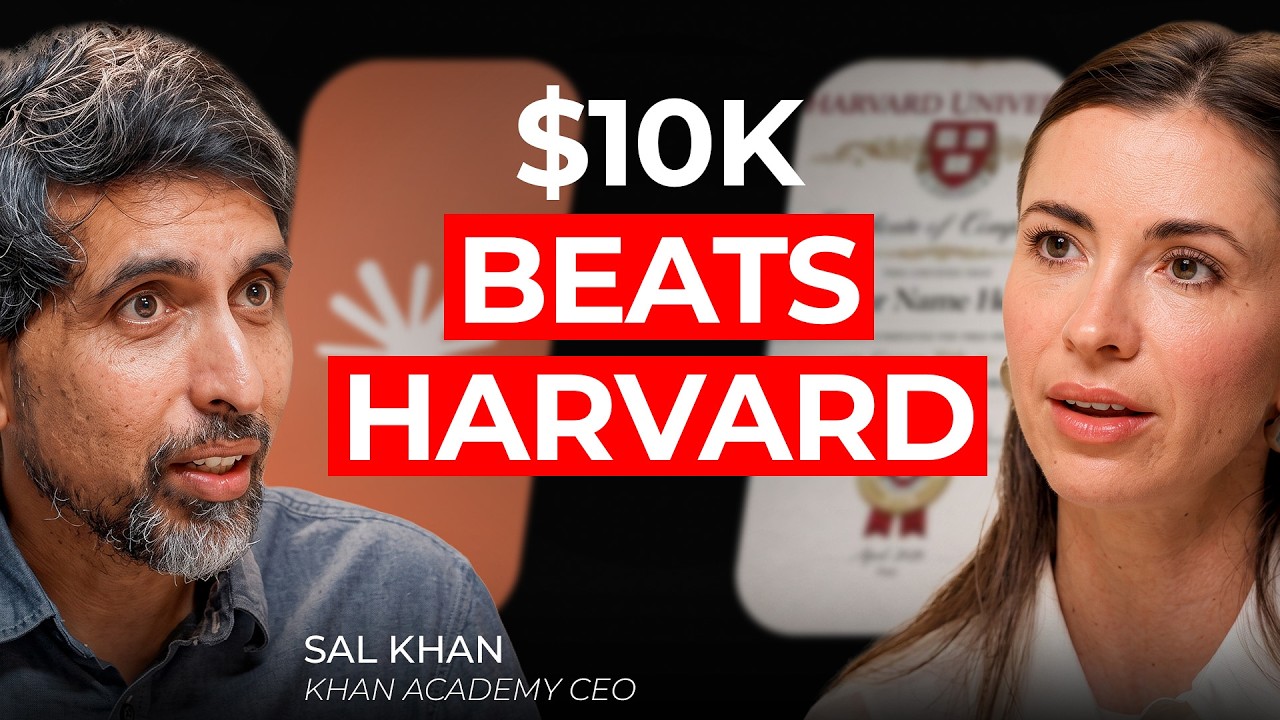
Sal Khan is the founder and CEO of Khan Academy, a free online learning platform used by over 200 million people globally. He pioneered early AI tutoring systems and is widely recognized as a thought leader on how AI will reshape education and employment. Khan is currently writing 'Job Shock,' which examines AI's impact on workforce displacement, and is developing a new $10,000 degree program in partnership with TED and ETS centered on skills durable to automation.
Sal Khan: And so they're asking, and we're saying, hey, use more AI, use AI. Software engineering, design, product management, and all of these tech firms, including Econ Academy, are changing fundamentally.
Marina Mogilko: This is Sal Khan. He runs Khan Academy. A hundred million people learn on it every year. He built one of the first AI tutors in the world. Excellent work. No one has spent more time on how people re-skill for AI.
Sal Khan: If we could do three times more with the same resources, we will do three times more. So that would never be the catalyst for layout. If you can automate yourself out of a job, we're going to give you a better job with better pay. What are you thinking about the next package? Don't run to where everyone else is running. Try to find the lanes that are most empty. And I would say
Marina Mogilko: Thanks to HubSpot for startups for sponsoring this video. And we're in this interesting phase where AI is changing everything. And your previous book was called Brave New Words. And now you're writing a book called Job Shock. So what has changed in the past two years?
Sal Khan: Wow, what has changed? So much has changed. You know, what I wrote in my last book, Brave New Words about AI and education, when I was writing this in 2023, I was afraid that as soon as I write it, it would be obsolete because things are changing so fast. But I keep looking at it and it's still, I feel very relevant. I write about things like how AI will broaden the aperture of how we assess people, how people have talked a lot about AI tutors, but... There's other forms of assessment, interviews, oral exams, and you actually are starting to see some of that. So we could talk a lot of, you know, some of those things that were just ideas three years ago, we're now seeing in reality. I just talked to the head of admissions at Caltech, and a lot students who apply, they give these research papers they've done.
And the admissions officer says some of these are real and some of them not clear if the student did the work, et cetera. And so they're already using AI to essentially do oral exams with these students to evaluate if they understand. And this is pretty high stakes. This is for admissions to top universities. So you're already seeing AI in that part. We've launched Conmigo out into classrooms. We've learned a lot. 0 AI, it's waiting to be asked to do something. And some students don't know how to do it. A lot of them didn't. So now we're in the process of launching a new version. It's more proactive And it isn't AI for AI sake, it's how do we get AI to motivate students, give them more practice, have the teacher in the loop, et cetera.
In terms of why I'm now writing Job Shock, which is, some people are surprised because most of, not just my books, but most of the things I've ever said tend to be pretty optimistic. But I am increasingly worried, you know, not too far from, this was about, I don't know, I wanna say about three or four months ago, maybe a little longer. I have a good friend from college who's now a prominent VC, and he... Said, hey, Sal, I wanna talk about re-skilling. And so I remember I drove over to his place, not too far from here in Los Altos, and while I was driving, you see the Waymo's, like you see everywhere here. I'm like, oh, that's interesting. This is cool, look, I live in the future.
Then I go over to him his office and he was telling me that one of his portfolio companies has a call center that they've just automated 80% of their workforce with a general AI solution. How many people? I don't know the exact number, but it sounded like it was in the hundreds, if not thousands of people for that one call center. Based in the Philippines. And this is why he said, well, maybe I wanna take 1% of my firm's profits and put it into re-skilling sometime and we started brainstorming. And we appreciated that, especially in an economy like the Philippines, where depending on how you measure it, five, six, 7% of their GDP is directly related to business process outsourcing, mostly call centers. If this becomes a trend and there's a lot of reason to think it will over the next three to five years, What are all those people going to do?
And then when we see a Waymo, it's awesome. I was at TED a couple of weeks ago and I interviewed Takedra Maokana, who's a co-CEO. I'm a big fan of Waymos. I think it's gonna save a lot of lives. It's super convenient. But my uncle's also an Uber driver in New Orleans. What's he going to do? That's not people's first choice job. It's usually their last choice job in a lot of cases. And... If ride share goes away. And that's just the tip of the iceberg. Out here in Silicon Valley, everyone's talking about what's happening to software engineering, product management, design, are those roles going to merge or we're gonna hire more or less, et cetera. But it is crazy times.
And I wrote a, the job shocks genesis was I wrote on New York Times op-ed piece in December where I made this argument that like we have to take this a lot more seriously. We can't just be like, oh, the industrial revolution turned out okay, more jobs. First of all, the Industrial Revolution. Also had many wars. The 20th century was the bloodiest. We experimented with communism. We experiment with everything. A lot of these things didn't go so well. And so we should have a plan and that's what Job Shock is about. How will it possibly transform? What are the types of things people need to learn? My son, my oldest son is a junior in high school. What should he be caring about to be relevant in four or five years? But also how do we as a society adapt?
Marina Mogilko: I think like universal basic work, people need to feel like a sense of contribution. But these are big questions that we have to be creative about. That's the exact question my team and I had to answer for ourselves. I run two companies. One is what you're seeing right now. My content business. 18 million followers, a team of 35. And for years, our problem was never coming up with ideas. It was everything around. Prepping, investor meetings, I did a lot of those, researching guests, writing the weekly updates, and reviewing the scripts. So I partnered with HubSpot for startups and put all seven of my clawed skills in. Plus the framework we actually use to decide what to automate into one free download. The link is in the description. Five of them are on the founder's site. One writes my investor updates in my voice.
One does the research before a pitch meeting so I'll walk in ready. One turns my messy notes into a clean weekly report. One helps to write my LinkedIn posts and one helps to handle hiring. The other two. My content team runs on every single thing we post. The first is a voice filter. It catches AI sounding copy before it ever goes live, where it's like, I'm a lock, a leverage, anything that reads like a chat bot wrote it. The second writes our real scripts, and we run it on every, single short we make. Of course, I do a lot of edits on top, but it's a great foundation to start with. The last one is the framework itself, the automate or hire roadmap. It takes every task on my team. And sorts into three buckets. What hands to AI completely?
Where AI does the first draft, when a person checks it, and what stays fully human. And you absolutely don't need a team of 35 to use any of this. You upload the skills into Cloud and you start today. Go to the link below and thank you to HubSpot for startups for sponsoring this and building with me. Okay, back to Sal. How much time do you think we have for someone who's an Uber driver watching right now? Because I feel like with Waymo's... It took them still, it took them 10 years to roll out the operation that we're seeing now and we're only seeing it in San Francisco.
Sal Khan: I think you're gonna start seeing a real dent in this in five or 10 years. And that's slower than what a lot of the AI optimist evangelists are saying, but that's also pretty fast. And-
Marina Mogilko: That's our lifetime.
Sal Khan: That's before your kids go to high school or when they go to high school, or when before they go to college and driving a vehicle is the largest employer, one of the largest employers of men. I mean, women, obviously my Uber driver just now was a woman, but like disproportionately men globally. If you have a lot of men who can't find a job, who are angry and women, that's going to lead into politics, polarization. People are going to move towards extremes. So. I suspect that you're going to see in the next four or five years, the dislocations start to happen for real and we're gonna struggle as a society on how do we re-skill people. I'm not a fan of things like universal basic income. I think like universal, basic work, people need to feel like a sense of contribution. But these are big questions that we have to be creative about.
Marina Mogilko: Yeah, and it's not just Uber drivers, right? You mentioned call centers. What are other jobs that are in danger?
Sal Khan: I think the writing's on the wall that software engineering, design, product management, these product jobs and all of these tech firms, including at Khan Academy, are changing fundamentally.
Marina Mogilko: But are they endangered? Like are these people gonna end up in the street? Cause I don't think so. I think they're- I'm not sure.
Sal Khan: I'm genuinely not sure. You know, what I've told our Khan Academy team, because you can imagine the employees are very worried and they're saying.
Marina Mogilko: How many people do you have?
Sal Khan: We have 350 people on our team and we're two thirds product people. And so they're asking and we were saying, hey, use more AI, use AI. And Anthropic just gave us a report that we're at the top of the stack apparently on organizations that are leaning into these tools. But you can imagine the team sometimes feels insecure about this. They say, hey, if we can be three times more productive that means you're gonna lay off two thirds of us. And what we've said very clearly to our team and it was what we believe is look, the reason for us, we have so much to do. Khan Academy is the budget of a large high school. If we could do three times more with the same resources, we will do three time more. If we can do 30, so that would never be the catalyst for layoffs.
Catalyst for layoff is if we don't bring in enough philanthropy, if we bring in enough earned revenue, then just money will force us to it. But it's not going to be AI. AI will allow us to do more. But we have also said that people's jobs are evolving and people really need to learn how to keep up with the times. And we've put on our career rubric, like learning new tools and adapting, or we're actually putting it into our career rubric. So I suspect that many of our team members are already there, a lot of them are very willing and are gonna get there, but I do sense that there's some people who are like, ah, I don't know if I like this, I don't know if want to do this. And I think that might be a bigger struggle if folks aren't in the position to adapt or change.
Marina Mogilko: And you think they're gonna be at risk in the next five years.
Sal Khan: I think some, yeah, I think, you know, we don't know exactly what these titles are going to be, but this designer, product manager, engineer division, it's really- It's kind of blending. Yes, exactly. And the current framework came mostly out of the late 90s into the early 2000s of, okay, how do you build web apps? And it's that model, but the new world, and not only are those roles, people who used to be designers or product managers are now. Not just prototyping anymore. Last year, I met some heads of product. They're like, oh, I'm forcing all my product managers to create a prototype. And I'm like, wow, that's really bold. Well, now at Khan Academy, we're taking our designers and our product managers and we're giving them full dev environments so that they can actually do pull requests and do full deploying of code.
Now, it's still leaning on more of the prototype, proof of concept, but it's blending. And similarly, because engineers can do so much more, I think there'll always be value of that engineer who could be super deep, But they're going to be much more productive. But I think you're also going to see a breed of engineer that can go more customer facing, et cetera. So yes, these things are all blending and just the development cycles speeding up too. So people have to feel comfortable with that.
Marina Mogilko: Going back to the jobs that are endangered. Drivers, call center, customer support, people who work in product slash designer, software engineer, and don't want to adapt. Anyone else?
Sal Khan: The people I think are safe are the people who really lean into the human element of it. So I've said, I think teachers are one of the safest jobs, but once again, even before AI, I don't view that the role of the teacher is to be the sage on the stage and to just disseminate information. We've had textbooks for now centuries, we have videos on demand, we have other places to get information. I think the teachers, and we've seen teachers do this. Great teachers have been doing this for decades, move up the value chain. And they're the planners, the architects, the coaches. They're able to form, you know, have eye contact with students and be their motivators. I can't speak for you, but for myself, when I think about the great teachers in my life, some of them were like, wow, they used to give a good performance.
But most of them were the ones that ran a Socratic dialog with all of us, really made us dream or do things we never thought about, or. Say, hey, Sal, can you see me after class? Say, Sal I really liked what you did that time. You know, you have a knack for that. Or Sal, I didn't like what you, stop it. If you did it in the real world, someone's gonna be really annoyed with you. That's what I remember. So teaching, I think nursing, hospitality, sales, anything that has a huge- Oh, sales. Oh, absolutely. I don't think you're just, I mean, maybe telesales and things like that, AI. And I know there's been companies for a while that I can be the sales person.
Yes, some of these sales agents, they're gonna get better and better, but their cost of deploying is so low that we're all just gonna get spammed unbelievably by it. And so they're probably all cancel each other out in terms of efficacy, but the ability to actually form a relationship with someone, be a convincing advisor, and the best salespeople aren't like salespeople. They're actually smart, thoughtful people where you actually respect their opinion.
And you want their advice and you know they're a straight shooter and they'll say you know our product isn't best for that you might want to use that and you're like oh I trust you let me use you next time and so I think that human connection anything that can be purely done on a computer and you're not interfacing with other human beings you're not having to build some of these durable skills of communication and persuasion and listening and collaboration Those will change or they might be under threat.
Marina Mogilko: Okay, let's talk about adopting those AI tools. You just mentioned you use Anthropic a lot. Can you talk about the processes in your company that seem absolutely mind blowing, that would have seemed absolutely mind-blowing two years ago and now they're part of your process.
Sal Khan: Oh, well, I think engineering is where we're seeing it the most. And that is where, we also, and I think you've heard many people say, some of the engineers who are really leaning into this, they're running five, six, seven, eight, nine, 10 agents simultaneously, writing code, reviewing code. The anthropic folks told us that we were one of the biggest users of actually the agents for reviewing code- Interesting. And, you know, we... I'm getting a little sticker shock for how expensive this stuff is. 2 million right now. Wow. And it's growing fast.
Marina Mogilko: A year or a month.
Sal Khan: A year, a year, but it's still a lot for 200 or so engineers, it's mostly engineers and we're looking on a daily basis and our CTO was saying, yeah, we just saw one of our engineers spent three thousand dollars in a day. I think that was the number of compute costs. I'm like, oh my god,
Marina Mogilko: Are you trying to push them to use even more? Because you see some companies try to do that. Some companies try to do that.
Sal Khan: I was like, what are they doing? And then he's like, then we talked to them and they actually in a few hours were able to do something that would have normally taken them three or four months. It's like okay, that was a great use of $3,000. Go spend more. But just today we had a company meeting where I said, you know, make sure you're not using the Opus model for just every task. Use Gemini and use your chat GPT accounts if you're trying to figure out the local restaurant to go to. We are trying to get there, but I had the same answer to our team. I was like, look, if we're using one million, two million, three million dollars of tokens every year, but if we look at what we're producing and that would have cost us 20, 30 million dollars in the past to produce, yeah, we should keep doing it.
But anyway, the engineering is the most, I think the rapid prototyping. We just launched a feature a few months ago that in the old days, it would have been like, maybe we can fit it by next school year. And this is one of the engineers at a hackathon, Vibe coded it in a day. And then on a weekend, he said, you know, he's an engineer. So he had the full development environment, but he was able to create working on our real data. And it's a very front end kind of game thing. So it didn't have a lot of implications to what might happen to the backend. He's like, I think we could ship this thing. And got some designers involved, made it a little bit nicer. And we were able to ship it in about a month. Something that would have- Thank you.
Marina Mogilko: I would have taken.
Sal Khan: And so that is the thing that's really, before people said, engineering is hard, so do as much time as possible on design so that you don't build things that aren't gonna be valuable. But now that model is changing. You should say, no, let's build stuff fast, put it out there. Not always. Certain things you have to really make sure work before they go out there, but certain things you can try out, test your thesis fast. So I think the velocity of the organization is much faster than I would have imagined a year or two ago.
Marina Mogilko: Do you think 2x, 3x, what's your estimation?
Sal Khan: If I'm honest, as we grew, 10 years ago, we were very fast. We started up, you know, 20, 30 people. And as we grow to 200, 300 people, from my point of view, it started to feel slower because you have the coordination costs, et cetera. And I think relative to where we were two or three years ago. It does actually feel, and this is a feeling. We haven't. Have it nailed this down. But to me, it feels at least 50% faster, maybe 100% faster than we were.
Marina Mogilko: That's awesome for a such a large organization.
Sal Khan: Yeah, yeah, and it's accelerating.
Marina Mogilko: Um, what about, uh, operational stuff? Have you tried automating that for yourself? Maybe what are you using?
Sal Khan: We just approved all the connectors with the various AI. So now our AI's can access our Slack and our Gmail and our docs and all of that kind of stuff. And we are learning and encouraging people how to use it, how not to use. Don't let it do things without you being in the loop. Don't it post on social media. Don't send the email. Maybe let it draft the email and then you check on it. But I am on a daily basis. I talk to one or more of these AI's and I say, what's falling through the cracks? And it's acting like a little bit of a chief of staff for me and it's going to my Slack, it's gonna my Gmail, it's like, oh, I've drafted something for you, is this good?
So I'm already using that and I'm finding that super useful for just, there's always people who are asking me, hey, can you do this? Can you do that? And I typically probably 20 or 30% did fall through the crack and I would, only when people keep bugging me do I, not bugging, reminding me, does it actually happen? Um, you know, there's just a lot of paperwork type stuff that has dramatically accelerated.
Marina Mogilko: Totally.
Sal Khan: We have to write a lot of proposals to people for philanthropic or even school, you know, earned revenue type stuff. And now you can have a meeting, keep all the notes, have a first draft of a proposal. We won't just send that, but now within 10 minutes of the meeting, you have a draft and then that's a good catalyst for everyone to now start weighing in. That would have taken a week before, two weeks before. Content creation, I'm, when I make a video, I always try to like, what about this edge case? What about that edge case. I've been making financial literacy videos lately and financial literacy is full of edge cases. Like what if I'm 55 and a half, but I've done this and this and I'm in this tax bracket and that has dramatically shortened the research time for me.
Cause I am literally, once again, I don't just go to the AI and accept its answer. I look at it. I'm like, oh, show me a source that validates that before I make a video on it. gov. I will now make that video. So that's dramatically shortened. As I said, our content creators are able to scale much faster. They're still reviewing all the questions, tweaking it, but they are definitely getting.
Marina Mogilko: Oh, the research of course. Quick pause here. If you're enjoying this podcast, you will absolutely love my Inner Circle newsletter. So what I basically do is I take all the tips from these podcasts and I apply them to my personal life, to my investment portfolio and to my businesses, this media company and my language teaching business. Sometimes we get amazing results and I share our real tactics. Sometimes we don't and I shared that too. Think of it as an insider version of this podcast. The link is in the description. Join my free newsletter to stay ahead. Does it ever make you scared? Because when you're seeing this progress, are you ever thinking like, oh, in three years, AI is able to develop another Khan Academy just by itself? Just because like, why would it need humans? Yeah.
Sal Khan: And I have two responses to that. One is my emotional ego response to that, and then one is my more higher-minded correct response to it. You can give me both. My emotional ego responses, yeah, I do worry about that. And one could imagine, I think it's very hard right now to vibe code something as like the same fidelity and quality. You could make something that looks kind of like Khan Academy, but not have the rigor, et cetera. I think it's quite plausible that in three or four or five years, people could maybe start to develop these things. There, I think there still will be the burden to how do you have the efficacy data that it really works? How do you make sure that you're working with school systems in a way that meets all of their data privacy agreements? And figure it out.
Yeah, yeah, but there will still be some of those frictions. It won't be as simple as vibe coding. So I think there will be still be some advantages of already having something out there that's already being used by millions and that you have real data on, real efficacy on. You're able to work with the system. The correct answer, which I tell the team all the time is if we or someone else can create a solution that's as good as us or better and actually show that they're doing it, it just doesn't feel that way. As a non-profit, We should be happy about that. We should say, good. One of the many problems in the world has now been solved. What other problems are there to be solved? And for better or for worse in the education space, there are many problems to solve here.
And one of the things we're thinking about at Khan Academy is assessment. So standardized assessment, historically it's multiple choice, et cetera. That's why a lot of people don't like it. It's very narrow, but we're working on real standardized assessment with real psychometrics. That has some of the traditional, but also starts broadening the aperture, asking students to explain their reasoning, giving teachers not just what percentile their kids are in, but giving a narrative. And those things like that are also very hard to just vibe code in a garage. Because you're doing all the psychometric data, you have to get it out there with millions of people to use it. And I think that's an area where...
Very few VCs or frankly even private equity firms are like, let's create a new standardized test leveraging AI because it's a lot of work and it'll take years to get the right psychometric validation and to go out there into schools and other places. But that's where I think we as a nonprofit that's tech focused can be valuable. We're thinking a lot about credentials, high school credentials, high school diplomas, credit recovery, college degrees, pathways into jobs. And, you know, those are the places where. I hope AI gets better. I hope it can create a lot of solutions, but I would be surprised if markets on their own are able to solve a lot these problems.
Marina Mogilko: Yeah. But someone who's listening and thinking, okay, he's positive about being likely replaced in three years. I'm not. So for someone who has these thoughts, can you talk more about your new initiative? Cause when I heard that at Ted Vancouver, that you're partnering with Ted and ETS for me was another full circle moment. Cause I also took TOEFL and we partner with ETS from my other channel where I talk about learning English and you're doing this $10,000. Is it a bachelor's degree? Uh, how long does it last?
Sal Khan: And this is going to the whole job shock thing, I think we need new systems of skilling people. And this started with a conversation with Chris Anderson, who's the outgoing steward at TED, and I've taken on this new role as vision steward there. And the reason why he wanted me to take on this role, he says, you know, we should do this, Sal. The future is all gonna be about human purpose, human meaning, and human connection. It's almost hard to focus on meaning and connection if you don't have a job. If you don't have a meaningful job, if you can't put food on the table. And so we're launching, we announced it at TED, ConTED Institute, it's intended to be accredited. We're pursuing accreditation. We're likely to do both four years degree and master's degree. And the idea is it would be essentially three components. There will be an academic component.
We still think, especially for the bachelor's, you should learn your history, your civics, your accounting, your statistics. But most of the program that makes it really differentiated, it will be online, but we're going to be putting students of all ages. We've already gotten in the last two or three weeks, 3,000 people interested in being students.
Marina Mogilko: Congratulations.
Sal Khan: It's amazing, most of them have bachelor's degrees, many of them had master's degrees and you can sense the fear that they have.
Marina Mogilko: They need to requalify. Exactly.
Sal Khan: Exactly, being relevant and what we're going to be doing is putting people into group simulations, projects, likely leveraging another platform. We have Schoolhouse or something similar where you're on Zoom, you're at a video conference together, you have four hours, you have to build a business, which means create a prototype, maybe make an ad, do the business plan, survey customers, whatever it might do, do competitive research. And then afterwards, the outcome of that, maybe other teams peer review you, but also you are going to review each other on your communication, your collaboration, your creativity, all of these things that we know really matter. And we believe are going to matter people calling them durable skills now. They're going to matter even in an AI world. They might matter more in an I world, how well you can sell and listen and form connections.
Marina Mogilko: How many are there, those durable skills? Can you name them?
Sal Khan: Oh, the ETS framework, there's the main framework, there's five, communication, collaboration, creativity, critical thinking. ETS has a whole framework around this and then there's sub-frameworks like, oh, leadership is one of them. I think it was in leadership. Is there evidence in that meeting that you had with the person, did they seek out other people's opinions? In communication, were they able to build off of other people thoughts as opposed to just talking past them, things like that. And so you can imagine when you're in many, many sessions like this, where you're doing real work that you would need to do in an AI workplace. And as you know, we've launched this with initially six corporate partners, McKinsey, Bain, Google, Microsoft, Replit, and Accenture. And I expect we're gonna have many more in the next couple of months. We're co-designing with them to say like, what are the types of work? What do you need now?
Yeah, what do you expect people to be able to do next year? And it might change the year after, and we're gonna create those real simulations so that these people, not just young people, can have practice doing that, create portfolios and artifacts of doing that but also start to surface these durable skills of communication, creativity, leadership, collaboration, et cetera. But that's what we're going to do in the master's program and that's we're we're doing in the bachelor's.
Marina Mogilko: Are those companies going to be hiring, uh, graduates?
Sal Khan: No one can commit that like, oh yes, when you have your first graduates in two years, we're definitely gonna hire 20 of them. But this is definitely designed and they definitely have a seat at the table because they too, just like Khan Academy, are reimagining how their roles change. They too are re-imagining how they do interviews. And they are completely aligned that right now, if you do an interview, I have a family member who's interviewing at a startup here in Silicon Valley. She's in the third round, and she has to vibe code a solution for a hospital, and then they're gonna have a panel interview. That's where the way that interviews are going. But that's just one project that she's going to do. It's a little bit of an arbitrary one that this company just invented for her. And if she gets the job, awesome.
If she doesn't get the job it kind of just goes away that artifact. What we're telling these employers is we're gonna make people do 20, 30, 40, 50 of these projects. And they're gonna be more rigorously designed. They're gonna have a, the portfolios are actually going to be rated and we're gonna get clear skills that, you know, when you do interviews, how one interview does it versus another, it can be, but here you can get feedback from 50, 60, 70, 100 people. So they're gonna
Marina Mogilko: So they're going to graduate with a different type of resume, basically. Basically.
Sal Khan: A very different resume. 9 GPA. When I look at that resume, I say, okay, probably smart, got into Stanford, good GPA. I don't know if those skills they learned are gonna be directly transferable, but there's probably someone I can work with. Leadership skills, I don't know looking at their GPA. Maybe, oh, yeah, okay, maybe they're the class vice president or if they were the co-captain of the lacrosse team. Okay, maybe, they have leadership skills. I don't know. But that's only, you're kind of reading.
Marina Mogilko: There's signals, not evaluation. Evaluation.
Sal Khan: And what I normally do now when I see a resume, even someone who's been working, no matter what they write, I look for YouTube videos of them. I look some evidence of like, how do they communicate? How do they, and then you try to do it in an interview, which is just, you only have a few hours to do. So our case to the employers, and I think they believe this, is you're gonna co-design these things. When we show you these different projects and simulations, you, Google, Microsoft, McKinsey, Bain should say, oh yeah, wow, we wish we could do that with people in interviews, but you're able to do and you're able to get that signal. 9 GPA, that's kind of the student that, say, McKinsey would interview, top 10% graduate of Stanford. Here's another student from the Conted Institute who is in the top 10 percent of communication skills, collaboration skills, critical thinking skills.
Here are the points of evidence. Here are video artifacts of them doing it. Our intent is that the employer says, oh yeah, we'll treat them at least as much of a priority as the top ten percent from an elite university.
Marina Mogilko: So you're comparing this to lead universities. What about other universities? Are they losing value in this new?
Sal Khan: Yeah, and it's a good point because our intent isn't to just only tackle the very cream of students only for these very aspirational employers, but there is an intention behind partnering with these aspirational employees because the higher education world is very polar in certain ways. On one extreme, you have the elite institutions where some of these employers try to focus their recruiting, but they're super inaccessible, very low capacity. Any of these elite universities, Harvard would tell you of the, I don't know how many students, 70, 80,000 students that must apply, 50,000 actually could handle Harvard, do well there, but they're only going to accept 2,000 of them. And maybe some of those other students go to another good university, but a lot of them won't. And then they won't go to a place where Google or Bain or whoever might recruit. So we wanted to show, and then the other extreme, you have online programs.
And online programs have been... There are some good, high-quality ones, and I would say the good ones are places like Western Governors University or Southern New Hampshire University. Those are very good for the person who maybe didn't go down a traditional route, they need to complete their college degree in order to enter, but it's very seldom that those people are getting the same signal of the person who just graduated from a well-known university, a well known four-year program. So the reason why we wanted to at least show But. Content institute can be a pathway, is to get rid of the stigma around online. That you can actually create online that is highly interactive, highly human to human, and also creates a great signal. If you do very good, that is as good as any university.
We also wanna be able to serve students that, yeah, maybe they're not gonna end up as a elite programmer at Google, but they can still create signals that they can get a great job. At a regional firm or things like that, comparable to still a very strong college degree at a top 50 type of university. That's where we're starting. But then as we scale, I hope we can add more and more programs.
Marina Mogilko: Looking ahead, like let's look 10 years ahead, should I be saving for my kids' college or you think higher education would be similar to what you're building, which is like $40,000 for four years versus $400,000?
Sal Khan: Oh, what we're building is maximum 10,000 for the degree. Oh, for the whole degree. For the whole Degree. Oh, okay. And we said 10,00 to be careful. We actually intended for to be a good bit less than that. Okay. But yes, it's for the hole degree. And also in terms of opportunity cost, because it's competency based, it won't necessarily take four years. So you might be able to do it in two years and then you get two more years of earning. And instead of $400,000, you spent. $5,000 or whatever it might be to get your degree. My answer to your question, and we're facing this myself, my son is a junior in high school, he's gonna start applying to colleges.
I, as a father, and I think he wants this too, I met my wife at MIT, a lot of my closest friends, I still have dreams about college on a regular basis for getting to drop classes. That was great.
Marina Mogilko: It was a great time, right?
Sal Khan: It was a great time, but that is, I hate to say it this way, but it's a luxury experience. And as a parent, yes, I would love my children to have that. And my son will be applying to schools like that. And I'm hoping he gets in so that we have the privilege of spending probably half a million dollars for him to go. But I think from that, he's gonna get great experiences, great friendships, hopefully some great skills, he'll have a coming of age experience. But I see, I could imagine he too might. Want to still do content institute on top of his degree at whatever university goes, because that might have a more direct link to some of these job ready skills. Content Institute, we plan on adapting much faster to wherever the tools are.
And we are also seeing even a lot of kids at some of the top universities, they're dropping out right now because they're entrepreneurial and they see, wow, AI is changing so fast.
Marina Mogilko: So fast
Sal Khan: This is the window. If I don't get in now, who knows if capitalism existed for years, much less, you know. So I think for those types of students, this is going to be a very interesting. And then the reality is, most students who are going to college aren't getting to go and throw frisbees on the quad and look at the IV on the walls and have Socratic discussion with world leaders. They're going pretty transactionally to get a job. They're gonna commuter college. They're starting at their local community college. And so I see. Things like content institute or maybe content institute coupled with their local regional college or their local community college could be a very viable solution. One of the main reasons you can get a great education at your local community College or at your local let's say the Cal State system here in California.
You could get a grade education at these places but a lot of students who are high capable or high ambition might say, oh, well, I got a full ride at San Jose State. But I'm gonna get my family to pay half a million dollars to go to Stanford because I'm not gonna get, McKinsey's not gonna recruit at San Jose State. Now they could say, hey, I'm going to go to San Jose state. I'm to get that full ride. It's gonna be free. And I'm also gonna do content institute.
Marina Mogilko: For 5K. For 5k.
Sal Khan: And then I'm in good shape. So your answer to answer your question, if you're in a position to do so, I think it's a gift that you can give your kids if they can go to a great college and have that experience. But I think as a society.
Marina Mogilko: It's becoming unnecessary, right?
Sal Khan: I mean, there's other luxury experiences I could give my child too, or to- Travel more. Yeah, exactly. That's like, yeah. Imagine if I spent half a million dollars on my child and I said, go travel the world with your friends and read great books while you're doing it. That's also pretty awesome. That might be better than-
Marina Mogilko: or even give them a fraction of that money and say start a business.
Sal Khan: Start a business. Spend that on tokens. Down payment on a house. Yeah. There's so many things that that could be. And I'll give another, I have a friend out, I mean, this is very Silicon Valley in the bubble type thing, but I have friend who, and this is artifact of privilege, but we were all talking about these, like, oh, what are our kids gonna do in four or five years? Like, who knows what jobs are? And he was saying, yeah, you know, I was looking at it for like two or $300,000. They're these like mom and pop businesses you can buy that are like completely unautomated, but they have good contracts with the government or whatever else, or they're part of the supply chain. It could be fun to buy one of those for two or $300,000 and have our kids go and automate and turn it into a essentially be private equity turnaround.
Marina Mogilko: Might be interesting use of money versus college to wrap up this topic. Are you more on a positive side? Like in five years, the world's still, cause I feel like we still take time to adopt. I don't think we're going to go through a dramatic change. Yes, things are speeding up, but I don't think we gonna have mass layoffs, like 90% of people gone. What are you thinking about the next five years?
Sal Khan: I hope you're right. I think you're, right. Things normally don't change quite as fast, but this is a different type of technology than what we've seen. I mean, you are seeing this kind of exponential curve. We've been seeing that in software engineering. People for the last two or three years have been talking like, yeah, AI is pretty good at coding, maybe it'll affect. And last year, if you ask software engineers like, yeah, it's helping me 20, 30%. And then there was this Claude code moment. About four or five years ago, where it just hit a certain threshold. For a month. And then everyone's like, oh, this is how you code now.
Marina Mogilko: And it's getting into knowledge work.
Sal Khan: That's what I'm seeing of the trend. Exactly.
Marina Mogilko: More than 50% of queries, I think, is now coming from non-technical people.
Sal Khan: Exactly, so my sense is even if we start seeing four or 5% unemployment in certain sectors in the next three or four years, that will be very painful. And I think it will start to affect our politics. It will affect just how we think about things. So yeah, I don't think you're gonna see mass unemployment in the three or three years, but I think you are gonna start seeing some of these pockets in three or years. It's gonna be scary. And if we don't start, and the AI is accelerating. So if we as industry, government, nonprofit sector start having some solutions to scale at that point, we're gonna be in trouble.
Marina Mogilko: Okay, what can an individual person do today to not get replaced?
Sal Khan: I think the best, the most important skill is this people, entrepreneurship, intrapreneurship, just being willing to try things out. Even for myself, I'm always preaching on this is that sometimes I'm like, oh, I heard about some, I heard open claw and this and that. I'm, like, I should try it out. And I'm be a little bit, but just getting over that activation energy and trying it out and fiddling with it and seeing if you can get it to do something. If you have that mindset and you'll be fine. And if you look at your different workflows that you have in your life personally, or that you haven't worked, and you're like, let me see if I can take that output, and maybe initially I just have to copy and paste it and put it here, and then I can generate this. Oh, I find that I'm doing that a lot.
Let me create an agent that can do that. Or let me just instruct Claude Coworker or open Claude to do that, or let me be careful, let put it in a separate device, or let put in a sandbox someplace. But I think it's that very incremental, none of this stuff is. Rocket science and you don't have to.
Marina Mogilko: And even easier, like, perplexity computers are so easy, or like, hyperagents. Like hyperagents.
Sal Khan: But there is a little bit of activation energy of saying, let me try to install it, let me play around with it a little, let me not be afraid to press some buttons and see what happens. You have to be careful sometimes. But I think anyone who has that mindset, I think is gonna be fine.
Marina Mogilko: Give them a prompt that has transformed how you work. I can, while you're thinking, give mine. That was super transformational this week. I talked to my chat GPT and I said, give me top five things that I'm repetitively doing by analyzing my Gmail calendar and whatever you have access to and tell me what should I vibe code. And it came up with a really cool thing. Like I'm repurposing a lot of content. So it's like, let's start repurposes your newsletter to LinkedIn. But I'm like, oh. Thank you. Yeah. This is a manual process where I'm a manager communicating with different teams. I'm like, this is such a cool prompt. I should run it every week or maybe every day, like as an agent.
Sal Khan: Yeah, you know, the ones that I like, something that I use the same prompt, I've, I mean, this is just, I've replaced what, like reading the news and I just have a bunch of threads about the topics I'm interested in. And like at night, I'm like, what's the latest? But one thing I've found and I think this is important to build AI skills, I've been fascinated by what's going on in the Middle East and the Strait of Hormuz and the game of chicken and the gamesmanship that's going on there and how the market seems to be. Ignoring it, ignoring the fact that we have $100 plus oil prices and $20 shipping rates, so it's essentially.
Marina Mogilko: I just saw $9 per gallon yesterday in New York, Atherton.
Sal Khan: I was like, what? Well, that's the foreboding of the future. But a lot of the times when I was asking like, what about this? I think this is gonna happen. And we've all had the AI is like, Sal, you're a genius. You're spotting what other people aren't spotting. And it is very seductive because sometimes it'll do it very. And so I have learned to say, be critical of me. Like really push back. And even then sometimes it won't. Like I say, you are so humble for wanting to be pushed back. Okay.
Marina Mogilko: If you were 22 today, MIT grad, what would you do differently?
Sal Khan: You know, when I was 22, I did try to do some startups. This was the late 90s, dot com boom. I think the same Sal now would probably be trying to do start-ups and. My advice would be don't run to where everyone else is running, try to find the lanes that are most empty, try to the most boring industries that are most ripe for applying some of these technologies. And I would say, yeah, make sure you invest in your durable skills, in your communication, your collaboration, seek out feedback, seek out mentors, build human connections with people. Those are truly going to be durable.
Marina Mogilko: If your kids come to you today and say, hey, Dad, I'm afraid I won't be able to find a job.
Sal Khan: My kids haven't said that quite yet, but I've had, we have Con Lab School and we have some kids who have said that to me. And I say, you know, I honestly don't know exactly what the answer is. And I actually have some people in my family who are older who are having trouble finding jobs right now. And, but what I'm telling them is be up to date on the technologies. This is a moment in time where even though in some ways it's hard to get a job, it's also a place, we're in a moment where it's actually still easy to differentiate yourself. Yeah. Like. Today, if I put on a job application that I have a webpage, people are like, big deal. But in 1996, if you said I have a webpage people are like, ooh, let's hire this person. They know what's about to happen.
Marina Mogilko: Now you can say I come with a hundred agents.
Sal Khan: I come with a hundred agents, or why don't you interview my agents first, or do you have an agent that would like to talk to mine, or here's my portfolio of AI-generated art, or here are my workflows that I've automated, or here is a loom video I created a day in my life where I have automated my life with agents. If you know anyone like that, I would be interested in hiring them for Khan Academy tomorrow. So, that's what I would tell them. My son, he's likely to be a computer science major. Five years ago, I was like, oh, that's great. You know, Imran's gonna go work in tech and I chose the nonprofit route. He'll go for profit. We'll retire off of his equity, you know, whatever. Now I'm like, Oh, computer science. I don't know, maybe, but you should do it because it's interesting. It's intellectually challenging.
It'll be a signal to the world that you can do hard things. And you're bright, you're hard working, but also do all these other things that we just talked about.
Marina Mogilko: Yeah, because 75% of Google's code is now AI. Thank you so much Sal. This was an amazing conversation and thank you for sharing your wisdom and thank for inspiring everyone across the world to learn.
Sal Khan: Thank you so much. Thanks for having me.