Stanford Economist on the Best and Worst Decade in History | Erik Brynjolfsson — Silicon Valley Girl Podcast
Erik Brynjolfsson is a Stanford economist and Director of the Stanford Digital Economy Lab who has spent three decades measuring the impact of technology on employment and economic outcomes. He is the author of "The Second Machine Age" and recently published "Canaries in the Coal Mine," a widely-cited paper documenting AI's early effects on entry-level employment. He also runs Work Helix, a startup focused on helping companies maximize AI productivity, and teaches a master class at Stanford on leveraging AI for economic opportunity creation.
Erik Brynjolfsson: There are a bunch of jobs, millions of jobs that are going to disappear.
Marina Mogilko: How soon?
Erik Brynjolfsson: Already, it's already happening.
Marina Mogilko: This is Eric, Stanford economist who saw AI coming before almost anyone. He spent 30 years measuring what technology does to jobs. And he says we've just turned the corner. But what happens next depends on what we do right now.
Erik Brynjolfsson: I think it's going to be even bigger than most people realize. The Industrial Revolution allowed machines to augment muscle power. Now we're doing the same thing for our brains, our minds.
Marina Mogilko: If intelligence is automated, what is left for humans to make money with?
Erik Brynjolfsson: The next decade, if we play our cards right, will be the best decade in human history by far. Or this could be like one of the worst 10 years ever.
Marina Mogilko: What can someone like me do?
Erik Brynjolfsson: I think what you really need to do is-
Marina Mogilko: You just had this lab paper called Canaries in the Coal Mine that shows that AI has already wiped out 16% of entry-level jobs but only for people under 25. Can we talk about that?
Erik Brynjolfsson: Sure. It's not just under people under 25. It is also specifically in the most exposed occupations. You can rank all the occupations in the economy by whether AI can affect them. So we did that and we looked at the most-exposed occupations, and that's the number you just quoted, about 16% less employment for young people up to age 25. But it's also worth noting that in the other end of the spectrum, the least-expose occupations like home health aids, there's actually growing employment. Also, for older workers, growing employment, and perhaps most interestingly, for people using AI to augment what they're doing versus automate what they are doing, we could kind of look at the kinds of prompts that we're using, that also, those people also did significantly better.
So I don't want to sugar coat it, the core folks who are using AI to automate their jobs in places like coding and call centers that are highly exposed, there was double digit declines in employment. And since we published that paper, we've continued to track it and the effects just getting bigger every month.
Marina Mogilko: What are these most exposed fields?
Erik Brynjolfsson: So Coding is obviously dead center. Call centers, parts of sales, marketing. It's actually, we find that the most useful way to do it is look at tasks as opposed to entire occupations. So every job is a bundle of tasks. Like Jeff Hinton, the famous deep learning researcher talked about radiologists being replaced. But radiologists actually do 26 distinct tasks we've recorded. One of them is reading medical images. That one's kidding. You know, done by machines. But they also sometimes conduct physical exams, they review lab data, they coordinate care with other physicians. Those are not nearly as affected by LLMs. If you look at all the occupations in the economy, there's not a single one where LLM's just run the table and can do everything. In each case, there's parts of the job that LLMS can help with, writing memos, you know doing emails, looking at labs.
There's others where LM's can't help, you know they don't lift a box or drive a car, at least not yet.
Marina Mogilko: For those most endangered fields, how much is AI doing in terms of tasks? Is it like close to 80% or?
Erik Brynjolfsson: Well, you know, so that's the other thing. Within tasks is varying quite a bit as well. So in coding, it's happened so fast with agents. And I might teach my course at Stanford. Even last year, the students all did projects and they presented at the end of the class, typically like PowerPoint presentations. This year. Every single student, every single project, they have to have running code. Because whether or not they were a coder before or not, everybody's a coders now. Everybody's a code now. That's a good message for your listeners. If you use tools like Replit or Cursor or Claude Code, you can just have an idea, you describe it and Claude Code or Replit will help create it. So they all presented, actually just Friday we had our final presentations, 20 teams presented it. So that's something where it's doing a lot. Call centers.
I did a paper on call centers And when I wrote that a couple of years ago, with Lindsay Raymond and Danielle Lee, we found that the LLMs were mainly helping the human agents answer questions and the human always did the actual discussion with the person calling in. Now, we're working with the same company and a big percentage of the questions are being directly answered by the agent, by the AI agent, I should say.
Marina Mogilko: So they're employing less people?
Erik Brynjolfsson: Not clear actually. That's another really interesting thing is that, you know, it sort of seems intuitive that when AI can do a task, you need fewer people, but that's actually not always true. In some cases, like with farmers and other categories, you do see falling employment, and I mentioned with the coders, we fall falling employment. But in other cases, when a person becomes more productive and AI does parts of their job, that actually leads companies to hire more of them. And if I can get a little bit wonky, I'm gonna explain a little economics here. Please, yeah. So the way I think of it is through the lens of what we call demand curves, which is a downward sloping curve. So if you compare price on the vertical axis and quantity on the horizontal axis, then lower prices lead to more quantity.
We all kind of have intuition that if you cut the price, more people can buy. But the steepness varies a lot, it matters a lot. If it's very, very steep, then a lower price leads to only a small increase in quantity. So you end up earning less money. But sometimes demand curves are very flat. Economists call that an elastic demand curve. And then a small decrease in price leads to a big increase in the quantity. Like when jet engines made air travel cheaper, it didn't mean that we spent less on air travel. You and I and lots of other people fly a lot more than people did 50 years ago, because flying is just so much cheaper than it used to be, and you end up spending more than you did before.
Roughly half the economy is in categories where you have falling spending as the price goes down, but the more interesting part is the half of the economy where lower prices lead to more spending. And that's a really important message, I think, is that as AI makes things more efficient. It's definitely destroying jobs and eliminating income in some places, but it's also creating opportunities and lots of other ones. That creation part is where I'm focusing my energy. That's what my course at Stanford is about. I have a master class that teaches people how to lean in to that creation part of the economy. I mentioned some of the changes in employment, a little bit in productivity, but it is really not a dramatic change yet. We're watching it carefully to see whether or not it will start taking off more.
There's a real contrast, we also create something called the AI index, the Sanford AI index which tracks some of the raw capabilities like all these benchmark tests, like how well can it do on a math test or read a document. On those, it's doing really well. The raw capabilities are skyrocketing, but the economic impact is pretty muted right now. That gap between the capabilities and what's actually happening is a big opportunity, I think. Over the next few years, businesses are going to kind of close that, that's why I teach the master class. I also have a startup called Work Helix, where we're very focused on teaching companies how to use those amazing capabilities to boost productivity, profits, sales. It's not happening as much yet as it should be, but over the next two years I think we'll see a lot more.
Marina Mogilko: So when you say it is not happening, does that mean that companies use it in a way that creates an AI slop or things they can't use? Why is it even happening?
Erik Brynjolfsson: So part of it is, yeah, they're creating AI slop, or they're using it in things that aren't that important. I was at one company, they did a big hackathon where everybody was making stuff, and they were so excited. You know, the winning one was this person who used LLMs to make lunch menus. And I was like, oh, that's kind of fun, but is that really the core value of your company to have better lunch menus? So they need to connect it to real business problems, and it takes a while to figure out what those opportunities are and then execute well. Now, to be fair... This happens every time there's a powerful new technology. Like I studied in my PhD work, I studied how electricity rolled out a hundred years ago in American factories.
Believe it or not, it took about 30 years between when they first introduced electric motors in American factory and when you saw significant productivity gains. People like Paul David looked at the production records. Now 30 years, that's insane. That's a lot.
Marina Mogilko: That's
Erik Brynjolfsson: That's insane. But that's true. That's what the data show.
Marina Mogilko: How long will it take us with AI?
Erik Brynjolfsson: It's going to be a lot faster. But it's not going to overnight. I was just visiting DeepMind about 10 days ago, and they were telling me, yeah, in London, and they're telling me how, oh my god, within 18 months, 24 months, we're going to have all these capabilities. And I believe them, I don't know. I mean, they're the experts on the capabilities, but I say it's going take a lot longer for that to translate into business value. Because you need to change your business processes. You need to re-skill your workforce. Sometimes you need to invent new products and services. Takes a while. I'm sure it's not gonna be 30 years like it was with electricity or 50 years with the steam engine. I mean, some of these earlier technologies took a long time. This time I think it's gonna be more like three to five years.
I think we're already actually seeing some inklings of it turning up. I actually made a bet with one of my economist friends, Bob Gordon, but he's kind of an AI skeptic. And he said, look, you know, AI is overblown. And I said, I'm on the other side of that. I think AI is anything, believe it or not, I think it's underhyped. I think is going to be even bigger than most people realize. So we made a friendly wager that by the end of the 2020s, by the year 2030, we actually made this bet at the beginning of the 20s, predictivity is going be significantly higher than with the Bureau of Labor Statistics. Is predicting. So I think the official government statistics are way low-balling what's going to happen. And that's going be great news. If we can get this higher productivity, it's going to help with the budget deficit.
It's going help with poverty. It is going to help us with health care. We're going to have a lot more wealth than we would otherwise have. I'm already a little bit ahead in that bet. And I think that the best is going to happen in the next three or four years.
Marina Mogilko: Eric just made a bet that the real payoff from AI shows up in the next 2-3 years and it goes to whoever actually puts it to work. And that's actually a perfect place to pause for a second. Lately, I care less about which model is best and more about turning AI into a system that actually helps me run the business. So I've been testing TenSpark with exactly that in mind. Every model is already incited. GPT Clyde, Gemini. Plus the image and video ones like NanaBanana, Veo, and Kling. So I'm not picking favorites or paying for 5 different subscriptions. Genspar crossed $215 million in annual recurring revenue in 12 months, and honestly, the models are just the starting point. The real value is what you build on top of them. Take a simple example.
My team lives in spreadsheets, so I opened AI Sheets and typed I ranked my last 30 Silicon Valley Girl episodes by views. Tag each one by topic and tell me which three topics I'll perform. A few seconds later, I had every episode ranked, sorted by topic, and three clear winners to make more of. That's exactly what Eric's betting on. Put AI to work on real decisions and act on them. That's where it turned into a system. I run that breakdown every week, so instead of retyping the prompt, I saved it as a skill. Now it's a reusable tool, my whole team runs with one click. And nobody rebuilt it from scratch. It feels less like an AI tool and more like an operating system for your business. And there's also design. I took a current future-proof newsletter logo and turned it into a banner in a few clicks.
None of this replaces anyone on my team, but what it does, it takes the repetitive work off our plates so we get our hours back for the parts that matter. I'm still finding new workflows to turn into skills. So if you try just one thing, make it this, Pick one task you repeat every week. And turn it into a skill. And if you're new, you can trial pro-tier deep research and AI web app building through the get started bonus. The link is in the description. And you have this report with ADP that private employees added 122,000 new jobs in May. What kind of jobs are they? Are they connected with AI? For people who are watching who are like, okay, I'm very technical. What is my next step? Is there any data that shows that you need to become a generalist or an entrepreneur within your workspace.
Cause we're talking about this, but is there something that's proving that?
Erik Brynjolfsson: You know, generalist and specialist is one lens. I actually have a different way of thinking about it. So when I look at it, I think almost every project can be divided into three parts. There's defining the question, there's executing it once you've got it defined, and then there's evaluating it. Did it really give you what you wanted? How do you need to change things? And through most of history. You know, people did all three parts. There wasn't anyone else, right? But now AI agents are getting really good at that middle one, executing. Once you've got it defined, so I hope all of your listeners are, you know, playing around with Claude Code or these other tools, and they'll see that once you ask the right question, these tools will execute and generate software.
So in the near future, and today it's already happening for folks at Work Helix and a lot of our clients, most people, their job will be managing agents, not just one agent, but like a whole fleet of agents. Each person will be kind of like the CEO of a bunch of agents, and their job is going to be at the first and third parts. That is, asking the right questions and evaluating, which is a lot of what a CEO does, right? And if you can think about, okay, what's the right question, like the FTEs, what are the problems that really need to be solved, that adds a lot value. And then once you can scope it out, now the agent does it. But let's be realistic. These agents, sometimes they hallucinate, they mess up.
Or what often happens is You think you asked the right question, and the agent does, and you look back and say, oh, I guess you did what I literally asked, but that's not really what I meant. And then you iterate and you go back and you change the question. So that's the evaluation part. That's the future of work, I think, is figuring out how to ask questions and evaluate and how the agents do a lot of the execution. And I think it can be learned. I think you can be taught. I think is the skill that more and more people are gonna have to have.
Marina Mogilko: Yeah, how do you learn that? Just start deploying agents for your work?
Erik Brynjolfsson: That's a great way. So everybody should start deploying if they haven't already. But when I teach at Stanford, we do a lot of things by the Socratic method. My students don't love it when I cold call on them, but I ask them to think on their feet and define the problem. They do homework and they have to figure out how to scope something. So it's not just, okay, let me write the problem for you and you just carry out the steps, kind of like a cookbook. That's the old way of learning. The new way of learning is you give them a much more unstructured set of issues and they figure out okay what's the core question here and like anything you practice you get better at it and you get to get to be pretty good at it.
Marina Mogilko: The art of understanding the problem and understanding which answer is correct.
Erik Brynjolfsson: That's exactly it. And it takes a special mix of skills. So I think if you only have technical skills, you're going to miss on understanding the problem. If you only people skills or domain knowledge, you may not understand where the technology can help. But if you combine the two, that's where you really add the most value.
Marina Mogilko: So basically becoming a generalist, right? Because you also have to have this academic knowledge, because otherwise, how do you know that this is correct or incorrect?
Erik Brynjolfsson: I think so, yeah. I mean, you know, some people, you know, they have this idea there's rigor on one end, you know, theory on one and there's relevance or practicality on the other end. That's not the way I think about it. I think of these two as being very synergistic. And if you combine rigor with relevance, that's the motto of MIT where I used to work, mens et manus in Latin, mind and hand. That we get the biggest value by combining those two things together.
Marina Mogilko: A lot of people have a dream of going to Stanford, but maybe they're, I don't know, 12 years old. I had this dream when I was a kid. Do you think it will still be a valid dream in 10 years from what you're seeing?
Erik Brynjolfsson: I hope so. I have a job there.
Marina Mogilko: From what you're saying, how relevant is education to what's happening? It is changing, honestly.
Erik Brynjolfsson: It is changing, honestly it's changing quite a bit and I think you know the kinds of courses where they're just kind of teaching a cookbook, this is how you invert a matrix, this is the step-by-step process for you know for doing whatever, I think those are going to disappear, they become less valuable because AI tools will do them.
Marina Mogilko: I'm going to name some jobs, well good paying jobs. Would you tell people to spend years becoming them or no? Junior software engineer that pays 95k a year.
Erik Brynjolfsson: No, unfortunately, that's one that's very much in the bullseye of being replaced because especially because you said the junior
Marina Mogilko: Mm-hmm
Erik Brynjolfsson: We see that in the data, they're disappearing. If you'd said senior, I would be much more positive.
Marina Mogilko: Where are they going? When they're disappearing, what happens to them?
Erik Brynjolfsson: I mean the jobs are the people, they need to find something else to do. So one of the things they do is they learn to do more of the senior stuff. So I was working with Infosys, one of big companies, and they said they're actually hiring as many junior people as before. But instead of having them do the sort of routine work that the LLMs and the agents can do, they're having them spend a lot more time training and learning the big picture project management stuff. They used to kind of learn that by osmosis, just by hanging around and hoping that it would rub off on them. Now they're explicitly teaching them, sometimes using AI as a tool. So it's a different mindset. Most companies, to be frank, are not that forward looking, and I think they're going to be hurt because they had this pyramid.
Most companies have this pyramid, like a law firm, software engineering. We get a bunch of junior people, and then some of them work their way up and become middle management and senior. Now if you get rid of the base of the pyramid it becomes like a diamond. Then where are those junior, those middle managers going to come from and where are the senior people going to from? And too many companies are being short-sighted about that. I think Infosys is doing it right and saying, you know, we're still going to hire those because we need the people with more taste and experience.
Marina Mogilko: And that's the question that a lot of people are having these days. How do I become senior if there is no position where I can be a junior for a few months, at least.
Erik Brynjolfsson: I'll tell you something. It's a societal problem. It is a bit of a prisoner's dilemma, I think, or a coordination problem economists call it, because for every company individually maybe it's, you know, it's privately okay to just like save the cost, not hire the junior people, but as a society you need to have those people have jobs and learn the skills. So we need to, you know I'm glad Infosys is doing it on their own, but we also need to come up with some societal solutions. For me, I think part of that is public investment and education and training.
Marina Mogilko: Mid-level marketing manager, 115.
Erik Brynjolfsson: Sorry, that's another one that I'm not really seeing a lot of value we see a lot of LMS being able to do that. Now to be fair in each of these jobs there's bits and pieces of them that are more immune you know some of the project management, the taste part, but the core part of the job is kind of in the bullseye.
Marina Mogilko: Paralegal.
Erik Brynjolfsson: Oh my gosh, it's even worse.
Marina Mogilko: What a list!
Erik Brynjolfsson: Look, I don't want to sugarcoat it, my job's not here to paint a happy story. There are a bunch of jobs, millions of jobs that are going to disappear. How soon? Already. It's already happening in our canary's data. Look, again, that's only half the story. The bigger story is all the new jobs being created. Technology has always been destroying jobs, it's always been creating jobs. And while we have this job destruction on one side, we're having new creation. And no society has ever succeeded by trying to hang on to the old jobs, the coal miners or whatever that sometimes get talked about or these jobs you just mentioned. Every society has succeeded by leaning in to dynamism, to re-education, to training and to embracing that kind of flexibility. There's a real instinct among politicians, among union leaders, among workers sometimes to try to just like, oh.
You know, just freeze the old way of doing things. That hasn't worked for a country, it wouldn't work for a company, it doesn't work as an individual.
Marina Mogilko: Mm-hmm. It's just the speed at which it's happening these days is much, much faster. Totally fair.
Erik Brynjolfsson: Totally fair and we do not have in place the resources and the investment to help with the transition.
Marina Mogilko: Transition. Yeah, we're still figuring out. No, no, I mean, look.
Erik Brynjolfsson: We've seen this movie before, unfortunately, with globalization and free trade. And I have to confess, as an economist, I'm one of the people who said, hey, free trade is great. It's going to make the pie bigger. Yes, there'll be some disruption. There'll be winners and losers, but with a bigger pie, we can make basically everyone better off. Well, we did the first part. We did the free trade, but we didn't do the second part where we helped out the people who are hurt. And now there's this huge backlash, like a tidal wave of anti-globalization, anti-free trade. Tariffs are like the highest have been in most of a century. From an economist's perspective, it's a catastrophe. But in a way, we brought it upon ourselves by not being careful enough to point out you need to compensate and retrain people.
If you just unleash all this disruption without a plan for managing the transition, you're gonna get a backlash. And what's happening with AI I think is 10 times bigger. And we're already seeing a backlash I urge my friends in the tech industry, political leaders, to work on smoothing that transition. You can't ignore it.
Marina Mogilko: Totally. Let's wrap up with a radiologist that gets 350k.
Erik Brynjolfsson: Radiologist, okay, this is a good one. I love radiologists because this is such an iconic story. You know, Jeff Hinton back in like 2017, he looked at what deep learning could do, read medical images, and he famously said, he's one of the smartest guys, I want to give him credit, but he got this one really wrong. He famously said we should stop hiring radiologists, it's over for them, AI can do that. However, we now have more radiologists than ever, if there's almost a shortage of radiologists are being well paid. Why is that? Was it's a couple of things. First off, reading medical images is only part of a radiologist's job. They have these 25 other tasks that they do. And so when you make one part more efficient, it actually increases the demand for the other parts.
And the related part of it is that the elasticity of demand for medical images is very high. What that means is that as you make it more efficient, you actually have more demand. More people want to do it. Yeah, like if I have a little bit of a sore shoulder and it cost me $2,000 to get an MRI, I'm like, ah, now I'm gonna do it, cost $200, yeah, I'll go have it checked out. And so what we've seen is that making things more efficient led to more demand, and there's a lot of people who could use more medical care.
So I think that's one of the areas where in general we're gonna have growth is in medical care, AI is gonna make it more efficient, but that doesn't necessarily mean we'll spend less, we'll spent more and I actually think that's good news because it means more people are gonna be helped and we're gonna have maybe twice as much spending, but four times as much cures, four times as much benefits. So it's a good job? I think it's been a good job, yeah, and it probably will be for a while.
Marina Mogilko: Okay, this is the part that actually worries me a little. Everything Eric just walked through, which jobs shrink, which ones grow, and the whole economy is shifting under our feet, is a lot to sit with. And the thing people always ask me after a conversation like this, Okay, but what do I actually do? Where do I even start? That's literally what my newsletter is for. Every week, I take what I learn from podcasts like this one from my own experiments with different agents and models and turn it into the real moves. What to learn, what to build, how to end up on the right side of the ship. My newsletter is called Future Proof. It's free and it's very, very practical. The link is in the description. Subscribe and start deploying AI in your life.
Erik Brynjolfsson: Ironically, I think a lot of the liberal arts become more valuable, philosophy, even art appreciation. In a future world where we have abundance, and I don't know for sure we're going to get there, but if we do, then learning how to appreciate art and music. You said you were a singer earlier. Are you going to sing for us a little bit?
Marina Mogilko: It's amazing.
Erik Brynjolfsson: You know, that actually is a great thing for universities to do. And so it's a little contrarian view, but I think one of the things that universities should think about doing is going back to the way they were like a few hundred years ago. You know a lot of universities really started off as being liberal arts, philosophy, religion, art, music, and history. That stuff I think is going to always be important.
Marina Mogilko: That makes total sense, that's developing taste basically.
Erik Brynjolfsson: Developing taste, exactly. And you know, I mostly took like nerdy math courses, but I'm so glad I took some music appreciation courses and I honestly like can hear music differently. Like you literally hear things that you wouldn't otherwise hear before you took the course. And you can taste things, if you go to wine tasting here in Napa, like you know you can like learn to like recognize new kinds of tastes. You can see things in art that you didn't see before. It's like opening up your eyes.
Marina Mogilko: Okay, now let's talk about this AI revolution as an economist, right? You've studied all the previous AI rev, uh, all the previous revolutions. And we've had the recent one, almost semi recent industrial revolution. It didn't happen as fast.
Erik Brynjolfsson: You're taking the long view. I like how you call the Industrial Revolution a recent one. Well, it's one of the... In the greater scheme of...
Marina Mogilko: In the greater scheme and in terms of impact. So I think the one that we can talk about when we try to compare to AI is industrial revolution.
Erik Brynjolfsson: It's a greater comparison, yeah.
Marina Mogilko: But that happened much slower. Apart from speed, what else is different this time?
Erik Brynjolfsson: Well, the main thing, you know, so Andy McAfee and I wrote this book called The Second Machine Age, which everyone should go out and buy and read. The Second machine age explains all of this. And the basic idea is that the industrial revolution was this first amazing transition in our world. Up until then, most people, their living standards just barely moved. Their parents, grandparents, great grandparents, they all lived close to poverty. That was just life. And you know the average family didn't change. With the Industrial Revolution, we started seeing economic growth skyrocket. So right now we're like 30 to 50 times richer than our ancestors a couple hundred years ago. And the reason for that is the Industrial revolution allowed machines to augment muscle power. So instead of, you know, humans or cows, you know providing muscle power, you had steam engines. And it just unleashed this amazing explosion of productivity growth.
A couple percent per year, which may not sound like much, but when you compound it, it's, like I said, 30 to 50 times richer. That was a real, it was kind of like a singularity, the first singularity where we transitioned from stagnant growth to much faster growth. The current era is what we call the second machine age because now we're doing the same thing for our brains, our minds, we're augmenting them. And in my view, that's gonna be at least as big, it's going to be bigger. It's going to be faster. It's gonna affect a much bigger share of the economy. Most workers in the United States and other advanced economies are doing cognitive work. Like, you know, most of what your job is, is not like lifting boxes. It is, you know, communicating ideas. Mine too.
And even, you know, even people who are doing a lot of physical work, they're also usually doing a lot cognitive work as well. So AI is gonna be even bigger than the industrial revolution. It's clearly happening a lot faster. And that's the good news. The bad news is, like we were talking before, we're not really prepared for the size of this tidal wave of change.
Marina Mogilko: So people make money these days because they have this scarce resource, a resource which is intelligence. If intelligence is automated, what is left for humans to make money with?
Erik Brynjolfsson: Oh my God, that's the trillion dollar question. And I don't think there's a clean answer, but you're totally right. People like me, I kind of prize intelligence because it's helped me make a lot of money and it's kind of where I get my status from, but AI is going to have intelligence on demand. So one thing that's gonna be more valuable is initiative or agency. My closing class, my students will remember me saying, I think whenever they hear the words AI, They should think of amplifying intention, not artificial intelligence. Because what it does is it takes your agency or intention and it amplifies it. If you don't have any, it doesn't do much for you. But if you've got a plan, this can totally amplify it. So the people in the future are the ones with a lot of high agency. The second thing I think that will be increasingly important is human connection.
You know, when AI was able to defeat humans at chess, that was not the end of chess playing for humans. People today play chess more than they did before. My son, Xander, he likes to play chess. And I asked him, do you play against machines or humans? He said, well, humans, of course. It's no fun to play against machine. And you know, there was this Nick's basketball game last night that millions of people watched. I don't think it would have been nearly as fun if it was a bunch of machines playing each other. So in the future, we will value things that are certified human, that are authentic, that real people are creating. I think that's another big area. A third area that, at least for a little window, will be valuable is just like physical work.
I mean, AI is getting very good at cognitive work, and if you are a plumber or carpenter, if you have, you know, particular skills, that's something that turns out is harder for machines to do. That said, I think the window is closing on that one. And then the fourth category I would say is all the things I haven't thought of. Every time in history that we have tried to think of what the future holds. We've always way underestimated. If you and I were having this conversation 200 years ago, we'd be like, well, all the farmers, they're going to disappear. 90% of people are farmers. I'm pretty sure we wouldn't have thought of podcaster or all the other jobs that exist today. And there will be new ones that are invented and created. And it's not necessarily my job to invent those. You know whose job it is? It's your viewers. It's entrepreneurs.
And here in Silicon Valley, people are possibly trying out new ideas. A lot of them are really dumb, honestly, and some of the really dumb ideas turn out to be brilliant. Later, you've turned out that, oh my god, space data centers, well, maybe that can work, I don't know. And so we have an ecosystem here. I had a brunch with a VC this morning and she was telling me that all of her payoff is just from like five or 10% of her investments, or less, and the other ones, they don't pan out. And thank God we've got an ecosystem where people like her are willing to take those gambles and the entrepreneurs are willing take those gambles, and they try out things. And America is leading the world in this kind of innovation of inventing new things. And I'm looking forward to seeing what they invent next.
Marina Mogilko: Yeah, we're always good with coming up with new things, new bottlenecks and things to solve. That's the definition of a human.
Erik Brynjolfsson: Yeah, that's our superpower. You know, I know you had Reid Hoffman on this before, and he told me something really valuable. You asked this question about what will humans do, and he said, human superpower is improvisation. And you know, you define the problem really well and the machine can do it. But if there's something unexpected that comes up, you know then the human figures out how to do it, actually, if you have time. He had told me this funny little example that really crystallized it for me.
He said, imagine that you have like an ordinary person from my class had to play chess against the world's best chess computer and the game was in 30 days and you know whoever wins you know great that the loser dies he said that he wasn't sure but he thought there'd be a decent chance that the human would win not because the human could play chess better but let's Face it, if that human was life or death, they would probably figure out some way to short-stroke it, maybe there'd be a virus in there, maybe a lightning bolt that day, you know, something water would spill in the wrong way. And they would just, they'd figure something out and they would find a way to win. And that's what humans are good at doing.
Marina Mogilko: How do you see resource distribution when it's not companies hiring humans? What is it?
Erik Brynjolfsson: I'm super worried about this. You heard me earlier say that I'm optimistic about growth, and I think we're going to have higher productivity growth, a lot more wealth creation. I'm concerned that that's going to be very concentrated, more concentrated than it is right now. It's not inevitability. We have choices going forward, and one of the things I want people to think about is what kind of values we have and what kind future we want to create. I would like to see a world where we not only have prosperity, but shared prosperity. But one scenario that worries me is AI will automate a lot of work, a lot of jobs, and people will be entrepreneurial. But if it becomes too focused in just a few companies or one big government owned entity, then all the wealth and power gets concentrated.
And we need to, you know, plan for a future where lots of people can participate and where everybody has a stake in the society. I don't think either of those paths is inevitable. But I do worry that we are right now on a bit of a path towards that growing concentration of economic wealth and therefore political power, and we need to be mindful of that.
Marina Mogilko: What can someone like me do or someone who doesn't have a podcast? Like, how can they make sure they participate by stocks?
Erik Brynjolfsson: Well, literally, one of the reasons I created... Companies... No, no. I think, well, stocks is a bit, but I think what you really need to do is create the value. And that's why I created the master class. That's what I teach in my Stanford class, is how can you use AI to create new goods and services? Not to be a rule follower who just does stuff because you're going to be replaced by a machine if you do that. But how can he be one of those people who asks the right questions? How can you use AI to create new products and services? In a world where there's more entrepreneurship and value creation, then I think we continue to have widely dispersed economic power. But if everybody's just following instructions, then we're going to have that concentration of wealth. So that's the number one thing.
Another thing, look, I think, we do have to look at different kinds of redistribution. It's not my first choice, but we need to have it as a backup plan that if we have a lot of concentration of wealth, then, we need have things like universal basic income and progressive income taxes. Wealth taxes. I know a lot of my Silicon Valley friends are going to yell at me for that. But I think that you don't want to have all the wealth and power too concentrated. It's not in anyone's interest, including the billionaires. People will come after them with pitchforks. And so we want to have a world where everyone can participate. And in the end, people create more value. I've visited some of these developing countries or parts of Latin America.
Where wealthy people live in gated communities with these walls and they have like machine guns and they, you know, they have their own schools, their own doctors and private police forces. No, it's not fun for anybody. I had a friend, she lived in Brazil and she said she and all of her rich friends were in prison. I said, what do you mean you're not in prison? She said, no, we're a prison of our own creation. I sit behind these walls. And when I go out, I have guards on either side of me because it's just like the society is not safe for me. And you know I don't think anybody wants to live in a world like that.
Marina Mogilko: It's just interesting when we talk about this problem, it feels like it's up to those large corporations, governments, and on the individual level, yes, you could become an entrepreneur, but it's not like everyone is entrepreneurial.
Erik Brynjolfsson: Let me push back on that a little bit. Honestly, I think a lot more people could be entrepreneurial than they are right now. A few hundred years ago, most people were kind of farmer entrepreneurs. They ran their own thing. And then we created these societies with big corporations, where people became kind of like cogs, and create a lot of wealth. But I think we may potentially, and I'm not for sure, but I think could try to go back to a world where a lot us, our initiative, our agency became more important. And I really think using these tools, like we show in the master class, is exactly what you want to do, is figure out how to do it. I think almost everybody has some area where they see problems that other people don't see, where they understand some needs and opportunities.
And you can just take a Saturday afternoon and just brainstorm with a sheet of paper or with one of the LLMs helping you. All the types of things you might be able to create and try some of them out. And the neat thing is that it's so low cost to give it a try. If it doesn't work, then you try something else, and for most of it, it's kind of fun. Honestly, I think it's more fun creating new things than it is just following instructions. So I would encourage probably every one of your listeners to at least give it a try.
Marina Mogilko: Yeah, that makes total sense. That's what the purpose of this channel is, honestly, to inspire people to... Obviously to inspire people to.
Erik Brynjolfsson: Yeah, you are doing it and we need more people like you, we need people listening to the show to give it a shot and have it work and it'll not only be good for them, it'll be good all the people.
Marina Mogilko: If you want more conversations like this with the people who can see where the economy is going before the rest of us and what they'd actually do about it, subscribe to Silicon Valley Girl for more. What about the whole concept because I studied economics and you know, we're all studied market economies. Do you think we're going to switch to this new AI economy where money loses value when you think about this, like in 10 years? What do you think it's going to be?
Erik Brynjolfsson: It could be, it could be different. We need an economist who can think through what the economics of the future is. I'm trying to help play that role. Adam Smith helped define the market economy and John Maynard Keynes helped update it in the early 20th century. I think for the 21st century, we're going to need some new economic rules to understand it. AI agents, we are going to have billions or trillions of them. We're going have a lot of routine work done automatically. The kinds of things that worked in the old market economy won't necessarily work going forward. I mean, one way I think about it, as I learned in my PhD program, is you can think of a market as a big information processor. It takes all this information about prices and quantities and aggregates it and allocates resources.
You can also think of an organization, like a big company, as an information processor, both of them are information processors based on 20th century technology. Now we're gonna have a million-fold more powerful information processes in AI, it would be a miracle if those two institutions just stayed the way they are. I'm pretty sure they're going to change exactly how, I'm not sure. You asked about monies particularly. I think it's very likely that we will have a world where our basic needs, you know, the base of Maslow's hierarchy will be taken care of and we'll be able to, just like you gave me some water here for free, you didn't charge it for me, thank you. You know, it'll be like that for most goods and services. It'll be just like, why would you charge or something. For something that can just be made by robots for free. Now, there will still be things that are scarce.
One obvious thing is status, because it's kind of zero sum. It's like a hierarchy. Or there'll be a few physical things, like I wanna go to the far side of Pluto or something. That would still be expensive. But a lot of basic needs will be taken care of, and then we'll have to figure out what the economy is, what our new status hierarchies are. Some people will get status from... Being great entrepreneurs. Some will be from getting lots of citations in academic literature. Some will it be great snowboarders or video gamers or movie stars. There'll be lots of different ways you can get status. And I think for better or worse, we humans are kind of wired for that. And the real job of the future economy is to steer all that status competition into something productive. Be like Einstein or be like Pasteur and cure some diseases.
Rather than zero-sum status that doesn't really help anybody.
Marina Mogilko: Totally. Do you think GDP is going to explode in five years?
Erik Brynjolfsson: Depends how you measure it. So traditional GDP is getting to be a worse and worse measure of what's really happening. I do think welfare and productivity is gonna explode and probably conventional GDP will capture a big part of it but the thing is that GDP measured all the things that are bought and sold in the economy. So when something has zero price with few exceptions, it has zero weight in GDP.
Marina Mogilko: Mmm.
Erik Brynjolfsson: And think of all the free goods we have like Wikipedia, YouTube, you know, most users of ChatGPT are free. That doesn't show up in GDP.
Marina Mogilko: By the chosen valuations of those companies.
Erik Brynjolfsson: Well, a little bit, that's not really GDP either, yeah, but yeah, so they think it's It goes somewhere. It's not like... No. It goes to well-being, but it doesn't necessarily show up in any measure of GDP. A little bit of it is in electricity. I wonder if those people who own those stocks spend money. Let's set aside the ones that we can do those separately, but let's just look at like Wikipedia, something that's totally free. Like that doesn't show up any stock value, but the average person, we've measured this values Wikipedia. You know, way more than Encyclopedia Britannica. They value it at like $10 a month if I have to go back and check the numbers. So there's, you know billions of dollars being created and there's lots of other free things like that.
And some of it does show up in advertising, stock and elsewhere, but I've studied this and most of it is just invisible in GDP. So we need a new measure.
Marina Mogilko: Happiness like Nordic countries where they have free education, free health care, they measure happiness.
Erik Brynjolfsson: It would measure. So, some of it shows up in happiness, and that really is the ultimate measure. And so, there's one measure, there are these happiness measures, where they ask people on a scale of one to ten how happy you are. And yeah, you know, my country, Denmark, usually does pretty well. 3? I mean, it's kind of. So, we've developed a new measure, we call it GDPB. And the B stands for benefits. And what we do is for every good, we ask You know, even if you're getting it for free, how much would I have to pay you to stop using it? If I paid you $50, would you stop using Wikipedia for the next month? Some people say yes, some people say no. What if I paid to $2? How about ChatGPT? How about Google search? How about email?
And so we've done this for 600 goods and services. And we now have kind of a ranking of how much consumer surplus, how much value people are getting from all these goods. And it's staggering. There's trillions of dollars from free goods that are not otherwise being measured in our economy. I think for the 21st century we need to lean more on tools like GDPB and be able to understand where the real value is. So we're in the process of rolling this out in such a way that we'll still have traditional GDP, which is where you spend the money, but increasingly we want to start paying attention to GDPB, which is where we're getting the value. And those are two different things. There you things you spend zero on and get a lot of value. Maybe things you spend a lot of money on and you're not getting a lot of value. They're two different things.
Roughly how much value is created by Wikipedia versus Jack GPT versus, you know, bacon and eggs. We do almost like, like, like just like for LMS, we did this and we just published this. So for LLMs like chat bots, the amount of value just in the past nine months has gone up by like 70%. And that's partly because people value each LLM more than they did on nine months ago. It's also partly because more and more people are using it. And so we're just getting, these are creating a huge increase in welfare in the economy.
Marina Mogilko: Is it $125 a month, I think, the number that people... It varies.
Erik Brynjolfsson: It varies. So here's the thing. It's like different people have different values. So our approach allows it to be heterogeneous. So there's some people who value it $125 a month or even $1,000 a month. There's other people who valued it at $10 or zero. So you get a whole demand curve of them and the total area under that is the value created. You know, a few people who value it a lot add some of it and then a lot of people who evaluate a little bit add some and you get the total value is the sum of all those.
Marina Mogilko: What's the number for you? How much would you pay to not touch AI this month?
Erik Brynjolfsson: Oh my god, it almost, I mean for me it's tens of thousands, you know, somebody, because it's my life. Like it's, I use it every day, I used it every night until too late at night, you know. I'm working with Claude Cowork and testing out different research ideas. I use them for fun when I plan things. Anytime I land in a new city, I have it give me advice on which restaurants to go to. It's just so integrated into my life, it would be like tearing off my left arm.
Marina Mogilko: Is there a use case that can be very inspiring for people who haven't tried using AI deeply enough if they only use it like search?
Erik Brynjolfsson: Here's a kind of meta way of doing it. Sit down with it and ask it how I can use it in my life. But if they haven't...
Marina Mogilko: But if they haven't used it enough, I don't think there's like enough data.
Erik Brynjolfsson: No, no, no. You have the conversation. So what you do is you ask ChatGPT or Claude, say, hey, tell me how you can be useful to me and ask me questions. You can literally say, keep asking me questions, interview me. And it'll say, okay, you know, what's your job? You know, do you have kids? You know, whatever. What are some of the problems you worried about last week? And it will have a conversation with you. And then, I've done this, by the way, it'll come up with like 10 recommended things that you can use it for.
Marina Mogilko: What would you never delegate to AI?
Erik Brynjolfsson: What would I never delegate to AI?
Marina Mogilko: There's nothing like that anymore.
Erik Brynjolfsson: Something pops in my head and I say, no, I could see doing that. Delegate entirely. There are some really life or death decisions. I use it before I go to the doctor and it gives me some thin questions to ask, but at the end of the day I still want to have a real human make the call and they're just not good enough. They have the issues. I think it's usually a partnership. Like so I almost never 100% delegate something to AI. For me, it's always coworking and collaboration where I'll interact with the AI and it will give me some ideas and then I'll overrule some and I'll agree with some. And it's kind of a partner.
Marina Mogilko: How much more productive have you become in the past few years?
Erik Brynjolfsson: I think I've become a lot more productive. I'm not sure it would show up in official GDP statistics, but I feel like the research.
Marina Mogilko: The amount of papers, maybe you can, can you try that?
Erik Brynjolfsson: A little bit. I think it's also like the quality. I'm working on some more interesting problems that I probably wouldn't have. Yeah, and my citations have gone up, but that's just because I think I just say the word AI and people, you know, cite me. You know, from my daily work, I feel like I'm being much more productive. I like, I'll give you a little more concrete example. You know as a professor, like a pretty common routine is I'll meet with grad students, we'll talk about a research project, and I'll say, hey, why don't you do this, Look at this data and see what the answer is. And then they come back, we meet like once a week and they show me what they found and like, oh, that's interesting. Well, this part doesn't make sense. Why don't you go back and double check that or let's explore this.
And we kind of had this weekly cycle and we move forward and after like 10 weeks or 20 weeks, we figure out what the answer is or we think we do and we write a paper. Now that cycle is like almost instant. I will sit with Claude Cowork and I'll ask him and say, well, what are the data show? And you know, five or 10 minutes later, it'll pull up the data and I'll say, oh wait, that doesn't seem right. You know, you should double check this part. And then we'll go back and I have a similar kind of conversation. In some ways it's worse than grad students, but no offense to my wonderful grad students. In some way it's better. Like it's much faster and it sometimes can track down different kinds of data. You have to know about its strengths and weaknesses, but that cycle time is just so much faster.
Marina Mogilko: Yeah, it's fascinating with the speed. But also something that I'm noticing myself. Yes, I'm becoming more productive. Yes, the speed is faster. But there hasn't been this change that's, I don't know, almost dramatic. For a while, I was just talking about this with my peers. Like, for example, like COVID happened, right? That dramatically changed our lives. With AI, we're talking about this dramatic change for some people. Yes, is right, because they've been laid off. But we will never know if that's AI or not, because a lot of companies just use AI as a word. But we haven't cured cancer yet. No. Self-driving is, yes, it's cool, but it's in San Francisco and it's still like it's rolling out, but it is regulation. When do you think we're gonna see something that's gonna be mind blowing for all of us?
And we're going to say, oh, wow, this is where I see the impact.
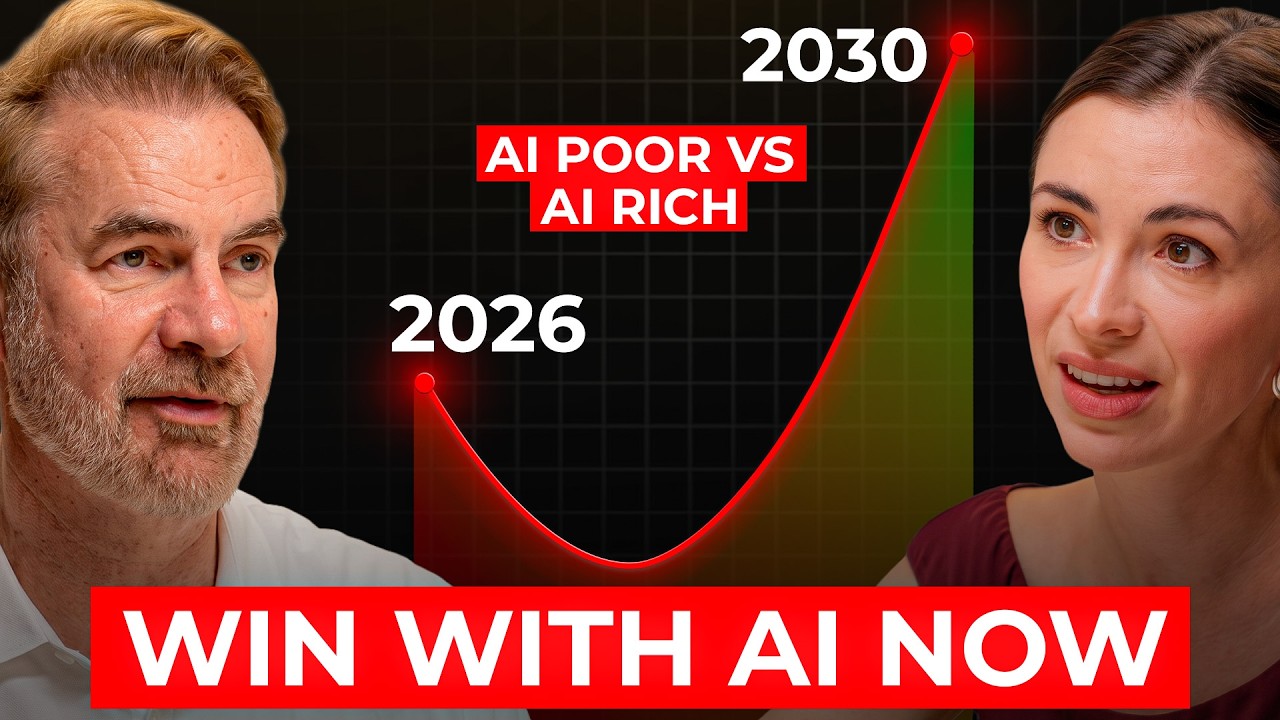
Erik Brynjolfsson: I think. Over the next three to five years, people are going to see more and more mind blowing things. There's little ones already happening. There are some breakthroughs in medicine and there are some, you know, you mentioned like cars and companies are beginning to use it. I agree 100% though that it hasn't nearly had the economic impact or the impact on work that you might expect given the magnitude of the technology. And that's back to that J curve idea. It just, everything takes longer than the technologists think. But it is happening, it is coming. And by 2030, I don't think there'll be any question that this is transformative of the economy. But these things happen step by step.
Marina Mogilko: So we're somewhere, do you think we're down here in the j-curve?
Erik Brynjolfsson: I think we've turned the corner, you know, that's why we created the takeoff tracker. If you go to the AI economic indicators at Stanford, you know, we have these, these metrics and every month we're updating them. And there's a few of them, like we have these different categories, no evidence, mild evidence, strong evidence. And you know there's one or two that show strong evidence, there's three or four that show mild evidence and all the rest show no evidence yet. But I'm pretty confident, well we'll see, is every month we're going to sort of be moving more and more into the mild or the strong evidence category and then it might start happening really suddenly. You know, there's this thing that we say in the Second Machine Age, my book, is the thing about exponentials is that things happen slowly and then suddenly. And we're just entering the suddenly part.
We aren't in the suddenly a part yet, but we're getting there.
Marina Mogilko: Okay, this makes me very excited, a little bit scared, because we never know how fast That's the right thing. I'm excited and scared too. No, look.
Erik Brynjolfsson: If you're not both excited and scared, you're missing at least half the story.
Marina Mogilko: Okay, my last question. If my daughter, she's five years old, just turned five, asks me tomorrow, what is my life gonna look like in 30 years? What would you?
Erik Brynjolfsson: Nobody knows 30 years now. I think it's gonna be hard enough either even five or ten years look I think the next decade if we play our cards, right will be the best decade in human history by far There'll be more wealth creation than ever before. We're gonna have noticeable improvements in longevity I mentioned I was over at in, you know, Google I was talking to I'm sorry a deep mind I was taking to Demis Hassabis. He thinks that they'll start curing a majority of diseases within ten years I hope it's right. That sounds ambitious, but your daughter will see that. So that's the good news. I also think there's a future that could, this could be like one of the worst 10 years ever. I have to be honest that like, there's the potential for catastrophic risk.
You know, viruses being created in the lab and released, AIs taking over social media and manipulating people from vast centralization of power. We already see AI powered drones like hunting down people. These are like, so tragic that dystopian, you know, these. Drones like chasing a soldier it's like oh my god and you know it doesn't matter which side of the war I'm on I kind of sympathize with the human being chased by the drone. So all those things are also possible. The thing I would say is that we have a tremendous amount of agency and so we should think less about what will happen to us and what AI will do and more about what we want to use AI for. AI is a tool. And a message I keep hammering over and over is that when tools become more powerful, that means by definition we have more agency, we have power to change the world.
So we need to really think, be philosophers and think about our values. What kind of world do we want to shape and don't take it for granted that AI is just going to steer us one way or the other. We still have the agency right now and we should be steering that technology towards one of those more beneficial futures and being damn careful to avoid those. Catastrophic futures. They, I totally think they're possible. The do-mers are not wrong that there's a real risk there. They are wrong if they think those are inevitable because we'll have choices and so I've been working with you know the labs and with politicians to do what we can to share a shape us towards that future of shared prosperity.
Marina Mogilko: Fingers crossed, we're gonna land on the positive scenario. Now, I keep telling my daughters that they won't have as many problems as I have. I mean, like- They'll have different ones. They will have different one, but the ones that I'm having, they're probably not gonna have them.
Erik Brynjolfsson: That's probably true.
Marina Mogilko: Thank you so much, Eric. This was so insightful.
Erik Brynjolfsson: Oh my god, it was such fun talking to you. Thank you for having me on.
Marina Mogilko: Amazing. Thank you so much.