Interview·October 13, 2026·56 min
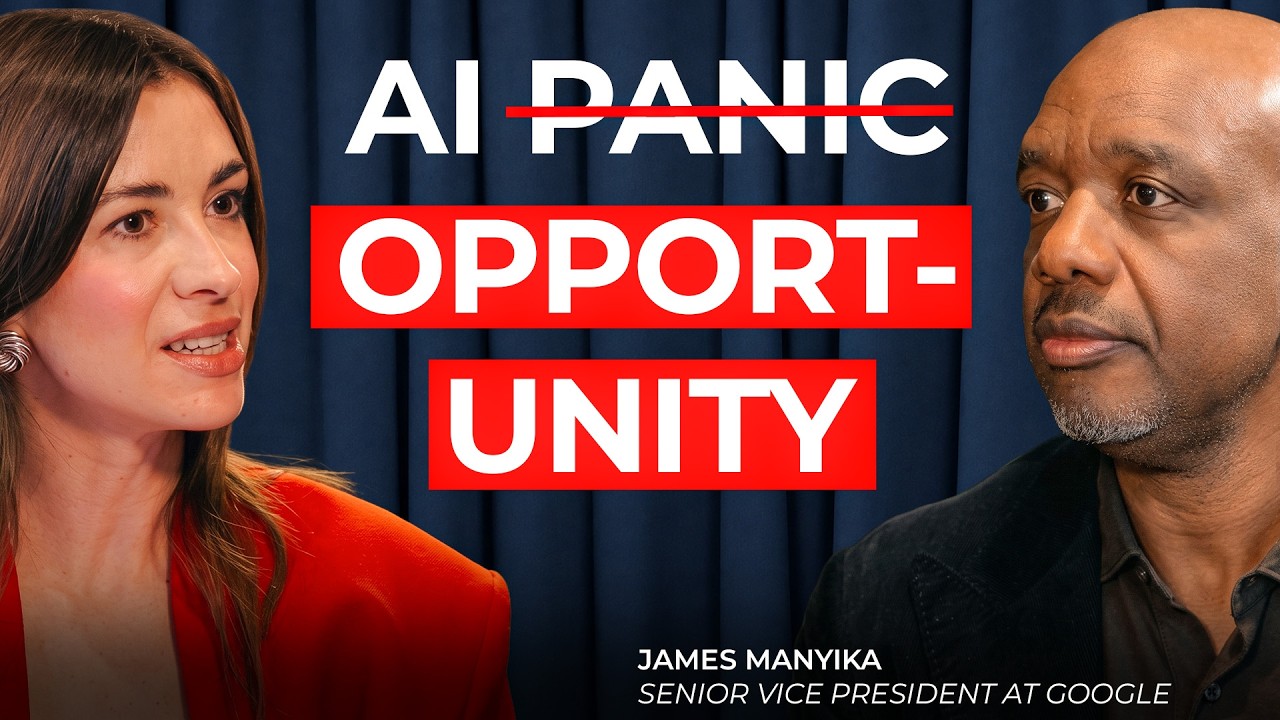
Top Google Exec: Why the AI Job Panic Is Actually Your Biggest Advantage | James Manyika
TopicsFuture of workHealth and scienceAI safety and the future
In this episode
James Manyika, Google's senior vice president of research, labs, technology and society, explains why he bet against AI researchers who predicted half of white-collar jobs would disappear within two years, and why he still expects jobs gained and jobs changed to outweigh jobs lost: the roundup by The Economist he cites puts AI-related losses at about 200,000 against more than a million jobs gained. Google's Atlas study of Gemini usage found adoption is wide but shallow, with AI used in about 21% of the tasks of a median job and mostly as an assistant. He argues that exposure to AI is not the same as risk, that workers whose output grows should advocate for higher wages, and names three signals that would change his forecast: longer task horizons, less jagged models and robotics catching up. He also covers AI in science and health, from AlphaFold and breast-cancer screening with the NHS to flood forecasts for places where 2 billion people live, as well as AGI, safety, and who gets AI's benefits outside the US.
Key takeaways
- Manyika expects three effects at once: some jobs decline as their tasks become easy to automate, demand grows for some existing jobs (electricians today, radiologists and bank tellers historically), and new occupations appear; by research he cites from MIT, something like 68% of today's occupations did not exist in the 1950s. The biggest effect, he says, is jobs changing while keeping the same name.
- About four years ago some AI researchers predicted that 50% of white-collar jobs would be wiped out within two years; Manyika bet against them, and when time was up they reset the timeline. He cites The Economist's estimate of at most about 200,000 jobs lost to AI against more than a million gained, and notes that software development jobs are up.
- Google's Atlas study of activity in the Gemini app, the Gemini API and AI Mode in Search found AI adoption is very wide but shallow: in the median job AI is used in about 21% of tasks, and mostly to assist rather than to complete them. The bottlenecks are jagged models whose output still has to be checked, long multi-step tasks and workflows that have not been redesigned.
- Being exposed to AI does not predict losing your job: exposure can also make your work more valuable, as it did for radiologists. Wages should rise when AI makes someone more productive, but for forty years wages have grown more slowly than output and AI could widen that gap, so workers should make their contribution distinctive and advocate for themselves.
- Three signals would change his forecast: AI handling much longer tasks in the real world (up to sixteen hours on some specific tasks), models that are consistent across tasks instead of jagged, and robotics catching up, since roughly 60% of the world's workers do work dominated by physical tasks.
- In science, AI now generates far more hypotheses than labs can verify: GNoME predicted about 2.2 million crystal structures, and attempts to synthesize them narrowed that to a few thousand. He calls AI "an invention for making inventions", and says its benefits already reach people without being credited to it: breast-cancer screening with the NHS, tuberculosis diagnosis in Zambia and India, and flood forecasts in over 150 countries.
Chapters
- 00:00What really happens to jobs next
- 01:00The bet he made on white-collar jobs
- 04:44What the job numbers actually show
- 05:45Why AI use is wide but shallow
- 07:34What's really holding AI back at work
- 08:44Why AI exposure can work for you
- 11:22What happens to your salary next
- 13:55Doing more with AI? Advocate for yourself
- 14:25The new kinds of work he's tracking
- 16:47Where founders should experiment right now
- 18:043 signals that would change his forecast
- 19:39Why robotics is the real wildcard
- 20:40How AI is changing the scientist's job
- 25:40The invention that makes inventions
- 27:39AI breakthroughs already in your life
- 29:35How AI warns you before a disaster
- 31:45Is this already available in the US?
- 33:25The moonshot AI already pulled off
- 34:45What quantum AI is discovering now
- 37:11The discovery he hopes to see
- 39:36Why language is AI's next moonshot
- 41:04What AGI actually means for you
- 44:20How fast is all this really moving?
- 45:50Is AI moving faster than safety?
- 48:02The AI risk we're underestimating
- 50:07The risk of not using AI
- 51:44Who gets AI's benefits outside the US?
- 54:35What matters when intelligence gets cheap
Transcript
James Manyika: It's such an exciting time. The possibilities are extraordinary, but the challenges and the risks and complexities are also as important to make sure we're working on both things.
Marina Mogilko: This is James Manyika, Google's senior vice president of research, labs, technology, and society. He spent years studying how technology changes work and how workers can benefit from those changes. What do you think will happen in the next five years?
James Manyika: The one thing that will happen is that there will be some jobs that will decline.
Marina Mogilko: What are the biggest jobs at risk?
James Manyika: People are doing a lot of kind of routine tasks, testing code, for example. But I think it's important to complete the picture. The other parts you'll see are jobs gained, new occupations that didn't exist before.
Marina Mogilko: Is there a warning sign you would be looking for that could accelerate the job loss?
James Manyika: There's several things I've been looking at that could
Marina Mogilko: James, thank you so much for doing this.
James Manyika: Oh, thank you so much for having me.
Marina Mogilko: I like how you're plugged into everything that Google does when it comes to technology and AI, you're so the best person to discuss so many topics. But I wanted to start with something that my audience is particularly worried and interested in is what's happening to our jobs. And you were willing to take a bet. I watched some of your podcasts that we won't see 10% of jobs automated away within a year. That was your bet.
James Manyika: This is a topic I've been spending quite some time over many years, the question of what happens when AI intersects and impacts jobs. And I've always had the view, and a lot of the research that I've done and, actually, many economists have done has basically described that three things will happen, and all of them will happen. We can debate the proportions of them. The one thing that will happen is that there will be some jobs that will decline, and that's because some of the constituent tasks involved become easy to automate. So we'll see some jobs lost Like over time.
Marina Mogilko: What are the biggest jobs at risk?
James Manyika: Well, I think you'll see that... So, for example, anytime people are doing a lot of kind of routine tasks, whether it's, you know, testing code, for example, or, you know, looking for bugs or those kinds of things. So there's a whole range of tasks. In fact, by by the original estimates that I did and many others did back maybe five... Several years ago, we keep updating these.
The proportion of jobs that could be lost that way added up to single digits number as a percentage of, jobs, say, in the US economy. So... But you will see some jobs lost in that sense, but I think it's important to complete the picture. The other parts you'll see are jobs gained, and the jobs gained will be of two kinds. On the one hand, there'll be some jobs whose demand will just go up, existing jobs, And we're seeing some of that today with electricians and a whole range of jobs where the demand will actually go up, for those jobs even though they exist. And this is the story of what happened with radiologists, what happened with even bank tellers of the advent of cash machines. So there'll be some jobs gained of that kind. The other jobs that'll be gained will be new occupations that didn't exist before. There's a long history of this.
David Autor at MIT and us have done some research that basically shows if you looked at the US economy back in the fifties compared to now, something like 68% of the jobs we have today, occupations just didn't exist before. It's kinda like if you had looked in 1995 and said, is there a job called web designer?
Marina Mogilko: Content creator.
James Manyika: Content creator. Content creator, podcaster, you would say no. But now in hindsight, can say, oh, yeah. Those are real jobs. So jobs gained will be of two kinds. But the biggest effect that almost most economists have looked at this will point to is the jobs changed, which is the third effect where many jobs, the content of them will change even though we may still keep the same name for them. So the reason I was taking the bet was because, you know, starting maybe about four years ago, there were some, AI folks who are arguing that in two years' time, we're gonna have... Wipe out 50% of white collar jobs. And that's the bet I was willing to take. I took a bet with a couple of the people who were making those pronouncements. And
Marina Mogilko: You were right.
James Manyika: And I asked them two years later to say, time's up. What's happening?
Marina Mogilko: What was their response?
James Manyika: And they said, no. No. We'll reset the timeline. So they'll say, okay. No. It's the next two years. But I think this expectation that we're gonna see this massive job declines, I just don't think will happen at least in the kinda ten, twenty year time frames. Because part of what happens, I think, the effect of techno... I mean, while technology is moving very quickly and the capabilities are extraordinary, I mean, we're right in the midst of it ourselves and many of the other frontier labs, the rate at which that translates into economic activity and into the economy is much slower. Look at the pronouncements people are making last year. Look at what the job numbers actually say today. Jobs are actually up.
Marina Mogilko: What do you think will happen in the next five years? Will the supply of new jobs exceed jobs lost?
James Manyika: My expectation is that the growth in jobs coming from both new jobs and existing ones expanding will will be bigger than the declines we see. I mean, this is... You may have seen the recent... I think The Economist did a good roundup of this, which basically said, at most, the most jobs we can attribute to have been lost from AI is what... I think that number was 200,000. And the jobs that had grown as a result of the AI effects were actually more than a million. So yeah, that's that's the data so far. And even in areas that we all are very close to, like software development, those jobs are actually up. Yeah. Yeah. I should look at the actual data. So I I think, you know, this is not to say, Marina, that we should... This will be the forever picture.
We should take seriously the possibilities of the impacts of this technology on jobs and work. It's just that it hasn't happened yet. Or the worst things that people expect have not happened, they may not happen in my view.
Marina Mogilko: You touched upon the economic effect, and this is very interesting because we have such powerful models. And they're capable of so many things, escaping, breaking rules, etcetera. But at the same time, when it comes to practical tasks, I think, your Atlas study suggests it's about 21% that could be automated with AI. Why is that so? What what is going on with the other 79% task? Is that the model is not capable, or we're still adopting the technology?
James Manyika: I think a lot of it... Because of the 21% you're referring to, that was the median percentage, the percentage of a median job where the tasks were being used... Where AI is being used in those tasks. And even then, it wasn't even to complete the task. So what we found in the Atlas study, maybe I should explain that. What that study looked at was we looked at all the activities through the Gemini app and Gemini APIs and also an AI search... An AI mode in search. And that's a that... That's a total of close to 2 billion people are using because Gemini app is now about a billion people using it monthly, and AI mode is also about a billion. And then people accessing the Gemini API.
So we sort of got a huge chunk of activity directly. And what we found was that the adoption is very wide, but very shallow. And the 21% points to the shallowness of it. And we also found that in in most of those tasks, these were assistive tasks as opposed to total automation of the tasks. So the human are still working with the technology. So I think that's what will take much, much, much longer when... You know, before we get to whole tasks being fully automated. Keep in mind that there's lots of bottlenecks along the way, to complete a full task, and many occupations consist of many, many tasks. And I think that's part of what you're seeing.
Marina Mogilko: So what is the bottleneck? Because that the model... Because sometimes you use AI, and you start feeding it data, and then the answer is completely different. You're like, oh, that was how I was supposed to use the app. Right?
James Manyika: Right. I I I think it's it's it's both things. I think on the one hand, the technology is still what many people refer to as jagged. So you often need to check the output. You need to evaluate the output. And then sometimes the the task you want just takes many, many, many more steps, and the technology is not quite ready to do that yet. So that's a that's a big part of it. And now, of course, the technology will improve, and we already know that the time horizon of what these agentic systems can do is actually extending all the time. So that'll get better. But the other part of it is that people interact with technology. We haven't involved yet the workflows enough to make the technology fully assistive or to fully automate them. And in any case, most people seem to find greater value when the technology is being used to complement human activity. The combination
seems to be much better when it's a complement As opposed to, full automation. The few... The tasks where full automation is the optimal output is still very small.
Marina Mogilko: That's a great point. And for someone who's worried about their job, what should they be doing to identify how risky it is for them to not adopt AI?
James Manyika: Well, I I think part of it is is just, as humans and as workers and as people just continue to evolve the value add of what we do versus what the technology is able to do. So in any of our tasks and activities that we do, there are parts where we still bring the judgment, the expertise, the ability to check, and the ability to frame the right questions as... And and the technology will be good at some things, and you as a human will be better at some things. So I think this idea is people to constantly evolve the value add of what we do working alongside these technologies. I think that's the ongoing continual learning Yeah.
Of what we're gonna need to do. I'll I'll say one thing, though, which, I often worry about, which, I think people throw around this idea that if you're exposed to AI, I think somebody says if you're exposed, you're toast. I think that's just the wrong way to look at it because we've seen the exposure to this technology go both ways. So some people are exposed. Yes. Some of the tasks that they do become easy to automate. But in other cases, people who are exposed are actually more able to capitalize on technology where the combination becomes more powerful. So I think the idea of using exposure as a predictor of the worst outcomes, I just think is plain wrong. Because I think both exposure will... Can lead in both directions.
Marina Mogilko: Because then if you're exposed, 50% of your job is now done faster, but that means your strategic thinking, whatever your taste now matters more.
James Manyika: It matters more. It allows you to be more productive. Yeah. Because, I mean, this is the case of the the the wonderful, case of the radiologists. Radiologists were clearly exposed. But what actually happened because there's so much more demand for what they do Yeah. They became actually more productive. Yeah. And, actually, growth in radiologists
James Manyika: Went up. Yeah. Right? This is the same thing that happened with, historically, the example of the bank teller. People had predicted back in the nineteen seventies before ATMs were prevalent that we're gonna see bank tellers as most exposed, obviously, because of, you know, the activity of taking money in and out of a cash machine of ATM. But what actually happened, the job of the bank teller actually grew. So the demand elasticity was actually up. So I think often we forget the demand elasticities that happen when the technology complements what people do. Yeah. There's some activities that demand is actually outstrips the complementary effects of the technology, but there will be somewhere it actually goes the other way. So just exposure on its own doesn't predetermine necessarily what the outcomes will be.
Marina Mogilko: What happens to your salary if you become more productive? What are you seeing now maybe inside your organization?
James Manyika: I think this is one of the most important questions are the wage effects. Because all too often we focus primarily just on... Is there... You know, what... What's happening to jobs and displacement? I think the wage effects are important because what happens is... So imagine if you are somebody who you're complemented by the technology and your output is actually even more productive and more valuable. Your wages should go up with that because you're doing more valuable work complemented by the technology, and it expands. I think the risk comes when, in fact, you're complemented by the technology, but the truly value added portions of your work are being done by AI, and what's left over is less value added. I think then you have...
You could have adverse wage effects. So the wage effect question, again, can also go both ways. I think this is one of the things we're gonna need to think a lot about. Economists typically think about this idea of the marginal contribution of labor to any particular task, and that can go both ways. But this is one of the things we're gonna need to worry about and pay attention to because I think we'll see some occupations, particularly when the demand for what they do, complemented by technology, goes up And there's greater demand. I think we'll see those wages go up where we should. Yeah. And then when people are becoming more productive and creating more value added output, I think that wages should go up. Let's make sure that happens. But there will also be some other adverse effects where the opposite could happen.
Marina Mogilko: Yeah. I think people who are seeing, the increase in productivity should be also advocating for themselves.
James Manyika: Oh, I think I think so. I think so.
Marina Mogilko: Because I don't think businesses will be able to catch up that fast, especially small businesses. You're like, you're just not, accounting for that.
James Manyika: No. I I think you're exactly right, Marina. Because one of the things... And this has been a long running trend even before this moment. If you look at the history of the last, sort of thirty, forty years, the idea of productivity is that as productivity goes up and GDP and and output goes up, wages should go up with it. But we've seen for the last forty years, the growth in wages go up, but not as fast as the output has gone up. I think that's a structural challenge in our economy. I don't think AI introduced that, but AI could actually make that worse. So we should think about how do we make sure that as people become more productive, that is reflected in their incomes and their wages as they make all these extraordinary outputs and value added contributions.
Marina Mogilko: What would be your advice to workers who are struggling with this?
James Manyika: They should advocate for themselves, and I think, and I think, you know, the more they make their particular contributions unique and distinctive, particularly in a way that complements what the technology does, I think they should... That that should lead to higher output and and wages. You could argue we're seeing some of that already in some occupations where, wages are going up. The question is, are they going up commensurate with the productivity contributions that are coming out of their work? I think that's the question.
Marina Mogilko: Yeah. And I think because of that, we're also seeing transition to more independent workers, like contractors
Marina Mogilko: Who do a particular function. But for multiple companies, an AI allows them to do that To do. At an increased speed, and then you're charging for the output. So
James Manyika: That is actually one of the things I'm most excited about. Fact, one of the things we're looking for is... And you mentioned our Atlas study. That's an ongoing study, so, hopefully, you'll see... We're gonna keep kind of, producing output of that. So... But one of the things we're watching for is the emergence of new activities and new kinds of firms and new kinds of work emerging, because that's what's happened historically Yeah. Where anytime a new technology comes up, you start to have new kinds of firms, new kinds of businesses, and new kinds of work start to enter the picture. So we're constantly trying to watch what is that. Have we seen that before? What's that activity? And is it growing? What do we call it? What do we name it? I think that's gonna be one of the most exciting things to watch.
Marina Mogilko: A few weeks ago, I had Anton Osika, the founder of Lovable, on the show, and he helped me rebuild my personal website right there in the episode, and I'm really happy with how it came out. But I wanted to take it further. We originally built that site to be AEO optimized so that AI tools would actually recommend my podcast. That part works. Now I want it to be more than that, a real home base for everything I do.
So I tried something I didn't know you could do in Lovable. My team sent me a long list of everything we could add to the site. I pasted it into the Lovable project chat and asked which of these are actually worth building, which should I skip, and what am I missing. It read my real site and told me the most useful thing I could add, a proper about me page so that when somebody asks an AI who Marina Mogilko is, it actually knows. It even talked me out of two things my team wanted, a search bar and a newsletter pop up.
Not because they're bad, but because right now, for what we're actually trying to do, they are not worth the time or the credits. Then it offered to build it for me, switching to build mode on its own, pulling together the facts about me, and a few minutes later, I had a full about me page in the same style as the rest of the site. And the part I actually cared about is that I got a second opinion on my own project before I spent a single hour building the wrong thing. If you've already made something in Lovable or you've got a project sitting half finished, go open it and just ask completely free. Link is in the description. Now back to James.
What is your advice to entrepreneurs? What market should they be looking at?
James Manyika: I think we're gonna see a range of new services emerge. I think the difficult thing, by the way, is to predict what those are. I think one of the things that's really interesting for me as somebody who's interested in the history of these things is that most new occupations and new firm activities, we've only been able to name them in hindsight. At the time, there's a lot going on. There's a lot going on, and it's hard to actually name it and say and make those predictions. So I'd be very wary about making predictions, but I have no doubt we're gonna see new kinds of firms and new kinds of activities and new kinds of work emerge. I think the the great opportunity for entrepreneurs is to experiment, build new kinds of firms, go after the market opportunities. What are, new work being emerging? So are there people now overseeing agents? Are there people now watching agent orchestration?
Are there people now doing new kinds of evaluations? Are there new services that large and smaller firms need? Are they newer? So those are the things I've been trying to experiment if I was an entrepreneur.
Marina Mogilko: Yeah. And, also, I think I see as as someone who started as an employee and then became an entrepreneur, you're seeing the process inside your company, and that's your idea. That's your business idea and what
Marina Mogilko: Exactly. Much more possible to to execute on. Okay. To kind of wrap up this, AI job loss section, is there a warning sign you would be looking for that could accelerate the job loss?
James Manyika: There's several things I've been looking at that could change the dynamics I just described. I think on the one hand, I'll be looking to see, are we extending the capabilities of the technology to do much longer time horizon tasks? Have we now solved and addressed much of the jaggedness that we see in the AI capabilities themselves?
Marina Mogilko: What's the time horizon? Is it now... What is it now? Sixteen hours? What?
James Manyika: For some tasks, it's up to sixteen hours, but it's very specific. I mean, when you... And I always think that sometimes the evals and the benchmarks don't tell the full story That... Of what actually happens in the real world. Yeah. So in some simulations, you've seen these things run for much, much, much longer. There's actually a wonderful study that, economists at MIT have done in looking at the time horizons and what... And and that is a predictor of... At least an early warning sign or at least an early sign of extending capabilities. So I think we should watch that in the real world, not just in the evals and the simulations that we run. So that's one thing I'd be looking at. The other thing I'd be looking at also is just this... What I mentioned is the jaggedness. I mean, it's still extraordinary to me that there's still some tasks that these models are terrible at.
Visual reasoning, for example, still have to do all kinds of kludgy ways to solve for counting, for example, because these systems are not very good at that. So the... Once you start to see more consistency across different kinds of activities and tasks, that's something to pay attention to. The the the the final thing I would just also mention, which I think will be a big factor we should watch for in the labor markets is whether robotics comes along as quickly or not. The AI systems are making a lot of progress in terms of the cognitive activities and, you know, kind of thinking activities. But robotics, even though it's making progress, so you'll see all these demos, is still lagging quite a bit. Yeah. The only real advance we've seen in robotics is in driverless cars, Waymo. You know, in some ways, it's, you know, it's an AI on wheels at some level. But robotics still lags.
But if robotics was to fully catch up, that would change the dynamics quite a bit because something like... If you look around the world, something I think the number is roughly 60% of people in work in the world do work where the... It's dominated by physical tasks. So if that catches up, that's an important, scenario shift that we would have to think, deeply about as to what the implications and opportunities of that would be. K.
Marina Mogilko: I'm very excited to talk to you about science because from what I'm getting by talking to scientists and entrepreneurs who work with scientists that we're seeing an incredible progress where we can do more research. But at the same time, the scientist's job is now running multiple experiments and verifying the AI's output. Is that what you see as well?
James Manyika: The intersection of AI in a sense, that's one the things I'm very excited about. Very excited because I think it's one of the most underappreciated, big advances that are happening today from from AI. So that cuts across everything from biology to physics, chemistry, a whole range of the natural sciences, but also recently in some of the formal sciences, so mathematics and algorithms and computer science. So the progress is extraordinary. But I also think it changes often the nature of the work and where the bottlenecks are. So one of the things that's... And we we just put out a, you know, a study where we're looking at. So how are scientists actually using these tools? And what's interesting is you see two patterns for now.
We'll see out whether that persists or not. There's a lot of use of the general models. So think Gemini. People using Gemini, the frontier models to do a lot of the, you know, the operational tasks, writing papers, researching papers, and those kinds of things. So that's kind of roughly half by the study we just published recently with working with some folks at MIT. The other half are scientists still using very specialized models. By specialized models, think AlphaFold, a Nobel Prize winning model, or any of these specialized models that are... We're either working on proteins or cell structures or connectomics or genomics or any number of areas. So most scientists are using both And often in in in tandem. So they may use, you know, Gemini for the general task, but then come back to these specialized models. So that's what's driving the the... Kind of a lot of the progress, and lots of great results. I'm... I'd like to come back to them.
But to your question as to where are the new bottlenecks? It's actually quite interesting. This has led to a huge generation of hypotheses, ideas, simulations, things done in silico. For example, one of our one of our models, GNoME, was able to kind of predict, crystal structures in chemistry that were, like, over 2 million structures that were theoretically possible in simulation. But then the task of verifying those, is now the bottleneck. In fact, after the 2.2 million crystals that were predicted, I think only a few hundred thousand were actually looked like they were viable for, for synthesis. And even then, when people then tried to synthesize, I mean, the number dropped to, like, a few thousand. So on the one hand, generating ideas and possibilities is almost, like, easier now, but the ball... Bottleneck is
James Manyika: Lab verification, and then often in vitro or in in our natural cell structure. We have the same experience where one of our models, C2S-Scale model, was able to predict these pathways and possibilities in in in cancer treatments, for example. But of the possibilities that came up with, we then worked with, researchers at Yale to verify them in in the lab, and only a handful were things that was actually reasonable in the lab. Interesting. Now have bottlenecks at the back end of verification and validation, but also the... But the process of generating possibilities and can... Hypothesis seems to be much easier, and the possibility is much more expanded.
Marina Mogilko: I wonder if overall then is AI speeding up science or... Because now we have this new bottleneck of verifying 2.2 million different crystals.
James Manyika: Well, I think when it comes to science, I think AI is actually doing two different things. There is a part of a way it's speeding up the process of research, where you can now look at all of it, all at once. And, like, in the protein structure predictions, you can look at all of them. Recently, you may have seen... We actually looked, for example, at all the single letter misspellings in the genome. This is the Alpha Genome Atlas, and we looked at all 9 billion of them. So this idea that you can look at all of them quickly is clearly one effect from science. But the other effect is actually being able to do things that we couldn't have done at all before. It's not really a speed up thing.
So for example, in the case of, some work we're doing in connectomics. So connectomics is the area where you're trying to understand, if you like, the wiring diagram of the brain of brain structures. And, actually, we hit a milestone, recently a couple weeks ago that we published working with the Howard Hughes Medical Institute where we did the first full brain mapping of a fruit fly, Drosophila. It was the first time it's ever been done. But the reason why that's interesting is not so much a speed thing as much as...
Think of the tools we used in that case as more of a a new kind of microscope, which allows you to look at things you could not have looked at before. We were talking about jobs earlier. I think what's interesting about AI as a technology, it actually has two properties that are interesting. One, which we often think about in the concept of economics, which is this idea that it's a general purpose technology, a GPT, which allows you to do in all kinds of economic activities. But the other characteristic, which is I find super interesting, is AI is an invention for making inventions.
And so when people make the analogy of AI to the industrial revolution, which is correct, people often think of think of it as a GPT, a general purpose technology. But I think if you're looking to these inventions as a method of invention characteristics, the the enlightenment may be a better analogy. Because what we did at the enlightenment was discover new tools, instruments, telescopes, microscopes, the scientific method, things that allowed us to do science in a way that we could not have done before, look at things we could not have looked at before. So I think AI has these two remarkable characteristics, and I think the impact on science is just... I'm I'm so excited about that. But also, it raises questions about... So what's the role of scientists? Are they... Is the role there... It's a bit like the work question.
Is it to formulate hypotheses? Is it to explore them? Is it to validate them? Is it to ask questions that haven't been asked before? But I think the possibilities are super exciting.
Marina Mogilko: James said AI adoption is very wide but still very shallow. In a typical job, people use AI for only about a fifth of their tasks and mostly as a helper rather than something they actually work with. That's the gap. And the people who close it are the ones whose work becomes more valuable. That's why we put together a free thirty day plan to help you go from using AI like a search engine to actually working with it with a step by step guide on what to set up and in what order. It's available through my newsletter, Future Proof. So subscribe using the link in the description, and you'll get the thirty day plan for free.
When do you think we're gonna see a scientific breakthrough that's gonna affect everybody's lives? Because for now, there are some amazing breakthroughs when we're treating very rare diseases in babies who were just born. Right?
Marina Mogilko: But there hasn't been a massive effect on the population where we're like, oh my god. This is thanks to AI.
James Manyika: I think we're starting to see that. Now the question is that people think of it as, oh, thanks to AI. So I'll give an example. In in health care, for example, in health, we're now able to do so many diagnostics that we couldn't have done before, either faster, earlier, and see and pick up diseases or evidence of of of illnesses that we couldn't have done before.
Marina Mogilko: Can you give an example?
James Manyika: Yeah. So we just, we just published, early this year one of the largest studies ever done on breast cancer detection. We did this with the NHS in the UK. I think it involved over 180,000 women were part of the year long study. And in that case, we're able to use these tools to do... To pick up evidence of breast cancer would have been missed before and pick them up much earlier. And we've been
Marina Mogilko: By looking at the mammography results?
James Manyika: And using AI tools to observe those and evaluate those. We've done the same thing in the colorectal cancer, in lung cancer, and also in tuberculosis. I mean, tuberculosis is interesting because something like thirty to forty percent of the people in the world who have TB go undiagnosed. And that's mostly because they live in communities, where the infrastructure just isn't there to diagnose them.
And so being able to use these tools in those places, we did a study that involved, we studied in Zambia and India, and we're able to show that, no, you can actually make accurate diagnosis for tuberculosis in those places. Now in all of these examples, will those people say thanks to AI? They'll just think, oh, I got a great, you know, diagnosis, and they discovered I have this disease. So a lot of those effects are gonna be a little indirect. It's the same thing with, another area we're spending a lot of time on is trying to help communities be resilient.
Imagine if, people would not get surprised from natural events and natural disasters. So we've been working down a list from floods to, monsoons and cyclones and weather and even earthquakes. One of my favorite examples, just because it's at scale now, is, in floods. So there's there's two kinds of floods you wanna worry about in most cases, which are riverine floods and, flash floods. And in those cases, it's always been known that if you could make a prediction, six plus days in advance, the impact on people would dramatically halved, just so people can move out of the way and so forth. And starting three years ago, we did our first, experiment using our AI tools in India, and it worked. And now we've expanded that to over 150 countries where more than... In places where more than 2 billion people live.
And... But, again, in those cases, I think those people... Those people experiences, they'll probably get an alert on their phone To get out of the way. There's a flood coming.
Marina Mogilko: So not necessarily bridging it back to AI.
James Manyika: Yeah. Yeah. But but the connection back to AI may not be as direct. And I'll give another example. Recently, in the Venezuela earthquake, we've been experimenting with the idea of using, you know, Android systems with AI sensors, but also AI systems to make predictions. And in that case, I think this was reported in the New York Times as well. We're able to send alerts to about 12 million people ahead of time, and in some case, a few seconds, in some cases, a couple minutes ahead of time. So we've been working our way down everything from wildfire predictions to monsoons to cyclones to hurricanes, WeatherNext, one of our models, was actually used in Melissa in Jamaica. And we're able to send alerts. So those are examples where the ability to make these predictions
Marina Mogilko: Is enhanced for the hours.
James Manyika: Are extraordinary. And the impact of people... This is not in the far future. It's right now.
Marina Mogilko: What about the the medical, examples that you, talked about? Are they available in the US as well? Like, are we using this technology in the US?
James Manyika: Oh, so we're starting to. So, for example, one of our tools called AMIE, which is an assistive tool that we've tested with a variety of hospitals and clinics, Beth Israel Deaconess at Harvard and other places, we're now involved in a nationwide trial. It's an assisted tool for doctors. Another AI based tool we've developed called... For detecting what's called diabetic retinopathy, where you can look at the at the eye as a way to predict all kinds of diseases. We've actually applied that, in more than six hundred thousand cases in India, and now we're working with a partner with a goal to scale that up to be able to do six million assessments. The tuberculosis example that I mentioned, now that we've demonstrated that it works with a year long study, we're now working with various providers in Africa and other places to actually start to deploy that and use that. So a lot of these things are
Marina Mogilko: Are happening.
James Manyika: Here and scaling. That's why these are such important examples. But often, the attribution of those things to AI is often indirect or at least a step removed from the people who are experiencing those things. But there's still so much more to do, by the way. Don't get me wrong. But I think I worry that when we think about the AI AI's contributions to science and health and all these areas, it's always positioned as in the far future. Someday, we will do x. And I say, no. No. No. No. We're already We're starting to do that today. Of course, there's a lot more we will be able to do in the future, but don't... This isn't some future promise. We're starting to see those effects, today.
Marina Mogilko: What is the wildest scientific moonshot, you think is available now because of AI?
James Manyika: Oh, what happened with protein folding? I mean, that was a seventy year grand challenge that
James Manyika: Idea was first posed by, you know, Anfinsen, in his Nobel lecture, like, in the seventies, so so in the sixties. So that's a moonshot that came to be real.
Marina Mogilko: What about future moonshots? Oh. Something you're excited about?
James Manyika: One one thing I'm excited about is the day we are able to build, a prediction model that helps understand the dynamics in cells. Cells are very interesting. We don't quite yet understand. Nobody's ever... Has yet built a fully complete virtual model of the cell, of how cells works, the perturbations that happen in the cell level. So that's still... And there's a lot of great work going on, by the way. So folks at the Broad Institute and a few other places are trying to build the cell Atlas, and we're contributing to that. This. Yeah. So the Yeah. But once we're able to build, models that allow us to make predictions about the dynamics in cells, that's gonna be pretty exciting. So I'm excited about that.
Marina Mogilko: What's your timeline for that?
James Manyika: Oh, I mean, that's the problem with breakthroughs. Scientific breakthroughs, it's hard to make predictions about timeline because it's one thing... It's easy to make engineering predictions, but when it involves scientific breakthroughs, that's hard. I'm also pretty excited about... By way, another area in science we haven't talked about, which I'm excited about, is intersection of, quantum physics and AI. So we have a team, the quantum AI team. The reason I mentioned this... So that's a moonshot. We're we're... Obviously, we're trying to build a quantum computer, and I think we're making progress.
And you'll be seeing and you've seen probably some big milestones we've had from the building of quantum computer point of view. But one other thing that's happening alongside our work in quantum computing is we're now able to do extraordinary science alongside trying to build a quantum computer. So we've had some breakthrough results in physics in understanding the structure of black holes, in understanding electromagnetism. In fact, we've even, demonstrated some new results in traversable wormhole possibilities. And, also, you know, last year, we had a a couple breakthroughs where we're able to do some work that relates to medical science, where we're able to understand the structure of some very hard to understand molecules and their dynamics, which is so important for some of the work we need to do in science.
So I think you're gonna see even from that arena breakthroughs that are relevant, not just for biomedical research, but also for other parts of science. So I'm I'm pretty excited about the, moonshots on on the quantum AI side too.
Marina Mogilko: Yeah. It's... It is really fascinating. I feel like it's happening gradually now, but then we're gonna probably have a moment in history where it just speeds up immensely.
James Manyika: I'm convinced of that. I mean, if you asked me, you were talking about bets earlier. I'm willing to bet that when we... You know, ten years from now, when we look back and say, what are some of the biggest things that came out of AI? I think this intersection of AI advancing science in ways that are hugely important for humanity and helps us to tackle questions in health and well-being and crises and and resilience, I think will probably be some of the biggest things that will have happened.
Now we also have to be super responsible because just as much as we're making progress on the science of it and the advances, you know, it does raise some complexities we should pay attention to. So there'll be some risks related to bio and and and a lot of this work in in biotech and in chemistry poses some risk. So the responsibility there will be super important as well so that we're doing this in a safe and responsible manner with regards to the science we're doing with AI.
Marina Mogilko: Yeah. Which is another huge topic. Do you have a particular scientific discovery that if it's made in your lifetime, say
James Manyika: Oh, wow. I've got quite a few. I mean, there's a whole bunch of mathematics, and we're seeing a lot of progress in mathematics these days. I mean, I think if we get to solving the Riemann hypothesis, that'll be great. I'd be... You know, I'd love to see that. It's been one of the long standing problems and challenges in mathematics. We've seen some of the things happening in mathematics, so that... That's exciting. But I actually think for me, the the the ones that I'm...
I'd love to see in my lifetime have to do with the structure of biology and of life and our brains and our bodies. So these questions around understanding cells, understanding the dynamics of cells, really understanding what's happening at the genomic level, those... Because I think if we make progress on those, it's gonna lead to so many more discoveries. And one of the things I'm excited about even with the work on on AlphaFold is the fact that what that work has done is opened up the canvas to many more scientists. So today, AlphaFold, I think we reached a milestone a couple weeks ago, is now being used by 4 million researchers around the world because we made those predictions open and available.
And these are researchers in 190 countries. And what's exciting about that is many of them are working on previously neglected diseases that would have been too costly to even tackle. So the fact that we've expanded the canvas so people can now work on problems, I think that's exciting. So I think for me, part of it is giving tools to scientists to expand the wide range of possibilities to solve humanity's problems. Yeah. Because I think so much of... So many of them have just been ignored.
Marina Mogilko: You know? Because we have no time.
James Manyika: We have no time. They're too costly. People in other... In various places around the world don't have the infrastructure to be able to do this work. But if we can make these predictions openly available, so that more scientists get to work on these things, I think that's gonna be exciting.
Marina Mogilko: Yeah. It's a community thing. Right?
James Manyika: Oh, I've I've I've... Absolutely. I mean, I think it's also the reason, Marina, where I think, you know, we have to do everything we can to make all of this, you know, available, accessible to everybody on earth. It's actually one of reasons I like how, you know, Google's founding mission, organize world's information, make it universally accessible and useful. So the more people can use this and access all these benefits. We talked about all these things in health, and, you know, we didn't even get to education in all these areas. One of the moonshots that we have, you're asking about moonshots, is actually around languages and accessibility. Because it's one thing to do all these things in health and education and work and learning, but often, you wanna be able to do that in as many languages as possible. So we have a moonshot...
Our current moonshot on languages right now has to get to a thousand languages. Last week, we actually hit a milestone, which I'm very proud of, where we now are at 300 languages that we can handle. We're starting to make sure that's available in all our products. But a thousand would be great. In fact, if you wanted to get all the languages spoken on Earth, by everybody, you'd have to do something like 7,000 languages.
Marina Mogilko: Yeah. I was reading a research with some languages. If you ask something in that language and AI does a translation, sometimes it's up to 60% difference in meaning, which can be critical when it comes to a health question, for example.
James Manyika: Absolutely. And in fact, it's it's even more challenging than that. In many... We often think of singular languages. Often, there's a lot of dialects in single languages where there's, in some cases, over 100 dialects of a single language. And so we're doing all this work, for example, in India with the Indic languages to understand the various dialects and all the languages. We're doing some work in Latin America and in Africa and many. So so even understanding the the the dialects underneath the singular language and what meaning with... How things what things actually mean, I think there's still a lot of work to do. It is. But that's that's that's a great moonshot.
Marina Mogilko: Yeah. Absolutely. Yeah. Can you talk to me about AGI? We're hearing so many... I think Demis Hassabis at Google I/O said we're at the foothills of AGI. What what does it mean for a regular person?
James Manyika: One of the things that's always challenged about AGI is this people have so many definitions, so many definitions. In fact, you know, at some level, if you'd gone back to, you know, the the now famous Dartmouth conference in 1956 where the term AI first came into being, if you actually read the definite... What the the the scientists who got together at Dartmouth in nineteen fifties were trying to do, it was... If you read that with a modern eye, you'd say, oh, that sounds like a definition of AGI, even though they didn't name it at that. And the term AGI itself, I think, one of was a big popularizer of that term.
It's actually my colleague Shane Legg back in two thousand and one or two when he first started to talk about that. And that was initially as as a way to distinguish that between, a more general kind of intelligence and set of capabilities compared to more narrow systems that we were building at the time, whether it's for natural language processing or this, that, vision, machine vision. So there was an attempt to describe a general set of capabilities. And at the time, I think... So so I think when it comes to AGI, I think of it as a spectrum.
So there's a minimal definition you could think of where you say, no. No. You're talking mostly about the kinds of things that Shane was talking about or even going back to the Dartmouth conference where you're you're describing the general cognitive capabilities that a typical human has With all the peaks and valleys. I mean, humans have all kinds of peaks and valleys and stuff that I don't know how to do, but some humans, maybe you can't... Cannot able to do. So there's a there's a jaggedness to it. And I think if that's your definition, you could argue we're close to it, if you look at it in hindsight. But there's some other high definitions. Demis, for example, likes a much more high definition, which is a more scientific one, which is more complete.
I think on that base, we're much further away. So I think the AGI question, usually, when people ask me, usually start with, what's your definition? Then I... I'm happy to give you a prediction if I know what definition you're working with. But I think the reason it's important to think about it is, you know, regardless of how close we are to it, as we approach it, the effects of it are gonna be quite profound, I think. I think we're gonna have to think about, you know, what does that mean for, you know, everything from the risks and complexities associated with it to, boy, all the amazing things we can use it to do, science, discovery, all these extraordinary things we can use the technology to do, but also even deeper questions about what does it mean to be human in an age of AGI?
Marina Mogilko: What if AI can do everything?
James Manyika: Or most things, or even everything. What do we... How do we think about meaning? You may have seen recently that, Demis, Shane and I announced the setting up of the DeepMind Institute. But that's work we've been doing for the last few years to start to think about these deep questions about... So... And we'd love to just engage others and think together on how do we think about these questions. I think this is gonna be so profound.
Marina Mogilko: And also the speed of it. Right? If it happens in the next hundred years, then we have plenty of time to think. If it's the next five years with AI models advancing so fast, like, how do we adapt?
James Manyika: Yeah. I think the speed question is so critical because I think right now, we're starting to see, you know, a a whole range of techniques kinda speed up this process of of advancing these capability, everything from recursive self improvement and all these different things that, you know, we're now starting to be able to do that'll probably speed things up. But I think there's still many breakthroughs that are gonna be needed, many more advances in my view
That are still gonna be important to get there. But I think we have to think about how do we do this responsibly and safely Yeah. Because, you know, we talked earlier about the risks to, you know, work and jobs and so forth, but AGI would probably pose other kinds of risks to the questions around alignment, questions around control. Those are all things we're gonna need to think through and make sure we're being thoughtful about how we build this technology to make sure we're still... You know, we we we solve alignment. We address alignment. I think what I worry the most about, Marina, is the idea that we shouldn't let the advances in AI capability and performance outrun our ability to control, build this technology safely. So I think that's the... We have to have those two things happen in tandem. But if if the capabilities outrun our ability to build this technology and deploy it safely, I worry about that.
Marina Mogilko: Do you think we're at a stage where capabilities are outrunning?
James Manyika: We should make sure that doesn't happen. I mean, we're trying very hard, at least on our teams, to think about, you know, how do we keep building our ability to build the technology safely, making sure that, for example, there's now a whole range of questions that are emerging around. You know, if you think about, you know, a lot of the reasoning capabilities of these systems, we do that through this chain of thought, reasoning and traces. How do we make sure we don't... There's a term now people are using a lot of this idea of, serial depth opacity. How do we make sure we can actually still see once the model's thinking all the way through? Yeah. And so we don't... There's some... There isn't some other part of it going on where the think is going on, and we don't have a way to understand that or see that.
Yeah. That's work we all have to do. And I think that becomes super important when we start to have these agentic systems where we may set a benign goal, but then the sub strategies or sub goals that the agent then takes on to achieve that goal may be things that we may or may not want.
James Manyika: Yeah. And so unless we understand it all the way down as much as we can... So I think that's what I mean by we have to keep these two things in tandem. Yes. Advance the capabilities because they're useful Yeah. The science and everything else, but also make sure at least we... That doesn't outrun, our ability to do the safe... Responsible safety work and security work we need to do.
Marina Mogilko: Do you agree with some statements that people say we need to start slowing down now, or you think we're not at the
James Manyika: Well, you know, I I always worry when people say that as to what they mean. I think if if people mean, let's not let these two things outpace each other Then I agree with that.
Marina Mogilko: Slow down the develop... The model development because it's getting so complex, and we can't Yeah. Trace what the agent is thinking.
James Manyika: Yeah. Either slow it down or speed up the safety and responsible work we're doing. I think, to me, the key thing is to keep... The two things should keep... Should not outrun each other. That's the pacing, I think, that I think, we need. And so that... That's the critical thing in my mind. I think we need to make sure that we are doing all the work we should be doing to make sure we're building these systems responsibly and safely.
Marina Mogilko: Is there an AI risk we're underestimating now? We're talking a lot about 10% chance of destroying humanity. That, I've heard so many times in the past few weeks. Right. We're talking about systems escaping. Is there anything else we're not talking about enough?
James Manyika: We're trying to spend a lot of time thinking about this. I think one of the things, we don't spend enough time on is, just at least in the public dialogue, is... And how these systems are now interconnected with so many other systems. I think we often... We think about AI models in isolation, but keep in mind that we're now connecting these systems. I mean, for useful good reasons to grids and other things and other systems. I think, you know, there's so many... So much benefit from that. For example, if we're able to manage grids more efficiently, manage electricity, manage more efficiently. But at the same time, that also raises some new questions about security and safety of infrastructure.
So I think thinking about these system... These these AI capabilities as systems, I think, is an important lens we should bring to this as opposed to think about, oh, if I evaluated my singular model, how's my model doing? I think we do a lot of that, but we don't often don't do these system system wide evaluations and understanding of the effects. Also, keep in mind that some of the intelligent capabilities, maybe the results, none of a single model, but a collection of models working together. So I think these more systemic kind of questions
I think are important both on the positive side because of, therefore, what that could mean. I mean, think about us as humanity. I think we're an extraordinary, species, mostly because of all of us, right, and all our complementary intelligences. I think it may very well be when we get to AGI one with the result of somebody's singular model achieving that. It may be actually the collection of agents and models that achieve this.
I think these more collective social components of intelligence, I think, is an important area to think about both on the opportunity side, but also on the challenges and complexity side. I remember a few years ago, a couple years ago, I was co-chairing this body, the UN high level body looking at AI and all the possibilities of AI. And I remember when we're having discussions about, the risks of AI. So we went through, the typical list that we all worry about, so misuse and misapplication of this technology. And I remember being struck by many of the members, of that body, from mostly from the global South, say we should add another risk.
And we said, what's that? They said, missed use. I thought that was interesting to think about missed use as a risk, and... But I quickly got it, I think, because I think what they're referring to is there are many communities, not just in the global South, but even in in in the US, in developed economies, where, you know, there's so many challenges already. Access to health care. I mean, if you if you go on a county by county assessment of the 3,000 whatever counties you have in the United States, there isn't equivalent levels of access to health care, to education, to all these things. And so if you're in some of these poor communities and, you know, how do we make sure we also don't avoid the missed use possibilities where this could actually make a dramatic difference?
Marina Mogilko: Absolutely. When it comes to health care. To health care. Discussed today.
James Manyika: Yeah. To health care, to schools. I mean, the kids who have promised somebody was gonna come teach them STEM skills and all the rest of it, it never happened. But this technology can actually be useful in some of those communities to address those. So I think we... That's another important kind of potential risk that's worth thinking about as well.
Marina Mogilko: And because we're here in New York during, the UNGA, I was talking to some representatives from other countries, and there was someone who posed this question. It made me think, I don't if you have any ideas on that. But if we're talking about, okay, AI is, amplifying our productivity, and we talk... Tax large corporations so that people can participate and employees can get... Gain benefit. We're only doing this in the US because, the models are being developed here. So we're taxing other corporations in the US, and then we're distributing wealth in... Inside the US. What happens to someone in Brazil, right, who are... Who's using the same model? Have you ever thought about that? Like, the the distribution of the benefits that we're getting with AI across the globe.
James Manyika: I think that's such an important question because, you know, in in in my mind, I think the possibilities of this technology benefit everybody Everywhere. So the question is, how do we increase the possibilities of somebody in Brazil being able to participate, in this extraordinary moment? Is it through, getting more educated, building their own capabilities, and entrepreneurial capacity to build start companies. That... That's one way of participating. The other is also to think about, you know, do they get better jobs and become more productive? So the question of everybody should have access to participate. Often when I speak to, you know, people in various parts of the world, it's actually quite interesting that that, attitudinally, there's a more positive view about AI around the world.
James Manyika: But often, the gaps and issues that most of them will cite are these questions of access, of infrastructure. How do we get to participate? How do we get infrastructures? How do we get access to the tools, to the models? So their concerns often have to do with just access and participation in this. Whereas, attitudinally, they tend to be more positive because they see the possibilities in health, in education Yeah. And entrepreneurship and all these things. I think expanding access is one of the clearest ways in my mind.
Marina Mogilko: And that's open models?
James Manyika: Open models, languages. In fact, I'm I'm I'm always interested in... In fact, just the other day since you and I are both here, I was in a conversation where we we talk about the infrastructure gaps in in other parts of the world, people will point to, yes, access to models and compute, but that also point to electricity, to connectivity. They said, we can have all the access to the models we want, but if you don't have access to broadband, connectivity, and electricity
Marina Mogilko: Basic questions.
James Manyika: Right? You don't even get to start. Yeah. And I was also struck by the fact that many of them also pointed to language as infrastructure. Yeah. Because
Marina Mogilko: So many things we need to tackle. Wow.
James Manyika: So so I think the more we can, you know, collectively invest, but, you know, team up with others to address those things, I think that expands the possibilities for everyone, everywhere.
Marina Mogilko: 100%. Okay. Let's wrap up with finishing a phrase. As intelligence gets cheaper, I don't know if you agree with that or not, something gets more valuable. What gets more valuable?
James Manyika: Human creativity, ingenuity, entrepreneurship, exploring possibilities, all those things become more valuable.
Marina Mogilko: And do you think intelligence gets cheaper? Or as humans, we're gonna just raise the bar for intelligence?
James Manyika: I think both will be true. I think intelligence in as far as we've defined it so far... Remember, there was a time we used to define doing mental arithmetic as intelligence. Yeah. We got over that with calculators and computers. So I think our definition of intelligence, I think, is gonna keep evolving. But I think if we're defining intelligence as we've historically defined it, I think that will get cheaper. But I think other forms of intelligence, other ways of knowing, I think, are gonna become more valuable, and we're gonna discover those things. Yeah. We're gonna discover those things.
Marina Mogilko: Absolutely. Thank you so much, James. I could've... Could be chatting to you for another hour because it's so fascinating, like, the scope of things that you cover. Thank you so much for your work.
James Manyika: Thank you for having me. It's such an exciting time, but I think we need to hold both things in mind that the possibilities are extraordinary, but the challenges and the risks of complexities are also as important to make sure we're working on both both things.
Marina Mogilko: Yeah. Fascinating turbulent time. But what a time to be alive. Right?