Interview·October 6, 2026·44 min
Nobel Economist: How to Stay Valuable as AI Changes Work | Daron Acemoglu
TopicsFuture of workAI skills and careersEducation and learning
In this episode
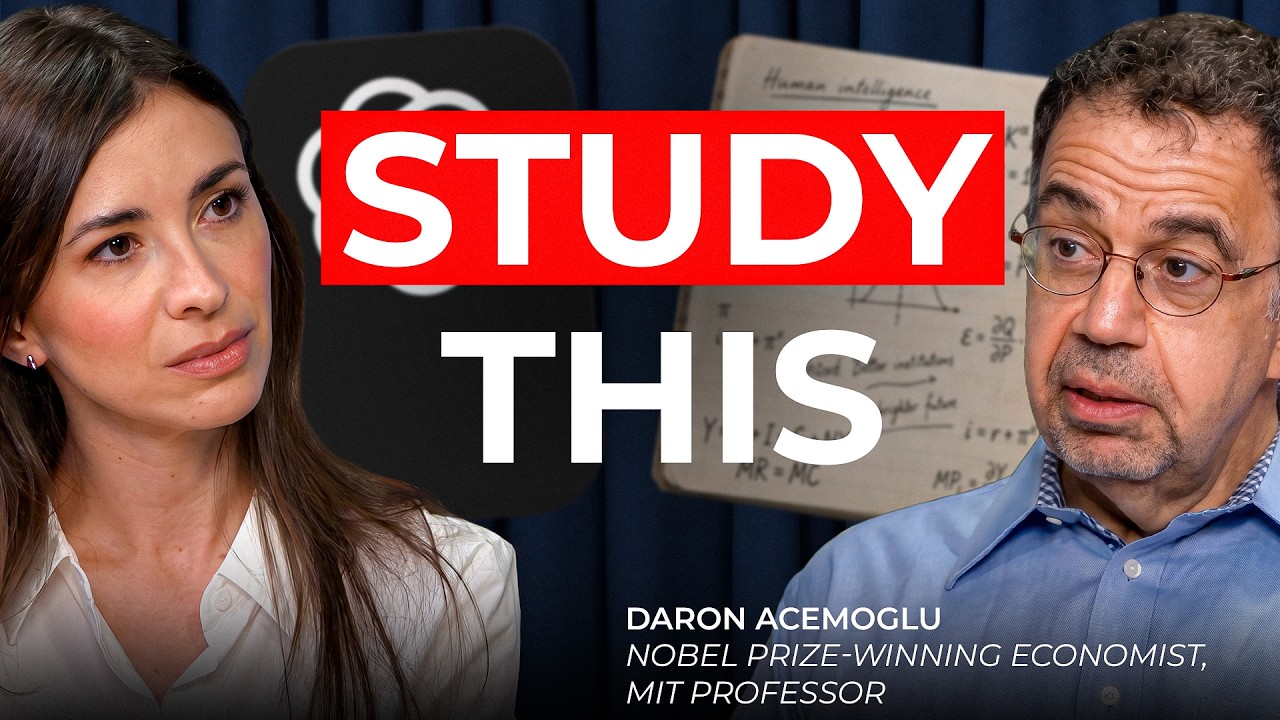
Daron Acemoglu, the MIT economist who shared the 2024 Nobel Prize in Economic Sciences, revisits his 2024 forecast that AI would add about 1% to U.S. GDP over ten years with only 5% of tasks fully automatable: he would now put that share a little higher, but still thinks the debate exaggerates how fast automation will arrive, because integrating it into organizations is hard and slow. He argues the bottleneck is applications, not foundation models: existing models are already good enough to build tools for nurses, teachers, electricians and other blue-collar work, which is where he sees both the productivity gains and the money. He explains why replacing workers with AI is often a poor business decision compared with making them 5% more productive, how he uses AI in his own research, why he worries that students delegate too much thinking to AI, and what he would study today: math, physics, economics and engineering, plus flexibility and civic responsibility.
Key takeaways
- Acemoglu would now put the share of fully automatable tasks a little higher than the 5% he forecast in 2024, but he still thinks the discussion exaggerates how quickly automation will arrive: integrating it into organizations and diffusing it across the economy is hard and slow.
- Coding advanced fastest because it has a ground truth for reinforcement learning (code either runs or it doesn't), it is done in offices, and the people supervising it are fluent in AI. Customer service lacks all of that: it is social, person-specific and full of edge cases, so it is turning out slow and difficult to automate.
- The bottleneck is applications, not models. Existing models are already capable enough to build quality control and tools for nurses, teachers and electricians; Silicon Valley puts too much into foundation models and too little into applications, while Chinese manufacturers such as Foxconn and BYD are putting AI and robotics on the production line.
- Automation alone will not create shared prosperity. His stance is balanced: use AI for automation, but also to create new tasks for humans. For a business, making 100 workers 5% more productive pays off more than automating 5% of the jobs at half the cost, and the companies people remember, Ford, GM, GE, IBM, Microsoft, did something new rather than cutting costs.
- He does not see how foundation models make trillions of dollars; the edge is in high-quality data and in creative, niche applications that open source cannot easily replicate. Builders have to go and talk to workers, because that is where the tacit knowledge sits.
- What to study: math, physics, economics and engineering, plus flexibility to change what you do within an occupation, learning to work alongside AI, and civic responsibility. He uses AI for background research and for criticism of his drafts, but warns against delegating the thinking that builds mental muscle, and says AI in K-12 schools without guardrails has made learning harder.
Chapters
- 00:00Could AI leave people without meaningful work?
- 02:36Why AI excels at coding but struggles with customer service
- 05:10Why we need more applications, not just stronger models
- 07:29Is Silicon Valley following the only possible path for AI?
- 08:39Why AI’s economic impact is still hard to see
- 15:24Who should build AI tools for nurses and teachers?
- 16:35What Chinese companies are doing differently with AI
- 17:13How should entrepreneurs choose an AI opportunity?
- 18:46How Daron uses AI in his own research
- 21:13When should you stop using AI and think for yourself?
- 23:29Future Proof: Seven skills for the AI era
- 24:25What companies miss when they replace workers with AI
- 27:39How do you decide which tasks to automate?
- 28:59Is university still worth the money?
- 31:07What should you study to stay valuable?
- 32:37Why learning to work with AI isn’t enough
- 36:11Has Daron become more optimistic about AI?
- 38:21How Daron invests amid the AI boom
- 38:58What work could look like in 2035
- 40:19Where Daron sees the real money in AI
Transcript
Daron Acemoglu: I could definitely see a future, a very scary future, in which a lot of people would not have meaningful work.
Marina Mogilko: This is Daron Acemoglu, an MIT economist and winner of the 2024 Nobel Prize in Economics. He thinks we're overlooking some of AI's biggest opportunities. So where should we be looking? And what will keep us valuable? I've seen a lot of posts where people say, oh, instead of hiring someone, I deployed an agent.
Daron Acemoglu: Automation is great. The problem is the only thing we do is automation. That will eliminate too many jobs without creating meaningful, high-paying, high-productivity jobs to create new opportunities for people.
Marina Mogilko: So what should people be doing? What skills should they be acquiring?
Daron Acemoglu: If anybody wants my opinion, I would say go and study.
Marina Mogilko: So you said something in 2024, that AI would add about 1% to US GDP in the next 10 years with only 5% of tasks being fully automatable. What do you think about this now in 2026?
Daron Acemoglu: Well, first of all, it's my pleasure to be here. And I do not claim that I have any unique insight into AI. AI is like an elephant. Everybody's feeling a different part of it. But I think I. Try to bring a little bit of basic economic calculus to the discussions of productivity. And this was more than two years ago, there's a huge amount of uncertainty, and there is even more today. But there have also been some very rapid developments, especially this year with agentic AI. Probably now I would have put that number a little higher than 5%. But I still think that a lot of the discussion exaggerates how quickly we're going to see automation, because automation is hard. Integrating automation into organizations is hard, diffusion of new technologies, especially when they require lots of complementary investments and adjustments, is hard and slow. That doesn't mean it's not a transformative technology.
It doesn't means that we cannot get benefits from it, but we have to be grounded. In thinking about how quickly and how thoroughly the economy is going to change. And we still have the same discussion that we should have about every technology. What's the best way of using it? How it could be misused? And who will benefit from it?
Marina Mogilko: You mentioned agentic. Is there anything you're, when you see it, you'll think, okay, now I can expand my figure to like two digits when it comes to impact of AI.
Daron Acemoglu: I think the advances in coding have been really, really rapid. What is it about coding that makes it so conducive to have the most rapid advances of any occupation? I think it's the fact that coding is obviously done in offices. You don't have any interaction with the real world. The people who are supervising coding are very, very fluent. In AI and technology in general, but also, and this is a very important part, just like math, just like chess, coding has rules, something either runs or doesn't run. Reinforcement learning is very effective when you have a ground truth that says, no, that's wrong. I think in many occupations, we lack that. Customer service, I think most people would have said customer service is to be the first occupation to be. Fully automated by AI. And we're seeing some of it, but it's turning out to be very slow and very difficult. And most of the organizations that I deal with, their AI system is so bad.
It's like a nightmare when I call customer service and I get AI, oh my God, it's gonna be another 10 minutes before somebody can actually help me. And that's because there's a social element. Many of the things that you ask from customer service change over time. They are person-specific, different people use different language for making the same questions. And there are a lot of gray areas, edge cases. So that makes it much messier and it will require humans to either oversee it or work with it or ideally a much better collaboration so that AI could be complementary to humans. So all of those are in play. Which ones we choose is going to have a very important impact, how many jobs are gonna be displaced, how much productivity effects we're gonna get, and who's gonna benefit from it.
Marina Mogilko: With coding, we have deterministic outcome that we can check easily. With customer service, it's much more personalized, as you mentioned. Do you think in the future, with stronger models, we'll be able to achieve it? Or it's just the bottleneck of AI in general, that it can't function without a human in there?
Daron Acemoglu: I would definitely not say there's this one thing that AI will not be able to do in the future. I think the last 10 years have given us enough examples of AI, if you put enough resources, enough data, can make progress on many things. But the question is how fast and can it do so across all the domains? If I step back and I say... If you ask me, why so little productivity improvements and what can we do about it? And I would have just one word for my vision of how we can improve the economic effects of AI, applications. We just need much better and more applications. And in some sense, one can make the argument, and again, I don't know, this may be incorrect. Look, I'm not in Anthropic, inside the organization, I'm not in OpenAI.
I don't know what they are learning in real time from their experiments and the enormous amount of resources and they're very, very talented people in all of these organizations. But you can make the case that the United States, Silicon Valley, is putting too much emphasis on foundation models and not enough on applications, and not in integrating applications into organizations. So when I, when, you know, we're told all the time. US is ahead of China and need in large language models. That seems quite clear. Chinese models are catching up sometimes, but they are using the lead of US models. There's some distilling going on probably. But one thing that I see Chinese companies do that I don't see as much in the United States is they're putting a lot of emphasis in getting robotics, getting AI into the production line. And one thing that they are throwing at that problem, there's a huge amount of engineering talent.
The United States doesn't seem to have that much engineering talent, and whatever we have is all going into foundation model.
Marina Mogilko: You touched upon such an interesting subject, because as an immigrant, when I see things, how they work in the US, and I ask, why is it so? And the reply is, oh, historically.
Daron Acemoglu: Oh no, that's the only way to do it. I think here is one thing, one other thing I'll say. I don't want to make overgeneralizations, but I think as a signpost, if there is one things that's been not good for the US AI industry, in my opinion, it's the inevitabilism, that the view that whatever we're doing is the only to do, there's no other way. And if you're raising that question, you're an idiot. So I completely reject that. I think AI is a very versatile technology as are all general purpose technologies, GPTs, what economists call things like electricity, printing press, et cetera, which spawn a lot of other applications. One thing we know from history, one thing we've learned from a lot of economics and looking at previous examples. There are so many different ways of developing these general purpose technologies and different ways are not neutral. They bring different types of benefits.
They have different types of costs and just thinking that whatever we're doing is the only way or by far the best way I think is a mistake.
Marina Mogilko: And I think another problem that comes with it is measurement, right? So how do you measure the impact of AI on your personal productivity, on your company's productivity? And when I talked to Erik Brynjolfsson, when they were doing this study, they like the economic impact of a AI was basically zero. We talked to him in May.
Erik Brynjolfsson: So the raw capabilities are skyrocketing, but the economic impact is pretty muted right now. That gap between the capabilities and what's actually happening is a big opportunity, I think.
Marina Mogilko: Do you think there's a measurement problem there as well?
Daron Acemoglu: He's a very, very serious scholar, and he knows this industry pretty much better than any other social scientist. And I think he's more optimistic than I am. So if you ask him about the productivity effects in 2035, 2034, which is what I was writing about at the time, he would have put it somewhat more aggressively. But yeah, I think his conclusion is AI is not having the kinds of productivity effects we're expecting yet, But it will. Which is very much where I am as well. We don't see it yet, but it will, but it would be a little slower than, in my opinion, than what Erik would say. But I would be very, very happy if he's right. And I think he's got a much better chance of being right than many other people in the industry who are just overly optimistic about what's going on.
Marina Mogilko: How do you think we should measure impact of AI on organization or even personal productivity?
Daron Acemoglu: Productivity has always been difficult to measure and there's a quality issue. I think one place where Erik has put a lot of emphasis, rightly, is that in the digital age more broadly over the last 40 years, we don't know how to measure quality. And that might mean that we are understating some of the productivity benefits of not just AI, but computers in general. I agree with that. The problem is I think we didn't know measure the quality improvements coming from better cars or better highways either. So there always been an issue of measuring quality.
Marina Mogilko: I think it's the happiness measurement, like we should eventually just measure happiness and see what happens. It is.
Daron Acemoglu: I mean that's also great. I think well-being is a very important thing. There I would be more negative about AI and all the associated technologies. I think social media has been horrendous for us. It has damaged community, it has damaged people's ability to deal with adversity because we don't interact with people in real social networks. It has made our worst instincts more salient. Because algorithms go after rage, emotions, envy. So I think it has been horrible. I hope, I mean, I will not repeat social media's mistakes.
Marina Mogilko: Let's talk about workers sharing gains of this new technology.
Daron Acemoglu: My favorite topic!
Marina Mogilko: Yeah, you're particularly vocal about it. So when you say we have these strong models, but we lack applications, is that the education problem? Do you think we still need a stronger model? What do we need to see the impact of AI on our day to day? Positive impact.
Daron Acemoglu: I think existing models are already very capable as a foundation upon which to build applications. There are so many things we can do that... Would be quite feasible with the existing infrastructure. Let me mention a few examples. Much better quality control. Very easy with existing models. Tools for nurses. We have a real healthcare crisis in this country. We spend almost one out of every $5 on healthcare. And look at the outcomes. There are real public health challenges. There are a real bottlenecks in the healthcare industry. Imagine nurses can be more involved in the care process in diagnosis, prescription, decisions about patient wellbeing. And one big barrier for that is quality control and information. Those can be very, very easily supplied by existing AI models with the right applications built on top of our current models. Yeah, I think you probably need to train nurses a little differently. So there is a human capital aspect that's gonna go complementary to that.
But the bottleneck isn't the human capital of the nurses. The bottleneck is the application. The bottlenecks is the tech industry not doing it. Teachers, same thing. Electricians, we can give so much better tools to electricians. It's just like such an easy low-hanging fruit. Many blue-collar tasks can be made much more effective with AI. We're seeing some of them in China. Again, why are we not doing that in the United States? So This is, the bottleneck isn't the foundation model. The bottleneck, I mean, even last year's models would have been good enough for most of the things that we could.
Marina Mogilko: A lot of it sounds like a great business opportunity.
Marina Mogilko: AI for electricians. This is such a huge market, again discovered after I moved here, how much those people are making, how you pay for a small thing.
Daron Acemoglu: And there is such a shortage of electricians, and you wait three weeks for the most basic task, and then an electrician comes and says, oh no, this new machinery, I can't deal with it. Why not? Because I've never seen it before.
Marina Mogilko: This is where AI comes in.
Daron Acemoglu: That's where AI comes in, it's just such an easy problem.
Marina Mogilko: When it comes to teachers and healthcare, do you think it's a government problem or there's still opportunity for companies?
Daron Acemoglu: Well, I think health care and education is a two-way street or three-way street because most health care dollars have involvement from the government one way or another, teachers too. So, so yeah, I mean, the government could play an important role, but for electricians, blue-collar workers, for customer service representatives, for scientists, that's the private sector, mostly the private sector, so I said three-ways because even when you take the government out. There are two parties, the tech companies and the management of the business that we're talking about. So both need to be on board. In my own conversations with CEOs of leading companies or high level managers of leading company, when I mentioned what I call pro-worker AI, AI that will make workers more productive, they say, this is exactly what we need. We're on board with it. Do they mean it? I don't know. I can't test because the tools are not being supplied by tech companies.
When I mentioned the same thing to people from tech companies, they either nod and turn their head or they say, you live in a different world, we're gonna create AGI, what are you talking about?
Marina Mogilko: They're worried about something that's way ahead versus something they can fix now. When you mentioned something for blue-collar workers and you mentioned China, what are the good examples?
Daron Acemoglu: Several manufacturing companies I've spoken to in China are integrating both robotics and AI, Foxconn, BYD, their other EV producers. They're all very teched up. And one thing I see from their experience is that it's a slow process and they require more engineers than they always think. Fortunately for them, China has an enormous supply of engineers.
Marina Mogilko: What would be your advice to entrepreneurs who are watching, who are choosing what to work on? How do they choose the right niche? Because I think from all of the podcasts I've been doing recently, everyone keeps saying me, riches are in the niches, especially with AI, because opportunity lies in this boring business, which hasn't been automated in the past 20 years, and maybe it's still pen and paper. But if you come in and you tackle that problem, this is where the opportunity is locked.
Daron Acemoglu: Absolutely, and the only thing I would not have, I would not have used the word boring. I think it's very exciting. Imagine you're...
Marina Mogilko: Boring from outside, AGI sounds a lot more exciting.
Daron Acemoglu: I know, but that's so wrong. First of all, it is pie in the sky. Nobody can even agree on the definition of AGI. It's always in the future. And it is, frankly speaking, not a future that we can fully imagine either. I mean, if you really mean by AGI and then the ASI, artificial super intelligence, machines could do everything, everything that humans can do better. That seems quite far. But it seems also very dystopian. I mean, there won't be even any jobs for the best physicists, the best mathematicians, the social communicators. AI will do everything better. So what I don't understand, there's so many like inconsistencies in the public debate on AI. One of them is people who they say, Oh, AGI is great. It's going to come soon, but we're going to also have lots of things for humans to do. That can't be. If you mean anything serious by AGI or ASI. There can't be that many things left for humans.
Marina Mogilko: I wanted to dig a little deeper into the practical use of AI today. So when you mentioned that business opportunity of researchers, how do you use AI in your daily research and what can be done? And what can be done?
Daron Acemoglu: I must say I am behind the frontier. I use AI for background research. And I have increasingly over this year started consulting AI for criticism of things I write and ideas I have, which is very interesting. 5 and then ChatGPT 4, I thought it was very disappointing. And now it's so much better. I also encourage all of my students and research assistants to set up an AI infrastructure for their research and sort of as support for what they do, never to replace them. I discourage people, even people who have English as a second language, from using AI to write for them because I think people should be in charge of their own writing. But I encourage every student who's a second, not a native speaker of English, to use AI as a correction, like run it through AI and see where your sentences don't make sense or are too long or are non-grammatical.
So I think there's a lot of mundane uses of AI already, as they're very, very good. And there are lots of things, but I very much worry about a different kind of loss of control, which is that we collectively. But especially as students and learners, delegate too much to AI so that we don't flex our mental muscles and we don't engage in learning. That is, I think, a first order issue. I see that a lot with students from studies that I think the use of AI has been pretty disastrous in K through 12 education because we've done it blindly without guardrails. I said that actually in 2024 also. Or 2023, that it was a dangerous, huge social experiment to unleash generative AI on schools without any guardrails, all at the same time. Because we didn't know what it was gonna do. And I don't think it has, my worst fears have come to pass, but it's been pretty close to that.
Marina Mogilko: When do you need to say to yourself, okay, I'm going to stop here and I need to think by myself when it comes to this issue and just use AI maybe too.
Daron Acemoglu: I mean, because for me it's like different. First of all, I'm from a different generation, unfortunately. And second, I just love thinking. I love taking pen and paper and sketching things out. So in fact, I have to prompt myself, run this through AI. I have never used, for example, AI to do math. I should. I mean, AI is much better than me in math, but I like doing the math myself. When I write down models or when I do calculations, I do them by hand because that's what I'm used to and I can do it fast and I learn something. I've learned something from my mistakes, but I'm sure if I step back, I could do more.
Marina Mogilko: When you do math by yourself, do you ever think about this, it was the calculator problem because teachers were protesting it's the calculator now we still use it everywhere and it sped up the complexity of things that we can solve. Do you think AI is going to enable us to do that or because it's taking away in general our critical thinking we won't be able to progress further?
Daron Acemoglu: I worry about the latter. I think the analogy to the calculator is useful, but you have to do it carefully. The calculator could only take over some very, very, small part of it. And I know of nobody who used a calculator to sort of do thinking for them. And I know of no school ever that said to students, now you have a calculator, you don't learn how to multiply. And there were calculators when I was a T student. We all learned how to multiply, how to divide. And I can't imagine not knowing that. That is such an important building block for many other things. Same thing for differentiation. Like if you don't know calculus, how could you even take the next step?
Marina Mogilko: Yeah, it's how far the skill goes with calculator is basically just this function with AI. It's the whole critical thing.
Daron Acemoglu: It's a whole lot of thinking and the boundaries are very gray, like where do you stop in using AI? How do you still engage in the key steps of human innovation and human creativity together with AI?
Marina Mogilko: One thing before we keep going, if you want to stay updated on all the things these founders say here, we take the use cases and prompts from every conversation and put them into my newsletter called Future Proof. And of course, we also put my own beautiful use cases there. For example, we'll put together the seven skills that came up again and again, the ones people will need in the next few years. These are the skills that my team and I are also using daily. Subscribe through the link in the description. You'll get that one. And you can also read our previous newsletters and see what you missed.
Going back to businesses. So when you look at all those posts on X where someone's saying, you know, I haven't seen a lot of like, I fired my whole team and hired agents, but I've seen a lots of posts where people say, oh, instead of hiring someone, I deployed an agent. What do these companies and people miss in the long-term when they do that? Because I know you're against marketing agents as a replacement for a person.
Daron Acemoglu: Let me actually clarify my stance on this. And this is based on work I've done on robots, work I have done on early 20th century technology, work I had done on the industrial revolution and theoretical work I'd done. I am not against automation, nor do I think it's possible to stop automation. We want automation. And anybody who wants to reverse automation, I'm against that. We don't wanna go back to the days where we carry heavy things on our backs. Automation is great. The problem is the only thing we do is automation. A, we're not gonna get the full productivity because it's not that easy to do everything with automation. And B, we are not gonna create shared prosperity because that will eliminate too many jobs without creating meaningful, high paying, high productivity jobs to create new opportunities for people. So my point has always been, use new technology, both for automation and other things, have a balanced approach.
And digital technologies, I have argued, have provided a lot of opportunities for generating new things for humans to do, and it's doubly true with AI. So I want AI to be used for automation, so long as we also use AI for creating new things, like for nurses, for electricians, for many occupations we can't even dream about right now.
Marina Mogilko: How do you explain it to a small business owner whose only metric is increasing profits? What is the economic downside?
Daron Acemoglu: Productivity, productivity. I think, again, and my experience, again it may be cheap talk. People may be nice to me when I talk to them or I might have fooled them, but most businesses actually get that. Not everybody, but most of them get that, your workers are your greatest asset. Imagine making them more productive. That's fantastic for the business. And in fact, it's a better calculus. Like imagine you have 100 employees and I tell you, you can automate 5% of those jobs and reduce the cost by half in those five percent, or you can make your workers five percent more productive. The latter is going to get you much more.
Marina Mogilko: Oh, and your competitors are going to be automating their workforce. And if you're getting rid of people, then your productivity is going to eventually.
Daron Acemoglu: Right, I mean, it's just your workers have a lot of experience, have a lot of, some of them, if you've ever been a good boss, they have commitment to the worker, to the business. If you can make them more innovative, better at problem solving, better at doing new things, that's the kind of business that's going to succeed. Let me ask you a question. What are the companies, which ones are the companies from the past that you remember? And you'll give me. Familiar answers like Ford Motor Company, General Motors, General Electric.
Marina Mogilko: The first comes to mind.
Daron Acemoglu: You know, IBM, Microsoft, what's common about all of them did something new. They didn't just cut costs and take to what others were doing. They imagined new markets, new technologies, new tasks. Henry Ford himself captured that. He said, if I had asked the consumers what they wanted, they would have told me faster horses. So that's what we need from successful companies. And cutting your costs by 5%, that's not going to make you go down in the history books.
Marina Mogilko: When it comes to automation, do you have a rule on how do you know which task, you mentioned 5% of tasks are automatable. How do you when to automate something or when it's not worth automating?
Daron Acemoglu: If you cut your cost by 5%, GDP is typically gonna go up by 5% times your share of GDP. That's not hard. The hard part is A, if you're changing quality, that's a little bit more complicated. And B, actually, even if you gonna cut cost by five percent in a number of years, it's gonna take you a lot of work to get there. And what I'm seeing from a few businesses that I know Is that. They take the automation plunge, sometimes because they think it's gonna be easy, sometimes because think they're under pressure, and then they can't make it work. Because automation is not that easy. You have to integrate it into the company. Now, many people have started using the word, AI has a jagged frontier. I like that image, but it's also a code word for saying, oh, we overestimated AI. It's much harder to do it, and we thought we could lay off workers. Because of AI, no, we can't.
But if you take that really seriously, it means, oh, it's so jagged, I'm gonna keep more or less the same number of workers and now I'm doing AI and it's just a melange.
Marina Mogilko: Yeah, it's just a lot more work. From businesses moving on to education. As someone who's in academia, as university is still gonna be worth a lot of money in 10 years.
Daron Acemoglu: I think so. But let me preface that with a few caveats. First, I have never believed, and I'm even more convinced about this, both for economic and social reasons, that everybody should go to college. People have diverse skills, they have different interests. We should be engaged in lifelong learning, but the traditional liberal arts type education is not for everyone, nor do we want everybody to have exactly the same perspective in society. Second, a lot of what university does, I'm afraid to say, is also a signal. When you go to Harvard, MIT, Stanford, you're also buying the name. And that's good for you, not necessarily that good for society. And third, every university is understanding now that they have to change their business model. They have to how they deliver education. They are in search of what types of skills they should focus on. And my very, very superficial opinion is that Universities understand that, but you know what?
The same actually applies to high schools and middle schools, and they are not. They're even further behind the curve. One thing I have experienced in the United States is that many students, when they come to college, are unprepared, and that is gonna get worse. And that really will make college's business even harder. I've seen that because I have written a textbook for first years in economics. How often weakly prepared students are and how that's actually getting worse over time, even before AI. How many colleges are finding it necessary to do more and more remedial stuff because high schools aren't doing well enough. And the evidence we have, I mean, we are in early days, things can change, but the evidence is that AI has made learning harder in middle schools and high schools. And so that problem is going to get worse.
Marina Mogilko: Totally, if you start using AI to solve all the problems and then university is only going to get worse then. So what should people be doing? What skills should they be acquiring? And do you agree with the notion that we'd need even more academic knowledge to acquire those skills, because I'm thinking about taste and strategic thinking.
Daron Acemoglu: Absolutely. Because I don't believe true AGI is just around the corner, I think we need human creativity more than ever. And human creativity without strong foundations is an oxymoron. If anybody wants my opinion, and I'm not the most qualified to give you this opinion, I'm a mathematician and I am not a computer scientist, but if anybody wants my opinion I would say go and study math. Don't be put off by AI systems solving difficult math problems. We need human mathematical knowledge, we need human, mathematical maturity. That's gonna be so important. Go and study physics, go and study economics, go and studying engineering. I think those are gonna be great, but also learn flexibility. I think we're gonna need a lot of flexibility because even within the same occupation, we will often need to change what we do as the technology changes, as the social context changes. So I think that those are really, really important things. But...
Human ingenuity and human creativity, I think are gonna be critical in the next 10 years.
Marina Mogilko: Yeah, and normalizing nonlinear careers, something that resonated with me a lot, someone who changed careers throughout our life. I think this is going to be our new normal.
Daron Acemoglu: But then two other principles that I think are very important that we have a day we should impart starting from middle school, learn how to work alongside and with AI, absolutely, but also even more emphasis on civic responsibility. We have lost in this country and in most of the rest of the world, a true sense of community and a true sense of caring for the common good and working for our collective good. And this is even more important in the age of AI. And that starts with being informed, being engaged.
Marina Mogilko: It starts with elementary school, really. You know, it starts with the elementary school.
Daron Acemoglu: Yeah, I could have extended to elementary school, absolutely. We may have encouraged too much selfishness. We may encourage people to draw into their cocoons via social media and other things. We may denigrated some aspects of community that are really important. That's also a major theme of my new book on what happened to liberal democracy, that you really need community to be at the center of a liberal democratic society. You know, here's what, I am not pessimist. I'm not an optimist, but I'm definitely not a pessimist either, I try to remain hopeful. And two things I find hope in, are that humans are infinitely adaptable. And second, even in this polarized divided world, We have very similar notions of fairness. Moral shared understanding on both sides of the aisle. They just need to come up more clearly in our communication and we need to see the other side not as the enemy.
Even the deepest disagreements should be situated within a context in which we recognize we're on the same boat.
Marina Mogilko: We're talking about all of this, but then there comes Dario and says there's a 25% chance things go really, really badly with AI.
Dario Amodei: I'm relatively an optimist, so I think there's a 25% chance that things go really, really badly, and a 75% chance things go well with not much space.
Marina Mogilko: What do you think when you hear this, especially coming from someone who has to IPO soon and prove that their technology is very transformational?
Daron Acemoglu: I think if people in the leading AI labs are worried about some of the implications of AI, of course they should voice that. I welcome and I applaud their. Courage to speak, but I am myself much more worried about a general sense of loss of control of society over AI than existential risk as articulated by Dario or by Elon Musk or by Klaxon. Loss of control I'm talking about is that the general public, the workers, students, Parents Lose control of their own agency because of AI. Not necessarily because AI has become super intelligent and an entity onto itself, but partly because of the way that other companies or frontier labs are developing AI, are using AI and are rolling out AI. So I am very worried about loss of control. We should have that conversation, but we should not ignore other risks.
Marina Mogilko: You have this rating for AI going from minus 10 to plus 10, and you said it was minus six. Did it get worse from then? I think it was 2025 when you.
Daron Acemoglu: No, I actually don't think so, because in 2024, 2025, I thought there was a lot of damage that AI could do, and I was not clear about what bottlenecks would be facing us in improving it. I think the improvements have been fast, so the dangers have increased, but I think the good things we can do with AI are also becoming clear, but we just need to redirect We need to steer AI, and AI cannot just be. The decision of a handful of people, very smart, many of them very well-meaning people, but it's too important to be left to just a few people.
Marina Mogilko: How do you foster that on an individual level?
Daron Acemoglu: I think we have to start with an information and a narrative. And let me tell you where I think, and this is a very risky thing to say, because I'm going to say something negative about the biggest gatekeepers in our world. But And here is my opinion of which institutions have failed us worst, the media, absolutely the media. The media has been awful in cultivating a true sense of information debate about AI. For 10 years, it's starting to change slowly, but very slowly and very unevenly. For 10 years, either Elon Musk and others like that could do no wrong. And every criticism of them was just elevating them. And everything about AI was just fascinating, bewildering, wonderful. Or we just talked of like AI as like the enemy as stochastic parrots or killer robots.
The middle ground where people could get engaged, could understand the issues and could actually exercise their role of stewards of our future as consumers, as democratic citizens, that was not cultivated. And this is true for pretty much every organization in the news media.
Marina Mogilko: Let's wrap up with some questions that are super practical because I want people to walk away from this with an action plan, what they can do. First of all, what do you do with your savings when you hear all the news or nothing has changed?
Daron Acemoglu: Nothing much has changed. I try to have a balanced portfolio. I think it's very, very difficult to beat the market. I'm not saying it's impossible, but you need to be either extremely skilled, spend a lot of time, or have inside information. I don't have that much time. I have zero inside information, I wouldn't want to have inside information, so I try to have a balanced portfolio.
Marina Mogilko: Let's jump into 2035. If everything goes in a positive way, what is a typical workday of a knowledge worker who spends 8 hours by their computer?
Daron Acemoglu: Great question. I don't know. I can definitely see a future in which people would work a few less hours and still be very productive. I could definitely see the future, very scary future, in which a lot of people would not have meaningful work. And I could see a future in which people still go to the office or do some combination of office work and work from home. But differently because of true complementary AI, but still human innovation and human talent are central. I think we live, even leaving AI aside, we live at a uniquely turbulent time. Climate change, aging population, changing geopolitical balances, a huge middle class emerging from the developing world. All of these require new goods, new services, new tasks, new ways of approaching the market, new ways or organizing companies. And who's gonna do that? Not AI, humans. And if we can help those humans be more creative.
Marina Mogilko: Will be your advice for someone who sees this amazing wealth being created by AI, at least what we see in companies' valuations. We still have to see the ROI on the actual economy. But when you say, you know, we want to participate in this goods creation, how can we do that practically?
Daron Acemoglu: Look, I actually don't see how foundation models are going to make a lot of money, despite all of the investment going into frontier labs.
Marina Mogilko: So we'll see some failed IPOs.
Daron Acemoglu: It's not failed IPOs right away because I think the enthusiasm is there at the moment, but I really don't see how you're going to make trillions of dollars from foundation models because of potential bottlenecks, either in the development of the models or in their diffusion. But even if those don't happen, the next layer of model, open source models are going to be very good as well. So it's just not the monetization opportunities are going to limited. So I think the money is in high quality data and in applications. That's where I see the edge. If your company, your line of business has a lot of data, cultivate it, use it, even build better data, find ways of capturing that data while also compensating your workers who are generating that data. That's fairness, that's also good business decision. Think of applications. That's what the edge is gonna be. Applications are gonna be much harder to replicate by open source.
If they're really creative and fill a niche. So I think those are the places, and as a worker, have that flexibility, have that understanding of AI, but maintain your creativity and maintain your base.
Marina Mogilko: Yeah, also for a worker, I think it's also very important to realize that they are the source of data. They've been working with customers and product for years.
Daron Acemoglu: And by the way, this is another important thing if you're gonna develop applications. A lot of the tacit knowledge is with the workers. You can't just sit in your office in front of a computer and have put a very powerful AI and come up with an application. You need to go there, get your hands dirty and talk to workers.
Marina Mogilko: Well, hopefully this conversation sparks some bright ideas and entrepreneurs who are watching who want to make practical applications of AI. I want to finish with the last question. You said students going to work at AI companies need a strong moral compass. I think in general, like even as an entrepreneur, member of society, strong moral compass. Can you explain what you mean by that?
Daron Acemoglu: Well, let me give one example from a different field, which is gene editing. Another amazing technology that has seen a lot of big advances, but I would say most people who go into medicine or gene editing adjacent occupations recognize that this is a very morally ambiguous technology and many organizations that oversight role from NIH to the Surgeon General and the Medical Association have put out general ethical guidelines for gene editing. Like germline editing is off right now because it's just too dangerous. We don't understand it, too many risks and et cetera. So that's the kind of moral compass that I think we need in AI as well. And we don't have it. People think of, oh, I'm doing it for the good. And I completely believe it. Almost everybody I know who goes into the field of AI is well-meaning and they want something good for not just themselves, but for society. But there is no clear moral compass. And that's what I'm talking about.
Marina Mogilko: It's another interesting conversation that might be to continue.
Daron Acemoglu: Hopefully to continue at some point again. Thank you so much.
Marina Mogilko: Thank you so much. It was amazing. This was my pleasure. Thank you. Thanks a lot.