Compilation·September 11, 2026·24 min
The Biggest AI Opportunities Are Hiding in Boring Businesses

TopicsAI business and startups
In this episode
In this episode of the Silicon Valley Girl Podcast, Marina Mogilko interviews Sal Khan, Amjad Masad, Andrew Ng, Eddie Kim, Jesse Zhang, Allie K. Miller, Daniel Priestley, Founder of Khan Academy · CEO of Replit · Founder of Coursera · AI founders and researchers. Marina Mogilko interviews seven AI founders, CEOs, and researchers to identify the biggest untapped opportunities in AI. The core insight is that while 76% of small business owners use AI, only 14% have integrated it into core operations—revealing a massive gap between AI awareness and actual implementation. Rather than chasing oversaturated AI markets, the guests recommend targeting "boring" industries with inefficient workflows, such as property management where customers experience multi-day delays between inquiry and paperwork. The episode reveals that domain knowledge—the tacit understanding of an industry's pain points—is becoming the primary competitive advantage, since building AI solutions is now cheap and fast. Speakers including Amjad Masad (Replit CEO) and Andrew Ng (Coursera founder) emphasize that deciding what to build matters more than technical execution, and that existing industry experience can be transformed into a valuable business opportunity.
Key takeaways
- The real AI opportunity gap exists between awareness and integration—76% of small businesses use AI tools but only 14% have built it into core operations, creating a massive addressable market in automation of existing workflows
- Domain knowledge is now the primary competitive advantage—your tacit understanding of an industry's pain points, customer delays, and exception cases that never made it online is more valuable than coding ability since prototyping costs have plummeted
- Look for money bleeding between steps in traditional workflows—property management loses revenue with each day of delay between listing view, reply, viewing, paperwork, and deposit, a pattern that repeats across all industries still using phones, email, and spreadsheets
- The bottleneck has shifted from building to deciding what to build—with AI making development cheap and fast, product management judgment and customer conversation skills now matter more than engineering expertise for identifying viable opportunities
- Test your side hustle systematically over 90 days with a five-step plan—your current job is your research lab; look for the recurring problem you solve weekly, then build an AI solution and validate with paying customers before scaling
Chapters
- 00:00Why building with AI is no longer the hard part
- 01:21Where the real AI opportunity is
- 03:00Alex Mashrabov: the property management opportunity
- 03:51Why money gets lost between the steps
- 04:13Amjad Masad: your domain knowledge is the advantage
- 05:45Andrew Ng: deciding what to build is the new bottleneck
- 08:517 boring AI opportunities ranked
- 16:11Eddie Kim: why small businesses are adopting AI
- 16:30How your current job can become an AI opportunity
- 16:57Jesse Zhang: the new roles created by AI
- 17:38What you should actually sell
- 19:11Stop selling hours, sell the outcome
- 20:44How to find your first client
- 21:19Daniel Priestley: test your side hustle for 90 days
- 22:24The five-step, 90-day plan
Transcript
Andrew Ng: I find that building something meaningful often takes either real technical depth or deep customer insight and integration with customers. And yes, we can now use AI to code something in a few hours, but that's a small piece of the puzzle.
Marina Mogilko: If you're trying to make money with AI, this is probably where you're stuck. The tools are everywhere. Everyone's so positive about one person businesses, and building is cheaper than ever. But the hard part is knowing what to build and what a real customer will actually pay for. So over the past year on my Silicon Valley Girl podcast, I've spoken with more than 50 AI founders, CEOs, and researchers, including people behind billion-dollar companies, products used by millions and the tools reshaping how we work. A lot of them built their companies in the past 2 years, which is the most fascinating thing, proving that this AI thing is actually working and it is helping people make millions. I kept asking all of them some version of the same question: Where are the biggest opportunities right now? And one answer kept coming back. Look where everyone else isn't looking.
Sal Khan: My advice would be don't run to where everyone else is running. Try to find the lanes that are most empty. Try to find the most boring industries that are most ripe for applying some of these technologies.
Marina Mogilko: That's Sal Khan, the founder of Khan Academy. His point is simple. Look for a process that wastes time or loses money in an ordinary business, especially one still held together by phone calls, email, and a spreadsheet. In this video, I'll show you how to find those overlooked niches. How to turn what you already know from your current job into an advantage, and how to package one painful workflow into something a business will actually pay for. I'll rank seven areas I'd look at from the ones you can realistically test this week to the ones that take a little bit more expertise and time but solve much more valuable problems. But first let's look at where the gap actually is.
So let's say a dental practice can open ChatGPT and any company can really do that, and so can a small accounting firm. Goldman Sachs surveyed small business owners this March. 76% said they were already using AI, but only 14% had actually built it into their core operations. That's the gap. And this dental practice still misses patients because nobody picked up the phone at lunch. They still haven't figured out how to build an AI robot that will pick up the phone and make everything work. The construction manager still builds estimates by hand. Yes, they might be using AI, but it's not automated yet. My accounting firm still chases me with documents over email.
Let me give you a cool example. So this year I talked to Alex Mashrabov, a phenomenal entrepreneur, the founder of Higgsfield. They've been growing like crazy and he told me about a large property company that was already using AI for advertising. But once he looked at their business, the bigger opportunity had almost nothing to do with content.
Alex Mashrabov: In this industry, there is a very specific workflow of a customer. A customer needs to learn about the property. Then they need to go to the website and get all the details. Then they need to call. Then they need to show up. Then they leave a deposit and the whole customer journey. No one is actually building a solution specifically for this industry to cover this journey end to end with agents. And the reason why agents are going to deliver lots of value in this specific business is that customers who want to maybe rent an apartment, especially in certain price points, they want to make a decision rather quickly.
So every day of delay, every day of just moving from one stage to another is just lost revenue. And I'm confident there are many more examples like that.
Marina Mogilko: What stood out to me was how much money the company loses between one step and the next. Someone sees a listing and waits too long for a reply. They book a viewing, then spend three days waiting for paperwork. The same kind of delay shows up in all sorts of traditional businesses. It seems like the tools to fix all of this already exist. Amjad Masad, the CEO of Replit, explained what will still set builders apart. What do you think is going to happen when everyone's building an app?
Amjad Masad: I think domain knowledge is very important. So if you have excellent domain knowledge in YouTube, you need to give that domain knowledge into the agent. You need to prompt it in a certain way so that you're downloading your domain knowledge and that is your competitive advantage.
Marina Mogilko: But at the same time, what OpenAI models are training on, they're so much better at defining what a good YouTube video is.
Amjad Masad: I think you still have tacit knowledge that is not necessarily expressed in all your videos and all the content out there. That CFO at the VC firm has a lot of knowledge and skills he built up over the years that he can make into an app that you can't find on blogs and you can't find online. And so I think every one of us as we go through life builds up a lot of experiences that LLMs do not get to experience because they're not embodied.
Marina Mogilko: People tend to underestimate how useful ordinary work experience can be. After a few years in an industry, you know which customer calls twice, which document always comes back wrong, and which weird exception slows everyone down. Most of that knowledge never makes it onto the internet. Now with prototypes being cheap to build, choosing the right problem matters more than ever. I asked the legendary Andrew Ng, founder of Coursera, where he thinks the best opportunities are.
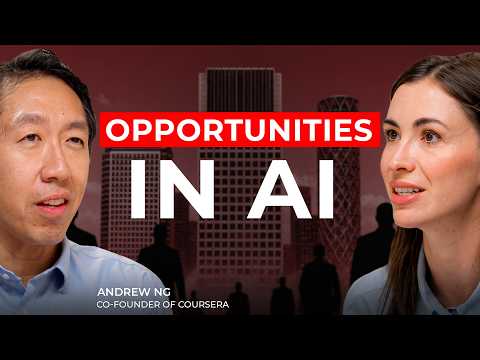
Andrew Ng: For an individual that wants to build, I don't think it's one size fits all. But because the cost of building has plummeted, I encourage people to learn AI, build fast, and talk to customers. I find myself building things I don't know every week, every weekend because I or someone on our team have some problem and I have some idea for building some AI thing to automate. Last weekend I was using a frontier model to analyze a lot of our key business metrics because I didn't have time to do it myself, but it was measuring key business metrics. What's happened with AI is the cost of building has plummeted and so the challenge is shifting to deciding what to build, which I've been calling the product management bottleneck. So people, founders, engineers, product managers, they can talk to customers, get a sense for the taste of judgment on what to build, and then build with AI and iterate quickly. I think that's just a ton of exciting things.
Marina Mogilko: That answer gives you a pretty practical place to start. Look for a recurring problem that costs a business time or money. And when I say boring niche, I don't necessarily mean an entire boring industry. Sometimes it's just one annoying workflow inside a normal business that someone still has to do every single week. And maybe you are the person doing that single boring process, which makes you actually the best founder because you know the process inside out.
This is how I started my company LinguaTrip, where we help people study abroad because I was that student booking all the schools and I didn't have this technology back then. We did everything by hand, but it is just the proof of this pattern. When you're inside the process, when you're the person doing everything by hand, you're the one to solve the problem. So this is your inspiration to start. Even if you think I'm just an employee and I don't know how to start a company, you have all the information to do that.
So a lot of people are asking, how do I get AI to actually do work, not just chat back and forth? This part of the video is brought to you by Omnisend. You open Claude or ChatGPT and connect your Omnisend account in a few clicks. The newest version added read-only permissions so you can give it access without letting it touch anything and any email it drafts for you now comes back fully editable.
From there you can just ask it: run a health check on my account. Score my campaign cadence, automation coverage and product catalog out of 100. Then tell me what to fix first. It comes back with a score for each area and the top three things to fix. The kind of audit that used to mean digging through three different reports, probably missing something. Some of the queries that we run ask for top five campaigns by revenue over the last 180 days. Have you checked your deliverability across recent sends and for that you use the same window and the same conversation. Omnisend customers get $79 back for every dollar they spend. The official app is coming soon but the setup right now takes a few minutes. Go to www.omnisend.com/aimcp. It is also linked in the description.
And here's some interesting data for you. The OECD found generative AI adoption was the highest in information and communication while more traditional and physically intensive sectors were further behind. And even among small businesses already using generative AI, only 29% said they were using it in the core activities of the business. Andreessen Horowitz, a top investment firm in Silicon Valley, looked at more than 600 US industry categories from laundromats to veterinary clinics and reached a similar conclusion. Cheaper software can make small, highly specialized markets viable.
So I went through seven areas I'd look at and rank them using three things: How easy they are to start in, how valuable the problem is to the business, and how much industry expertise you need to actually solve the problem well. And there is a pattern. The easiest opportunities are lower on the list. As we move toward number one, they become more specialized, the cost of getting things wrong gets higher and domain expertise matters more.
So, let's start with number seven. Local marketing for physical businesses. This is probably the easiest one on the list today. And it's not about making 30 Instagram posts. We all know that doesn't work. The AI generated social media post ideas are bad, but it's good at spotting patterns. Bring all customers back. Respond to inbound emails, turn missed messages into appointments. For these tasks, you can show a before and after pretty fast, and you don't need years of industry expertise to get started.
Number six, home services, HVAC, roofing, pool companies, repairs. We have tons of them here in Silicon Valley, and they still operate really manually. The guy comes to clean our pipes, he still writes all the estimates on a piece of paper. But the money that they're making, oh my god. They cleaned one of the pipes with a special machine. $750. Welcome to Silicon Valley. I like all of these boring industries because the money leak is usually really obvious. Somebody misses a call, an estimate goes out 2 days late, nobody follows up because the competition is real. That makes the ROI easy to explain to an owner and you can start with one narrow workflow.
Number five, property management. You already saw this with Alex Mashrabov. There are more moving parts here. There's listing, inquiry, viewing, paperwork, deposit. That makes the workflow harder to automate end to end, but it also creates a lot more places where time and money can disappear.
Number four, payroll and small business bookkeeping. I personally invested in a startup a couple years ago that was automating bookkeeping with AI and later they raised money from OpenAI and all the other firms. And by the way, when you see this and you think, "Oh, that means there is no place for me on the market." That actually means the opposite. That means there's market opportunity. And the market really appreciates having different competitors with different perks. So maybe that's your sign to start. And we're getting into work that repeats constantly and is directly connected to money, deadline, documents, approvals, reminders. The value is higher, but so is the cost of getting something wrong. So knowing the industry starts to matter a lot more. My friend who started that company, he's not a CPA, but he started hiring a lot of CPAs and tax consultants.
Number three, freight and logistics. That industry is super boring, but they have so many call spreadsheets, status updates, documents, moving between different companies all day. And there's a lot here to automate, and there is a lot of value if you get it right. But this isn't a market I would enter completely cold. You need to understand how the pieces fit together, and it can be quite difficult.
Another piece of business advice like this actually applies to any industry. Ideally, you know some people. Ideally, you have a friend who owns a company. Ideally, you work for that company. As a creator in the US who's been doing this for 12 years, I can say that in the creator economy, everything also runs on personal relationships because people trust people that they know. So don't be discouraged by lack of success in the first few years. You're just learning how the industry works. You're making necessary connections and your goal is for other people to see how useful you can be to their businesses. It doesn't happen overnight. Even in the AI era where information travels fast.
Anyways, number two, document workflows for small law firms. As someone who went through the immigration process, I saw how broken it is and it is still very broken in 2026 because your lawyer has to manage so many documents for different people and my pile was like that for my O-1 visa. There is intake, there is sorting, there's status updates, there is reminders, there is a huge amount of repetitive work around the actual legal work. But this is also where the expertise barrier comes very real. AI can organize the workflow. Legal judgment stays with the lawyer who remains responsible for the work.
And finally, number one, dental and medical billing. Oh my god, I had a couple of very prominent doctors here on my podcast working for top institutions and they both were saying how broken the system was. And it is number one not because it's easy. It's almost the opposite. There's forms, codes, rejected claims, resubmissions. The work repeats constantly. Mistakes cost real money. And you really need to understand the industry. And that's exactly why I find it super interesting. And the more people I talk to inside the industry, the more they tell me the solution has to come from outside. So if you start working with a small clinic that you know and come up with solutions and can scale that, this is actually the best way you can do it. And of course, if you have experience working inside that industry, it does become your advantage against someone who just built their first AI agent over the weekend.
I don't mean that everyone should go straight to number one. Of course not. Everything depends on the level of your ambition and how you reason about starting a business for yourself. For me, I always try to solve problems that I understand that I encounter daily and I know what a great solution looks like because if you don't know what great looks like, it's hard to program your way to a good solution. In an ideal world, of course, you want the most valuable problem on this list that you already understand unusually well. And whichever one you choose, keep the offer narrow. AI for dentists could mean almost anything. I help dental practices follow up with every new inquiry tells the owner exactly what you solve.
One thing before we keep going, if you want the full version of what we just went through, I put it in my newsletter, Future Proof. We take the use cases and the exact workflows from every one of these conversations and turn them into something you can actually apply. Plus, how I'm using this stuff in my own team. This week, I'm sending the full ranked list of these seven niches and the one-page map I'd use to find where a business is losing money between steps. The one I described with a property company. It's free. Link is in the description. You get that one and you can read the previous issues and see what you missed. Keep watching because at the end I'll pull all of this into a five-step 90-day plan. How I choose one niche, set the first paying client, and figure out if you can actually make money before quitting anything.
But first, there is an obvious problem with this ranking. The opportunities near the top are also some of the hardest businesses to change. A dental office or an accounting firm isn't going to rebuild its entire workflow because somebody walks in and says AI agents. Fair, but that doesn't mean they aren't already experimenting with AI. Eddie Kim is the co-founder and head of technology at Gusto, which serves more than half a million small businesses, and he sees something very different. Here's what he said.
Eddie Kim: A lot of small businesses start using AI to help run their business. I think maybe even a little bit more so than your average tech startup or enterprise business. And I think the reason why is because just out of necessity. Small businesses have so much less resources. They have to be a lot more creative.
Marina Mogilko: That creates a very practical opportunity. Take the AI tools the business is already experimenting with and turn them into a process the team can actually use every week. And this is where that expertise score really matters. You don't necessarily have to enter one of these industries from the outside. The easiest way may be to already be inside. Jesse Zhang, the CEO of Decagon, has already seen customer support employees move into new roles designing and managing AI systems.
Jesse Zhang: For us what we're seeing actually with a lot of our customers is that people grow into new roles that are much more exciting. So there's now this concept of a conversation architect or AI architect and their whole job is to use Decagon to design the way that their AI should behave. That requires a different skill set. You have to be fairly good at reasoning. You have to be fairly good at communicating.
Marina Mogilko: And they were customer support before those people.
Jesse Zhang: Yeah, so before they were either managers, CX managers, or they were in charge of their original knowledge base or they were in charge of the old school chat bots and so their roles have kind of evolved as well.
Marina Mogilko: If this becomes a side hustle, describe it in the owner's language. An auto shop owner cares about getting missed calls answered and appointments booked. The technology behind it is secondary. So the offer could be, "I'll respond to every missed inquiry, collect the details your team needs and pass along qualified leads." With one client, that's a side hustle. If the same offer works with several small businesses, you can standardize it into a productized service and charge monthly. A useful starting question is, "Which manual task does this business already spend money on?" In Eddie's example, AI helped surface a potential tax opportunity and prepare the paperwork.
Eddie Kim: And that's one of the ways that we're leveraging AI. We're using AI to analyze all the things that we know about a small business and proactively letting them know of things that they should be doing or things that they should know about to help improve their business. And what you just referred to is called the R&D tax credit.
Marina Mogilko: When you're developing something.
Eddie Kim: Developing something, it's a tax credit that's given to any business in the US that's doing some qualified research. We helped this one company called Cabana Pools where we use AI to let them know that they are actually potentially eligible for this R&D tax credit. Not only did we do that, we actually helped them fill out the forms, also very much assisted through AI that they then submitted to the government agency and ultimately got $50,000 in R&D tax credits, not just one time, but year after year.
Marina Mogilko: This is where pricing gets interesting. If AI lets you finish in 20 minutes what used to take 2 days, that doesn't mean the client suddenly got less value. They're still getting the same result. Allie K. Miller put the rule much more simply: Stop selling hours. You said you're personally 10x more productive?
Allie K. Miller: In the past, some tasks 2x and some tasks I'm like, "Oh my god, where did the time go?" It feels like the concept of an hour has changed. Something that I talk about with my team a lot is just, "What is time? What is time? What are we doing? Should we ever charge by the hour again?"
Marina Mogilko: We're actually switching that in my team because we used to pay by hour and I'm like, we should pay by video because I don't care if you spend 5 minutes on this video. If you have a process set up, then...
Allie K. Miller: We made that same. When did you make that shift? A week ago. But still, but now is the time. I think paying by output and at a minimum quality level is the right play. So if you are someone who's, I don't know, you're building AI SEO strategies for small-medium businesses in your neighborhood, which is perfectly lucrative right now and still is a really nice business opportunity, or you're building websites for restaurants in your area, whatever it is. Maybe before it took you two days of work, you are still giving the same level of value to that end buyer. They were no more likely to solve their own problems. So why would you charge 1/48th of what you used to charge just because you can do it in one hour instead of two days?
Marina Mogilko: For your first client, start with someone you can speak to this week, a former employer, a client from your day job, your accountant, or a friend's company. Ask them to walk you through the mess. What happens after a missed call? How do they prepare an estimate? How do they chase missing documents? If the same complaint comes up several times, build a small pilot around that one workflow and show a clear before and after. At that stage, the client only needs evidence that you can make the problem smaller. Once you have a niche, a problem, and an offer, give yourself a limited test. Daniel Priestley suggests 90 days.
Daniel Priestley: Deliberately do some side hustles that are open and shut within 90 days. Open and shut side hustles might be I'm going to promote a workshop and it's going to be $300 and there's going to be 30 people there and I'm going to organize it and deliver it and everything's going to go open and shut in 90 days, and it's like...
Marina Mogilko: Because there's no pressure of continuity like I have to do this for you.
Daniel Priestley: Exactly. It's just a complete start finish thing. You might say, "All right, I'm going to be an AI consultant to some small businesses, and I'm going to do that for 90 days and see whether I can do that." It's not going to be a business. It's just something I'm—it's a project for 90 days. I'm just testing it out to see how that works.
Or I might see if I can sell 100 items of clothing in the next 90 days. But the commitment is it finishes at 90 days. So you're able to start, have a go, finish all in 90 days. If you make a grand, if you make two grand, fantastic. But it's about the learning of going through a value creation cycle.
Marina Mogilko: So where would you actually start? If you're completely new to this, I'd stay closer to the bottom of the ranking: local marketing, home services, maybe property management. The problems are easier to see. You can talk to an owner quickly. You understand the problems better, and you can test one result without needing years of industry experience. But if you already work in accounting, logistics, legal, or healthcare, I would not ignore that experience because the industry feels boring. That's exactly what lets you move toward the more specialized end of the list. So the goal is to find the highest value boring problem that you understand better than most people.
And once you picked it, I'd run the same five-step 90-day test. First, choose an industry you know well enough to recognize its small recurring problems. Then map out one customer journey from the first inquiry to payment and mark every point where someone waits, copies information or follows up manually. Third, find out what the business already spends on that problem—staff, agencies, freelancers or software. Fourth, package one clear result: faster responses to new leads, missed inquiries turned into booked appointments. And finally, give it 90 days. Talk to real customers, test one offer, and build one working pilot. By day 90, you need three answers. Did anyone pay for it? Can you repeat the result? Can you deliver it faster for client number two? Three yeses and you have something worth pursuing. The next good AI business may still look incredibly ordinary from outside, and that's the whole point. The boring part might actually be your advantage. Thank you so much for watching to the very end, and I'll see you soon.