$13B Lovable Co-Founder: Turn Your AI Side Project Into a Real Business — Silicon Valley Girl Podcast
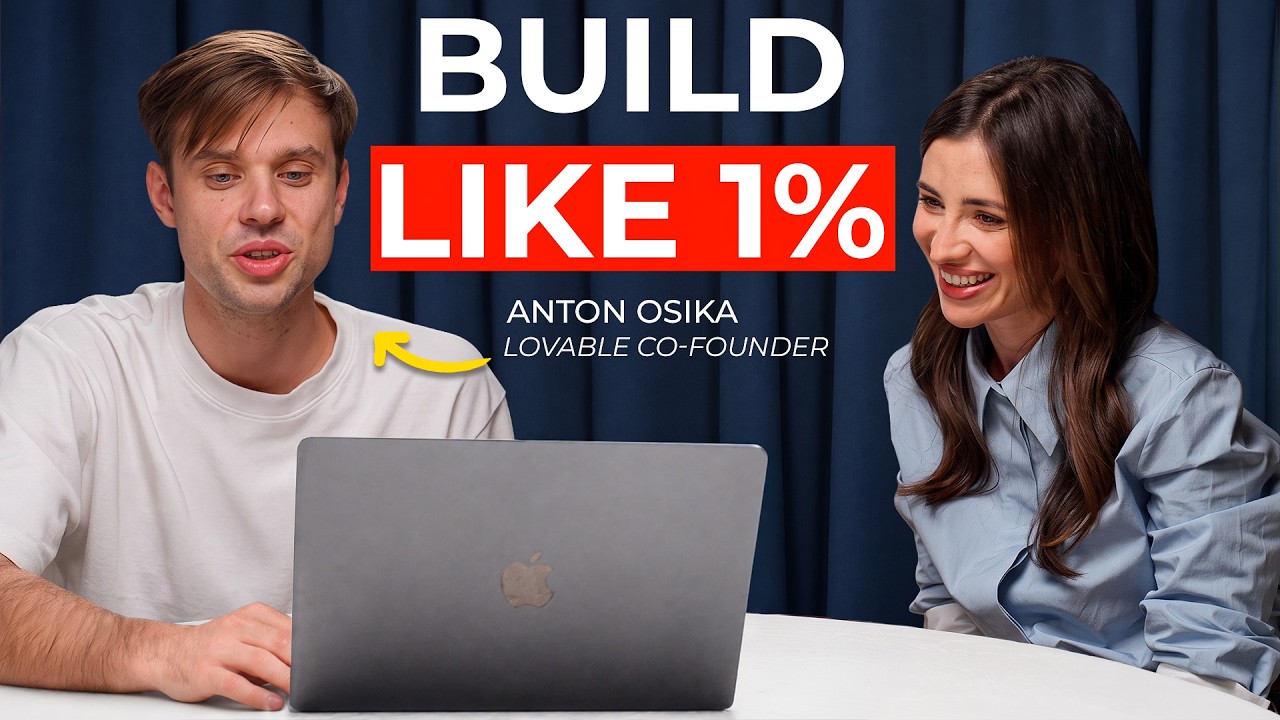
Anton Osika is the co-founder of Lovable, a no-code AI platform valued at $13 billion that enables anyone to build functional applications without coding expertise. Under his leadership, Lovable-built apps have grown to receive nearly one billion visits monthly, with more than one-third of platform users generating revenue from their creations. Osika focuses on making software development accessible to entrepreneurs with domain expertise but without technical backgrounds.
Marina Mogilko: We're abandoning the word vibe coding.
Anton Osika: Vibe works for demo, but we're way past that. You don't build your company on vibes.
Marina Mogilko: This is Anton Osika. He launched Lovable, where anyone can build an app without code. Less than 2 years later, the company is worth 13 billion. Together, apps built on Lovable now get nearly a billion visits every month. And more than a third of the people building businesses on the platform are already making money.
I've seen those apps built on Lovable. $300,000 a month.
Anton Osika: Yes.
Marina Mogilko: Why? How is that a business idea?
Anton Osika: I think the creativity is the biggest differentiator as the execution becomes easier.
Marina Mogilko: Everyone in the knowledge worker space should be building for yourself to make their lives easier.
Anton Osika: Everyone should build an agent for themselves. Is it okay if I do the prompt here?
Marina Mogilko: Please. I want to see your prompt.
Thanks to HubSpot for Startups for sponsoring this video. When I tried vibe coding, there were so many errors even a year ago. The QA was all manual. You would run into bugs. Now you said you're abandoning the word vibe coding.
Anton Osika: Vibe works for demo, but we're way past that. You don't build your company on vibes and people are running their businesses on our platform. I have these amazing founders, Sabrin. She's building a startup called Plink and she wanted to solve a real problem that she saw in the world which is that can I trust this person I'm dating and she's been able to reach tens of thousands of dollars in revenue on something that's just for social good and the beautiful thing that I think it comes back to is that it used to be so hard to build software and it used to be a lot of overhead to run your business and you can now simplify a lot of those things and that's not something you do on vibes, it's something you do on a serious platform.
Marina Mogilko: When you think about a problem that you're solving, do you have a framework in your head? How do you solve a problem that seems big? Do you separate it into tasks? When you have a problem that you want to automate, what is your thinking process of how to do it step by step and whether some of the problems are worth automating and some not?
Anton Osika: I think it's usually good to just do things manually and then be systematic about how can I break this down into pieces that I can test and see if I can get value from. If something is broken, that replicates the thing I used to do manually. If you're overengineering or overly ambitious from the get-go, then you might end up being very close, but there's some small part somewhere that doesn't work in the way that you thought it would work or your solution wasn't the right one. You want to avoid that. You want to iterate towards perfection.
Marina Mogilko: So do you think because doers are becoming entrepreneurs, do you think people who are day-to-day working on some boring tasks are becoming the best position for the next three years to become entrepreneurs?
Anton Osika: We're seeing from our customer data that most people on our platform have more than 11 years of professional experience and they've come very close to a problem that they've been frustrated they can't solve with skills that they had at the time and now the person who's closest to the problem can actually go out and solve that problem and that's one of the biggest unlocks of these new technologies.
Marina Mogilko: Do you see that group of people generating the most money with Lovable?
Anton Osika: For most of our customers, it's people who are building and they're already generating revenue themselves or tracking towards building a business towards generating revenue. Most of them have experience. There's also a lot of young people who are building companies as you might know in this day and age. And that often is connected with having advantages of seeing things with fresh eyes for the first time if you're a younger person. But we're seeing people across the spectrum, across the entire world, every continent and every country building very serious things on the platform.
Marina Mogilko: Love it. If someone's watching and they're like, "Okay, this sounds incredible. I want to build something. Can you give me some ideas? What do you think are the top three opportunities to build these days?"
Anton Osika: I think what you want to do is solve a problem that is not just on the internet but usually want to build something connected to the real world. A combination of a service and a product and those two things together can actually make it really good. This is the type of direction that I would be going if I was starting a business myself.
Marina Mogilko: It's even something that hasn't existed.
Anton Osika: I don't think you need to start something that is completely new either. You can take a fresh take on something. You can go out and talk to people who aren't yet adopting a solution that exists somewhere and see how can I make it so exciting for them that they want to adopt it. It could be something in how they get their groceries or how they get things in their home taken care of and you can personalize it for them.
Marina Mogilko: If you're an entrepreneur with that hustler mentality, finding a good idea is the first step. The next one is growing it into something bigger.
I love learning how successful founders think and steal a little bit for my own work. The best cases go into my newsletter. It's called Future Proof so you can repeat them yourself. In my recent issue, I show how the top founders use AI for everyday tasks. There are rules and prompts step by step, plus a bonus, the one prompt I run every single month that helps me with my productivity. Get it right now. The link is down below.
Do you have any ideas what everyone in the knowledge worker space should be building for yourself to make their lives easier?
Anton Osika: I think everyone should build an agent for themselves. And if you do it from scratch or you use AI to build it for you from scratch then you get a better understanding for how an agent works because you can ask how did you implement building this agent. So I think that's something we could build today. I also wanted to actually make a refresh on your personal website if you wouldn't mind.
Marina Mogilko: Oh please let's do it. Absolutely.
Anton Osika: There was a specific challenge I heard about which is how you handle everyone who wants to talk to you and who sends you emails I imagine and building an app specifically that helps sort that out with the help of AI.
Marina Mogilko: By the way let me ask quickly when do you build an agent? When do you build an app?
Anton Osika: I think everything that needs data is an app. And then if you want to oversee what is in the data and have some pieces that visualize what this app does, then you of course want a graphical user interface. A recent thing we added to Lovable is that for every single app you can connect that to any agent harness. It's called agent integrations. And then it's almost like the data that you're talking to is a part of the agent. You can use Lovable as that agent. You can use Claude, ChatGPT, whatever. So these things are actually merging depending on how you like to think about it.
Marina, I said I really wanted to create a new version of your website.
Marina Mogilko: Yeah. And I don't know if Lovable is going to do it automatically. It looks the way it looks. It used to be much more stylish but then we redid it for SEO and we didn't really pay attention to design. We just paid attention to being visible for agents, chat bots, and AI. So that's why it looks like that.
Anton Osika: So there is a primitive in Lovable to optimize for SEO.
Marina Mogilko: Do I need to say it to Lovable?
Anton Osika: We'll first make it look good and then we'll optimize it for SEO.
Okay. So tell me something about what you care about with your website in terms of the brand and the aesthetics.
Marina Mogilko: Absolutely. So Silicon Valley Girl is a podcast that helps people see the bridge between them and Silicon Valley because for a lot of people Silicon Valley is where stuff happens, AI, whatever it is. My goal is to translate what that AI means for their daily lives. For an entrepreneur that means building things faster. For a mom that means managing household with some agents and maybe in 10 years having a robot that does the laundry. For someone who's an artist that means managing the whole production flow with AI and I interview founders and scientists who are building those tools and ask them to show me what I can do today to feel the magic of AI.
Anton Osika: Great. Let's see if we can make a new version of the website based on that just so that it has something to reference. I think we can put in the URL to the current website. Now what Lovable is going to do is research your current website, look at how it looks, look at how it's implemented and then depending on how you want to use it, ask you some clarifying questions or it will just give you the first version that we can look at and iterate from there if we don't think it's perfect yet.
Marina Mogilko: Can I see the prompting that's going on there?
Anton Osika: You can click and see what's happening under the hood. Here are the details of how it's thinking through finding the current website that you have today to be able to compare with that one.
Marina Mogilko: So the color grid we have white, red, black. Let me pause here for a second because this connects to something we've been building for the last few months. After every interview on this show, my team goes through the transcript and pulls out the specific ways these founders actually use AI in their companies. Some of it we put to work right away in our own business and it's changing how we operate almost every single week. Over that time, we went through hundreds of use cases and together with HubSpot for startups, we collected the best ones into a free database. 120 plus creative AI use cases from Silicon Valley Girl. This is the stuff that top 1% of founders know and sometimes don't share publicly. And now anyone can get it for free. It is sorted into 11 categories: marketing, operations and logistics, customer support, hiring, pricing, legal, and more. Every case has a build level—beginner, intermediate, or advanced.
So if you've never built anything, filter to beginner and start there. If you're already working with different tools, go straight to the advanced ones. My favorite one so far is content gap identifier. We actually tried it in our own business and it was really helpful for finding video topics because I can not only analyze what's working on other channels or what no one's covering, but also cross reference that with my audience's comments and interests. Right now, building is no longer the hard part. The hard part is choosing what to build and how to grow it into something real. I really hope these use cases help you with that. It's free. The link is in the description. Thanks to HubSpot for putting this together with us. Now back to Anton.
Anton Osika: I was thinking we can go back to your original problem statement, build that, and then we get back to see how the first how this new website the email.
Marina Mogilko: There are so many different types of queries that come to our email. So my initial thought was an overview of what was going on, categorized AI intelligence to tell me oh this was actually major.
Anton Osika: Is it okay if I do the prompt here?
Marina Mogilko: Please.
I want to see your prompt.
Anton Osika: So let me tell you what I heard you say and I'll have Lovable listen in. You want a lead capture form for Silicon Valley Girl and anyone should be able to reach out to you about different types of opportunities. Then you and your team should be able to try it and see all the opportunities sorted by how relevant AI thinks these are, with a proposed answer. Then when they maybe let you choose what the AI proposed or they do some edits, they can send the answer back to the person who reached out. Is that correct?
Marina Mogilko: The question is should it be inside the email since we already have our email listed on several websites, or should we now just list the website so that they fill in the form? Because for me—
Anton Osika: You could take care of the inbound emails as well. That's a great question. Let's start with this and then we can use the same flow and connect and read the emails as well later on.
Marina Mogilko: So we can do both. What kind of opportunities should people be able to submit? The thing is, when I think about the forms on the website, I want it to be first of all as free flowing as possible to give people some freedom.
Anton Osika: I think in the interest of time, let's tell Lovable to be as fast as possible at implementing this as well.
Marina Mogilko: Shall I just write it down as fast as possible and don't limit to any use case?
We'll let it build.
Anton Osika: Now we can just let it build. It's going to take a few minutes. You're wondering what's happening here?
Marina Mogilko: It copied my style really well.
Anton Osika: Lovable keeps asking you which design you prefer and you can zoom in on them if you want to or just pick the one you prefer.
Marina Mogilko: I think I like this one a lot.
Anton Osika: Let's do it.
Marina Mogilko: This is like a knowledge worker can just build for themselves. What separates something like this that is very personal from a business that can be built on Lovable? How do you distinguish what idea is going to make you money? I've seen those dogs built on Lovable. I could not believe when my team was like, "Have you seen this website? The paintings you order with the dog—$300,000 a month."
Why on dog paintings? Explain it to me. How is that a business idea?
Anton Osika: The founder is obviously very curious and creative, and when he sets his mind to something he goes through with it. I think that's the main differentiator. If you can build a serious business on this platform or if you can just build a tool for yourself—both are good outcomes. But for building a business, it usually comes down to how hard you're going to work to make this business work and whether you're going to be able to make people who would be your customers care about you and understand that this is something exciting that they want to be a part of.
Marina Mogilko: When I'm looking at a lot of businesses as an entrepreneur myself, I'm like, "Okay." Even when I have ideas, I tell myself, especially if it's like a dog idea—like, "I'll make a dog look like a painting." This can be done with ChatGPT with an easy prompt. How do I tell myself as an entrepreneur to keep pushing? I don't know if you talked to that guy because he's the best example of it because I tried and I could do the same similar thing with ChatGPT. How do you not stop when you know ChatGPT or Claude can do this with one prompt?
Anton Osika: Damian who built this surrealism world website doesn't just create the images for the dog—he sends it home to you as a portrait. And I think entrepreneurship is usually about combining those new discoveries into a service or a solution that hasn't been built before. That's when you can really make people care about it. That's what he did: combining the website, the payments, and finding marketing for the service.
Marina Mogilko: This is amazing because he added this extra feature and turns out there is a market for it. How do you first of all know there's a market for it and how do you price it right? Even when it comes to Lovable and pricing—how do you think about it?
Anton Osika: There are different approaches. You can be just in your garage. But the most reliable and fastest way to learn about your customers, which is key, is to get in front of 10 customers or potential customers and tell them about what you're thinking of building and actually dig into what they care about. Ask a lot of questions from your customers: what's a pain that you're experiencing, what interests excite you? Then get in front of 10 customers and try to make one of them actually buy and pay for what you're building.
Marina Mogilko: Is that what you do with Lovable as well? Do you still talk to 10 people before you build a new feature?
Anton Osika: That's what we try to do.
Marina Mogilko: Do you think 10 is a good number?
Anton Osika: I think 10 is a good starting point. And in terms of pricing, I think you should get 10 really big fans of your product. One way to know that they are really big fans is to not make it too cheap and not make it free because it's only if they actually pay that you know this is something they really care about.
You introduce that friction to know that they really like the product. Then you should hope that they spread the word. Make them feel special and make them spread the word about the product that they are paying their hard-earned money for. Then hopefully you get more customers from them and over time figure out how to scale that distribution.
Marina Mogilko: Also knowing how big it can get—because if you have a lot of ambition, sometimes you think "maybe this is a too small problem to solve." Do you think a good entrepreneur starts with a very small problem and then finds a way to scale it?
Anton Osika: I think it comes from both sides. Some of the most authentic products start with a problem for yourself. I was, to some extent, passionate about building Lovable because I felt that there are so many ideas both from me and people around me that will never come to fruition because of how hard it used to be to build software. That's what we started with—being able to give anyone who's really close to the problems and who has that ambition and ideas the new tools to do it. That's what our mission remains to this date.
Marina Mogilko: Let's see what it's building for us. This is it: building work with Marina brand deals. Anything. Tell us your name. What's it about? Budget or timeline. I like it.
Anton Osika: We can polish the UI later. But just from your point of view, the first reaction, what do you think about this?
Marina Mogilko: I think it's great.
I like that it's also opportunity, so it filters for serious requests.
Anton Osika: Let's test it out with some example data.
Marina Mogilko: Only such opportunities. What am I proposing? Sponsor the podcast.
Sponsor, yes. Sponsor pod. Send opportunity. And then here we can see the inbox now.
I'd love to see the budget right here so I can prioritize.
Anton Osika: Let me show you how you can iterate a bit on the visuals by creating a new draft. What you would do is go up and click new draft at the top and under the title here.
Marina Mogilko: So it's going to create the same version but looking different.
Anton Osika: Yeah. And then we can choose which one we prefer. And then we can use the microphone again and say, "Hey, let's improve the styling a bit." You can maybe find Marina's Beehive website and take the branding from there, which I think looks pretty good. And let's say while we're iterating on the branding, we should put your face on there.
So if you just search for your name, take a copy of a photo, we can paste it back into Lovable and the—
We can ask you to put on your face in a way that makes it feel more personal.
Marina Mogilko: Great photo.
Do this one. My signature. Oops. And we just put it here.
Anton Osika: You can just drag it in from up there.
Marina Mogilko: Add it to branding.
Anton Osika: Add it at the top.
Marina Mogilko: To the top. I wonder will it look stylish enough?
Anton Osika: I think it will understand that this is a photo of your face.
And we will add it to the top. Photo was added. I think it looks better. Do you want to check if we also want to add the new branding? If we like that one by going back to the other draft.
Marina Mogilko: Ah, this is so much better.
We can also look at the website meanwhile.
Do you want to look at it?
Anton Osika: I like that you're also multitasking.
Marina Mogilko: Whatever.
Anton Osika: So, we asked for a new take on your website. What do you think?
Marina Mogilko: I think it's great. I think it looks amazing. Question is, does it help with SEO and AI?
Anton Osika: That's a great question. Click on SEO and AI search. And here you can do a bunch of things. The thing that I think is the simplest thing to do is to just tell Lovable, hey, we want this geo optimized by doing a scan on how can we improve discoverability for AI agents and Google. So these are example questions that you could do if you want to research how can we differentiate more for a specific audience. But now it's going to run your full SEO and AEO.
Marina Mogilko: Can we make sure that the team receives an email when a request comes in and that people who submit the form get an email that it was submitted?
Anton Osika: I think it's fun with all this listening.
Marina Mogilko: I know, I have too many assistants.
Anton Osika: But it's Whisper Flow and Granola, same as me.
Marina Mogilko: Cuz Lovable is recording. It's going to give me feedback on how I did on this podcast right after. I have an agent that grabs the transcript and then gives me feedback.
Anton Osika: I should have this.
Marina Mogilko: And Whisper Flow is just—
Anton Osika: In my meetings with Senka, she can roast me.
Marina Mogilko: It's actually so much because AI is more empathetic than my brain. For example to me, empathetic. It was like Marina you did well. It's okay. It's so nice. You mixed this up but it's fine. Next time you're going to remember. It just makes me feel better because if it's me, I'm just roasting myself.
Anton Osika: Okay.
And here you can see some more of the primitives that is making Lovable into a platform for you to run your company on. So you, as you can obviously assume, you can store data in there. You can handle emails, but you can also do things like payments, connecting to your existing emails or connecting to any other tools that you might use. You might for example want to get this posted in Slack when there's a new email coming in.
Marina Mogilko: Cuz now we have, now that I'm thinking, we have everything that's running like inside different AIs and projects. If we connect all the emails, all the corporate emails to this and make it a hub where you see all the brand deals and what's working, like if we have email for producers that are working on a particular video and there is a brand deal, like it all gets connected. So it's like building a back end for your business, not just and this connective layer between the different things as well. How much more expensive is this versus using just a Claude project for running your business? Because like in terms of tokens?
Anton Osika: For the building piece, it's very similar in terms of costs and what you get as well is which is going to be included for free is the hosting for the projects that you're using, which is very scalable on the hosting side and you get these things like the analytics. So you can use Lovable for free, then pay with a certain amount of credits, and then if you want to upgrade the default is $25 per month.
Marina Mogilko: And how complicated can the setup be when I'm building something? Can you draw me a line where it stops being something that can be done on Lovable and I have to hire a developer? Does it exist?
Anton Osika: I think so. That line and the line is probably moving. The line is very much moving and it depends on how dedicated you are and how much of a creative problem solving person you are. If you are dedicated and curious and really want to learn the things, then the line is very far out. If you for example building Facebook requires you to have a lot of load, a lot of hundreds of thousands of customers at the same time and do it globally, that is outside of the line, but most of the software that I'm interacting with day-to-day you can build in Lovable.
Marina Mogilko: What about something that I built 12 years ago with the help of different developers, study abroad booking platform?
Anton Osika: I think that's a great example. You can build it with Lovable. And the thing which I hear from our customers is that they are usually the ones who understand their users and their customers the best. So they're closest to the problem and that's why you often end up with a very good polished, very well-thought-out product compared to if you have very slow cycles where you have to hand off every few weeks.
I remember that. So that's a big part of the advantage of building on this platform and what we work really hard for is that it just works and you can focus on your customers and the product vision that you want to have.
Marina Mogilko: And because ideas can be deployed that fast now. Do you think ideas still matter these days? Because remember how people used to say idea doesn't matter because you have to build it, you have to deliver on it.
Anton Osika: The ideas are becoming more important. I think the creativity is the biggest differentiator as the execution becomes easier. And you can, even if you're curious and smart about it, you can figure out how do I make Lovable run in the background and do work for me when I'm not there, so that you can really focus on the next big idea for your business and lean into the creative parts.
Marina Mogilko: How do you develop your creativity? Any ideas?
Anton Osika: I love that question.
Marina Mogilko: Do you go to museums? Look at art.
Anton Osika: Being bored, I know is good for creativity. But I think every person has creativity within them. And the best way to improve, increase your creativity is, sophisticating it by trying to build.
And by taking your ideas and putting them to the test. And when you're doing that feedback loop, that's actually when your creativity that everyone has becomes more refined and more applicable and you actually have more useful ideas.
Marina Mogilko: And when you have so many ideas, how do you like, when do you stop and tell yourself this is what I'm going to work on? Just because in this world where it's easy to build ideas and you have so many ideas, how do you select the one that is really worth pursuing?
Anton Osika: I still struggle with this sometimes. Obviously you build this. So sometimes you want to really push through even though you realize that the problem was harder than you thought and sometimes you should say hold on with that idea. I'm going to take the next idea and then I'm going to take the next idea until you find something that really works. The way to do it, I think it's a learn skill to develop. In terms of, is this thing, how big can this thing become and why isn't it working as I want it to work yet? Is it just me, not talking to more people? Is it me being better, have to be better at marketing, or is it that the product has some bugs and glitches that make people not retain? I think it's being good at spotting that bottleneck. Why is it not, why is the idea not working yet? That makes you become good at deciding should I continue?
Should I take the next idea?
Marina Mogilko: And I also think the scale because I read your story how you realize that you're going to build the last piece of software. I think when you have this major idea that's so transformative, it gives you more energy to try and pursue it.
Anton Osika: Yes. You should, I think it's very important to lean into what gives you energy and to me that is, to a large extent, the people I surround myself with and are there people that are giving you energy that you can work with? And then you can usually run through walls together to a completely different extent.
Marina Mogilko: How do you think about competition? Do you ever have these thoughts like ChatGPT, Claude can build, they can build apps?
Anton Osika: I don't think so much about competition. The platform we're building is becoming this perfect place to run your business and we're not doing code generation. We're doing this creation of businesses for our customers. And it's still extremely early days in this complete agent development. So there's, we're naturally going to see a lot of companies like us continue to grow at this extremely rapid pace. And what I focus on is to look at what are our customers trying to do and how can we really make the best possible product and platform for them to reach their objectives, which is to build a business and then to run and operate that business and actually help them with growing your business as well.
And we, I showed you there that you can make your website AEO optimized. That's one of the pieces that makes it so that there's millions of visits to Lovable apps. I think there's actually a billion visits every month to Lovable applications.
Marina Mogilko: Do you have any fears at all that when AGI comes, I don't know, models start building for themselves, like when you think about 5 to 10 years ahead?
Anton Osika: I think we're going to be in a world where focusing on your career and making money is going to be less important to many people and it's more going to be focused on how am I a good person to those around me and to my community. But trying to build a business is still going to be one of the key ways of developing yourself, learn skill set and creating valuable things for those around you. And what we're working towards is that the overhead and the cost of making a business run is going to be so low that there can be much much more companies that exist.
Marina Mogilko: All right. Well, let's see what it's doing for my business now. And it's a CRM for managing those. What's the 10? What's the five?
Anton Osika: We asked in the beginning for scoring them according to AI.
Before we wrap this up, I have an idea in how we make sure it actually works. I would just tell Lovable, can you test this end to end? Both submission and answering the email in the inbox and then you can tell me what we need to check in our inboxes to verify that it worked and if you run into any problems. We're doing the end to end test. I just want to queue up and tell you something that I think is very important and it's that we do a deep security scan to make sure this is ready to be published to the internet. Do you want to just ask for that?
Marina Mogilko: Do a deep security scan.
And I just send it. Okay. We asked it to do an end to end test. It submitted a fake pitch. It tells me to check my inboxes and it didn't find any errors. So it does QA.
Anton Osika: It did some QA here and it said it has sent two emails.
Marina Mogilko: Brand deal sponsorship. Beautiful. And then did it reply to the—
Anton Osika: Yeah, that's what I want to see. It did.
Okay. So here it actually decided to say yes to a collaboration.
Marina Mogilko: Nice. But ideally I just see before sending. But that's great.
Anton Osika: Marina. Now, as you can see, I love building things and I hope this is valuable to you.
Marina Mogilko: Totally. It's been fun to build together.
Thank you so much. Let's wrap up with a step-by-step plan for someone who's launching a business with Lovable. So we talked about figuring out the idea. We did the whole demo coding or creating a platform. What are the next steps that they should be taking?
Anton Osika: The first thing is to have an idea and I think you get that by taking something from your own life or from people you're close to that experience a problem and then you find your idea for how to solve that problem and you try to find a few people that are willing to pay for your solution and when they're actually willing to pay that's a great sign that they care and they're excited about what you're doing. But you still want to make sure that they keep coming back and they keep wanting to pay and it wasn't just done from excitement. And when you've gone through those steps, that's one example of clear product market fit. And you should be then starting to think what are the most effective ways for me to find more customers like this customer and think about where are they? How do they find new products and what do they care about?
What is it that's unique about me that I can tell as a story to make those people care about this product and start scaling into a real business that makes serious money.
Marina Mogilko: Which is mostly social media, I guess. These days the answer would be to the marketing question.
Anton Osika: I think there's this fun Twitter about that everyone a carpenter from a small business owner to tech companies they need to be on TikTok and creating reels. I don't know if that's true, but I think it's a fun meme.
Marina Mogilko: It is. Well, a lot of businesses are starting on social media. Thank you so much, Anton. That was very practical and hopefully we inspired a lot of people who are watching or at least some people to start and build something.
Anton Osika: I hope a lot more people take the leap and they go and build.
Marina Mogilko: Awesome. Thank you so much.