Interview·January 30, 2026·42 min
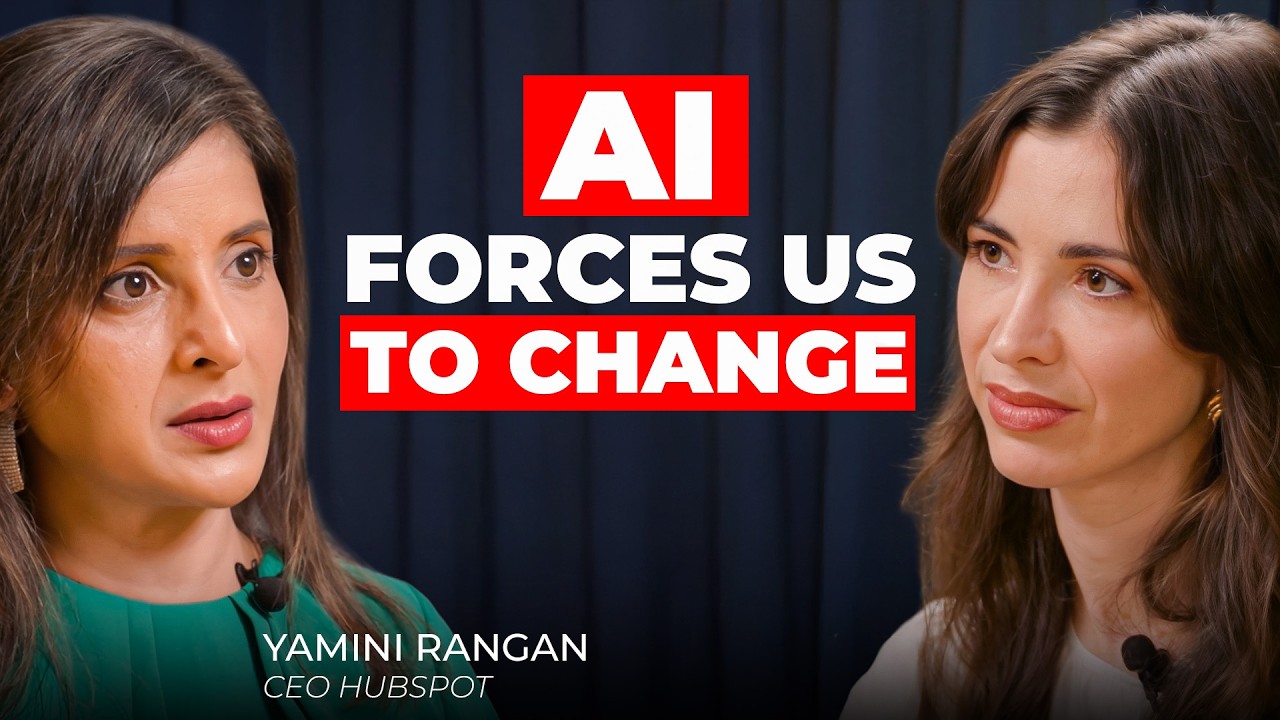
$11B CEO: The Great Career Reset in the Age of AI | Yamini Rangan, HubSpot CEO
TopicsLeadership and mindsetAI skills and careersEducation and learning
In this episode
Yamini Rangan, CEO of HubSpot, joins Marina Mogilko to discuss her journey from arriving in the U.S. with $200 to leading an $11B+ tech company. She shares how she navigated career pivots across engineering, sales, and marketing, stepped into the CEO role during a crisis, and what skills matter most in the AI era. The conversation covers her 5 Whys decision-making framework, the future of college education, and how companies should approach becoming AI-first.
Key takeaways
- Yamini arrived in the U.S. with roughly $200 and graduated business school during the dot-com bust — her first day on the job, half her class was laid off, yet she built a career spanning Workday, Dropbox, and ultimately HubSpot CEO.
- Authenticity over imitation: early in her sales career, Yamini stopped trying to copy extroverted male colleagues and leaned into her natural strengths as an analytical, deep-questioning engineer — which became her competitive edge.
- She became HubSpot CEO after founder Brian Halligan called her from the hospital following a snowmobile accident and asked her to 'just run the company' — illustrating how readiness and trust are built long before a title changes.
- The 3 skills every hire needs in the AI era, according to Yamini, are the ability to learn fast, navigate ambiguity, and think cross-functionally — because AI removes the map and rewards explorers over executors.
- Her core decision-making framework is asking '5 Whys' — drilling five levels deep into any problem or plateau to uncover the real root cause and break through career or business stagnation.
Chapters
- 00:00Teaser
- 01:13From $200 to Running a $30B Company: Yamini's Journey
- 05:56I Still Walk Into Rooms and Think: Can I Do This?
- 07:15Your Past Will Limit Your Future — Here's Why
- 09:14How to Switch Careers Without Experience
- 11:55Navigating Uncertainty: The Skill No One Talks About
- 13:51FREE AI Toolkit: The Big 3 LLMs at Work
- 15:30How She Became CEO: Leading Through COVID Crisis
- 20:18What It Means to Be an AI-First Company
- 22:56Is AI Really Taking Your Job? The Truth
- 24:30The #1 Mistake Entrepreneurs Make with AI
- 26:17The 3 Skills Every Hire Needs in the AI Era
- 29:00Should You Still Go to College in 2025?
- 31:14The Decision-Making Framework of a $30B CEO
- 32:42How to Make Better Decisions Under Pressure
- 34:36The Questions You Need to Ask to Build Your Principles
- 37:52Advice to Your 21-Year-Old Self in the AI Era
- 39:39Ask Yourself 5 Whys: How to Break Through Any Plateau
Transcript
Marina Mogilko: Today with AI, there is no map. So you have to get comfortable with being an explorer. This is Yam, CEO of HubSpot, a $30 billion company. She arrived in the US in her 20s with a few hundred in her pocket. And now she's running one of the most powerful tech companies in the world. You know, you land in Silicon Valley, which is mostly male, right? I still feel it. I go into some rooms and I'm like, can I do this? She navigated her way in a dotcom crash. First day of my job, they laid off half the class. Years later, she joined HubSpot and almost immediately everything breaks at once. Covid hits and a year later, the founder and CEO, Brian Halagan, had a snowmobile accident and he called me from the hospital and he was like, "Look, I need time to recover, so just run the company." I was like, "Really? What what do I do?" And he's like, "Don't screw it up." She steps in to run the company. A lot of people think functionally. I started in sales. Now I'm going to become a senior manager and then I'll become a director. That is great if you want to be just in a function. But sometimes things that got us here are not enough for us to get to our path forward.
Can you give advice to someone who feels like they've plateaued in their career? What is the one thing that they should change right now to start growing? Okay, first off, Yemen, you have an amazing story. You arrived in the US in your 20s with a few hundred in your pocket. Now you're running a multi-billion dollar company as a CEO. For anyone who doesn't know you, can you talk about your background and career shortly?
Yamini Rangan: Yeah, I grew up in India and in a family of two girls. I know you have two girls. We grew up in a super small town, so we should not have been dreaming big, but my mom was just amazing. She really helped us think beyond our little town, our little school. The school didn't go all the way till 12th. So she moved to a different city to make sure that we got an education. And look, I think Marina, if someone takes you seriously, you begin to take yourself very seriously. And so that was a huge thing.
So the rest of the story is I did come here after my undergrad in electronics engineering. I came here and did a master's in computer engineering, worked as an engineer for a handful of years, and then I was still searching for something. I was like, this is not the thing and I want to do something more. And so, you know, like everybody who doesn't quite know exactly what they want to do, I went to business school.
Yamini Rangan: And I went to business school here in Berkeley and I graduated literally at the worst time because it was right after the bust. My first job after business school was at Sevil Systems. The first day of my job they laid off half the class, and then they said they somehow looked at me and said you should be in sales. And I was like, sales? Okay, I have no idea what I will be doing but that's how I got started in sales. And then the next decade was at companies like Workday and Dropbox, which was an incredible experience of being very cross-functional in nature. So I went from sales to sales strategy and operations, and then marketing and customer success. And then I landed at HubSpot in 2020 and it was crazy times. But I will tell you that in a nutshell, my career started as an engineer, went into sales, and then went into multiple customer-facing roles and have just enjoyed every bit of it.
Marina Mogilko: I love it. I love that you changed so many roles and positions in companies, especially as an immigrant. Can you walk me through one of the hardest transitions that you had to make and what was your mindset back then? Like, yeah, I'm going to quit this company and do this?
Yamini Rangan: Well, mindset is a really important word because you have to have a growth-oriented mindset to figure things out. I mean, here I was, newly minted MBA, and I was in the sales organization. I had a quota, and you know Marina, I looked around the room and there were not that many Asian women in the sales organization at that time. And initially, I kind of looked at that and I said, uh, who's the successful person here and how do I kind of become them? Turns out they were all men playing golf, and they were incredible at their job, but they were also exceptionally extroverted. They had a method about that and I was like, you know, I'm an engineer, introverted Asian woman, and I'm like, I'm going to try that. So I tried their approach of trying to sound extroverted, trying to play golf, trying to learn sports. None of that worked for me. So I was like, you know what, this is not what I'm going to do.
There was a moment where I decided I'm so bad at what others are doing, so naturally let me do what comes naturally to me. For me, I was analytical. I was a deep thinker. I liked businesses. I was curious about people's businesses, people's careers. And so I said, you know what, I'm going to really be the kind of person who asks deep questions about the company and their business and what they want to accomplish. So that was a big shift and I started enjoying it because it was tapping into what I was naturally inclined to versus trying to find someone else's playbook.
Pretty early in my career I said, you know what, I need to stand out as myself authentically versus trying to fit into this room, fit into what others are doing. And I think it was a huge lesson. I've taken it forward.
Marina Mogilko: It's amazing and it's such a great lesson for everyone listening because it happened to me as well. You know, you land in Silicon Valley, which is mostly male, right? Still mostly men. You're like, do I fit? Can I do it like them? Do you still get this feeling ever like when you walk into a room?
Yamini Rangan: I still feel it. I go into some rooms and I'm like, can I do this? And that is natural. And I think that it's healthy even because it actually pushes you not to just sit in the doubt and uncertainty, but to find a path forward. And the way I found it works is instead of saying, can I do this? You know, can I crack this particular project or initiative or role or a new company that I'm part of? I always start about looking at the future and creating the future that I want. So I always think like three years from now and I say, okay, what should I be really happy to have accomplished? And let me work backwards from that. So then it stops this feeling of can I do it and really focuses you on exactly what you're trying to accomplish. Then you map all your actions and where you spend time and what you are really prioritizing towards those actions, and then all the doubts kind of go away. But you know, the thing is, it never goes away.
Marina Mogilko: Yeah. It's basically focusing on your long-term goals and focusing on them versus comparing yourself or feeling like your past. You know, the biggest learning for me was don't look at your past to predict what you want to do in the future. Look at the future to create the kind of patterns that you want right now.
Yamini Rangan: Interesting. Do you ever have a feeling like, oh, my past is what got me here? Yeah. So if I change, I might not be as successful because I don't know, like, I ground, I did this, this, and that. Yes. But sometimes, you know, things that got us here are not enough for us to get to our path forward. So there are times when if you just look at your past playbook and things that have worked for you, it's not enough. It's not enough to get where you're going. And so there are times when past is just limiting. There are times when past will just add doubts to your capabilities, not energy towards something that you want to create. And so for me, it's I don't lose lessons from the past, but I also don't just bank on the past for my future success. You just create it. You just create it and you put your intent and the set of actions, and to me it's super practical Marina. I do have what I want to accomplish in three years, and I update it every year. At the end of the year, I'm kind of reflecting on where I made progress and I write it, and I have like top three goals. And mostly during the year I'm looking at those goals on a weekly basis. You know, does my calendar reflect those priorities? Am I actually spending the time improving my skill set to get to those priorities? So it's actually very practical in terms of where I'm looking to go, and you know, really puts away all this doubt and the way we get limited by just kind of what we have accomplished in the past.
Marina Mogilko: That's amazing. I think that's a great tip for a lot of immigrants. We're like, I've done this in my country but it's not going to work here because it's different. And then Yemen, you've done so many different things. You've done sales, you've done strategy, customer success. How do you convince someone you're good at something you haven't done before, like with sales, right?
Yamini Rangan: Yeah, I think I had doubts like any twenty-something, thirty-something would have. I had a lot of doubts. I started in sales and I did that for almost a decade. Marina, then I had two kids and both of them were under three, and we had two crazy careers in the family, and I'm like, this is not sustainable. So what can I do with my skill set of what I have done in the last decade? Then it was like strategy and operations, because I understand being in front of customers. I understand how customers think, negotiate, and buy. And now I can use that to kind of help companies scale, and where do you put in the right resources? How do you support salespeople? I can do all of that. And so that pitch was easy.
Once I did that, then I found that connecting the dots was just exceptionally important as a skill. And what I mean by that is a lot of people think functionally. I started in sales, now I'm going to become a senior manager, and then I'll become a director, and then I'll become a senior director. And going through that is great if you want to be just in a function. What is also fascinating is if you can connect the dots across multiple functions. In strategy and operations, I learned how important marketing and sales interlocking on their strategies was. And so I helped marketing teams, you know, talk to sales teams to come up with common strategies. So I think later in my career I was able to connect the dots and bring insights that teams were generally missing being in silos.
And the ability to connect dots, you know, I call it the T-zone leader. Go deep in a couple of functions and go broad across multiple functions. And you have to have some functional orientation to have depth, but then later on in your career it's all about being a T-zone leader, connecting the dots across multiple functions. Really solving first for the customer, you know, not even for your function or your company—first for the customer, then for the company, then for your function, and then for yourself. And if you have that mental model, then new roles open up and new opportunities open up.
Marina Mogilko: This is fascinating. The shift you talked about, like how you thought, okay, I want a sustainable career to have a family. Did you ever have regrets that because you're now a mom, you have to go through this change?
Yamini Rangan: Yes, of course. So that transition didn't happen easily, right? I mean, we all have doubts. I mean, you know, looking back, you can see the things that worked and the things that didn't work. For now, it looks like such a good strategic move, right?
Yamini Rangan: But at that time, I was like, why is it that I am the one who has to take a backseat? Why is it that maybe these people who are just, you know, still doing sales, they're going to progress, and you know, you're trying to figure your life and you don't know if all of the decisions you make are actually going to add up to something good. And this is the thing about being in your 20s and 30s—you have to have a certain set of principles of what you want to do. I do think that I wanted to be there for my family. I wanted to be there for my kids and be part of the time that I was spending with them. At the same time, I didn't know it was going to play out. And I had regrets along the way of am I doing the right thing? You know, is this the right move for me? And you don't know. And a little bit of uncertainty is what you'll have to live with as a mom, as a career professional navigating multiple careers and multiple kids. You just have to navigate that, and it's hard.
Don't assume that people know exactly what they're doing. It's kind of okay if you don't know every bet that you make. As long as you know what your priorities are at any given point and you have a way of sorting through what those priorities are, that can ground you. But you don't know if it's all going to lead to anything.
Marina Mogilko: It all played out well for you, right? You became the CEO of HubSpot first interim, then permanent CEO. What do you think made the board say she's the one?
Yamini Rangan: I don't know. But here's what I will give you about that journey. So I joined HubSpot in January 2020. And initially Brian Halagan, who was the CEO at that point—he's the co-founder of the company, an incredible mentor—he was like, take all your time. You don't need to make any changes. March 2020 hit. You know what March 2020 was? It was obviously the world shutdown, but also for small and medium businesses, our customer base, there was so much uncertainty and churn. We started seeing customers who didn't know what to do. They were stopping their businesses. Businesses went bankrupt. All of this stuff. And he looked at me and he's like, do something. You know, and I need something that we can go and talk to our board about.
I pulled our team together. We had a great leadership team within the go-to-market organization, the team that I was leading. And I said, okay, we're going to meet every day, a couple of times a day—morning and evening. And I want all of your best ideas and any crazy idea that you would never have done before because it was not the time or we couldn't have pushed it. Let's just do it. And so we started making all these crazy ideas, and the list was Marina, really crazy. It was take your product and cut the price by 75% and give it away to customers because they all needed digital tools. Take features that were pretty expensive and move them to free because now customers needed to use digital marketing. They needed to do inside sales and they needed to support digitally. So we did all of that.
We went to the board and we said, we're going to cut the price by 75%. We're going to take a lot of features and move it to free tier. And then we're going to create a fund for customers and call it the customer relief fund. And anybody who feels like they cannot pay for the next six to nine months, we're just going to give them the benefit of doubt and we're going to use this customer relief fund to help support them.
Marina Mogilko: And the board said, "Okay, how are you going to get this money back?"
Yamini Rangan: I literally said to them, "I don't know." Yeah, this is the first time. But I'll tell you what, we've always said our north star is solving for the customer. Our customers are really at this point where they don't know what to do. And we're just going to help. And we hope that goodwill will pay something forward. And it did.
So March was terrible, April was terrible, May was terrible. Towards the end of May, people started buying. And then June, second half of 2020, everybody wanted to get digital tools to market, sell, support, and reach their customers. People who didn't have websites needed websites. 2020 and 2021 was just massive acceleration.
So you asked this question. Brian did have an unfortunate snowmobile accident in March 2021. And he called me from the hospital and he was like, "Look, I need time to recover, so just run the company." And I was like, "Really? What what do I do?" And he's like, "Don't screw it up." Oh, no pressure. Just don't screw it up and don't call me because I really need to recover. And he did need the time.
And frankly, I think that doing the right thing for customers and making some bold calls where you don't know the answer, but you have high conviction on the path—I think that worked. And so by the time Brian came back in August, I'd done this for a little while. And I would say that if I asked him now, if I asked the board, they would say that you took bold actions and those actions turned out to be the right thing for the customer and was the right thing for HubSpot. And so we built enough confidence that you can continue to execute. And so yeah, it comes down to: do you have a north star priority principle? A set of principles that you can count on yourself to make the decisions, and can you do it? You know, if you need to make a decision five minutes, five days—quickly—can you use those first principles to make the decisions? And then can you take a little bit of risk, have a point of view, and then really make that happen? And if you can do those things, then opportunities do open up. I'm super grateful. It's just a privilege to lead a company like HubSpot.
Marina Mogilko: Since then, it's again like going back to your principles, having a north star, having a big goal in mind, and acting from it. So from the operational standpoint, being this AI-first company, what does it mean from your day-to-day?
Yamini Rangan: I do think that because of AI we are building things differently. We are selling and providing services to customers differently, and we are working differently. This year, you know, 95% of the code that our engineering teams have committed came with AI assistant. So compare that to 2023 when we were actually writing code. So it requires a pretty big shift—both a cultural shift and a technology shift—in terms of how we build products, and that is the shift that we have made.
And then how do we market, sell, and support customers? A lot of the prospecting that we do is with intent data as well as AI intelligence. Our reps, when they go and talk to customers, they have intelligence of the past 100 conversations they've had with similar customers. They've talked to them. What objections should they expect? Who are they talking to? All of that is within their fingertips. And so we've really changed how we interact with customers.
And then how we work internally. When we think about work, we think about what can be automated with AI, what can augment the productivity of teams, and how can we do things better? And so look, I think somewhere last year there was this debate of AI is all about efficiency. It's going to cut jobs and it's all about efficiency. We at HubSpot had a very different view. We said this is the way of the future, which means that every HubSpotter needs to learn, and we need to use these tools ourselves. We need to experiment with a lot of these tools so that we can have high conviction when we communicate with customers. So it was more of a let's inspire the team to learn. And therefore serve customers better.
And I tell you, like the people send me Slacks with, here's what I created, and here's a demo, and they're actually excited about learning. And when you create that culture of learning and growing and experimenting, then you get AI-first or AI-native. You've really changed the way you work, and that is what is important right now.
Marina Mogilko: Yeah, and I like how you noted that, and I'm feeling this now. Like, last year all the headlines were like, AI is taking your job. Now we're like, we've used the tools, right? It's not really taking our job. It's making it easier. It's making us more effective. But I haven't seen a job end to end without me having to check or having my team—
Yamini Rangan: Totally, totally. I mean, two years ago, they'd be like hire an AI agent. I think it's still somewhere around, but less. Have you—
Marina Mogilko: I have. It's less, right? It's less. And now, you know, our perspective has been the future is hybrid.
Yamini Rangan: It's going to be humans and agents in the loop taking all the intelligence that agents and AI can deliver, making ourselves much more productive, and doing higher value work. And when we do that, the overall productivity within the organization goes up. But we're also able to translate that into wins for customers. And so we're believers in the future is hybrid with humans and AI in the loop.
Marina Mogilko: 100%. Yeah, and I remember the billboard said, um, stop hiring humans, hire something like—
Marina Mogilko: Startup. I have a picture of it. I took a picture.
Yamini Rangan: Yeah, I have multiple pictures that my audience was freaking out when they saw this. Um, if you were advising an entrepreneur right now, what would you tell them about like one feature, one AI feature they have to integrate in their processes to feel this amazing power of AI?
Marina Mogilko: So the advice I would give is do not start with an AI feature.
Yamini Rangan: Start with your business. What is the biggest problem that you are trying to solve? Start with that and why have you not been able to solve it? And when you start with that, then you identify the right use cases to leverage AI. What is happening is that people are like, oh, use AI for this and use AI for that. And when I have customer conversations, I always ask them, um, next year you're looking to grow. What is the biggest obstacle for you to grow? And they will say something like, "We don't have enough top-of-funnel leads." Great, use AI. That's your prompt to generate top-of-funnel leads with better personalization. That's the place to start. Or they'll say, "I have hired enough salespeople. They're just not productive, and I want to make them efficient, and the deal process is broken. I don't have enough visibility." Start there. Use prospecting to be able to improve the level of intent information you can get so that your reps can reach out to more accounts at the right time. So my push is if you're an entrepreneur, if you're a builder, if you are driving a company strategy, start with the biggest problems and then look for AI features and opportunities. Don't do it the other way.
Marina Mogilko: Yeah, because otherwise you just spend hours and hours trying different tools without really understanding what the KPI should be, right? What's the metric? What makes this tool successful if it's not solving a real problem? So start with a problem. Love that. So when you're hiring these days in the AI era, what are the two to three skills that you're looking for in a candidate?
Yamini Rangan: Yeah, it has changed pretty dramatically. And the way I would frame it, we are looking for explorers. And I'll tell you what that means. You know, I think there's a fundamental shift that's happening with AI where not everybody knows exactly how to go from point A to point B. You know, if you knew exactly, think about them as map readers, right? You know exactly what point A is, point B is. You read the map because someone has figured out the path and you follow the directions and you get there. That is what we were doing because you had playbooks that worked and you were really clear about following the playbook.
Today with AI, there is no map. So you have to get comfortable with being an explorer, and there are a few skill sets that are important. The first one is that you have to have almost a scientist mindset. And I look for people who are comfortable experimenting and having a hypothesis, proving if the hypothesis is right or wrong versus saying there is a set path. Like, experimentation, moving quickly, having a hypothesis and proving whether you're right or wrong—that is skill number one. And I look for examples of when they have done it or how they have comfort around it. That's the first thing that I look for.
The second is just this passion and curiosity to go deep in the work. What is happening is that in order for AI to be effective, you got to be close to the ground. You have to know what parts of the workflow are broken. What parts of the workflow can actually get value from AI? And you got to get really close to the ground, you know. And I talk to customers, but we also do gamma walks. We look at like how people are using different technology. I'm looking for people like that who are very close to the ground, close to the process, who can actually make changes. That's the second one.
And then the third is really what I would say is just curiosity and customer orientation. Again, my focus has been don't forget about AI, use it to solve something for your customer. So can you be super curious and ask the right questions of your customers to get the right thing? And if you have the ability to experiment, the ability to stay close to work, the ability to stay curious, then you're actually going to thrive in the world of AI. If you are stuck with your playbook, if you are very comfortable with going from point A to point B in a path that someone else has prescribed, then you're just not going to be successful in the world of AI. That's what I'm looking for.
Marina Mogilko: Yeah, totally. Do you feel like you're still looking at their education or is it less important now?
Yamini Rangan: I mean, no, I don't think I have ever looked at just education, because that's just one thing, right? And it is important to be technically qualified. You know, if you're building product, you need to have the basic capacity and everything, but education is just part of the picture. It's all of these intangibles that I'm looking for.
Marina Mogilko: Yeah. Do you still feel people should pursue higher education?
Yamini Rangan: You know what, this is a very controversial topic. I'm all in on education. Yeah. And so I just dropped my son off as a freshman in college. About four years ago, he said I want to do computer science and math. And he stuck to it, so he's studying computer science and math. And all of our friends were like, that is such a wrong thing. You shouldn't be sending him to study computer science and coding is gone. And I was like, "Yeah, but who said computer science or math or any of this is about the skill of coding? It is how you think. It is how you learn. It's how you break down problems."
And you know, interestingly, when I graduated from business school, now I'm dating myself multiple decades ago, there was no job called Chief Customer Officer. That's what I eventually ended up becoming. There was no job. So every decade as things evolve, new jobs will evolve. You can't even plan for a job that's going to be there 10 years from now, 20 years from now—even two years from now. But what you can do is learn how to think, learn how to break down problems and solve problems, and learn how to ask questions. And if you can do those things, then you know, education is really worthwhile.
And that's kind of like I told my son, "Yep, you should do all of this, whatever you want." But also go deep. If he ends up wanting to do a graduate program or even go deeper, I'd be all in for that. Just go explore and learn how to learn.
Marina Mogilko: Exactly. Is there a decision-making rule that you follow as a CEO that someone could learn from you? That's a difficult one.
Yamini Rangan: It really is. First of all, in a role as a CEO, in a role as a C-suite leader, only the most difficult decisions come to you. Sometimes people who are early in their leadership career or in the C-suite, they're like, oh my god, these are all tough problems. I'm like, guess what? Yes. Yeah, that's your job. Really tough problems come to you.
I do think that you have to have some set of principles that you kind of look for. In our case at HubSpot, and certainly in my personal philosophy, it's always having a north star for the customer. That has been one. I think the second probably is, you know, balancing short-term versus long-term, which a lot of leaders find exceptionally hard to do. And you have to be able to balance short-term versus long-term decision-making. And you have to be able to set a vision for slightly long-term. And there is—it's a balance. I don't think it's an easy decision-making framework. It is a balance of some things you have to do that give results immediately, some things you have to have the foresight to see how it'll play out over the next couple of years. And your job is to balance both.
Marina Mogilko: It's interesting, but also like making decisions where there's so much fear, right? When it came to Covid, right, the lockdown, and then AI—anything like that—is there anything that calms you down or like is that the north star you would say?
Yamini Rangan: First of all, operating from fear is never a good place to operate from. You will make poor decisions. Operating from principles, being grounded in a certain set of principles but also certain ways in which you operate with enough peaks and valleys—that is important. So I think, like for me, I do think that clear breaks where I'm thinking about something else is important. You know how they talk about peak performance of athletes? When you are in flow, when you are in peak performance, the thing that people don't talk about is that they have a period of deep rest. And you can't operate in peak performance. You cannot be operating in peak decision-making skill set without having clear ways of grounding.
For me it is like rituals that I have. Like, every evening between 5:30 and 6:30, I take an hour off and I listen to music, I listen to podcasts, I listen to something that is not related directly to my work, and that disconnects. And then I do take clear breaks, you know, whether it is vacations with family or something. But I think we underestimate the impact of things that ground us.
Marina Mogilko: We do, especially as immigrants, because we all want to work harder and get to the next thing. But you got to recognize that peak performance comes through peaks and valleys of rest. And you know, you have to be able to do both. And for me, those practices have grounded myself. I mean, I make better decisions when I get seven hours of sleep, you know. I make better decisions when I've had some level of clarity after I do yoga or meditation. And those are as important as the days that I spend grinding, you know.
Yamini Rangan: I love it. Yeah. When if someone listening to this is also like, I want to ask you this question because you talked a lot about principles. How do you come up with them? What questions do you ask yourself? Do you have any questions in mind that you should ask yourself to come up with a set of principles to make those decisions better?
Marina Mogilko: It's a really good question. I think for me, a practice of reflection has worked. Over the years, I've always been introspective and somewhat critical of myself—probably the most critical of myself. And as I reflect, you know, I'm super critical of myself. I always am like, what did I learn from this? And what would I do differently? And I use every year as a reflection period to say, what did I learn? And what would I take away? And over a period, if there's a pattern emerging that every decision, if you put your customer at the top, it's always going to be the right one—that comes because you're reflecting on things that worked and things that didn't work.
And for me, having a practice of introspection and really thinking about what did I learn from this year's experience? What worked? What didn't work? What would I take forward from here? That has revealed patterns—both small in terms of making quick decisions within the business, but also fairly large, principled decisions.
Marina Mogilko: I love it. That's awesome. And I feel like you can also use AI for that. I've been using AI to brainstorm a lot of decisions with AI. Yeah. And now I can just ask questions: if you could give me advice six months ago, what would it be based on all the problems that I experienced and tried to solve with you? And it was super clear. That's awesome.
Yamini Rangan: This is what you prioritize. This is what you struggle with. Yeah, this is what you should be doing. There you go. I haven't, you know, created a personal style for AI where I talk about the tone and what my values are. Even when I write, I'm like, you know, I don't want any fluff. I want direct, candid communication. The communication needs to feel human. You know, no offense, AI. I don't want random fluffy words. And I give all of that, and I think over time it learns. But you know, now I'm curious. I'm going to try and use a lot more of my principles as we make decisions.
Marina Mogilko: Yeah. I learned this from Mustafa Suleyman. He tells me that every night he talks to his AI, just like reflecting on his day. So basically documenting but with AI. And this way, AI understands the decision-making process, what makes him sad, what makes him happy. So the next time he has a question, AI already comes up with anecdotes from the past like, oh, you did this, you felt that, so here's how you should probably tackle this. I think it's genius.
Yamini Rangan: I love it. I love it. I try and do the reflections, but not