Interview·May 8, 2026·59 min
AI Schools Are Here: How kids learn 2h/day and become top 1% nationally | MacKenzie Price
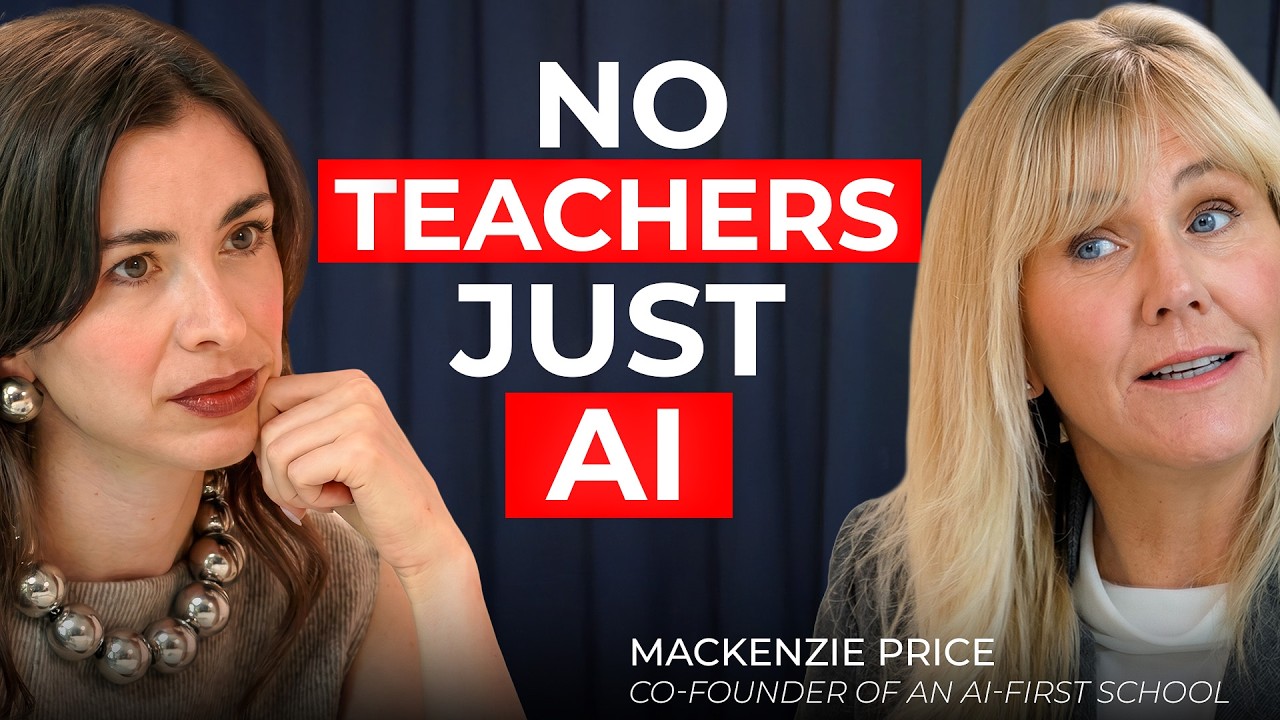
In this episode
MacKenzie Price discusses Alpha, America's first AI-powered school where students complete academics in just 2 hours per day while scoring in the top 1% nationally across every grade and subject. The school operates full-day from 8:30 AM to 3:30 PM, but dedicates only 2 hours to focused 25-minute academic sessions in math, reading, language, science, and history—with AI tutors handling personalized content delivery rather than traditional teachers. Price explains how the model addresses the fundamental flaw in traditional education: the one-size-fits-all, time-based classroom system that leaves advanced students bored and struggling students overwhelmed. By combining high academic standards with high support through AI-driven mastery-based learning, Alpha students achieve exponential growth—taking students from the 25th percentile to the 90th percentile, or accelerating high-performers even further. Price also addresses the broader implications of AI in education and the job market, warning that parents should prepare their children for a world fundamentally different from the one they grew up in.
Key takeaways
- Traditional education's one-size-fits-all, time-based model is broken—it leaves advanced students bored and struggling students confused—and AI-powered personalized tutoring addresses this by allowing students to learn at their own pace and level, resulting in 2-5x faster learning
- Alpha School achieves top 1% test scores across all grades and subjects by combining high academic standards with high support and mentorship, mixing the rigorous, disciplined approach of Soviet/Eastern European education with the supportive environment of US schools
- Students spend only 2 hours per day on academics through focused 25-minute sessions, freeing time for coaches, athletes, and business professionals to teach practical skills like entrepreneurship, sewing, biking, and swimming
- AI tutors—not human teachers—deliver academic content at Alpha, while staff serve as coaches and mentors; this model scales and isn't limited by teacher availability or quality variations across districts
- Parents should immediately begin preparing their children for AI-driven job displacement, as most professions are being rewritten by AI; traditional university credentials may not matter in 5-10 years, requiring a shift toward building creator and builder mindsets rather than consumer-focused education
Chapters
- 00:00Intro
- 01:00What's wrong with the traditional education system — Soviet, China, and what AI can't replace
- 02:40Why we need to reform education for our kids
- 04:42The AI-powered school: no teachers, 2 hours a day, top 1% nationally
- 06:08How AI helps kids go from 25th to 90th percentile
- 06:38Top 1% in every grade, every subject
- 08:00AI tutor instead of teachers
- 08:58The one focus that helps Alpha students outperform
- 10:50(Sponsor) HeyGen — how I scale my Lingua Marina channel
- 12:28Who Alpha hires instead of teachers — coaches, athletes, business pros
- 13:57What if a kid can't understand the material from AI?
- 17:30The Alpha student who turned her TikTok scrolling into a successful business — and what if adults DO know better?
- 22:00How her project could land her in Nature — the world's top scientific journal
- 23:40The 6-year-old who made $1,600 selling cookies
- 25:50Consumers vs. creators: raising builders
- 30:17Is screen time actually harming our kids' cognitive development?
- 34:14What Alpha kids learn besides academics — cursive, sewing, biking, swimming
- 36:202x learning in 2 hours: how it actually works
- 38:28How much Alpha School costs per year
- 39:17Can you replicate Alpha at home for free?
- 41:54The programs: Math Academy, Claude, and AI for parents
- 43:15Why ChatGPT is banned at Alpha School
- 44:15What to watch with your kids — what good content looks like
- 45:25Will universities matter in 5-10 years?
- 47:20What happens when Alpha students go back to a traditional system
- 49:00A self-imposed Alpha school for adults
- 50:40The professions AI is rewriting first
- 53:00How we'll need to pick a profession in the future
- 53:42What if your kid graduates and can't get a job?
- 55:30The one action every parent should take this week
- 56:45Why we can't rely on the old system anymore
Transcript
Marina Mogilko: We're going to start seeing in the next 6 months our friends and people that we work with or maybe even ourselves losing jobs to AI. We have to prepare our kids for a different reality.
MacKenzie Price: This is MacKenzie Price, founder of America's first AI powered school where kids do academics 2 hours a day and test in the top 1% nationally.
Marina Mogilko: We're using technology to provide a better learning experience for kids and as a result, our classes are crushing it. You don't have teachers?
MacKenzie Price: They are not in charge of delivering academic content. Our AI tutor is doing that.
Marina Mogilko: Education is changing and most of us were prepared for a world that no longer exists.
MacKenzie Price: The industrial revolution model of education did a great job of raising factory workers who knew how to follow rules and be obedient and compliant. I think the world's in for a pretty big wakeup call. What's this world going to look like in 5, 10, 20 years? I don't know a lot of those answers, but here's what I do know. Education is what I breathe because I have a business in education. I have a whole channel where I help people speak English more like Americans and accent everything. And I came here from Russia 10 years ago and went through school in Russia which is a completely different system compared to what my kids are doing here in the US. Strong focus in academics. Nobody cares about your feelings. But at the same time, we see a lot of people who come from that system. In China, they have a similar system and then they win all of the world Olympiads in maths, or we see people who came from post-Soviet countries start amazing companies. If you look at top researchers, a lot of them are Eastern European.
Marina Mogilko: Do you think that system can still survive or is it useful in today's world?
MacKenzie Price: I think that what you're describing that your school experience was, was an environment with really high standards, but probably the support was a little more minimal. It was just this top down, you will do as instructed. And I think what's happened in the United States is that we've gotten much more into let's be supportive, let's be thoughtful, let's meet kids a little bit where they're at, but the system can't actually do that. So as a result, standards have gone down. What we've done at Alpha and what I think is really the key is that if you can build an environment where there are high standards and we believe high standards are key to kids' happiness along with high support and mentorship and connection. That's where you really see true motivation lies.
Marina Mogilko: I like how you're mixing these two systems and I think both should exist. But also when I think about my education, I remember times when I was sitting in a class absolutely hating the subject, not liking the teacher. But now when I think back about that experience, I think it actually taught me persistence. I can handle this. It's a tough situation. I don't like being here, but I can also talk to myself internally.
MacKenzie Price: And I can overcome this. There's a bunch of things there, but I think that the importance of building resilience is critical. What I think is there are so many other ways that you can teach resilience and grit and how to work with difficult people. A lot of times people will say, well, sometimes you have that bad teacher or that teacher that's hard to get along with. You have to get used to that. There's so many other ways that we can do this while making sure kids are able to stay engaged and not be bored. And I also think that in the US that's happening in a lot of classrooms too. I think if you look at a rural school in India or you go to a high-end private boarding school in Connecticut, you're going to see the same thing. You're going to see a teacher in front of a classroom teaching kids in a time-based system all at the same pace when those kids are at wildly different levels. There are kids who are sitting there before the teacher's even opened her mouth to explain a concept. They understand and they know that concept. So as a result, it's like, okay, I'm bored. And at the end of that explanation of the concept, there are kids who it's totally over their head. They have no idea what's going on. In either case, the teacher just has to continue moving forward. And that's a real testament to the fact that the model is broken. The one-size-fits-all time-based system. It doesn't work. And it doesn't work in Russia. It doesn't work in the United States. And what it's doing is it's leading to a large group of kids who are just going through the motions or not participating at all and just refusing.
Marina Mogilko: And you've been running the system which is a 2 hour per day academics system. And you measure your success by standardized test scores. Correct?
MacKenzie Price: We do. Our schools are full day schools. Kids get dropped off at 8:30 in the morning and picked up at 3:30. But what we do during that school day is very different. We are only spending 2 hours doing the academic part of our day. So when you think about the traditional classroom that you and I grew up in where you're spending 45 minutes in every class and maybe you get one elective and a little bit of lunch, instead our students are just doing these 25 minute focused sessions of math and reading and language and science and history—those types of core academics that kids are learning in a traditional school—but in so much shorter time because they're getting personalized learning that meets them at their level and their pace. And as a result, our classes are crushing it. Top 1% across all grades and all subjects. And one of the things that's really cool about this that I'm very proud of is we're not choosing students for our school just based on the kids who already come to us at 95th percentile. We can take those kids that are 95th percentile and we can have growth rates in the 80s and 90s, but we can also take kids who show up to us in the 25th percentile and give them exponential increases in their learning. And it's really what's so awesome about leveraging artificial intelligence to finally allow kids to have that one-to-one mastery based tutoring experience that for years researchers have known results in kids learning two to five to 10 times faster. It just hasn't been possible in our current system.
Marina Mogilko: So can you reach the top 1% across every grade?
MacKenzie Price: Every grade, every subject. Our classes are crushing it across the board. I think it's such an example of what's needed in education. But more than that, it just points to when you can help a student find, here's what you know, here's what you don't know, which is part of what our standardized assessments are able to do. They're really just feedback tools. Okay, this is what maybe this sixth grade student might be having holes in their math knowledge down in fifth and fourth and third grade. And you can go back and fill holes and really get that mastery learning. And math is a great example to talk about with this because I remember sitting through math class being like, I am so confused. I don't know what I'm doing. Well, probably the reason I was struggling is because there were some foundational concepts that I didn't fully understand. And so as you get more and more sophisticated in the material you're learning, it gets harder if you don't have that foundational concept. Learning algebra, if you don't have your multiplication tables memorized, is harder than if you do. And that's what's really cool about this true ability to finally have a mastery based system where kids are learning at the pace that's right for them.
Marina Mogilko: And you don't have teachers, right? It's so funny that that comes up very often.
MacKenzie Price: We're always that school with no teachers. And here's the thing. We have the most unbelievably incredible adults in our classes. Our ratios are like 1:15, 1:5 for younger students. But we don't call our staff teachers, we call them guides. And the reason we don't call them teachers is because they are not in charge of delivering academic content or teaching that material. Our AI tutor is doing that. But instead what they are doing is they are truly coaching and supporting and guiding students on their learning journey. Their focus is motivational, emotional support and they're also the ones who are really running the whole school day around life skills development and building out the ability for kids to become self-driven learners. There is a huge graveyard of failed edtech platforms. Here's the reason. Our edtech is not better than some other edtech platform. Our reason for success is because of what our guides are able to do, which is focus on what is 90% of creating a great learner. They're motivated.
Marina Mogilko: Motivation, 100%. That's
Marina Mogilko: If you're not motivated, if the kid's spinning in a chair and not even looking at the material, how are we going to help them learn? And that's the key is focusing on that motivation part. It's funny because we'll often see articles that'll say, "Well, alpha only works for motivated kids." And it's like, "No, no, no. That's the whole point of our school is that our guides have the time to focus on figuring out what motivates this kid, what gets him excited, and here's the really cool part, Marina. When a child is motivated and starts doing the work and they're met with the same level and pace that's right for them, they develop competence and then that competence turns into a confidence. They start seeing themselves as I am capable. I can go crush my academics. I can learn that. And I think that's one of the coolest things to watch kids really change how they feel about themselves and what they're capable of.
Marina Mogilko: And that's the key difference. I'm thinking back about my school system and my best friend was not doing well in any subject. So the teachers would always tell him you're a failure. And I feel like when you live with that, you don't even want to try. So whenever I think about those kids in those systems, they are the ones really struggling because if you navigate the system, then you get all the good grades and you feel great and you develop that confidence. What about the kids who can't navigate the system?
MacKenzie Price: And that by the way is the majority of kids nowadays.
Marina Mogilko: This part of the episode is sponsored by Hey Jen. I want to break here because what MacKenzie just said is really important for me personally. I've been talking about learning English on Lingua Marina for 10 years. And in that time, I've tried everything. Long form, short form, live streams, courses, and recently we started something new. We created an animated character of me to deliver some of the lessons. Our methodologist build the content, the AI character presents it, and the channel keeps posting consistently while I focus on this podcast. So it takes a lot of my time. And honestly, it fits right into what MacKenzie is describing. Alpha School uses AI tutors, adaptive methods, video, text, a mix of everything to create more visual, more personalized, more ondemand content. Animated educational content is part of that shift. Even three years ago when I was thinking about this, creating a cartoon for English language learners, making an animated educational video meant weeks of work and thousands of dollars. Now we can do it in 15 minutes. What we decided to do for our channel is the animated cartoon version of me. And the way we did it, we uploaded a photo, wrote a few prompts, and the short was done. One thing I actually appreciate, Hunen only creates an avatar with your explicit consent and identity verification. They don't use your face or your voice without your permission. The AI handles delivery, humans handle the thinking. If you're running a course, an educational channel, or any business where consistency matters more than you have hours in the day, Hen lets your team scale without faking who you are. Use my link in the description and try it yourself at hij.com.
MacKenzie Price: Yeah. And you hire former sports people, right, who are really good at motivating.
Marina Mogilko: Yeah. So what we really look for is we want the people who come work in our schools to be world class at motivation and about 50% of our guides come from a traditional teaching background. And they get so excited when they finally have been given the room to really make that positive impact that they got into teaching for. But this whole other population of people are also coming in to work as guides that probably wouldn't want to be traditional teachers, but they love the idea of connecting and motivating young people. And so we get a lot of people who were former coaches, former athletes, people who were in the business world, all kinds of stuff that they're bringing their talents, their experience into the classroom and focusing on that motivation piece. And it is so much fun to see that type of person. We're having had really incredible success with just so much interest because unlike in the traditional teaching world where teachers are leaving the field in droves and it's hard to attract good talent, we're finding really good talent. Part of it is we pay them really well. Because I think anybody who is working in a classroom every day with kids, they're a hero and they should be well compensated. And we've just made their jobs a lot easier to really provide that impact.
MacKenzie Price: I get how they're great and motivating, but I also remember when at school like there is a concept in algebra that I don't understand and sometimes I would use books, technology and I still don't understand. What happens in that situation where it's something really complicated and someone whose ex-coach didn't really take that subject. What happens in that situation when a kid needs an explanation from a human?
Marina Mogilko: So there's a couple of things that can happen there. Let's say a student is working through a math concept and they are struggling to understand that. First of all, they have a variety of resources that their guide will be coaching them through like hey did you check a different video explanation or did you read this other thing or did you see this part that you can learn. It also is able to understand what, maybe the reason the student is having trouble with this particular concept is because we need to go back and revisit a concept from earlier just to help you understand this. Let's go back and refresh your understanding of something else as you're going into this difficult material. But let's say a student still is struggling with that. Then what they have the ability to do is schedule basically an academic coaching call. So we have a learning science team and academic coaches who are able to go in and one of the things that's great about that is during this experience our coaches and our AI system are able to understand where is this student getting tripped up in the lesson because if this one student is getting tripped up here there's a chance that especially as we scale to millions of kids that there'll be lots of other kids that could get tripped up and so it helps us improve the quality of the teaching concept that's happening both in our technology and where students are struggling. And I think one of the things that sometimes people have a really hard time understanding because we're so used to the way we all grew up, which is at some point you have to have a teacher sit down and talk with you and work with you or a parent, more often working through the subject.
MacKenzie Price: Do you have academic conversations?
Marina Mogilko: You think you have to do that, but then I also go back to, well, it seems like it's working because our results are showing that our kids are learning to mastery. They don't move ahead until they've mastered the concepts and the results are showing that it does. And I think the other thing that happens is I go back and remember how often when I was confused about something, I'm sitting in class, it wasn't like I had the teacher standing over me saying, "Let me help you with this." Because the teacher's busy trying to teach everybody. So maybe you get to go into office hours or more often you're asking a friend or a parent for help.
MacKenzie Price: Yeah, or a tutor.
Marina Mogilko: Yeah. The amount of money that families spend on their private tutoring and their Russian math after school and all of those types of things is just insane. And that's something. So I think sometimes what happens is people have this romanticized what I think of as mismemory of what's actually happening in traditional classrooms. And as much as we would love to believe that every English class is this Socratic discussion where all the kids are super engaged and they've fallen in love with Shakespeare, that's not really what's going on there. And so what we're seeing instead is we're using technology to provide a better learning experience for kids that is getting results for every kid wherever they're at. And then where it gets even more exciting is what that really enables the rest of the day to be, which is where I think the human element and the human experience are just on fire.
Marina Mogilko: Interesting. Okay, we talked a lot about motivation. Another concern with motivation that I have from my childhood is that kids get motivated by weird things. Like I heard this story, which is a cool story of a girl who was when the coach asked her what she was motivated by and she said nothing. And then he asked, "What do you do when you're alone at home?" And she's like, "I'm scrolling through TikTok and I think about boys."
MacKenzie Price: Think about boys.
Marina Mogilko: That's like a typical 80% 16-year-old female answer.
Marina Mogilko: And when I told something like this to my parents, well, my interest was different. I told them, "I love English, so I'm going to become a translator from Russian into English." My parents told me, "Sounds amazing, but you're going to do math." And I'm so glad they did because what does a 16-year-old understand the world from compared to what they see around themselves? But adults who are guiding them have a different experience. I'm actually glad that my parents didn't follow my passion. They're like you can do whatever you want as a second degree, which I did eventually. But I studied mathematics and economics and I'm really happy I did because that really helped me build a business because you learn all the concepts. You learn how to think through very complicated problems and yes I didn't understand 50% of what was going on in the class but it actually helped me navigate that world. So I'm thinking what if my child, I don't know, a 12-year-old says oh my daughter tells me she wants to be a puppy yoga teacher. I'm thinking what kind of job is that? Isn't it helpful to sometimes not follow the passion of a child and tell them, hey, you know what?
MacKenzie Price: So I think that what your line of thinking is assuming it's got to be either this or that. And in our opinion, we believe that it can be both. So for example, that student who really did say, I'm the world's best TikTok scroller and I'm thinking about boys. And actually, the way that she came to that conclusion is we have our students do a workshop called 68 hours where they track the amount of time in their week, what they do with it. How much time are you sleeping? How much are you studying? Where are you spending time with friends? Are you playing music? What are you doing? And that's where she had this realization of, gosh, I don't do anything. I just scroll.
Marina Mogilko: We should all do that exercise. And so it was there. Now, her guide, when she told her guide that story, first of all, I love that they had a relationship where the student felt comfortable enough to be honest and didn't feel like they had to make up a story like I'm interested in curing cancer. She was very honest about that. Her guide could have said, "No, get your head out of the gutter. Fourteen-year-old boys are not worthy of having a lot of thought around right now. You shouldn't be doing that and get off social media. Go focus on math and economics instead." She didn't do that and she also didn't say, hey, that's cool, just hang out, you should enjoy your TikTok experience. Instead, she said, well, let's figure out how we can go deeper to understand if there's a problem there. What's going on in the teen dating world? And so it allowed her to say, okay, I'm going to take this interest and see if I can create something productive out of what a lot of people would think was just a random, superfluous interest. And so what she did was she went through and proceeded to do research and understand that the dating world is incredibly unhealthy for teenagers right now. And she started building out expertise in what healthy dating habits look like. To be clear, it wasn't even dating habits. This came out of COVID when kids didn't even know how to say hi to someone that you're interested in, introduce yourself, any of those things. She built up an audience, which when you think about any product or business that you're going to do, a podcast, if you don't have an audience, you're out of the water. So she built up an audience, got millions of views on TikTok with her advice. Then she was able to build an AI avatar that was able to give advice and she built an LLM that was based on this expertise. Now that led her down the path of let's actually do some research to understand if the expert advice that she's giving is good. And so she ended up doing a research paper where she looked at the quality of advice from her LLM, ChatGPT, and suburban moms. And of course, I think most of us would guess, I certainly would as a mother of two girls, well, moms give the best advice. We really do. And what she ended up finding out was that moms were actually dead last. Her LLM was top rated and ChatGPT was in the middle. Now you go, "Okay, well, cool, I guess this is like she wrote a research paper." Well, that research paper is now in the final stages for approval in Nature, which is the number one scientific journal in the world. And if she goes through that last hurdle and gets submitted and gets in, she'll be the youngest female ever and the only high school student to ever be published in Nature. And that same student is actually right down the street today at her admitted student days at Stanford University. And so you really take this scrolling.
MacKenzie Price: It's a beautiful spin-off.
Marina Mogilko: You take this scrolling. So let's say it's okay, I want to be a puppy yoga instructor. And you know what? This is actually a really fun exercise that you can do with your six-year-old is, "Okay, let's think about this. What if we were building a business? How would we go about building that? And where can we make it 10x?" In fact, for our high school students, when we're talking about our alpha x projects, we call them Olympic level projects. And the reason we use the term Olympics is because it's such a clear standard for being the best in the world. If somebody is an Olympic runner, you don't think, oh, they must be a pretty good runner for being 18 years old. They are literally the best runners in the world. And so we put that kind of classification because we don't want our kids to just be good for their age. We truly want them to be the best and seen as experts in that. And there are so many places you can do this. I'll never forget, and this is another thing, your kids are a perfect age for this. My oldest daughter came home one day and she said, "Mom, I saw some kids doing a lemonade stand down the street. Let's do a lemonade stand." I said, "That's a great idea. We should totally do that." I said, "But then let's go through and think about this. Where would we do it?" She's like, "Well, I guess at the top of the driveway." And then I said, "Well, let's think about this. Let's count how many cars go by." Well, we live in a pretty quiet place, so not a lot of cars. And so we started thinking, "Well, if we really wanted to sell, what would we do?" And she was about six years old when this was happening, and her little sister was four and she's jumping into it and we walk through this thought exercise where, okay, where do you find a lot of people? And she said, "Mom, your exercise place that you go to seems to have a lot of people. Maybe we could do something there?" I'm like, that's a great idea. And I said, "But do you think exercise people want to drink lemonade or something else?" And we land on no, they probably would like coconut water and water. And then we came up with this idea that they might need a snack after they're done exercising, but it's got to be a healthy snack. So she ended up creating these paleo cookies and called the gym owner and asked at six years old, would it be okay if I came and sold? And she did this and it worked so well and actually her product was so good, she ended up getting to go to larger and larger gyms and athletic competitions. Now here's the only problem, the backfire of this story. She went to an athletic competition where she was selling her paleo cookies and her coconut water and water and she made about $1,600 in profit. Well, here's my problem. A six-year-old's like, I'm set for life. I never have to work another day in my life.
MacKenzie Price: You don't understand that they're getting paid because they're so cute and everything.
Marina Mogilko: No, no, no. It was a really good product and it was doing great, but then I was like, we should do this. You could do this every weekend. She's like, why? I bought a Barbie doll. What else am I going to do with this money? Which is funny, but I think these are examples where you can take an interest that somebody has and figure out how do you take that further. I'll tell you there's some crazy puppy yoga and goat yoga businesses that business owners are probably doing pretty well at. And so I think sometimes we underrate what kids could be capable of and what we need to do is reframe. There's some interest that a kid has. How do we take that? Video games is another example. There are so many moms and dads out there going, "I wish I could get my kid off the game console. All they want to do is play video games." And we see boys come into our school who are literally going to say, "If you could just pay me to play video games for my whole life, that's all I'd want to do. It'd be the best job in the world." And then when you start saying, we could teach you to code a video game. And then maybe you could host an event and you could be the shoutcaster and work on these things. And suddenly these kids get excited about something that they're doing and they start realizing, "Oh my gosh, great." We have a student who was absolutely that boy who would say, "I would play video games every day for the rest of my life." And now he's like, "I'm too busy to play video games because I'm out building this business and doing these things." If you can inspire kids, it's going to go somewhere hard.
MacKenzie Price: That's what I'm seeing, not just go straight into scrolling and playing the game, but go behind the scenes and become the creator behind your content.
Marina Mogilko: What is it you do? And really, that's what I think is another thing that is so important to teach young people, especially in our society today where being a consumer is so easy to fall into. It's like, okay, I can just scroll TikTok. I can play video games. I can just hang out and watch YouTube. What we need to do is instead create creators and contributors. How can you go out and be someone who builds? And people naturally, they want to be builders. They just often aren't given the tools, the time, or the mentorship to do that. And again, not to bag on traditional school too much, but kids go to school every day and they say, "Okay, I'm going to sit in this chair and I'm completely beholden to what the teacher is going to be giving out for curriculum," instead of saying, "Hey, I know I've got to learn this material and I can go forward and I go as quickly as I'm capable of doing." They're sitting here just doing this or let's say they're working on a project in a class. As soon as that class is over, it's like the project's done. And last spring in May of 2025, a bunch of our students were doing a pitch for a VC firm for funding for their businesses. One of the questions that one of the VCs asked was, "So, what's going to happen this summer when school gets out?" And the kids look at them like, "What do you mean what's going to happen? I keep going. I got work to do." And in fact, our high school students came to us last spring and said, "Can we please keep our high school open for the summer?" Because they didn't have this attitude of, "Well, my business is done because I got the A in the class and so it's over." They're like, "I got work to do, and why would I not want to be surrounded by my friends and classmates and getting the mentorship and support that our guides are able to provide while they're going forward with this?" And it just creates this amazing energy and environment where it's ambitious and it's exciting and it's also supportive and collaborative because every kid is working on something different. It's not like there's only one spot at the varsity tennis captain and you have to get that or you can only have the one winning robotics team at the competition. We've got kids doing things from such varied backgrounds and they're all there saying, "Let's support each other. Let's help." And we really find that when you put kids in that environment and call them to something greater with that support, they get just psyched. And it's a fun place to hang out.
Marina Mogilko: That sounds incredible. Hearing that story, the thing I keep coming back to is that it wasn't talent, it was the system around her. And it made me think about something very simple. Most people use Claude as a search engine. They type in a question, they get an answer, most times they're not really satisfied with it, and they close the tab. I did the same thing for months and I was looking at people who were saying AI is changing their life and I'm thinking then I spent one afternoon setting it up properly. Uploaded a few files about how I think and how I work and it completely changed. I wrote the whole process up step by step. You get it when you subscribe to my newsletter Future Proof. It's free. The link is in the description. Let's talk about screen time, something that a lot of parents are concerned with. And also Sweden did this experiment. I know if you know about this—they abandoned books, they introduced iPads and then literacy went down. So they had to ban iPads and reintroduce the books. Do you have books in your school or is it just iPad, even for four-year-olds? Is it like two hours on the screen?
MacKenzie Price: No. So we do start as early as four years old in a prek program. They are doing some work on screens but it's a shorter period of time than that two hours. And actually, fun fact, the average amount of time kids are spending on screens in the United States right now is two and a half hours a day. So our kids actually spend less time on a screen than kids there. But here's the other big key component. There is not equality between all screen time. I myself with my kids, we were a screen-free family. And I recommend that, putting an iPad in front of your kid at the dinner table or even in school to say, "Hey, let's do this online"—you know, that could have been just a worksheet. But we're doing it online. It's just technology for technology's sake. And the key difference here for us is it's not just doing something on a screen. It's having that engaged level of interaction with your academics that's keeping you in what's called the zone of proximal development where the work isn't so hard that you've turned off and not so easy that you're not really engaged. So it creates a very proactive connection with what students are doing, which is why we're seeing better learning results than just putting something on screen. That said, yes, of course we have books. One of the things that I think is such an important thing for kids to learn is we have to teach them not just to read, but to fall in love with reading. And what better way to do that than first of all teaching them the skill of reading, which we're able to do very well with this environment. And I will say the importance of one-to-one out loud reading with a human is so critical. And so that's what our reading specialists are able to have time to do—that one-to-one pull out reading time with every kid as part of their learning. But then it's also teaching them to say okay let's figure out how we can encourage you to love to read. And an example of that, we have an app that we have created called Teach Tales. And what it does is it's basically an AI app that allows kids to create stories that match their interests and it's at the difficulty level that's exactly right for them that keeps them in that zone of proximal development. So basically, you can take that little boy who maybe would rather be just going around on his scooter than sitting down and reading a book, but suddenly he's the main character with his best friends in a save the world kind of adventure that matches his favorite movie and all of a sudden he's excited about reading and these are things we have to do. So yes, our kids get to be exposed to Shakespeare and yes, our kids are reading the great books and they're doing that stuff. It's one part of what I think is important for education. Ed Hirsch has 5,000 facts, concepts, and what they call core pieces of knowledge that are considered important to be an educated person. And we're able to put that information into our curriculum in order to make sure that kids are getting that education. And the wonderful thing that I think people often forget is that when you only have to spend two hours working on academics, it opens up the whole rest of the school day to be able to do things like, okay, you're going to do a great book check. We call it a check because it's on a checklist. You've got to read a certain number of books and then you're writing reflections on them and having kids have that opportunity.
Marina Mogilko: Are they writing on iPad or handwriting?
MacKenzie Price: We teach cursive.
Marina Mogilko: This is what I really want my kids to learn because I spend months probably learning that.
MacKenzie Price: You know what's crazy? I only write in cursive. I still think cursive is a pretty important art.
Marina Mogilko: I think it's a great skill.
MacKenzie Price: It's a great skill because of what it does with your hand eye coordination, how it helps develop the brain. Same thing with music. Same thing with art. There's so many different types of things that we want to give kids to do. And so yes, they're doing that on pencil and paper. Here's another thing that our kids get to do. They're learning to sew. They're doing a woodworking class. Stuff that has actually been torn out of the traditional school day because there's not enough time. Everyone thinks we just need more time on academics in order to see success rates go up. And that's not really true. We're showing that in less time, kids can learn more effectively and then open up all of those other life skills experiences. But if it's anything like when our kids, our five and six year olds were riding back and forth on the Golden Gate Bridge in their alpha biker gang where they finished that ride as a team, or they've climbed 40 foot rock walls or our middle schoolers have been able to complete a triathlon together. There are so many different activities that we're seeing. Kids can absolutely rise to the occasion. And part of what helps us do that is we're making sure that it's fun, that the kids are having fun even when it's hard. It doesn't mean when we talk about kids loving school, which we think is critical. Kids need to love school. In fact, it's our first commitment that we make to our families, which is that your kid will love school. The reason that's so important isn't because every day is Disneyland. It's because when kids feel this fire in their belly and are like, I like being at school. I love being at school. It allows us to challenge them to do hard things, to take on tasks that maybe they wouldn't know how to do, and they've got that support. And it's what helps unlock potential, which is what I think school needs to be.
Marina Mogilko: And so you basically compress—I'm thinking about a typical school day. It's six hours of academics, right? In a typical school, and you compress that to so 3x less?
MacKenzie Price: And you still cover the same material and same depth just because everybody moves individually within—actually I'd argue we cover it in greater depth. Because when you think about what, let's say, fifth grade academic knowledge for math as an example, kids in a traditional system are moving through the math concepts and whether they know it or not they move forward. It's why a third of kids in this country are actually proficient in their grade level in math or reading. That means two-thirds are not at mastery. Whereas in our system, kids don't move up in their academic grade level until they've mastered. They've got to be above 90% in order to master. And so it goes to a larger depth. This is the other reason we get sometimes this question. So our second commitment is that kids will learn twice as much in only two hours. We measure that with something called the NWA MAP assessment. It's a standardized assessment that's taken by about 10 million kids all over the country—homeschool, public school, private school.
Marina Mogilko: And they actually remember what they learned.
MacKenzie Price: Yeah. And then what happens is when you set kids up for success by giving them mastery of earlier content, it makes more sophisticated content easier to grasp and go deeper on that. At our high school, our kids are taking the same advanced placement courses that some kids are taking, and they're taking four years of English and foreign language and science and math and all of those types of history. They're doing that, but they're doing it in less time. At the high school level, it's three hours. It's a little bit longer there, but we have basically been able to compress that time and make it more efficient and more effective. So I think they are learning at a deeper level than kids in a traditional classroom.
Marina Mogilko: That's very interesting. Okay. So if somebody's listening to this and you have a pretty high check, right? Is it like 70k? How much is it?
MacKenzie Price: So our alpha schools, Alpha School is the school that's gotten a lot of the attention. It's like super high-end private school kind of redefining what parents expect out of their kids' private school experience. So when kids are learning teamwork and adaptability through sailing and then they get to sail from Florida to the Bahamas, they're doing that and that's basically between 40 and $75,000. Those schools are opening all over the country, and it's been really cool to see the amount of demand we have from families who are excited about not just the part we've spent time talking about—the academics—but really all the life skills. So somebody who can't afford 70k, if it's just well two hours a day, can a parent like me replicate part of this experience? Because I am a dedicated parent. I spend two to three hours at least per day with my kids just doing stuff with them.
Marina Mogilko: If I want to do something like that, what are the steps that I need to take? And I also feel like it's really important because all the skills that you're teaching, it's not just for kids. It's for adults who understand that the world is changing and they need to be constantly learning, adapting. Basically the world changes every week. So that's what we're up for.
MacKenzie Price: I love this question because it's been so fun to watch people who are replicating a lot of the alpha magic in their own homes with what their kids are doing. And so that's everything from families that are using our Alpha Anywhere homeschool program. That's $10,000 a year to get the same academic platform that our kids in school are getting. And then their afternoons get to be the life skills development that the family decides. There are so many ways that you can teach great life skills. Sports obviously has always been a really popular way of teaching grit and resilience and teamwork and leadership and receiving feedback, and learning to mastery as well. One of the things we think about with sports that it's harder to understand with academics, but we're taking the same approach. If you're a basketball player, you're not working on your dunking if you don't know how to dribble the ball down the court, right? It's start with the basics, master the basics, and then move up. You analyze game film when you're finished with a game. You're watching to see where you could do better. We're doing a lot of that same stuff on the academic side. But there are things that families can do at home. I always think entrepreneurship is such a great tool and we talked about that with the lemonade stand. Those are great ways to learn financial literacy, and those are things that parents can be doing at home. Now, here's the challenge. There's only so many hours in the day. So when kids are going to school all day long, they come home, they get hopefully a little bit of a break. They often are ending up doing homework, which is starting earlier and earlier. They've got homework, you've got to eat dinner, you're doing piano practice or you're going to play soccer, whatever it is. There's only so much supplementing that can be done. And that's one of the reasons I think families are starting to realize it's time for us to demand change in our school districts and to ask our schools what are you doing to try and improve academics.
Marina Mogilko: What about academics? If somebody wants to deploy part of your system at home, what can they do with their kids? Is it like watching particular videos or I don't know, like videoing an app?
MacKenzie Price: Let me give you an example on the academic side. There is an app called Math Academy that we absolutely love. It's not one of our apps. It's built by an outside team that they've just done a great job with Math Academy. It's a great app. So that's an example of something that if you're wanting your kid to be able to spend some time doing app work there. I think the other thing that's so much fun now is working on so many of these AI tools that are coming out. In fact, a bunch of our students went to New York last month and they did an open class for parents to teach them what to do. And when we're thinking about a super important skill as an employee, in order to have a job, you're going to have to always understand how do I take whatever I'm doing and add the most value from it? How do I become AI first?
Marina Mogilko: Oh yeah. How do I automate part of my skills and rise up to the most...
MacKenzie Price: Use AI to give me superpowers, right? That's what's going to make people job resilient and employable is if they are constantly knowing, all right, here's how I can take something and use it to my advantage to build something big.
Marina Mogilko: And also use personal judgment when interacting with AI.
MacKenzie Price: Absolutely. Here's the other thing. I think there's a lot of fear around AI, and in schools there is, and it's rightly so because chatbots in schools are cheap bots. We don't use chatbots in our schools because kids do switching apps. Do you have a blogger?
Marina Mogilko: So our kids are working on computers, so they've got basically in the Timeback platform it's monitoring so that they can't say okay I'm moving from here to here, or if they're able to somehow we can see it. We're screen recording to be able to see how kids are moving through this. It's also what allows us to give coaching to kids when it's like, "Oh, okay. I noticed that you maybe skimmed the reading. You didn't spend enough time reading the whole thing in order to do that." And then coaching, often times slowing down will actually help you go faster than trying to rush through something. Getting that kind of skills is important to do. There's a lot to do, but in education, we've got to make sure that we're implementing AI in a good way. What I would hate to see is just every kid gets a computer with a chatbot on it and say, "Wow, we're AI first."
MacKenzie Price: That's my concern time. I really want them to watch some videos. There are some TED talks I absolutely love, which are also very visual, so I can show them with my kids. But my concern is that if there's a phone call and I leave the room, they're going to figure out how to switch to Shorts.
Marina Mogilko: Oh, yeah. If your kids like Mark Rober who does all the science stuff.
MacKenzie Price: Yeah. I just showed them the glitter bomb. They were fascinated.
Marina Mogilko: There are some interesting ways to do it. I think we have the ability now to watch a heart surgery on YouTube versus just dissecting a pig in class. There are so many cool ways that we need to take advantage of what the world has to offer in the right way where we can say, "Okay, let's learn this. Let's get inspired by something here." Mark Rober is a great example of a really good influencer who makes kids fall in love with science and activities like that. You've got to pepper in that right amount. Parents at home who are able to say, "All right, I'm going to intentionally have my kid do some work using adaptive apps. I'm going to also have a way for them to develop life skills at home."
Marina Mogilko: We grow up in a particular system and we think it's the best system for our kids. But what I also realize is that the world has really changed. Do you think higher education matters? Do you think universities are going to matter in 5 to 10 years?
MacKenzie Price: Here's what we're telling our students is that we want you to be prepared to go do whatever it is that you want to do. If that means you want to go to an Ivy League school, then you should be able to have the resume that gets you into that. If you want to be ready to go out and hop into business or go straight into the working world, you should be prepared to do that as well. I think that's a very personal choice. Now if you ask me in general about higher education, I think the university system is following very closely behind the K through 12 one, which is that if you took AI tools just like what Alpha is doing and said hey let's do all our basic courses this way and then free up the professor's time to really spend time in more sophisticated discussion with kids who are at that level, let's go be doing research, let's go build a startup together, do whatever that is. I think that would make it really exciting. I believe university and I've got one daughter who's in college and another who's heading there next year. Both those girls were so excited to go to college because they're excited to be around other ambitious young people. They're excited to build their network. I think university does an amazing job at building out networks. It's where you often can meet your spouse. There are your best friends for life. That's what they want to go to college for. They want to have that experience. But I think again their time spent in classes is pretty inefficient.
Marina Mogilko: How do they adjust from 2 hours to 8 hours?
MacKenzie Price: It's funny. We actually looked at this because that's a big concern that people have—okay, what happens when your kids go back into a traditional environment? Here's what we've found: they do great. They are able to very quickly understand okay, here's how I can learn, and they have a proactive attitude of taking on ownership of their learning. But they will say, and my daughter was one of them, she called me up after the first week of school and she's like, "Wow, mom, these lectures are so inefficient." In a 45-minute class, there's probably five minutes of real information that was worthwhile. But do they do well in grades? Absolutely. More importantly than that though, I think what it feels like our alpha grads tend to do is they have a desire towards mastery even when the system isn't doing it. We had a student who went off to university and he wrote a paper for one of his classes and he got the paper back and he had a 95% but there were no notes. So he went and met with his professor and he said, "Hey, I see that I got a 95% but I don't see any notes on how I could improve." She just said, "Well, you know, that's a good grade. That's an A. You should be happy with that." He's like, I am happy with it, but I just want to know what would make it better. What would get 100? She said, well, writing, you're never going to get to 100. There's always improvement. He goes, great. Share with me what I could improve upon. She looked at him and just crossed out the 95 and put a 99 and sent him on his way.
Marina Mogilko: He didn't get the feedback he was looking for. It's just an example that even teachers are programmed to be like, it's just about the grade. Just here's the grade. Go on your way. I think alpha students realize like, oh, I can go learn this because it's interesting and I have an ability to get better.
MacKenzie Price: Interesting. Okay. So you're saying all of this and I'm like, what would be the version of self-imposed alpha school for adults?
Marina Mogilko: Well, first of all, for me, if I had a little bit more time, I sometimes think, you know what, I'd love to go back and do some hole filling, and remember where am I at in my math and history, those types of things. I think that one of the things that parents can do is start doing some of these apps with their kids—not with them, but do them too so that they can understand how they work and what they do. Find a thing that you're interested in learning more about and go deep. Our middle school students, we do this all the time. Actually, we start earlier than that, which is we'll have kids go down a two-week long rabbit hole around a subject that they find interesting. As an adult, go find a topic that you're interested in learning about and say, I'm going to go and I'm going to build what we call a brain lift, which is basically a list of everything I learned. Who are the experts in this area? I'm at the point where I'm starting to think, oh, I should start learning about hormones and menopause and all those kinds of things that are going to be happening in my next stage. Go and find out who's the expert, who's built, who's doing this. Then, this is what a lot of our students do—they spend a half hour each day doing research on their topic of interest. They build a brain lift and then they can actually build an LLM out of that and they can search constantly, okay, here's what do I know about this topic from what I've studied, and they're continuing to add. I think it's a great example of really encouraging this idea of continuing to go deeper and learn and becoming an expert in something.
Marina Mogilko: When you talk about professions to your kids, what is your thinking around this? You're basically replacing teachers and you're moving them to more like a coach cohort. The thing that I'm getting from this conversation is that you're raising a lot of entrepreneurs, which is amazing. I feel like if you don't have entrepreneurial qualities, it's going to be really hard to survive in 10 to 20 years when a lot of manual work is automated. Who else do you think doesn't have a future?
MacKenzie Price: I don't like asking young people what do you want to be when you grow up. There are a few reasons I don't like that. First of all, I think it can box kids in to think, oh, I have to say I want to be a lawyer or something like that. One of the things is you have to ask what are the things you enjoy doing? My daughter is a great example of this. I think she would probably want to be a lawyer. I think the field of law is going to be a really interesting place because now you can literally write up a legal document in two seconds and save the money on this. I think the law profession is an example of how lawyers are going to have to elevate themselves to say, okay, here's how we're automating the things that can be automated and here's where the real focus should be—incorporating strategy, deciding what we're doing, how we're negotiating and communicating. I think there's going to be so much change. Doctors—I don't think we're ever going to replace doctors, absolutely not—but it's interesting. I was at my last dermatology appointment where they're doing my yearly skin check and instead of the doctor coming and looking at my moles with a little mirror, the doctor is literally taking a camera and scanning my body and using AI to analyze if anything is wrong. Guess what? They have the record from last year to be able to know, hey, that mole looks different than it did this year versus a human eye who's like, I don't know. Now, does bedside manner become even more of an important skill? Absolutely. Those are some places where we're going to have to see change. I think with our students, we have no idea what they're going to want to be when they get older, but if we can help them develop the skills that will be helpful in whatever they do, I think it's a very important question to ask yourself—what do you actually enjoy doing, the skills, the process—instead of what profession you want to be doing.
Marina Mogilko: And that's the key because professions are going to change.
MacKenzie Price: Absolutely. We have our middle school students and our high school students do an Ikigai values chart. What are you good at? What do you love to do? And what does the world need? That is something that I think we should all be revisiting on a regular basis, as adults too. These are things that we should do. That helps people see who do I want to be? What do I want to do? How do I want to contribute? How do I want to build and create? And then where can this plug into what you can see as a need that you can meet?
Marina Mogilko: Have you ever thought about what to say to your daughters if they graduate and they don't get a job in this world that's changing so fast?
MacKenzie Price: That's a really interesting question. So I've got a daughter who is a sophomore in college and she was hustling to find her internship for the summer. I've got another daughter who's really different actually because she's a very well-known influencer. She's got a different thing which is she's going to have to make sure to take advantage of her 15 minutes of fame and figure out how to grow and develop. But gosh, if they didn't get a job, that's a very interesting question and I think I'm such an optimist that I really struggle to ever think that kids are going to be in a position where it's like I can't get a job. Here's what I do believe: I think the value of knowing how to work hard is important. I would say there's got to be some place that you can find work to do and make sure you're building those skills that are going to be resilient. This opens up another question. I was reading something that Elon Musk had posted on X the other day around what happens when we really are in a world of total abundance, where we can have universal income. I think there we have to help people plug into what they believe their purpose and passion is.
Marina Mogilko: So that they have a desire to get up each day and go create even if it's not out of necessity. And that's what you help kids figure out, which is amazing, instead of just following whatever teachers tell them to do. They explore themselves.
MacKenzie Price: Okay, my last question. Let's do the one sentence takeaway. If one person watches this and takes one action this week, what would it be? A professional, a parent, whoever is watching. If you're a parent, ask your kid what's interesting to you these days. I think that right there is something that can open up so much. What do you find yourself curious about? And then you take that and actually you could even do that with your spouse, your business partner, someone your friend that you're at dinner with. Ask them, what's something that's been interesting to you that you've been thinking about learning? And then say, hey, if we were going to go do a deep dive on learning about this, how would we go about learning this? Maybe that turns into a book that was recommended or maybe it turns into going into ChatGPT and following something. I think getting curious and asking questions is something that I would absolutely do. I don't think there's a better way to connect with your kids than to ask that kind of open-ended question. Not a yes-no question, but what's something you're curious about these days? And then how do we go into depth on it?
Marina Mogilko: I love that. And also, maybe 10 cents from me—just changing the mindset around the fact that your kids don't have to be raised the way you were raised. That's such a tough thing for me because I grew up in the system and my parents grew up in that system and my grandparents. I'm like my kids have to follow the same system and they're in a different country. They're in a different age. We're in a different world.
MacKenzie Price: Well, we often will say, hey, I turned out fine, so how bad can it be? But I think it's also a mindset change from scarcity—what do you need to get by—versus abundance.
Marina Mogilko: You know what can really set us up for that? I've talked to families all over the country who are looking into Alpha School and our founding families—the families that say, hey, I want to be one of the first 25 families to come into New City—they're my spirit twins because I was very much like, I cannot watch my kids go through this obedient, compliant, just follow the rules system experience. But there are other families who say, I got to wait and see how this looks. I think there's going to be some level of that. But the other thing I think we're going to start seeing in the next six months is when we start knowing our friends and people that we work with, or maybe even ourselves, losing jobs to AI and starting to realize, you know what, we have to prepare our kids for a different reality than the one we've grown up in and the one your parents were in. The industrial revolution model of education has been around for a couple hundred years and it did a great job of raising factory workers who knew how to follow rules and be obedient and compliant. But I think the world's in for a pretty big wakeup call. It's one where we don't have to be doomsday about it. I think it can actually be a really exciting place if we're equipping ourselves and our kids with the skills to be successful.
Marina Mogilko: Being open-minded and trying new things. Thank you so much. This is fascinating. I think this is the conversation I really needed because I feel like with this new country, I'm like, "Are they doing the right thing?"
MacKenzie Price: Well, thank you for having me. This is so much fun. Thank you.