Interview·June 12, 2026·46 min
$2.1B AI CEO: The Beginner's Playbook to a Profitable AI Startup in 2026 | Grant Lee, CEO Gamma
In this episode
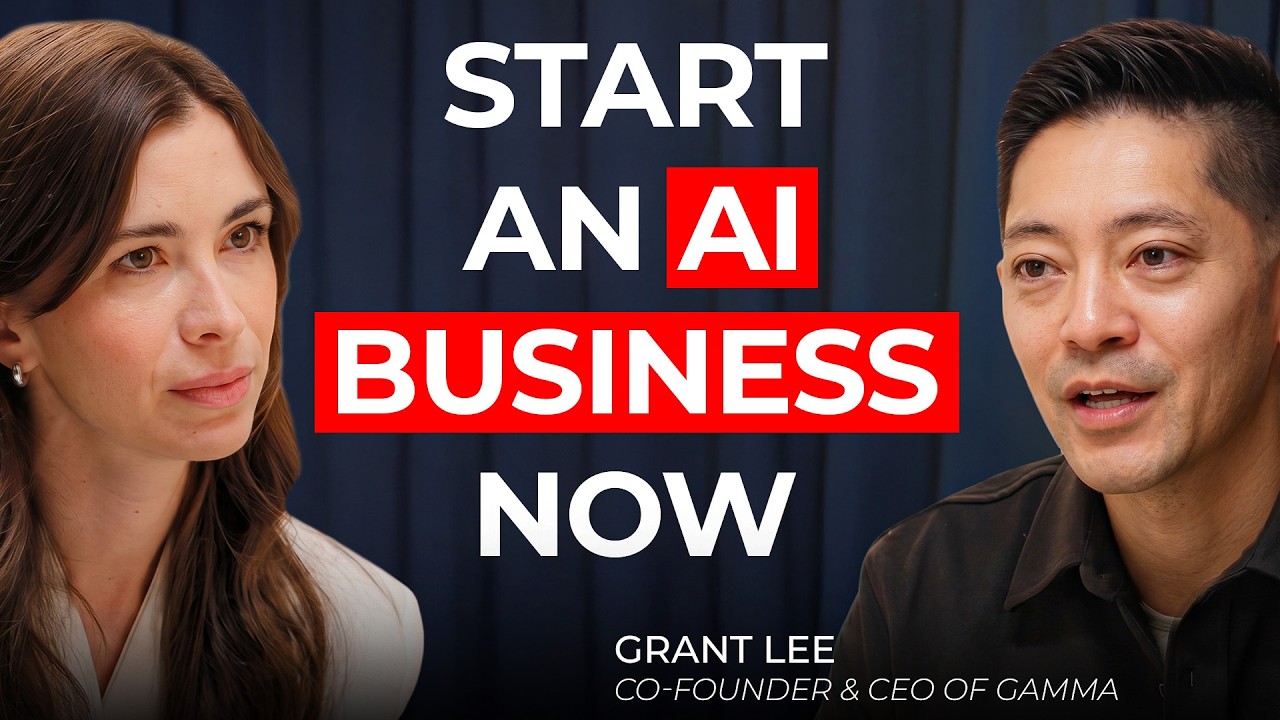
Grant Lee built Gamma, an AI tool that turns prompts into finished presentations, into a $2.1 billion company in just 4 years starting in late 2020 during the pandemic. He shares his journey of launching with no salary, a newborn daughter, and an investor who called it "the worst idea he'd ever heard." Despite these obstacles, Gamma grew to 100 million users with a lean team of 50 people. Grant breaks down the specific strategies that got Gamma to product-market fit, including how to run a fundraise in two weeks, how to identify if an idea is worth dedicating a year of your life to, and the two signals that indicate product-market fit before revenue proves it. He emphasizes that the biggest mistake AI founders make when fundraising is not thinking about distribution and organic virality from day one, and that friends will lie about your product—the real validation comes when people put their credit card down to pay.
Key takeaways
- Choose complementary co-founders with different skill sets over trying to build alone—Grant intentionally selected founders from his previous company who brought different capabilities to balance product, engineering, and business needs
- Product-market fit shows up before revenue through two signals: customers willing to pay (credit card test) and organic virality built into the product mechanics from day one, not added later
- Distribution must be architected into the product foundation for AI startups facing incumbent competition—build product-led growth and organic virality into the core philosophy rather than treating it as a later-stage problem
- There is no perfect timing to start a company; founders should commit when they have an idea they think about night and day, full team alignment, and family support rather than waiting for ideal circumstances
- Early negative feedback from investors can be a catalyst—Grant used the harsh criticism about facing massive incumbents as motivation to build distribution-first, turning a painful message into a core product strategy
Chapters
- 00:00Intro
- 04:43What his wife said when he quit his job
- 05:38Live demo: building a pitch deck with Gamma in real time
- 10:04The biggest mistake AI founders make when fundraising
- 14:33Grant rates the AI-generated deck as an investor
- 21:42How Gamma got its first 1,000 users
- 26:20Why every founder needs an audience now
- 28:27How to price an AI product
- 32:01Can you triple revenue without growing the team?
- 39:00The honest truth about delegating to AI agents right now
- 41:11First 30 days plan for anyone starting a startup today
Transcript
Grant Lee: So the investor told me this was the worst idea he had ever heard, there was no way we would ever succeed.
Marina Mogilko: This is Grant Lee, co-founder and CEO of Gamma, the AI tool that turns one prompt into a finished presentation. He started at the end of 2020 before the AI boom. 1 billion valuation. A lot of people are trying to build an AI startup these days. What is the one thing they should copy from your playbook?
Grant Lee: You can build anything, whether you're vibe coding or just agentic coding, all the capabilities feel like they're there. You can, you can build anything. The question is, should you?
Marina Mogilko: So how do you know?
Grant Lee: One thing you'll learn is friends will lie to you. They don't want to hurt your feelings. They'll tell you the product is amazing. If your product is valuable, they'll put their credit card down to pay for the product. Then you'll know you have product market fit.
Marina Mogilko: In this episode, Grant breaks down the three things that decide it. How to make people fall in love with your product, how to know if an idea is worth a year of your life, and how to pitch it so investors say yes. Can you give me their first 30 days plan, step by step?
Grant Lee: First 30 days plan is...
Marina Mogilko: Thanks to HubSpot for sponsoring this video. A lot of people are trying to build an AI startup these days. What is the one thing they should copy from your playbook when building in 2026?
Grant Lee: Honestly, the number one thing is to figure out who you're gonna build with. You know, there's obviously a lot of speculation around the single person billion dollar startup. I still think, you know, even if that were possible, why do it alone? It's so much more fun building with a team. If you're going to build a team, make sure you choose the right team. So a team needs to look like a set of individuals that maybe share the same ambition, share the values and principles, but should be very complimentary and skill set. So for us, I chose two co-founders that, again, we worked together at a company called Optimizely, became friends, but we're also so different. We bring a lot of different skills to the table. And so if you're starting to tinker today, find people that are very complimentary. You don't all need to be developers.
You don't t all need t be product people. Come up with something where each of you brings something and then start tinkering on a bunch of different ideas. Find a problem space that feels uniquely sort of positioned where. You as a team have the best chance of actually going out there and create something that's compelling for the market.
Marina Mogilko: Yeah, now that you're saying it makes total sense. But back then, you had to go through so many difficulties. I read the story where an investor hung up on you saying it's the dumbest idea. Then you were fundraising in your small apartment. Your wife just had a second baby. Talk to me about that time. How did you know you should keep pushing? And by the way, was that investor right about anything at all?
Grant Lee: So the investor, basically, this is early on in pitching, told me this is the worst idea he had ever heard, said that not only were we going up against massive incumbents, but they had ultimate distribution. So there is no way we would ever succeed. And I think he was absolutely right. In this market, especially what we're trying to build, there is going to be incumbents. They do have distribution. So as a product, you really have to think about growth from day one. You have to think about ways that your product itself can distribute itself just by use of the product. So leaning heavily into things like product-led growth and how do you build organic virality, these are things you can't afford to wait until many years later.
" So he was right, and I think for better or worse, we took that sort of painful feedback early on and sort of internalized it and used that as motivation to keep building. Um, for me, you know, I think trying to start the company when peak pandemic, you know, uh, my daughter was just born, there's all the reasons not to start the company sounds like the worst time, but then in many ways it was the best time because you also start feeling the sense of what if we didn't do something like the regret you'd have, you know, the, the sort of life is short mentality of, Hey, you know, like why not just try something? In the hardest of times. You know, if we come out through the other end, we're gonna feel all the more sort of, like we have, you know a sense of accomplishment.
And so I sort of avoided the sort of you know the trap of saying, hey, too much going on. I'm just gonna wait till later, wait for perfect timing. I think the reality is anybody that's starting a business realizes there's no such thing as perfect timing, there's you with an idea that you just cannot help but like think about night and day. And hopefully if you have a team that's also equally excited and energized by idea, sort of like you're just hungry to go after it. We are ready at the end of 2020 to commit to this full time. And so for us, it was a no-brainer. We were gonna go after no matter what.
Marina Mogilko: What about your wife? How did she take that decision? Because you quit your job, right?
Grant Lee: So, I was in between jobs at the last startup I was at was acquired, so I was exploring what was next. I think this is another part about anybody that's building companies, like obviously you have your partners internally at the startup, your founders, your founding team, and then you have every life partner, and you have to be equally transparent with both. And so, we had a conversation around, hey, if I'm going to do this, obviously I need the full support of you and being able to actually take a big swing at this. And it means like. You know, probably not taking a meaningful paycheck for a period of time. It means many late nights. It means, you know sacrificing some weekends to get work done. And so we sat down, we felt like, yes, this was right. It felt like the right thing to do.
And obviously, you the benefit of building something special as a founder means like, you share that with your family. If you build a meaningful business, you bring that to your family as well.
Marina Mogilko: Okay, let's actually test your product. A lot of people who are building today are gonna be fundraising. So I want you to help me create a perfect deck with Gamma for a C-Stage company. And you've been investing, you've launched this $10 million for 10 ideas. Yeah, so you know what a good deck is, right? Let's imagine, cause I have a business where we help people learn languages, specifically English for universities. Let's make a deck for an app that helps people master their English. I want to hear your prompt.
Grant Lee: All right. And this would be for a services business or?
Marina Mogilko: It's an app that I'm trying to raise for it. Okay.
Grant Lee: I'm actually going to use this new agent feature down here that we have. Let's just say.
Marina Mogilko: You can also use.
Grant Lee: Build a presentation, pitch, you want to do a pitch presentation, right? Yeah. Well, let's just start there. And so it's going to do some thinking in terms of, okay, what are the things that would be important if you were actually pitching this sort of app? And this will start with a question here, which is, what's your app's name and maybe key differentiator? Would you like to describe it?
Marina Mogilko: Yeah, let's say it's a general English language learning app. Content is generated on the go for you based on students' current level and interests.
Grant Lee: All right, very specific wait, what would you like to cover problem market? So there's some options here
Marina Mogilko: Well, I guess for fundraising, you know, you know all above. Yeah. We can ask it to them and then we're.
Grant Lee: And then we're pitching VCs in this case, or? And angels, yeah.
Marina Mogilko: Or angels, angels, tens, tens perfect, right?
Grant Lee: All right So we got our basic scaffolding in place and then we'll hit continue. In this case, right now we were leveraging more of like web search to kind of parse together, okay, what are some interesting things that would be relevant to an investor? If we were doing this for real, we'd also probably include maybe if you already have like, you know, a one pager or like, you know a notion doc with a lot of things that, you know, describe like the actual, you know, product requirements or the, you know, the specific features you intend to launch with. All of that could be sort of included. In this case, we'll keep it to basically what Gamma can search out in the wild with a more generic prompt here and see what sort of can be created.
So we'll choose, right now it's kind of looking through, it's adding some of the sort of content, things that are relevant, it created an outline, we'll chose a theme and then basically from here we can basically generate the first draft of the deck.
Marina Mogilko: How many pitches did you have to do to get your first check?
Grant Lee: I probably did over a hundred pitches in that. In how many days? It was over two weeks. So I was living in London at the time. m. , basically for almost two weeks straight. And this was the ability to kind of do this really quickly. Fortunately, during the pandemic, you actually, the benefit was you could all do it over Zoom. Today, if you had to drive from investor to investor, actually, you probably couldn't squeeze in that many. Zoom, you can do back to back. And so I had, I just crammed it in. I would say even in those a hundred pitches, less than 50% success rate. So of course, you have to figure out how do you pick yourself up after hearing no many, many times.
But I think one thing you do also learn is that in hearing yeses, you can always ask an investor, okay, what made you want to invest in GIMP? Like what are the things that actually caught your attention? You fold that into much earlier on in the pitch, you kind of adapt your pitch. And then you can also ask, if you're pitching to angels, angels you can ask, okay, the ones that said yes, who else should I talk to? Because many of these angels co-invest with other investors. So tapping into their network, getting a warm intro, these are things that just made it easier, even though it ended up being 100 plus, I got to the point where Um, near the end, you're starting hearing many more yeses.
So you start off with like many yos, a few yeses, and you start shifting it to like snowball into people that give you warm intros and you can build towards, uh, actually getting many more yesses by, by, at the end of it.
Marina Mogilko: Is there a mistake that you're seeing a lot of AI founders are making when fundraising?
Grant Lee: I'd say part of it is just you need to get into the mindset of this is a game. There's a two-week period or like, again, going back to time boxing, time boxing matters a ton. You don't want to get in position where fundraising drags on indefinitely. Many times people say, oh, I'll just give myself a couple months to figure it out. Then there's no urgency for investors and there is no sort of process that you're running. You're just letting it drift. So, one, define the timeline. Out of the founders, you should have one person running point. It's very distracting to have multiple founders all being dragged into hearing all the no's, for instance. It could be demoralizing. You need to have one that has the right mindset going into it.
And then number three is when you design the process in a way that can allow you to snowball in the end, that just allows you to stick to your timeline, be able to actually wrap things up in a really efficient manner. And go into, you should always go into a fundraise with as much momentum as possible. So if you're early, that means like maybe having a prototype you've really thought through and it like really feels complete. If you're later stage, obviously it means like you're building towards, hey, we're going into this fundraise with a ton of revenue momentum or ton of signup momentum, go into it with momentum, set that sort of time boundary for yourself two or three weeks, get it done in that process, have real urgency. And I think that's where, you know, the best founders treat this as like a short-term sprint, Get it done with.
Move on to what's more important, which is building the business, and not be overly distracting to the rest of the team.
Marina Mogilko: What happens if in two weeks you haven't raised what you wanted? Do you just stop and go back to it in six months?
Grant Lee: It depends on what you're hearing from the market, right? Like if it's like a definitive no across the board, everybody you've talked to, then it probably means your product's not ready or there's something about the market that is out of your control. Or your team. Or it could be your team, yeah. Cause it's early stage. So it's, like, you need to almost then be the most, you have to be your own worst critic in that sense. You have to self-diagnose, like okay, what is the root cause? And for every company, it's gonna be probably slightly different. You know, it could the team's not, you know, the right team to go after this market. Could be the market has too many of these, they've heard too many of these pitches, so there's not an appetite. Or it could just be you spoke to the wrong investors.
Maybe you pitched a bunch of like FinTech investors where in fact your business is a completely different type of business. So each sort of, you know, area is like one area to like, to put it as you diagnose. And if you can find the root cause then go back to the drawing board and probably reset the clock and say, okay, I'm gonna give myself another month to prep for this new process. And then again, go into that two week sprint. I would say more often than not, it's because you're going into the process without enough momentum. If you're into it with momentum, in most cases you should be able to find a clear path to be able raise.
Marina Mogilko: The hard part for most founders isn't knowing that. It's actually doing it when you're buried in operational work, rewriting the same pitch deck for different investors, researching leads one by one, starting every LinkedIn post from scratch. So much of it is repetitive work AI can already handle. I learned this running two companies and a content business with 18 million followers and a team of 35. For a long time, the honest answer to how to keep up was barely. So my team and I started asking one question on every task. What should stay human, and what should AI own. We turned that whole system into a free bundle we made together with HubSpot for startups, and we called it the Workplace Automation Kit. Inside are five cloud skills we actually use internally. One helps write investor updates and LinkedIn posts in My Voice. Another turns messy brain dumps into structured reports.
Plus two creator skills my content team runs on every script, including the voice filter, that catches AI sounding copy before it goes live. And my favorite is the automate or hire roadmap. It's a one-page framework for what to delegate to AI, what still needs a human in the loop and what should never leave you as a founder. The whole point is not replacing people. You will be running the same system my team uses every day. You don't need a huge team to use any of this. You can be a single founder or you can be knowledge worker automating their workplace. Drop the skills into cloud. Takes two minutes. It's free. The link is in the description. Thanks to HubSpot for startups for partnering with me on this. And we're back to the interview with Grant. Let's look at the deck. Let's see what Gamma built.
Can you, as an investor, can you rank rated?
Grant Lee: Yeah, so this is talking about the language app that learns you. It's talking about a billion English learners, zero personalization. So it's saying that, you know, a lot of people go into actually trying to learn, but in no way has this opportunity been personalized. And so, I mean, you now, obviously this is generic. So the question is, are you building a product that actually addresses this? Is there true personalization in the way you're dealing with this? Of course, this is intended to be a placeholder. So You'd have to go back and say, is this, are any of these things relevant to how I'm thinking about building my app and be able to flesh that out quite a bit more. So I think what we found is that, oftentimes when you're starting off with something that is a little bit more generic in this case, you're using it as more of like a thought partner.
You're saying, okay, these are the potential questions or things that could come up. And then you as the builder should say, Is any of this actually relevant? Do I believe in any of these? And if not, then I'm gonna go ahead and replace it. And of course, this is where you start iterating.
Marina Mogilko: You start iterating. I remember when I was building a deck it was just me and like looking at some like Airbnb decks. Yeah. Like it was good.
Grant Lee: And, you know, I think one big thing, so traction of obviously is important to plug in your real thing here. I think, one big that's actually missing here and where I would have probably changed the order is to talk about your team way earlier on, especially if you're an early stage company. I always think about as like, when you're just pitching, you're product and you're you're, just getting going and investor is really just looking at the team and the dream. It's really just those two things. And you're answering, you're trying to answer for them why you and why now, right? There's probably been many different startups that have attempted building in this category. So what makes your team unique and special? What sort of insights do you come that actually offers something that feels differentiated? And then why now?
Is there something else that has happened such that there is an opening in this market for your team to go after? These would be things I would actually, looking at the stack, I would push all the way to the front, is start off with that. Before you start talking about TAM or the market opportunity, just talk a little bit about what is it about your team that feels truly differentiated.
Marina Mogilko: Yeah, I feel like so many people have so many ideas. Ideas change so much. You can ship a new product every week, like an MVP, new MVP every week. It all comes down to the team. You were picking ideas based on energy. Is that right?
Grant Lee: Yeah, early on, I think for us, the true sort of North Star was energy. Was this an idea where, again, you wake up in the middle of night sometimes thinking about, oh my god, like tomorrow I'm gonna work on these things because it's gonna be so impactful. And I think that energy gets you to the point where you can create the early versions of the roadmap, you can start talking to early users, but you really need that energy to be the fuel. And we actually had, when we first kind of raised money, we actually... The ambition was to sort of help people change the way they communicate. So we actually had two different ideas. One was, well, you know, presentations are one form of communication. People spend so much time formatting, trying to design it rather than the idea of themselves. That could be one category of an idea.
The other was, this was again, peak pandemic. And so, so much work was shifting to like more hybrid and virtual work. We thought, what if we created a virtual office environment where, you now, instead of all being in the same room, like we can collaborate on a canvas and like. Really share the work that's going on and be able to communicate in a way that almost emulates being in an office. We sort of parallel path like building both for about six months. Oh wow, that's a lot of work. A good amount of work and we were dogfooding both products at the same time. So we would create presentations, present internally to each other. We would sometimes present in the virtual office or like there's some sort of like cross-pollination of the ideas there.
And after six months, we realized that the presentation idea, Each one of us could like have like this roadmap of all the things we wish we could build. It felt like even after six months, we were barely scratching the surface on like the possibilities of what would the future of presentations look like if we could just invest fully in it. Whereas like the virtual office, we almost hit this sort of ceiling and part of the ceiling was part just due to our own ability to imagine in this space. It was like, well, we really felt like we, the virtual law office, no matter how good it got, it could never really replace the sort of magic that you get within real life work and like being able to work shoulder to shoulder with a colleague. And so that was almost a limitation of our own imagination.
And so we were like, okay, well, if we're having trouble, even like imagining the next few months worth of roadmap for this idea, let's go back to the one where we can't stop thinking about it. Let's go to the presentations because this is the one where every one of us lights up when thinking about the problem.
Marina Mogilko: Do you use the same metric? Cause I also read this amazing story, how you rebuild the whole onboarding process, especially when you get, where you were getting good traction, but you decided to rebuild it and you started getting an enormous amount of users. And in general, when you rebuild a product, when do you know when to stop iterating on features?
Grant Lee: Yeah, I mean, probably never need to stop innovating today, especially given how fast things are moving. But when you're early on, the sort of, you know, one question every founder will ask is, how do I know if I have product market fit? And I think the answer for many types of businesses, maybe not like infrastructure or B2B, but most like consumer or prosumer businesses, there's basically two things you're looking for. One is Does your product have organic growth? Is it's so good people are telling all their friends, family, colleagues about, because if it is, then you don't even need to spend any money in sales marketing, you'll just have more and more users come to your door to actually try to use your product. So that's step one. If people are using your product, telling all of their friends about it, you have organic growth. Step two is their willingness to pay.
If you're a consumer product, maybe you can monetize via ads or different formats. But if you're a true sort of productivity or creative tool, people need to pay for your tool if it's really valuable. And payment is always an exchange of value, right? If your product is valuable, they'll put their credit card down to pay their product. So if you have those two ingredients, I think then you'll know you have product market fit, and you'll have something where you can put more fuel on the fire by obviously investing in marketing and sales in different ways. But without that, any sort of sales and marketing is premature because the product itself isn't good enough for it to actually spread on its own. And you're always going to be fighting an uphill battle to kind of retain customers.
Marina Mogilko: Quick pause. My team and I are celebrating one year of the Silicon Valley Girl podcast. I know the channel has existed for a while, but a year ago, I made a decision to focus on amazing conversations with people who are building our future with AI. And for a whole year. We work to bring you the biggest founders and builders in AI, so you can keep up in this era and get inspired. If you love what we're doing, please subscribe and hit the notification bell. It's what helps us bring you the biggest minds of our lifetime. Thank you so much for being here. Talk to me about getting those first thousand users. How did you get them? And is there any advice on getting them in 2026?
Grant Lee: Yeah. So when we first launched, maybe like many founders, we tried to recruit all of our friends to use the product, anybody that created a presentation. And we were able to get several thousand people just to sign up through our network, Extended Network. And of course, you ask your friends, how do you like the product? And one thing you'll learn is friends will lie to you. They don't want to hurt your feelings. They'll tell you the product is amazing. The real truth is then going back and looking at the usage, or people actually using the And so then we'd go in and many of the friends that said they loved the product weren't even coming back to the product, not using it. So then you start honing in, okay, where is the real usage of the product? What kind of use cases are people actually leaning into?
And we saw early on a lot of freelancers, solopreneurs, small business owners that had to create a lot content using gamma as the way that they were presenting and sharing with their clients and customers. So that's where we understood, okay, there's a pocket of users here, we should be spending much more time with them, talking to them. And then of course, over time, then you can find out ways to message to them specifically, whether it's on social media or if you're working with creators and influencers, really tap into the personas where your product's the most useful and start getting that flywheel of going of, they're finding the product, they're fighting real value, they're sharing the product with their network, with their friends, and that's where you can really start building the initial core of your core users in the beginning.
Marina Mogilko: But you haven't done a lot of paid marketing at the beginning. So was it just word of mouth?
Grant Lee: It's just word of mouth, even today, word of mouth is by far the number one acquisition channel for us. It's like people telling other people to use gamma.
Marina Mogilko: That's fascinating. And you also do influencers, right? Yeah. And you do a lot of micro influencers, going after big ones. What did you learn in that process? Was there an like an influencer campaign that didn't work?
Grant Lee: So the very beginning, it was actually all organic influencers, people basically learning about gamma and just sharing with their audience. That was me. Yeah!
Marina Mogilko: That was me. When I first saw it, I did like a video about, yeah.
Grant Lee: We'll really appreciate that. Because it's amazing. It's an amazing tool. Yeah. And so that's where we started seeing, just in the very beginning, some organic spikes of people coming and learning about gamma and starting to use gamma. And so we realized, OK, well, if this is already happening organically, what can we do to reach an even broader set of creators and influencers out there? And we started just testing a bunch. So I also, in this process, started to try to figure out, how could I be a creator myself because I felt like to really empathize with other creators, I kind of needed to go on the journey myself and just understand how hard it is to even build an audience, come up with content, share information in a way that feels authentic and really genuine, and you need to build that muscle, right?
And so for me, it was like, okay, I'm gonna start by learning how to do this, and then when we do work with influencers and creators, I'm going to onboard all of them myself. Because now you
Marina Mogilko: Because now you know how to do that right? I know how
Grant Lee: I know how to do, but I'm also still learning, right? Like it's helpful for me to like go down and say, okay, rather than just saying, hey, go, you know, go and showcase gamma is like, okay. Let's actually sit down and think about your audience specifically. And what I actually learned was that many of these creators struggled with presentations because they never learned it in school. They never, you, know, learned it on the job. And so I got to actually unveil kind of the magic for them. And then specifically for the use case, like, you know, if they're targeting, you real estate professionals. We would think through, okay, how do we actually package this up in a way where the use cases we're showing are relevant, make sense, the way we talk about the product, like resonate with your audience, and we can brainstorm a ton.
And that for me was also a learning opportunity, because then I could really say, okay. What do the best creators do? How did they write a good hook? How do they come up with a structured story in a short amount of time? How do the capture people's attention? And I was also sort of like, now I could teach them about the project. They learn how to use gamma. They could talk about Gammon in a very authentic way. And then in the process, I can become a better creator myself and translate that into, you know, many founders today have a chance to be their company's sort of megaphone or amplifier, right? Like anytime they want to share information, if you have your own audience, you should be able to package up that narrative in the right way too.
And I did so by just learning from, you know, the best creators out there, like how can I actually build this muscle myself? You know, it definitely felt like there's some good synergy there.
Marina Mogilko: And you're active on X and LinkedIn, right? Try to be active on x and LinkedIn.
Grant Lee: And I think this is where many customers will reach out, many partnership opportunities come to fruition because of the audiences that I've built there. And again, barely scratching the surface, but more I wanna do. And I just think it feels very rewarding to start building an audience.
Marina Mogilko: Yeah, just wanted to highlight it for everyone. Like 10 years ago when I was talking to entrepreneurs, the sentiment was you're not taken too seriously if you're actively posting on social media. Now, I think it's such an inevitable part of being a founder because this is how you hire, this is you learn the marketing channel, and this is just how you meet the peers.
Grant Lee: Totally. And I think there is a negative stigma because, you know, sometimes, you know, this is more like five, 10 years ago, where people, it almost felt like they were tooting their own horn. They want to like, oh, hey, look at me, look at me. I think you need to reframe it. Like if you have an audience and hopefully your audience overlaps with your core user base, you're trying to provide as much value to them as possible. Like you're not talking about your product all the time. In fact, you should be talking about your product very little. You should be talking about things that your audience cares about, has questions about. Obviously in this day and age, everyone's curious about how to apply AI to their work lives. How do they sift through all the noise?
How do the maintain a sense of productivity without just becoming insane because there's just too much to try to do on any one given day? So I think as a founder, you have a chance to figure out what are the, with your experience and your background and what you're building, what can you instill on your audience to inform them and keep them educated? That value in itself should be where like all the. You know, the ability to build an audience comes from, it's not about tooting your own horn, like really just talking about your product all day.
Marina Mogilko: Have you looked at users who are coming from LLMs when ChatGPT recommends Gamp? Because we're tracking on a newsletter. We're just seeing crazy open rates when people find us through LLM.
Grant Lee: Yeah, that's actually been one that's also trending very positively, both in terms of people landing on Gamma's website, but also converting long term. So I think we're early days. It's still a relatively smaller portion of overall traffic, but it's definitely growing. And it's exciting to think about what this could look like, obviously, in a couple of years. And every business wants, obviously to diversify how customers hear about this, so that obviously you want to be able to activate multiple different channels at once. And it does feel like LLMs, you know, chats. Chat to BT, Claude, are going to be meaningful channels for us in the future.
Marina Mogilko: Talk to me about pricing in general. So you start with free, then it's $8 and it goes up to $90, right? How do you come up with pricing for an AI product? And also it's dependent on how the models price themselves, right.
Grant Lee: Totally. So yeah, there's a lot of different moving parts. I think every startup today needs to be thinking about pricing as something that they're probably constantly experimenting with. It used to be, you know, five, 10 years ago, you kind of set it and forget it. You come up with pricing once and maybe revisit it every several years. I don't think companies today have the luxury of doing that. You constantly need to be think about, okay, the tension between like seat base versus usage base. How your product evolves, the different segments of users. So we have users that are individuals versus B2B customers that may want to buy in a completely different way. So, I mean, the honest answer for us is this is something we're still constantly experimenting with. You also want to do so in a way where pricing, you know, pricing, you're trying to align the value you provide to your user.
And then the other side of the equation is you need to be able to build a durable business. So like, are you... Actually building a business that's able to operate profitably or efficiently, the worst thing you could be doing is to be essentially selling dollars at a discount, right? If you're selling dollars a discount feels good, you're making money, but you're doing it so very unprofitably. So these are all things where constantly moving target, I think the best you can do is being willing to adapt and then user-based to kind of figure out what's the right way to balance both the value they're seeing and the cost you incur as business.
Marina Mogilko: Do you have any strategies on converting customers from free into paying? Because you had this competitor, Satoma, that shut down. 5 million ARR. You had 40 million users at 20 million ARRR. So you're doing something there converting customers. Can you give advice to AI founders on how to do that?
Grant Lee: I think it will sound generic, but it just comes back to what is the quality of the product, right? Every single category, if it's a meaningful category, there's going to be multiple competitors. And so your ability to kind of ignore the competition and focus on your users is all that really matters. Are you delivering something to them that competitors aren't either delivering on or unfocused on? Even within our own category, You know, there's many people that focus on kind of the design portion of creating a presentation, we want to focus on the communication, the storytelling. So how do we abstract design, the need for design completely away? And so you're gonna approach it differently depending on your sort of vision for this category. And then you're specifically, like your customers you're serving, what are their needs? Many different types of customers might have different needs for a presentation tool.
You need to figure out where in that space do you actually want to play.
Marina Mogilko: And your strategy has been product first from what I'm hearing, from what I'm experiencing. And you only have 50 people.
Grant Lee: Is it still the same? We're a little bit bigger than that, but like when we were crossing a hundred million and there are, we're 50 people. Yeah. So it was relatively small too.
Marina Mogilko: Grant just said he crossed 100 million in revenue with only 50 people. This is exactly the kind of thing I love to explore in my future proof newsletter with a community of 18,000 builders and creators. Twice a week, I share the best practices from my conversations with CEOs and founders, the AI tools I'm actually using, and the skills worth learning right now. It's free. The link is in the description. The question that's very, I think, is on point for 2026. Do you think you can triple your revenue with the same amount of people? Is the technology there? Yeah.
Grant Lee: I think the answer is yes and then the nuance is how do you triple it, right? Because we're trying to build a global business and so this means, you know, we have a lot of users in Europe, a lot of users and Asia. We still feel like we need to build the physical presence there. And so ignoring that for too long, just assuming, hey, we'll just grow from San Francisco and not grow headcount, I think would be the wrong long-term decision. And so we are trying to grow now our footprint in these different offices, which MEANS growing the team much bigger than it was obviously a year ago. So I think every business should think about what is their ambition as a business if it is to be a company that has global presence, if it to serve many different segments of users.
So like we have the prosumer end and the B2B set of users that are much different in profile, and then also serving developers through our platform or API MCP part of our business. Those all require different teams and like different places of like emphasis in terms of. Building out the complete product and platform, those require headcount. And so if we were just focused purely on prosumer, growing that as fast as possible, I think we could stay pretty lean. But if our ambition is to build a global business that can operate across segments, I think, we're gonna need a much bigger team.
Marina Mogilko: And also the question is, is there longevity in just growing the consumer business, like trying to do everything by yourself?
Grant Lee: Trying to do everything. Yeah, that is another tension. I think every startup is feeling today, especially today, because when it feels like you can build anything, whether you're vibe coding or just agentic coding, all the capabilities feel like they're there. When it feels like you build anything the question is, should you? And if not build everything, where are you going to focus? And so this is both the challenge and I think the opportunity building today like you have the feeling of being limitless in terms of going out there, but you also need to provide your team the right level of focus and to be kind of committed to some path of this is what we really care about and these are the things we don't and being committed to that for as long of a time horizon as possible.
Marina Mogilko: Your principal is hire painfully slow. Is there a role that you wanted to have in your company, but you're not hiring because you think it's, you know, you're still like debating whether you need it or not.
Grant Lee: I think it goes back to like every stage of company, you need to ask yourself sort of where you're at and what are the limiting factors for you to continue to grow. Oftentimes the moment a startup raises a little bit of money, they think like, okay, I need to immediately open the floodgates on sales and marketing and just hiring as many people there to build top of the funnel, build demand. But going back to is that the best way to grow an early product? Probably not. You know, it actually means. Going back to focusing on the core, like making sure the core product is so good, going back organic virality is like so good people tell all their friends about. We wanted to focus there. So rather than like open the aperture in terms of hiring across the board, when we were super early, it was all about reinvesting in the core.
Hiring the right obviously engineers, product designers. We actually probably over invested relative to what people would say like in product design. We had... It was almost a third of the company was product designers early on. And most people were like, why would you invest so much into product design? We're like, well, that matters a ton to us. So even though we were small in the relative overall head count, we were probably over indexed on product designers because we felt like that was super important. And to get true organic virality, we needed to be exceptional in that one area of that one function. And so every stage you're gonna have to look at, now that we're much bigger.
We can't afford not to hire sales and marketing because we have a massive audience to go after and we have B2B business that still requires a ton more relationship building, a much more consultative approach to actually expanding within these larger companies. And so we can just, hiring pay if only slow at this stage doesn't mean we never hire sales or marketing. It means now that we're at the stage, we feel like we've earned the right and we can gradually open up the aperture a bit more. If we had done that two or three years ago, think that would have been premature.
Marina Mogilko: How many of your employees are generalists versus specialists?
Grant Lee: I feel like nearly all employees are what I would still define as generalists today, even though they spike in different areas. So, for instance, our head of design, exceptionally talented designer, very visual, but he also knows how to code. And he was coding even before like, vibe coding was more accessible to most designers. But the fact that he can now ship something like end-to-end, test it, like get early versions into the hands of users, that's a superpower, right? And so he can cross domains where You know, traditionally it'd be a designer or a UX researcher that does a little bit, some of this like early, you know, sort of investigation or like early research. He can do that himself, develop the early prototype, ship the early product type, get something into the hands of users to actually give feedback on, and oftentimes then ship something into production, like almost like completely end to end.
That just wasn't really possible before, but for us, like we try to look for that, the spirit of like a generalist across every function, whether it's, you now, sales, marketing, engineering, product design. And I think that allows you to have a relatively lean team that can, again, like play across multiple domains at any given point in time. And I thinking general, that just means a team that can be pretty collaborative too, because you have deeper empathy for what each function can bring to the table. And like when you're bringing something to an engineer, for instance, you've already done so much work to think through like, okay, how do I make this right? So the handoff is as seamless as possible. These things I think are hard to quantify, but when you have a team of generalists, There is some magic in working together.
Marina Mogilko: But does this model ever break or start breaking with scale? Do you feel like there will be a point in time when you will need to start hiring more specialists?
Grant Lee: I definitely think so. But there's also the sort of competing sort of race of like, as you get bigger, you want more specialization. LLMs and AI is also getting better at being specialized in certain domains. And so there's almost like this race now of like at what point does AI also kind of fill in the remaining gap and the generals can go deep when they need to. TBD, I think certain functions like I think we're noticing, You know like within like finance and legal still pretty hard. Like you still want specialization and specific types of questions that come up. Like you don't want to just trust like an LLM, obviously to give you the right answer.
But for a lot of like sales and marketing where, your goal isn't to replace the human, it's to augment or like to really automate as much so that the human can focus on what they're good at, which is the relationship building, again, the consultative approach. You're trying to carve out, if they only have a certain number of hours in a day. You don't want them to be wasting any time like fiddling with business systems or any of that. They should be spending time with customers. And so our goal is like those generalists can help automate as much of the work that is not customer facing as possible. And the rest of the time, their specialty is to work with customers, we're trying to carve out as much time as possible for them to do that.
Marina Mogilko: Yeah, that makes total sense. With all the companies deploying agents, what was the last process that you completely delegated to an agent?
Grant Lee: I think one thing we've learned is that even with agents, you're not completely delegating things away. Like a human still needs to supervise. Still needs shade, yeah. And agents can still be fragile. They can go off course. And so I think the best cases are still where the human and agent are working hand in hand. And of course, maybe over time, you have multiple agents all working with the same human. And they can then be subdivided into different tasks. But we're still so early. We're not at the stage yet where I think any of our teammates feels like, okay, 100% agent work, now I can go do something else.
It's more like, okay, agent can actually help me provide a ton more leverage, can obviously reduce the time to complete a task, and then can help me do the things that I just would never have gotten to because my time in the day is too precious. And so there's certain aspects of that. Fast forward several years from now, then I think we're talking about maybe agents doing way more. Being much more self-directed and truly being like a partner where you can leverage the agent sort of workforce in a way that today still seems like we're still a little bit out of reach.
Marina Mogilko: What's your favorite agent?
Grant Lee: I mean, we build a lot of things internally to help with things like customer research or even just understanding what should we be building next? Like what are pockets of things that are gonna be useful? So like taking all the input we get, we look at obviously things like churn analysis, like what are people saying? We look at when new users sign up, what are they using? How are they leveraging the product? These are all inputs. And so we wanna be able to take those inputs to say okay. Now stress test, like some of the other things we're thinking about building, like how useful is this to an end user? Where might we kind of add value in ways that we aren't even considering today? Like really being a sparring partner there.
I think those are things where you can now with much more, like every company now has so much more data they can actually work with. Taking advantage of that is really, I think where the magic really happens.
Marina Mogilko: So your analyst is basically a data analyst meets product and they make decisions together. Somebody who watched this video has a startup idea, built a deck with Gamma. Can you give me their first 30 days plan, step by step?
Grant Lee: First 30 days plan is spend all 30 days talking to your customers. Really, I think it feels like if you're assembling the team, you need to be laser focused, customer obsessed from the very beginning, and nothing else really matters in the long run.
Marina Mogilko: It's not you wouldn't start with a co-founder
Grant Lee: Well, I mean, I'm assuming if you've raised money, you have to come find us.
Marina Mogilko: Had an idea and you're like, okay, I'm going to start. Is it the co-founder or you start talking to clients first to figure out who you need as a co- founder?
Grant Lee: I personally think you shouldn't jump into the idea before the team, because the team should help inform what the idea actually is. You might have like, hey, I'm again, going back to our specific thing, which is we think like, you know, visual communication can be improved, but we weren't gonna be prescriptive into how we actually solve that. Let's, as a team, start tinkering. Like, what can our team deliver in the space that feels differentiated? And once we had that, that's when we said, okay, we feel like. There is something here, we don't know exactly what the product might look like in three or four years, but there's something here. Let's go raise money. So we have a chance to actually build this for, you know, over the next several quarters.
Once you have that, then it's about, you have the early team, you flip all of your energy into spending time with customers and early users and like testing, like, does the my thing even deliver on, you know anything that's valuable to you. And if not, let's course correct. Let's make sure we're not heading down a path of like delivering something that has zero value to you as a customer. Let's makes sure we are listening to your problems, fine tuning our own sort of understanding of the problem space, and then building the right thing over the long haul.
Marina Mogilko: So for someone who came up with the idea, found the team, which is kind of hard if you are not in the ecosystem, like finding writing, but would you say this deck will help that company raise money?
Grant Lee: I would say yes, but it will help you sort of have the right conversations, but ultimately the investor is going to judge you based on your level of conviction and their level of conviction in your team to go after this market. So use this as a tool and every great tool can help you open the right doors and obviously to have some of the right conversations.
Marina Mogilko: Can we wrap up with one final question? So if you could send one message to the founder version of yourself in 2023, when your growth was stagnating, 6K users just start there, what would you say?
Grant Lee: It'd be some version of just hang on, you know, like every founder will go through many ups and downs. If you're surrounded by a team that, again, shares like the same level of ambition and the values and principles, then you gotta just lean on them as much as you can, and then still have belief that you can make it through. The earliest days are the hardest because it very much is, they describe it as like the idea maze. You're like bumping into wall after wall and. Not knowing if you've made any sort of meaningful traction. And so for us, it was like, hang on for as long as possible, make sure we don't lose belief in the longer-term mission of trying to help people communicate their ideas. So we feel like that should be something we could commit to for a very, very long time.
And so hanging onto that belief that we can make a difference, that's what for us actually did change the overall trajectory of the business.
Marina Mogilko: And it comes from the energy, I guess, that the product has given you, right? That was the source of that belief.
Grant Lee: It comes from the energy in knowing that what you're working on should help improve people's lives and the energy you're putting into it will hopefully result in amazing outcomes for your customers and users. That energy, obviously, it needs to be built up. It's like the conviction that you're constantly trying to fill up as much as possible. And if you're building the right things, I think you'll wake up every morning being excited about the things you're working on.
Marina Mogilko: Thank you so much, Grant. Thank you for having me. Thank you. Grant Bergamot to a $2 billion valuation. If you want another founder story from the AI era, watch my conversation with Yang Zhao, the CEO of Opus Clip. He gave me one of the best frameworks I've ever heard for picking a niche when there are already 50 AI tools in every category. Click right here or here, somewhere, and also in the description.