Interview·May 21, 2026·34 min
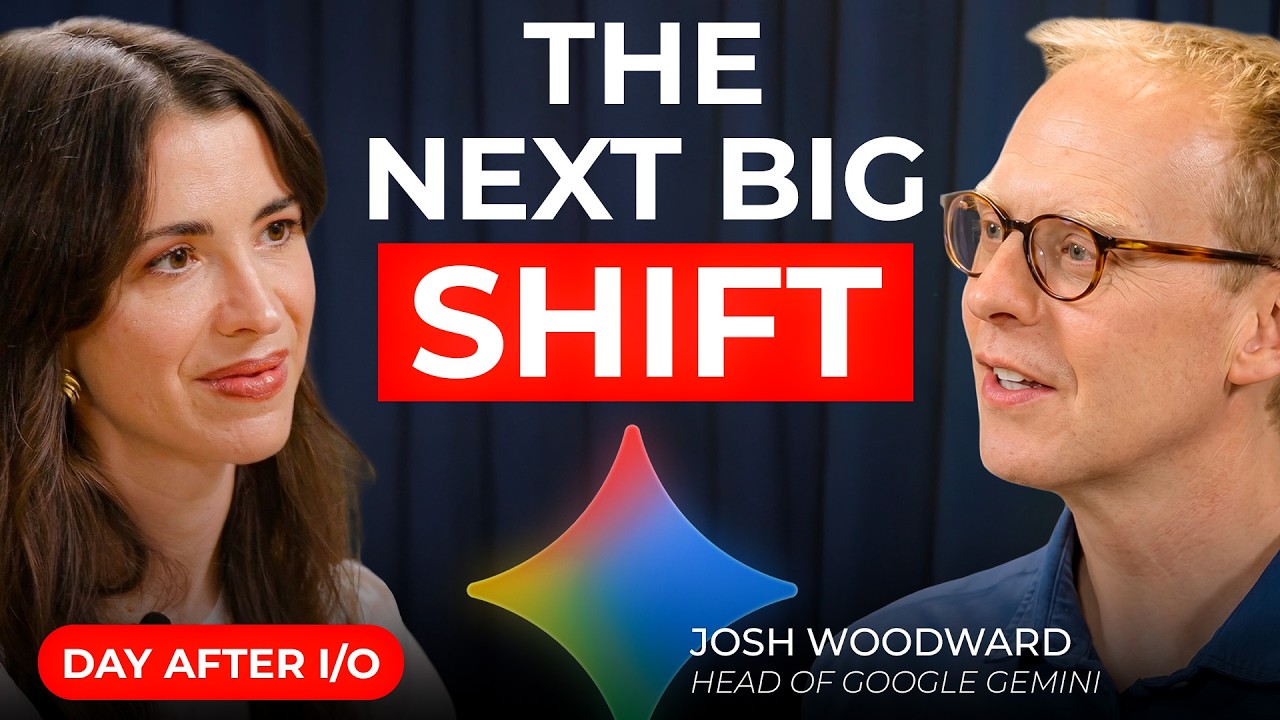
Head of Gemini: You're Using 5% of What Gemini Can Actually Do | Josh Woodward
In this episode
Josh Woodward, VP behind Google Labs and head of Gemini, discusses Google's shift into the agentic AI era and reveals that most users are only accessing 5% of Gemini's capabilities. He highlights Gemini Spark, an AI agent that works 24/7 in the background, deeply integrated with Gmail, Google Docs, Sheets, Slides, and Calendar to automate digital chores and free up calendar time. Woodward shares that a voice feature demoed at Google I/O—which understands file context, creates emails with tables, and generates images and videos—was built just two weekends before the conference. He explains Google's competitive advantages: native Google ecosystem integration without connectors, cloud-based virtual machines enabling parallel task execution, and access to a generative media suite including Imagen and music generation that competitors don't have.
Key takeaways
- Gemini Spark's killer feature for regular users isn't work automation—it's helping manage personal digital chores like remembering library book deadlines, freeing up calendar time, and filtering content based on personal interests like sports team news
- Google's agentic AI can execute hundreds of parallel tasks in cloud virtual machines, meaning productivity gains will be exponential as the technology scales beyond today's early beta limitations
- The shift to voice-first interfaces is already happening internally at Google; upcoming features let users talk to documents and files directly, with AI understanding context from PDFs and images to generate formatted outputs
- Google's competitive moat against ChatGPT and other AI tools is native integration with its ecosystem (no connectors needed) plus access to generative media capabilities—Imagen for images, music generation, and video creation—that competitors haven't matched
- The agentic era fundamentally changes work from 'doing' to 'directing': as AI agents handle execution, human judgment and taste become MORE valuable, not less, making career advice for new entrants focus on developing irreplaceable human skills
Chapters
- 0:00Intro
- 1:01Why This Google I/O Is Different From Every Other One
- 2:21Feature That Was Built Two Weekends Before I/O
- 3:22Why Switch to Gemini When You Already Use Another AI
- 6:53The Shift to Voice-First Is Already Happening
- 8:02From Doing to Directing: Everyone Becomes a Manager
- 12:10Is Google Actually Losing the AI Race?
- 15:18Gemini's Personality
- 16:27How Josh Builds Personal Context Into AI
- 19:58Why Everyone Needs to Organize Their Personal Context Now
- 20:55What AGI Actually Means
- 22:35Why Human Taste Becomes More Valuable, Not Less
- 23:42Advice for Someone Starting Their Career Right Now
- 24:29How Google Labs Ships Products in Two Weekends
- 26:13The Metric Josh Uses Instead of Retention Dashboards
- 29:39The Next Shift Nobody Has Internalized Yet
- 31:12What His Five-Year-Old's Future Looks Like
Transcript
Josh Woodward: The amount you're going to be able to get done is unbelievable. What used to take a few seconds is just going to like boom, boom, boom,
Marina Mogilko: This is Josh Woodward. He runs Google Labs, AI Studio and the Gemini app where Google builds its biggest AI products. They just launched the AI agent that works for you 24 seven in the background.
Josh Woodward: That was a project we started called Personal Intelligence. If you're a Gmail user, use Google Docs, Sheets, Slides, Calendar, all that stuff just works. Helping us free up time in our calendar so we can do things we wanna do, either together with our family, hobbies and whatnot.
Marina Mogilko: So if agents do a lot of stuff instead of us, is this officially a new year of work coming? Let's get into it. Josh, welcome to Silicon Valley, girl. I'm so excited to finally be chatting with you. I know, yeah. Congrats on all the success. You've been with Google for almost 20 years.
Josh Woodward: Well, yes, 16 and a half, I think I started as an intern.
Marina Mogilko: Okay, so you've seen a lot of Google IOs. Can you rank this one in terms of significance?
Josh Woodward: Yeah, I think this is a big one. For a couple of reasons. One, it's the first time we're really starting to shift more into this agentic era. And I think that'll be a big shift for a lot of our products. You saw some of it yesterday, but there's a lot more cooking we have in Google labs coming to. So that's one. I think the other, this Gemini Omni model is another one. It's a very big shift in how you start to think about any kind of input in and the output that comes out of it. So it should be fun. And then at the end, it was a bit, you know, Google IOS is such a flood of news. But um towards Ian Demis actually mentioned a couple of our science products that we're working on. I'm very excited about that and where that's going to go.
Marina Mogilko: What was your most exciting update yesterday?
Josh Woodward: Ooh, well, I can't wait for people to play with Gemini Spark. I think it's going to be fun.
Marina Mogilko: It's rolling out this week to testers and next week to pro.
Josh Woodward: Yeah, to the Google AI Ultra members in the US and then we're going to scale it up from there.
Marina Mogilko: You know, what was my favorite update when you were demoing this voice feature. Like you're talking to your computer, but instead of just transcribing, it actually went to your Google drive, went to Gmail, found all the necessary information, pulled it together and created this beautiful email with like a table inside of it. I like, this is nice. This is the next step of voice. Is that rolling out? Yeah.
Josh Woodward: Yeah, that's in the coming weeks. Exactly. We're playing with it right now. It's so fun. And I think what's amazing to me the first time I remember was two weekends ago, we were hacking on this on the team. And they're like, Do you think we could get the same Google IO? It's like, it's a little tight to get something in we snuck in. So this feature is two weeks old. Yeah, this feature was two weeks ago. And it's amazing because you select all your files, you know, that could be in driver on your desktop. And then you just talk to it. And can go through and understand what's in the PDF, what's in the image, and then create it all. And then it also enhances the text. Like I essentially made a mistake on stage to like change the date and understand exactly.
Marina Mogilko: So this thing is happening now that I wanted to touch upon. So a lot of people are using different tools, right? And we've seen something similar in like, I don't know, Kodak, Klaudia. Yeah, yeah. With these features rolling out, what would you tell to people who are thinking if they need a switch? Like why would they switch to Gemini?
Josh Woodward: Yeah. Yeah. Well, I think the Gemini, you're going to get a few things. And if you're thinking about Gemini Spark in particular, first, that is deeply integrated in the Google environment in each system. You don't even need to
Marina Mogilko: You don't even need connectors. That's right. I've been saying this for so many years, like, please, start emolling. Yeah.
Josh Woodward: That's right. Yeah. So I think, you know, whether if you're a Gmail user, use Google Docs, Sheets, Slides, Calendar, all that stuff just works. Yeah, and it's very good. Second thing, we actually have virtual machines that we can spin up in the background on Google Cloud. So, I think where all this is going is you won't just have one or two tasks, you may have hundreds of tasks. And you can imagine, we can do that in parallel. And just the amount you're going to be able to done is unbelievable. So that's two right off the bat. The third I would say is we're really trying to push the limits on the types of things that Spark's going to be able to create for you. So what I showed on stage was a Google doc or Google slide deck for our neighborhood block party, but imagine this has got man of banana.
It can make images. It's got Omni, it can make videos. It's Got Lyria, it could make songs. And that's the kind of stuff that no one else has that sort of generative media suite. And so I think the ability of this thing over time, it's just going to way more versatile. But we're starting out very early. It's a beta. There will be a lot of things. When we add NCP connections in a few weeks, we'll add agentic payments with Google Pay and Wallet. With Google Pay and Wallet.
Marina Mogilko: YouTube Analytics by any chance. Oh, that's- Good feature request, maybe. This new thing is as a YouTuber. Yeah. I can't really use Gemini to talk to my analytics because it's not connected. So I have to either download a CSV file or use computer agentic features to go and take screenshots. Is there a killer feature that everyone should try once this rolls out so that they're convinced? Because I feel like a lot of people, they're hearing words, agentic, you know, agent running in a cloud. But like as a mom, what does that mean for me? What can I try and do to be blown away by this?
Josh Woodward: Yeah, yeah. Well, I think just to take that example, maybe outside of work as a mom, like you said, eight is so good at any kind of just a lot of people have been doing user research, like I have all these digital chores, I have to go do. So it might be like, helping you remember things that you might have forgotten. It's helped me remember a lot deadlines for our kids. Like you've got to return that library book before the end of the school year.
Marina Mogilko: I'm like, how many things am I supposed to do for both my kids? That's right. What do you have four? Yeah, yeah, yeah. I don't know how you guys do it.
Josh Woodward: Yeah, yeah. So anything around that, I would say also, it's very good at I finding that my wife and I use it this way for helping us free up time in our calendar. And so we can do things we want to do either together with our family hobbies and whatnot. One of the things I would say for your work life for a lot of people out there, ask it what are the three meetings should cancel this week. It's very good at that. Yes. So that's one that's really interesting. I'm using it more and more when I started, I was setting up reoccurring schedules. And so one of my favorite ones right now are huge NBA basketball fans, the Oklahoma City Thunder, and they're in the playoffs right now. And so I just get like all the news about the team.
But it's inviting it to me as if it's like a die hard sports fan for the thunder. So there's all kinds of different ways. But I think anything around like, help me not forget something. Help me free up time. Help me follow an interest I'm really passionate about. It's excellent and all that stuff.
Marina Mogilko: Yeah. And you also released docs live yesterday when you can talk to your Google doc. Yeah. And you know what it got me thinking? Are we slowly moving to voice first apps? Do you notice that internally? Because I started talking to my computer all the time. Now you're releasing this feature, which not only allows you to transcribe what you're saying, but like have some smart thinking behind the scenes. Yeah. Do you think the shift is happening now when we're using more voice?
Josh Woodward: I think so. We see it in our Gemini usage stats as well. There's certain. How do you?
Marina Mogilko: Oh, do you have any numbers?
Josh Woodward: Well, not to share here, but I will say that, like, there are certain countries now where it's tips and voice has become just a dominant way. A lot of people are interacting. It's natural, it's faster. It also, now we're at a point where you can kind of ramble and the model can clean it up for you. We've also now got it where the model's hooked in, it can do all the tool calling, it can generate the images. So it's, and then the stuff I showed yesterday with the dialects He's really fun. So you can have it sort of talk in any number of different ways. Yeah. So all that stuff is coming, you know, in the next, we're talking weeks here. This is not far out.
Marina Mogilko: Talk to me about the shift that's happening. So what I'm noticing as a user is that a lot of companies were optimizing for software engineering. Like let's use AI to speed up our software engineers. I'm seeing this huge shift to knowledge workers. Like let us now help knowledge workers to experience the same magic that it's AI has done to software engineering is that the priority at Google right now?
Josh Woodward: Yeah, there's big focus on it. And I think what's interesting is kind of taking the lessons we've learned over the last few months and quarters with coding and applying some of that to knowledge work. One of the early projects I worked on on all of this, which is still going a lot is Notebook LM.
Marina Mogilko: Oh yeah, my favorite.
Marina Mogilko: com, upload all the articles they send me, like listen to a podcast about this phenomenon.
Josh Woodward: Yeah, yeah. And I think that was one of the first ones we realized, if you can make it really easy for people to assemble all that context, like all those papers in your case, and then either hit a button, it's a podcast, hit a button, It's a slide deck, it is a mind map, whatever you want. That was kind of our first like glimpse into where this is all going. And I think like where notebook is going to go, and even you'll see it in Gemini and other stuff, is like that ability to just describe or talk about what you want. It's like, I need to understand this, go grab all these things, make this, this, and this, and it's just gonna happen.
And so I think for knowledge workers, it's very exciting, but also it is a different shift because you're almost going to a point where you're orchestrating much more about the outcome or the deliverable you want, instead of the how to get there in some cases. And so we on the team talk about as you're moving from doing to directing.
Marina Mogilko: And that's like a big shift. Exactly, everybody becomes a manager.
Josh Woodward: That's right. Yeah. We've having thought on the team, you know, in companies like Google, you would do like manager days or leadership days, you do manager training. And that would only be for the people managers, like a certain percentage of your whole team. Now we're matching, we may need that for everybody. Yeah, because you may be managing these different sort of like agents and others.
Marina Mogilko: Absolutely. And you're launching so many products that are helping people do that. Yeah, we're trying to. What Josh just said about how people are starting to use AI for decisions is actually a much bigger shift. For years, if you ran any kind of business, a startup, a SaaS product, an e-commerce brand, even a personal brand, you optimized. Google search. You wrote blog posts, chased rankings, played the whole SEO game. But now, people ask Gemini, ChatGPT, or Perplexity, what's the best sushi restaurant near me? Can you recommend a podcast? What's the Best Hotel in Silicon Valley? How do I keep track of all my customers? And whatever answer the AI gives, that's what drives the decision. The problem is, most founders have no idea how to make their brands show up in those answers. And we noticed that too.
So a couple of months ago, we saw that our podcast was doing really well on YouTube, getting hundreds and thousands of views, but was almost invisible inside AI Answers. So we started digging into that. And after trying a few things that didn't work, we realized it actually comes down to small details. What you write in your descriptions, how your content is written, even small things like your text bio. Once we fixed that, we finally started showing up. It's still a work in progress. But it's a really important long-term investment. That's why I was excited when I saw a new tool called HubSpot AEO. It's a tool that shows you exactly how your brand appears across chat, GPT, Gemini, and Perplexity, your visibility score, how you compare it to competitors, and specific recommendations for what you can actually do about it. Where most tools just give you a score, HubSpots AEO gives you a plan.
What to fix, what to write, and what to post. You don't need an agency. You don't need expensive consultants or technical expertise. You just see where you stand and what you do next. It's a $50 a month, but you can try for free for 28 days first with access to 25 prompts. The link is in the description. Thanks to HubSpot for sponsoring this video. Now back to the interview with Josh. But for the past three years, I was sad to hear that people were saying, like Google is kind of losing this AI race because people are using like all the other tools. You know, ChatGPT was the first. Do it! Uh, LLM like when it comes to search, how do you see the situation changing now?
Josh Woodward: Yeah, well, I mean, it's very dynamic. It's very fast moving. It is as you know, you have people on your show too. I think first off, it is fun. I think competition, a lot of us on the team, we like that. Because you get this, it sharpens you, you know what I mean? So that's one I would say. The other thing I would stay though, is that there's a lot things Google has, and in some cases has had for years. And what's fun for someone like me, who's been around here while as it's like, how do you kind of put these together? And new and interesting ways. And so, you know, we talked earlier about, you don't have to use connectors. That was a project we started called Personal Intelligence. And it started from this idea, what if you could just tap one button and all your stuff could be connected?
And I wouldn't mean that everybody wants to do it. We made it opt-in, so it's like you can choose. But for a lot of people, they're like, yes, I want that. Yeah. And so I feel like it's really fun because we're in this stage where we're getting to reimagine not only kind of existing products, but combine them in new ways to make new products. Yeah. And that's just super fun to get to do.
Marina Mogilko: And also like fun, fun fact, my dad started using AI like a few months ago when he came here, he was visiting. Yeah. And he does like, he teaches MBA. So he needed to do some like table on weights of different like experts, et cetera. Yeah. So I asked ChatGPT, he was like, okay. We asked Claude, he needed some follow-up questions, but he was happy with the result. We asked Jamine. First. Prompt and he was so happy. Oh, nice, great. I had to give him a phone that's powered by Gemini so he can run all these things. And like this, this is what makes me sad, right? It's still like if we look at B2B usage and Tropic is leading it. Yeah, yeah. What would you say will make people make this shift?
Josh Woodward: Yeah, well, I think there's a few things. I think one, the core model, a lot of the early adopters choose wherever that is. And you can even look back over the last like six months, how people have jumped from different models to different models. I know, we're jumping every week. Yeah, yeah, yeah. So there's lot of that. Now that's happening kind of at the edge, the really early adopter. I mean, for most people in the world, they hear AI and it means all kinds of things. For some, it may be excitement, like more for you and me. For others, it I mean, fear, uncertainty, or what is this thing? And so I think how we try to think about it is like, almost a tagline. It would be like, look, what Jim and I can do for you, because it's not about liquid AI can do it for you.
It's about for your life, your problems, your daily annoyances, the things that make you grumpy, how's it going to help? And I think that's how we're trying to think about all these features as like, and it may start very small. Like for your dad, that one thing may be like whoa, that leads to another thing and another thing. So we're trying to build out these very almost bite sized things that you'd be able to turn to your dad or I could turn to a friend and say, hey, look what this can do for you. And that's kind of how we're imagining. So over the years, you kind of learn sometimes that sometimes you get lucky and something goes incredibly viral on one thing, but often it's this accumulation of small things that add up and cause people to be like, oh, that thing, I use it for this.
Marina Mogilko: Yeah, he is for this, he's for that. Maybe I should completely switch. Well, do you think Gemini's personality is important? Because we know AIs have their different personality. How would you describe Gemini personality?
Josh Woodward: Oh, that's a great question. I mean, hopefully it's helpful. Hopefully it's something that you can trust. It's like comes across. We see this in the user research. People think it's factual, it's accurate, it is precise.
Marina Mogilko: Not too agreeable. Yeah.
Josh Woodward: Yeah, that's right. We also hope that it's concise. It doesn't ramble on and on, it gets to the point. We also want it to be kind of warm, sort of friendly, but not too friendly. Do you know what I mean? And I think one of the things we've also been exploring is ways we can let people steer the personality. There's maybe something that comes out of the box by default, but then some people do want to, in certain cases, we'll see this, or they'll be like, be really harsh on my ideas, like toe coals and everything. And so we want the model to have some degree of steerability too, but I do think, yeah, for us, we don't think of it though as, you know, a friend or something you're trying to fall in love with or anything like that. It's a tool.
And it's something that, again, at the end of the day, hopefully it's useful and helpful.
Marina Mogilko: Uh, do you have any tips for someone who's just starting using Gemini? And you mentioned some people ask it to disagree with everything. They're like, is there anything that you have personally? Cause for example, I have this MD file called personal constitution. Yes. It talks about all my principles. So I would upload it to every AI that I'm using. So it learns my principles or my tone of voice, or like a personal dossier. Cause I use AI to write a lot of texts. So I don't want it to come up with facts. Do you have like your own personal productivity set up that you would recommend to everyone?
Josh Woodward: Oh, that's interesting. Your sounds good, by the way.
Marina Mogilko: Yeah, I love it, because then AI really becomes your strategic partner versus just...
Josh Woodward: Okay, that's what I was going to say. The biggest shift I feel like years ago I made was instead of just going to it one-off, actually trying to build that context. Like you use MD files, it sounds like.
Marina Mogilko: How do you create this context? How do store it?
Josh Woodward: Yeah, so I mean, I have certain files like you've got now, like something like Gemini Spark, these are all now skills that are in there. I've turned on personal intelligence so it knows kind of my backstory of all my Gmail and calendar and drive. The other thing I do is it's very good if you ask it. So one thing I try to do pretty regularly is I'll ask it, what are the things I'm doing that I should no longer be doing? Or what are the patterns you see me using in Gemini that I should just not do, or I can make better. And so I almost use it as a mirror in that way to sort of reflect. That's interesting. I've also, I've got tons of notebooks, which now I'll sync across Gemini too, which are awesome.
So I've Got Ones is like everything I've ever written that I feel like is like my best writing, not for the style necessarily, although it takes on some of that, but also just the ideas. I take, I read a lot of books and just going back on that.
Marina Mogilko: So when you have all your newsletters inside a notebook and you ask Gemini a question, it can reference those newsletter because it's one whole ecosystem. Do you have to specifically point it out, like go to my notebook or it knows?
Josh Woodward: Yeah, usually today how it works is you can just hit the plus icon and just add that notebook to your prompt, or if you go into the notebook itself, it takes all that context automatically.
Marina Mogilko: I wonder if it's, I'm just thinking from the user perspective, is it's too much context because it has to ask Gmail, you know, calendar, notebook. Is there like, do you need to kind of narrow it down and say, only take these things? Like what would.
Josh Woodward: Yeah, we're actually experimenting with this right now. So in a product like Notebook LM, as you know, you can change which sources it uses to sort of shape the answer. But I don't know if the UI paradigms for all this are really have settled yet, because I think that's one of the things we're finding too is these models love context, but then finding the right context.
Marina Mogilko: Find it in the right context, not eating all the tokens. Because I've been using Gmail since 2015, right? Yeah, exactly. Too many emails. Exactly.
Josh Woodward: Yeah, exactly. We all get too many emails. That's right. But I think what you'll find model over model, and even this three point flash model, way better at these things. We have we put it through all these tests. Can it retrieve the right stuff? Can it synthesize the right stuff? It's very good at this. And I think that'll just keep getting better too.
Marina Mogilko: Okay, so you would recommend so you put your best newsletters? Yeah, that's what I do.
Josh Woodward: Yeah, that's what I do. I put that in. I have another one where I read a lot. So any of the notes or books, you know, I take lots of notes, I use read wise for Kindle highlights, I sync all that. So you can almost imagine my own collection of like experts that quotes things that have shaped how I think that's a whole other area as well. Yeah.
Marina Mogilko: Okay. So it's, I feel like we live in an era when everyone has to organize their personal context. Because it's so important to launch your agents because they have to have a proper base on what they're acting. If you and I were having coffee after this episode, I'd certainly pull up my phone and say... Look what I tried this week. It changed how my team works. This is what I do all the time to share these kinds of things that don't fit into the podcast. I started my own newsletter every week. I read about AI tools, strategies and experiments. I'm running in my own business with real numbers, real results, templates that you can use and also honest mistakes. If you want to be in the loop, the link is waiting for you in the description. OK, let's talk about AGI. I've heard it. I've heard that word so many times.
Yesterday on stage and I'm like, oh, cause last year I remember Demis talking with Sergey here at Google IAR and they were kind of predicting like maybe in five years, yesterday Demis was like, we made another step towards AGI with this model. What is AGI for me? Like for a normal person, what does that mean?
Josh Woodward: Yeah, and at this point, it's been thrown around so much. It has lost, I think, a lot of its meaning in some ways. To be honest with you, I don't think about it all the time, all that much. There's a spectrum of people who are talking about it every time they get on a stage. I'm probably more on the other side of it. I think at some level, it is probably like, is there an app or some sort of experience software you can probably talk to that is able to kind of answer almost like superhuman questions for you? And I try to think always the best products make you feel something. And so to me, I think less about how many years away and things are, but more probably, what are the feelings or the experience you would get interacting with something that's that good.
And it probably would feel something like, man, it just like saves me so much time. It's like mental relief. Or even that I imagine, I'm hoping it'll be fun. Like it'll be able to kind of bring up things and insights and connect dots that you wouldn't otherwise do. So I tend to think of it a little bit more that way, I guess, from like a product perspective, as opposed to some of these maybe bigger thoughts and timelines and things and specific definitions.
Marina Mogilko: How do you think it's going to change our workflow? Because you're releasing so many features for workflows. Will the workflow exist at all if AI is capable of something?
Josh Woodward: Yeah, I happen to think it still will actually because I think there's still going to be a huge premium And i'm actually sympathetic to the argument actually things like human judgment human taste These things are actually going to become more valuable than they have been even in today or in the past
Marina Mogilko: but then also AI can learn your taste. This is what I'm trying to do within my team right now.
Marina Mogilko: Teach AI my tips, so we're collecting all my feedback that I'm giving to my team. And like, let's teach AI that so it can help me make decisions.
Josh Woodward: Yeah, yeah, I think that they still happen and probably will we do things similar, where you can almost simulate like a meeting before the meeting ever happens and you can almost like anticipate the feedback you'll get. Maybe that's what you're doing on your team. The other thing I would say is I do think on the workflows point, we are seeing like areas where AI today can get you maybe to like a really good first draft. And maybe let's assume it'll get you to a second, third or fourth job, it'll get better. But there's still something about creating and I'm finding in small teams of people, it's just so fun and it's hard to imagine. I don't know.
I wouldn't want to give that up and you could imagine there will be like single-person giant companies or whatever all the predictions but to me it's like life is about the memories and the people you're doing it with too and so it feels like hopefully we're going to put a lot of power tools on the table and let small groups of people just create amazing stuff.
Marina Mogilko: Yeah. What would you say to someone who's starting their career now and worried about AI?
Josh Woodward: I mean, the advice I continue to try to even give myself is just every week, be on the edge of these tools and try to figure out like, build an intuition for what they're really good at and what they are not good at. And then the important thing is what's like almost possible because, and another maybe rev or two of the models that may become possible. So I think it's, that's probably, it's a new skill set. I think there's a lot of soft skills and maybe like. EQ around some of this too is like how to deal with uncertainty, how to invent things, how to adapt to things. So there's a whole whole set of things even beyond just the the core tool usage. Totally. Yeah.
Marina Mogilko: Can we learn some of your culture as well? Because you're rolling out so many products. Like, as you mentioned, this voice feature, you coded it like two weeks ago when it was on stage yesterday. How are you able to manage all of that, let alone like having four kids? I can't imagine that. Is there a principle? Is there life hack?
Josh Woodward: Oh, I wish there was a life hack. If you find it, let me know. I mean, I'd say it's a lot of things. I mean, part of it, I think just as an individual, I try to think about what are the things in life that I really want to prioritize. And some of them are at work, but a lot of them or outside work. I mean, life's way more than just work, right. So I think that's just like a personal thing. I think at work. I think it's a lot about small teams. With these tools can do remarkable things. And so there's been a big shift, a lot of our Google Labs projects, they start with like five, six people maybe, and you kind of are hunting for like what's an interesting problem to solve that will really make a difference in a certain set of people's lives.
And then you kind of just let them cook, and we try to minimize all the reviews and all the stuff you could imagine. And I think that's to me, the best thing people say is like, oh, this is like I'm empowered. We built this thing in two weekends. Are you know what I mean? To me, that's like we're hitting the mark. And then what the other part of this is you'll build a lot of stuff. Some of it, maybe you get lucky. It becomes an studio or a notebook or Google flow. A lot of it, though, doesn't work. What's the percentage of the things that don't work? I wish I would know. I mean, what I will say is it usually takes us three, four, five times on an idea before we realize that's it or just ditch it.
Marina Mogilko: What's the metric that you're looking for?
Josh Woodward: You know, it's funny, we don't look as much at like retention or dashboards. I always kind of tell the teams and I try to go with them on a lot of these, you see it in people's eyes. When they use the thing to their eyes light up, or are they like recoil?
Marina Mogilko: If you're an entrepreneur launching something, how do you try to sit down with a customer and just watch the music?
Josh Woodward: That's it. Go to the coffee shops, go to the student unions, go out in the real world. Really, I'm always trying to keep our teams as little as time possible in conference rooms, thinking and theorizing about stuff. It's like, take it out here, go talk to those two guys, see what they say. And that's when you really know how far off you are, from your sort of lofty concepts to like reality.
Marina Mogilko: That's, that's fascinating. And so, and then you just see people's faces light up and this is how you know you're gonna continue working on it. Yeah.
Josh Woodward: Yeah, you're trying to develop an intuition of like, because the biggest thing is you make something no one wants. That's the biggest risk. And so you're trying to find like, did that strike a nerve with her or with him?
Marina Mogilko: And like how you quantify that because you're in a larger organization also. Like exactly, exactly. Oh, I saw their eyes light up. We're going to play like a billion.
Josh Woodward: Yeah. Well, you take it step by step. You don't go from like zero to a billion. But I do think it is, it's very counter cultural to a very data driven place, like a Google or other big tech companies or even startups, right? You're looking for like, what's that? Yeah. And we'll get to that, but it's kind of that early stage. One of the biggest things is doing like all big things start small. And we're very lucky at a place like Google, you saw Sundar showed that slide with all these huge products with a billion users and things, but Actually, all those things originally started going to coffee shops or showing it to your friends and seeing like, is this something people are gonna like? And that's how Notebook LM started. That's how Flow started. That's AI Studio started. So.
Now, you know, they've got millions and millions of people, but it all kind of starts, people forget that it starts in trenches, starts very small. And then you'll get to, what are our DALs? What's our D7 retention? What our ARR? All that stuff comes. But you got to get out of the first phase, which is like, does anyone even care about what you're working on?
Marina Mogilko: What would you say to an entrepreneur who's working right now, building these ideas, five times he tried, nothing's working? What's the mindset they should be adopting?
Josh Woodward: Yeah, that's always the hardest part we have too, is like, you believe in your idea, you're on your third or fourth or fifth iteration. I think sometimes, you know, sometimes the cash just runs out. And that's when you know. In our case, sometimes what I've noticed is the core team, those like four or five, six people, they often know before I do if there's anything here. And so sometimes you just have to face that moment. I also like to be, when we're doing this with our teams, like so clear of like, all right, well, let's try it. We have one more shot and everyone kind of gives it like one more shot. It's a lot like if you're playing on a sports team or something, you know, you kind of get put it all out on the field and you kind of see if it works or not.
Marina Mogilko: Sometimes you're just worried like if I text and take another step then it's going to work and you're like, I don't know when to stop.
Josh Woodward: And you know, it's funny, sometimes I know we stop things too early, sometimes they go too long. I think that's the other thing I try to remind the teams is like, it is a lot more art than science at that stage. It's a lot of more gut and sort of like feel. Yeah.
Marina Mogilko: What's the next big AI trend you're predicting?
Josh Woodward: Ooh, that's good. Well, you-
Marina Mogilko: There's someone there you're seeing, maybe. Yeah.
Josh Woodward: Yeah, I mean you hit on one. I'll think if there's others too, but I was a couple of minutes on voice. Oh, I think you're on the cusp of like a big shift to voice. So that one immediately comes to mind. The other one I am not sure people have fully internalized even at Google is how fast these models are going to get and how quickly. 5 Flash is already way faster than what we had before. But even the demo we showed Sundar showed with the dinosaur, the dino game. 1500 tokens per second. This is coming. This is not theoretical. Like we have this running at Google internally right now. And when you can stream that fast, it changes everything. We've seen that over time with search. Every time we make a feature faster, more people use it. So speed's a feature.
And I think that's one part of these models. That's like just around the corner. That's going to be incredible.
Marina Mogilko: Okay, so we're going to be iterating on so many ideas, I guess, really fast. That's right.
Josh Woodward: Well, practically that's how it's going to happen is your, what used to take like send wait a few seconds is just going to be like, boom, boom. And that'll be amazing for all the image, video, audio stuff. It'll also be amazing. For anything with agents or anything with multi steps, because it'll just compress. Yeah. And so.
Marina Mogilko: In the face of research, accelerating, that's what I'm very hopeful for.
Josh Woodward: That's the thing. Yeah, then you apply that to something like our science tools or other things. You got all this discovery that's just waiting to happen. So I'm very excited about that. I think that'll be fun.
Marina Mogilko: Yeah. My last question is your daughters are five, six years old. Mine are five and six. Yeah. Yeah. Just almost five. What do you think their future is going to look like?
Josh Woodward: Oh, it's so hard to imagine right now.
Marina Mogilko: Is it going to be totally different or do you ever think it's just going to be the same things we'll have in a different way, but it's
Josh Woodward: I mean, it's interesting, because I think in some ways, human nature is remarkably resilient, right, for its both like virtues and vices. So some of that I predict will be the same. But I do think like our kind of almost human computer interaction feels like it will be way different. And I don't know, you talk to your parents, you mentioned your dad earlier, I think about my parents or my wife. And then it's like, you hear them talk about when they were in the workforce. And suddenly like spreadsheets showed up. And, you know, for us it was like, oh yeah, of course we worked in a big group. It was like no big deal. But I was like I wonder if there'll be feelings like that where our girls will be like. Yeah, of course, you just talk to this thing and it does all this magic and it's like done in like 200 milliseconds.
Yeah. So I do wonder, I mean, you sit in a Waymo today and you think about, I can't believe I'm in this car driving on the highway. And so I think there'll be many of these shifts. I'm very excited, though, for them, you know, to be able what it's going to do for what they can learn about and explore. What's the main principle you're trying to instill in them? I think for them, I'm trying to teach them a lot about like... You can both create anything you can think of, but you can also, if something doesn't make sense to you, just tell it to describe it in something you're really interested in. One of our girls is so into soccer right now. She can't wait for the World Cup. And so there's a lot of like lessons from even like kindergarten where we're just kind of translating it into like.
Oh well what if Rinaldo is doing it this way or whatever you know what I mean and like that's the kind of stuff that it just feels like it'll be like at their fingertips. It's pretty fun to think about.
Marina Mogilko: Thank you so much, Josh. It was amazing. I'm looking forward to all of the updates from you because whenever you release something, that means I'm using it in my workflow because I love where you're building.
Josh Woodward: Well, thank you and keep the feedback coming. We'll follow up on your feedback requests.