Interview·June 19, 2026·50 min
Godmother of AI: In 10 Years There Will Be Only 2 Kinds of Workers | Fei-Fei Li & Masterclass CEO David Rogier
TopicsFuture of workAI tools and workflowsAI safety and the future
In this episode
In this episode, Marina Mogilko interviews Fei-Fei Li, who built ImageNet—the dataset that sparked the deep learning revolution—and David Rogier, CEO of Masterclass (valued at $2.75 billion), about the future of work in an AI-driven world. Rather than endorsing either extreme (AI will save us all or destroy all jobs), the guests present a nuanced view: AI is a powerful tool that widens the gap between those who use it effectively and those who don't. David shares how he's shifted from buying software to building custom AI apps in a weekend, including a to-do list that auto-deletes tasks sitting longer than 1.5 days. Fei-Fei discusses her new $1 billion initiative at World Labs focused on teaching AI to understand physical space—spatial intelligence—something the technology still struggles with. The conversation reveals that the real divide isn't between employed and unemployed, but between high-agency workers who embrace AI and those hesitant to engage with it.
Key takeaways
- In 10 years, there will be two kinds of workers: those using AI to multiply their output and those left behind—the gap is widening rapidly as the cost of building custom AI applications has dropped from months to a weekend
- The polarized public discourse on AI (utopia vs. apocalypse) misses the nuanced middle—AI is a civilizational tool that requires society to learn how to wield it responsibly, much like we learned to use fire, knives, and the internet
- Agency matters more than tool selection—David Rogier built his entire CEO stack with custom AI apps rather than commercial tools, prioritizing workflows designed for how he actually thinks and works
- Teaching AI adoption requires personal demonstration, not just resources—David found that walking employees through one basic task step-by-step unlocks their confidence to independently explore AI far more effectively than pointing them to YouTube tutorials
- Spatial intelligence remains AI's frontier—Fei-Fei Li raised $1 billion for World Labs because current AI excels at pattern recognition in data but still cannot reliably understand physical space and 3D environments
Chapters
- 00:00Intro
- 04:47David's CEO playbook
- 08:57If the cost of intelligence goes to zero, what happens to your career?
- 12:38Mass layoff headlines vs. reality: what's actually driving AI fear
- 16:23What AI can and can't do right now
- 21:23What does a company look like in 10 years?
- 25:25The barbell effect: specialist vs. high-agency generalist
- 28:39The tools that actually changed how Fei-Fei Li works
- 31:11What is spatial intelligence
- 39:10How to build agency in yourself
- 45:52The easiest way to start with AI if you feel completely lost
Transcript
Marina Mogilko: This is why I think a lot of
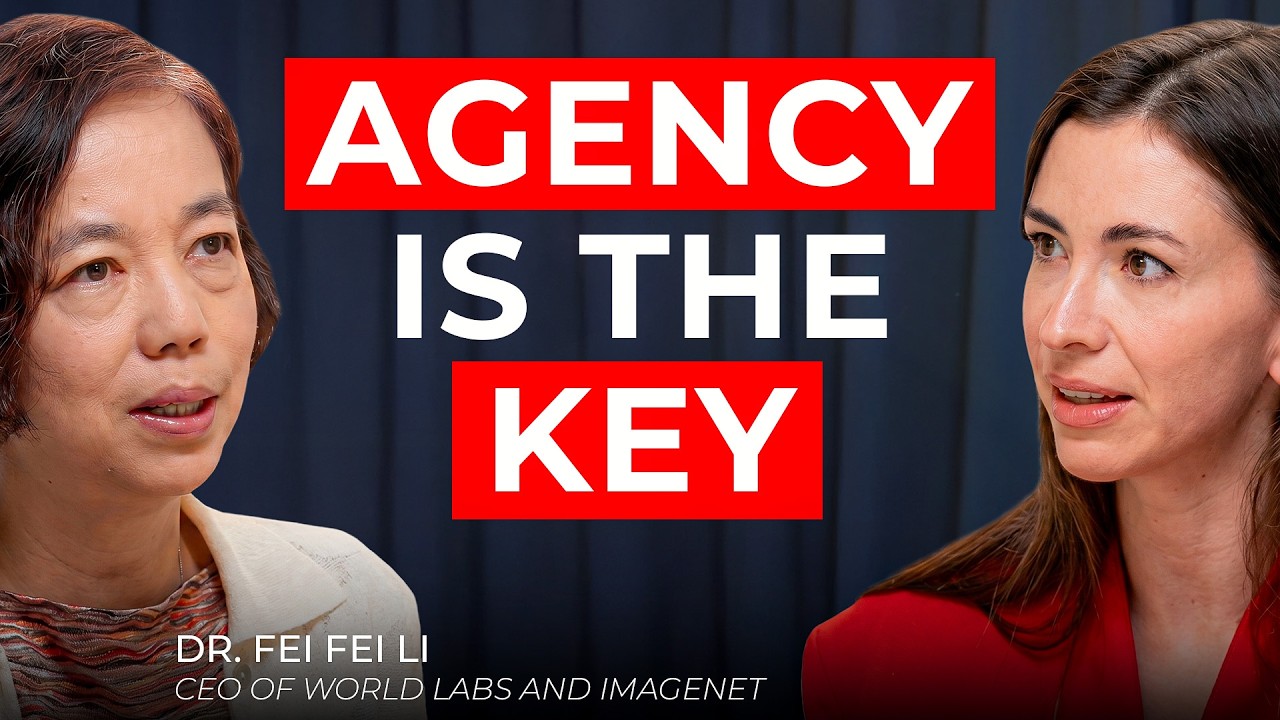
Fei-Fei Li: people are scared. I thought university was like a path to career. I think the word entrepreneur is very much a synonym to agency. Agency is the key in the face of a technology that is so cognitively advanced. Get familiar with that technology.
Marina Mogilko: Fei-Fei Li built the data that made modern AI possible. Now she's raised $1 billion to build what comes next. And she's teaching all of this in her new master class, AI's future and yours. David Rogier turned Masterclass into a $2.75 billion company teaching people from the world's best today. They're both watching the same shift and they have a lot to say about it.
David Rogier: It's a gap that's widening and increasing. If somebody's using AI, they're able to get tremendously more done that they never have before.
Fei-Fei Li: We aren't going to have to work anymore.
Marina Mogilko: Universal basic.
David Rogier: Yeah. We're just going to get paid to chill.
Fei-Fei Li: Time of change could be a time of loss. What does it look like? What should people be preparing for?
Fei-Fei Li: Loss of old habits, loss of sense of steadiness. But that's also a time of opportunity. It's an opportunity for
Marina Mogilko: you are running companies these days, multiple. What are you seeing? What are the biggest shifts happening?
Fei-Fei Li: My world is very much AI. So I get to experience really the cutting edge of where the technology is pushing. I cannot tell you how exciting this moment is. The technologists, the entrepreneurs and including product people, business people before people are all recognizing this, really seeing a change of how AI can now be used to rethink business, to rethink applications, and it just feels—I've been in Silicon Valley for 17 years. The energy is just. I've never seen this before.
Fei-Fei Li: Even 10 years ago I did not feel that level of excitement.
Marina Mogilko: That's amazing. And I feel like everyone's working more. David, would you agree with that? What's happening in your company?
David Rogier: It's a gap that's widening and increasing. If somebody's using AI, they're able to get tremendously more done and they feel a sense of agency that they never have before. If they're still nervous or haven't been trained, you are seeing that gap increase. One of the most interesting things I think that you talk about is that it seems like the world is split between "all this is godlike and going to save the world" and the other half of people are like "this is the devil and going to destroy everything."
David Rogier: Very polarized society.
David Rogier: Very polarized. And I think one of the things that you talk about and have shown is that this is not a healthy approach or maybe isn't the best designed approach, and that if you actually try to figure out what are the best aspects of it and how do I use it to actually help people, we might be able to get the best of both worlds. You asked early about tools. I was thinking about it. If you asked me a couple months ago, I would have listed Claude and ChatGPT and all the tools. I have now found that most of the apps I use I built.
David Rogier: And I built them with Claude Code or with Codex.
David Rogier: And I think that's amazing to me because now my CEO stack is all apps that I've built.
Marina Mogilko: It's called Dividify, right? I've read something like you build your own. I created a David Fi.
David Rogier: And I gave it to my team, which is like if you're trying to write something in my own voice, here are a bunch of emails that I wrote and things I said so you can do it. But even my.
David Rogier: To my productivity apps, my to-do list app I built, and it is set so that if it's on the list for over a day and a half it can't stay on the list. So it forces me to either decide that I'm going to do it now, I'm going to dump it because it's actually not an important thing, or I'm going to pass it off to a person on my team. And this allows you to create all these apps for the way that you think and work. So back to our agency point, you're able to create the workflows and tools, anything that you now want. So now it's about what's the motivation to do it, what's the skills to go do it. But the cost of making an app dropped from months to like a weekend.
Marina Mogilko: Yeah. That's a very good point.
Marina Mogilko: If an employee comes to you and says "I really want to start using AI," what would you tell them? Like where do they start? What is the task? Because I've heard some entrepreneurs ask their employees to just vibe code their dashboard for example. Do you have a go-to thing?
David Rogier: I don't like vibe coding a dashboard because when somebody vibe codes a dashboard, it's only in the front end. It's never tied back to the actual inputs. So it's great for an hour, but then it stops working because they haven't tied it back to everything most of the time. When they want to learn AI, I have found that if they're asking that question, they are hesitant to try it on their own.
David Rogier: There's something that's holding them back.
David Rogier: And so what I do in those cases is—and sometimes I worry "is this a waste of my time?"—but I've learned it's not. I will sit down with them or in groups of two or three and I will show them a basic task.
David Rogier: Like deep like on research.
David Rogier: And I'll walk them through it step by step.
David Rogier: And in some ways I feel like that's a waste of my time because I'm like you could watch a YouTube video on this that's way more effective than I am. But what I found is there's something about me doing it with them that unlocks something. They then go soar on their own. So I don't know if it's somebody walking over, if they feel forced to do it because I'm the CEO and I'm making them do it, or that, but then the act of walking them through it—they are unlocked to go do it and they do lots more things.
Fei-Fei Li: Yeah, thank you David for really bringing the complexity of reality. That is something that I observe and frankly I'm concerned because I think the public discourse of AI is so polarized. We have to look at the upside, we have to look at the downside. But the public discourse right now is not like that. It's either total utopia—it's going to save the world.
David Rogier: Yeah. We're just going to get paid to chill. Or this thing about AI—
Fei-Fei Li: it's so bad it's going to displace all jobs.
Fei-Fei Li: It's going to take away all human agency, and these two extremes are very dangerous. I genuinely believe it's a technology, it's a tool, it's a very powerful tool, but it's a tool that humans can wield to help make things better. But we also have to be very vigilant about how to use the tool. We teach kids how to use tools from fire to knives to the internet. Now we have to learn that as a species, as a society. And the most important discourse is missing. And that's the discourse of the nuanced middle.
Fei-Fei Li: Is what this tool is. How can we use it for good? How should we avoid the pitfalls? And how do we go forward as a civilization with this civilizational tool?
Marina Mogilko: The AI agents you're building right now don't understand each other. Your sales agent closes a deal and learns something about the customer. Your support agent picks up the same customer an hour later and starts with zero context. That knowledge just vanishes every single time. Outshift by Cisco published a white paper this year called "Scaling Out Super Intelligence." Their argument: the biggest bottleneck in AI right now isn't bigger models or smarter agents. It's making them work together better. They're calling the solution the Internet of Cognition. Shared intent, shared context, shared reasoning across all your agents at once. There is a live demo at outshift.com. Five use cases. You can watch the agents reason together in real time. If you're building anything with agents, read the paper and try the demo because they are working on this future right now. Links are in the description.
Marina Mogilko: And then it's a revolutionary tool. I feel like it's the first tool that is so industrial revolution automated our physical labor. Right here we're automating our intelligence, and this is why I think a lot of people are scared because they're like "oh I thought university guarantees"—not guarantees but it's like a path to career. Now if the cost of intelligence goes to zero, I don't know what's going to happen. What do you think?
David Rogier: One thing I learned from you was that right now when we talk about AI, it is language-based. That, to use your phrase, is lossy. You aren't going to learn how to drive a car with words. You aren't going to learn how to shoot a basketball with words. And so I think we're still in a V1 of AI. And I think the sphere is a little overhyped because AI doesn't have a set of its own values. It's our values, and so I think that means an opportunity for us to design and shape it. Do you want to share your thing? I thought it was really neat the thing you did with the doctors and them washing their hands.
Fei-Fei Li: I agree with David. First of all, the industrial revolution did not automate labor. It made labor more efficient. It scaled up labor. It has shifted the labor market, but it did not automate labor. And also we cannot imply that labor is not intelligent. That is really a wrong premise. Physical labor, cognitive labor, emotional labor—human activity is deeply intertwined with human intelligence, which is still very much an unsolved mystery in nature. We don't know the depth and nuance of human intelligence. Claiming that the cost of intelligence goes to zero is just an irresponsible claim because human intelligence is so deep. As David said, in addition to the more familiar language intelligence, we also have perceptual intelligence, spatial intelligence, physical intelligence, emotional intelligence. We don't have a grasp on creativity—where that comes from. Everybody's creativity comes from different parts of their brain but their holistic life. So I think we need to be very careful of these reductive claims. I do agree that language intelligence, the LLMs and the derivatives of LLM, are incredibly powerful. They're helping business intelligence, they're helping software engineering, they're helping deductive logical reasoning and even deeper tasks. We're not seeing a generic use of language and software intelligence. All this is important, but it is nuanced. It is complex. A lot of it can be powerfully collaborative with human intelligence, but I would not use words like automating human intelligence or intelligence goes to zero. I am very concerned about that kind of rhetoric.
Marina Mogilko: The exact rhetoric that's causing people to be so anti-AI because what they see—they see headlines of mass layoffs and "we don't need you anymore," that type of stuff. And this is what's causing this negativity.
David Rogier: But the answer isn't in those cases to say I'm going to avoid using AI or that I'm not going to use it. I think the answer is you grab the tool and then you figure out how I'm going to design it better or how I'm going to improve the tool or some of your work. In hospitals, if you take a job, a job is actually a whole set of tasks. And I think one of your arguments is there are some tasks that you do in your job that you probably don't like. Your example I remember was a nurse has to chart all their notes.
David Rogier: And doctors. I have never met a nurse that's like the part of my job I love the most is charting.
David Rogier: That is not why they got into the professional field. So I think the avoidance is the wrong way. But I also think I agree with you—I think it will. If we look at any technological shift, it's always ended up in net more jobs. The issue is just who gets those jobs. But the people who don't get those jobs are the people who do not adapt to it.
David Rogier: Right. And if you don't adapt, the outcomes are very bad. So if you look at the past with the advent of the computer, the spreadsheet—what happens if you don't adapt is you lose your job, your lifetime income drops by over a fifth, and your mortality rate in the first year doubles. It actually hurts your health.
Marina Mogilko: That's crazy stats.
David Rogier: So the answer isn't to go into a hole. It's to push yourself to explore and improve the tools.
Fei-Fei Li: I totally agree with David. I think some of the words we talked about deserve to be highlighted. You use the word agency. We talk about collaboration and empowerment. I think that's the core meaning of any technology, including a so-called godlike technology like AI—it should be human-centered. And what does it mean to be human-centered? To me, the simplest but the most profound meaning of human-centeredness is really empowerment to humanity, including individuals, communities, and society. And that is the meaning of this technology, which brings up this point that David said—that it's a time of change. A time of change could be a time of loss, loss of old habits, loss of comfort that we were familiar with for the past decades, loss of sense of steadiness. But that's also a time of opportunity. It's an opportunity for what's coming next. It's an opportunity for what we can make better. And how do you cross that boundary between the time of confusion and loss to a time of opportunity as an individual? It is really a responsibility of each one of us to learn, embrace, upskill, and be intellectually open about this opportunity. And that goes to the core of every human journey, whether you are a K-12 student or you're already a professional. We have to embrace this together.
Marina Mogilko: But also to your point about change—it's happening so fast, faster than ever. Can you tell me, if we take AI today, what type of tasks it can do already, what is still very human, and what's going to happen in a year? So how fast is it moving?
David Rogier: I think in education it's having a tremendous impact. The biggest obstacle I'll share: we know from the last 60 years that the best way for somebody to learn is one-on-one instruction.
David Rogier: So the question has to be asked, why do we sit in classrooms of 20 people or 300 people? It's simply cost. It is too expensive to provide a doctor to every person in the world, even though that would be amazing.
David Rogier: And so with AI, from the work that's been done in the last couple of years, we now know that AI can provide that personal level of instruction that is almost as good as that one-on-one instruction. It is so much better than learning in a classroom or reading just a book on it. So then the question becomes: now you're able to provide that same education that you sat in in an elementary school classroom for $12,000 a year, or a school for $80,000 a year once you're an undergrad. You're now able to provide that same education for about $100.
David Rogier: So the question has to be asked, when are we going to see that change in our own education system? I think the biggest obstacle is not the tech. The biggest obstacle is the institutions that are afraid of that change. But I think what's going to happen—we know that if you use AI to learn, you're able to learn the same things in 60% less time. So if school says I'm going to ban AI, I'm going to ban my kids from using AI, and another school allows them to use AI in a structured way, those kids that use AI are going to be far ahead of the kids that don't. Now, that's not a replacement for everything. You still want the in-person interaction, all those social bonds. But I think you're going to start to see a divergence in kids where one group that is open to AI is learning at a much faster rate than everyone else. And I think that's bad. So I think it's not a tech issue, but what's going to happen is those schools that do not adapt—in 10 years, they aren't going to exist because they're going to be so far behind. And
Fei-Fei Li: their world will be changing so fast because of AI. Like David said, part of it should be changing. I also adamantly believe every school, every classroom should embrace AI. Every student should be embracing AI. But I also believe that we have a collective responsibility to include them—especially the teachers and educational administrators—in this discourse about AI and show them what is a viable path that maintains the goal of education. The goal of education is not a tool. The goal of education is not closed book or open book exams. The goal of education is not standardized test scores. The goal of education is building humans so that every individual is a meaningful contributor to their community and society and leads to a meaningful life. And AI should not be taking any of these fundamentals away. But AI should help achieve this goal much better, much more effectively. This polarized, extremely simplified binary conversation about AI being for cheating or not—closed book, take away AI—is just not where we should be. We should be looking at how we empower teachers, how we empower students, how we restructure our classrooms, how we rethink about examinations, how we rethink about standardized tests, how we rethink about college admissions, how we rethink about resource distribution. There is a technology that's lowering cost and barriers. So how can we resource our inner cities, our rural areas, the global south? These are really important, more important topics of AI and education that we're missing in that conversation.
Marina Mogilko: You know what I think will help this conversation? Because when I'm thinking about my kids' education, I want to imagine the workplace where they're going to be. When I was growing up, the workplace was big company—you're doing this. And so in order to get there, you need to study this, this, and that.
Marina Mogilko: Can you paint me a picture of a workplace or a company in 10 years? What does it look like? What should
Fei-Fei Li: people be preparing for? Agency. I think AI will give people more agency. A lot of the future of work I think will rely on people who know how to use these tools in a very effective way. So let me give you a concrete example. One of the very coveted jobs in Silicon Valley in the past 20 years is product manager. There's a lot of conversations about the shifting nature of the product management job. It used to be 10 years ago fairly standard—product managers were more the thread between users, markets, and engineers. They're more conductors. They don't have to code. Fairly often they were not software engineers. So if they want a prototype they go to a designer. They go to a software engineer, they get a prototype and then they send the prototype to users and they listen to the users and synthesize the feedback and that life cycle of product management might take typically months in a company. Today if you look at the job of product manager, a lot of companies are experimenting with different things, but there are some fundamental changes. A lot of product managers now code themselves.
Fei-Fei Li: They don't have to wait to get a prototype from a team of people. They can use AI to help design something very simple and write code so that part shortens the life cycle. It doesn't mean we should get rid of designers or software engineers, but it just saves time so that software engineers and designers can do much more sophisticated work. Also on the user side, things are shifting. AI can actually simulate user behaviors and there are much more efficient ways to reach users and close the loop with users. I'm looking at these young product managers. When I look to hire them, I look for those who are riding the wave of changes. I don't look for product managers who are still talking about the textbook workflow of even five years ago. So what I think the future of companies—there's a lot to imagine depending on the company, from healthcare to education to whatever industry—but I think our workforce will be much more empowered or can be much more empowered by powerful tools like AI. So that personal agency, creativity, and also the boundaries of what a person can do and cannot do is much more blurred and lowered. So to me, that's going to fundamentally shift the structure of corporate America and every student today should try to imagine who they want to be in that new structure.
Marina Mogilko: Most people use Claude like a search engine. They type in a question, they get an answer, most times they're not really satisfied with it and they close the tab. I did the same thing for months. I was looking at people who were saying AI is changing their life and I'm not seeing that. Then I spent one afternoon setting it up properly, uploaded a few files about how I think and how I work and it completely changed. I wrote the whole process up step by step. You get it when you subscribe to my newsletter, Future Proof. It's free. The link is in the description. It feels like you're describing entrepreneurs within a workspace. You're either an entrepreneur or you're an entrepreneur within an organization, which means you're handling multiple things and you're responsible for multiple things.
David Rogier: My hypothesis on this: you will get a barbell effect and this is what we are seeing at MasterClass where you have one group that are becoming the specialists.
David Rogier: It used to be—I remember in school I was told to pick one area and go deep in that and that's how I build a long-term career. I think that's eroding except if you're in the top one, if you're the actual best. What I mean by this is if I'm a copywriter and I'm an okay one, anybody that now uses an LLM can do a decent job at that.
David Rogier: But if you're the best in the world at it or if you're in the top 1%, I can't beat you at it.
David Rogier: And so we're seeing the rise of people who are specialists that are very good at their thing. I think that extends to tons of crafts. And then the other role we're seeing is this high-agency generalist.
David Rogier: Who's able to do lots of different things well and has really good skills on the judgment side, on the agency side. Those people when you see them interact is really neat because they then interact with somebody who's in the top 1% at their craft and they're like, "Whoa, I couldn't do that."
David Rogier: And so my guess is that it's a bifurcation of those specialists and the people that can do lots of things well.
Fei-Fei Li: That's interesting. I agree with you. I think both—whether you're on the specialist side or generalist side—you both have agency.
Fei-Fei Li: Yes, and you should both be able to use tools in ways that's uniquely creative and deep. I'm already seeing this. For example, designers—they bring so much human creativity, but I see some of them use all kinds of AI tools in ways I cannot personally imagine. So I know that's where their craftsmanship comes. And also the word entrepreneurial—in Silicon Valley, that's almost like I'm going to do a Delaware incorporated startup and that's the label entrepreneur. I disagree. I think the word entrepreneurial is very much a synonym to agency.
Fei-Fei Li: It doesn't matter. You can be a doctor, specialty doctor. You can be a K-12 teacher. But agency is the key. And in the face of a technology that is so cognitively advanced, be brave, have your human agency, and command that technology. Use that technology, get familiar with that technology. Don't be afraid. Don't shy away from it because that's where the wheels of history is turning towards the future. And I think everybody—it doesn't have to be a Silicon Valley founder—everybody can be entrepreneurial in their craftsmanship or whatever they want to do.
Marina Mogilko: You mentioned so many tools, use tools, use tools. Can you give me an example of some of the tools that have been transformational to your job? Obviously all kinds—from ChatGPT to Gemini to Claude.
Fei-Fei Li: I use it in many different ways. They have so many features, from helping me study some deep topics or to have a conversation. Here's a fun example. I'm in charge of laundry in my household. So every weekend I have to do loads of laundry and it used to be my audiobook time, but sometimes I get bored just listening to audiobook. About a few months ago I realized I can have a conversation about a deep topic with AI as I was folding laundry and that has been so much fun. Somehow it's even more motivating for me to go fold laundry because I can have me time with AI to learn anything I want. Of course, software engineering has been completely transformed and also on the art and design side—at World Labs we are creating models to help our creators imagine 3D worlds and all that. So we also see change in the creative world. Once again, that's a very contentious area because some companies have positioned AI creative tools as if it's a replacement and I deeply protest that positioning. Human creativity, even just on the visual side, is so vast. Human creativity is profoundly intertwined with our emotional intelligence, with the story we bring, with the values we bring. Each creator brings something unique. I just think AI is such a powerful tool to help them express their creativity instead of replace it.
David Rogier: Totally. Do you feel AI can never be very smart until it figures out spatial intelligence?
Fei-Fei Li: So this is the work I'm doing now in World Labs. What is spatial intelligence? Spatial intelligence is a term that encompasses multiple abilities that humans display in a 3D environment. If we look at movement, we call it a 4D environment. We can understand what's going on. I see people, I see equipment, I see this beautiful home. This is the understanding part of spatial intelligence. We can reason. If I want to go grab a bottle of water in the fridge, I have to reason about the space. I can go up the staircase, I can recognize the fridge, I reason about my movement. That's reasoning. That's another part of spatial intelligence. A third part of spatial intelligence is generation. In my mind's eye, even though I'm not seeing your living room, I actually have a view of what that living room looks like. If I'm a better artist, I can generate a lot of visual 2D or 3D or 4D visual artifacts and pieces. Humans can generate a lot of space. And the fourth, last but not least, part of spatial intelligence is interactivity—how I focus on interacting with the space. Laundry folding—that's my favorite weekend activity these days. That's deeply spatial. How you fold each piece of garment and how you hang them in the closet is highly interactive. So spatial intelligence is these four things: understanding, reasoning, generation, and interaction. We are working on that. We have made tremendous progress. Collectively, today if you use DALL-E or if you use GPT image, that tool can actually help you generate a lot of 2D imagery. It can explain to you what an unknown flower is in your garden. That understanding is quite advanced. It can help you reason. Now we can draw figures in AI tools. The generation part right now is more mature on the 2D side. What World Labs is doing is on the 3D side. 3D is fundamental for robotic interaction, for truly controllable creativity such as design, architecture, game development, VFX. That's the piece we are working on.
Marina Mogilko: Is it separate from LLMs? Do LLMs have their limit and then world models step in?
Fei-Fei Li: Yes and no. I think they're complementary. Think about humans—just as you were saying, to put a basketball in the hoop. First of all, that's such a fast action that people don't sit there and think and talk in their head. But I do think that act itself is a highly complex intelligent moment where language reasoning comes in because you probably, as an athlete, are keenly aware of the score or missingness—what it means to the game or to the moment. Some of that is probably happening in the language way, but seeing the court, seeing the other players, and aiming the ball—that is deeply spatial. Orienting your body, knowing how to make that move, is deeply physical. So many things we do in life are actually a mixture of linguistic intelligence, spatial intelligence, and physical intelligence. To me, they're very complementary. They work together. I deeply believe spatial is a huge piece of it. Evolution took 500 million plus years to get spatial intelligence to maturity. It took much shorter time for language intelligence. So it's a very profound, ancient, fundamental intelligent capability of animals and humans.
Marina Mogilko: How far are we from understanding the fullness of it—100% of it?
Fei-Fei Li: Wow. As a scientist, I never know what's 100% because science itself is pushing the boundaries of the unknown. If the goalpost is human intelligence, the challenge is we don't even know how far human intelligence is. We never know the boundary of human intelligence. But if you think about the daily capability of humans, the average capabilities—folding, cooking an omelette, laundry folding, playing basketball—how far are we? We're not there yet. But is it going to take a hundred years? I don't think so. My goal is we could get there in my lifetime.
Fei-Fei Li: I think a lot of people are working on that. So that puts a kind of bound. I don't think it will take 100 years. It might not even take 50 years, but it's not going to take one year either.
Marina Mogilko: What is your estimate? When does Dr. Li retire from laundry folding on Sundays? How many years?
Fei-Fei Li: Well, laundry itself involves physical embodiment, so that also involves sensor technology and hardware technology. That makes it more complex. But I'm hoping as our lifestyle evolves, things will change.
Fei-Fei Li: Yeah, me too. As a mom, I'm hoping.
David Rogier: I know this is a term that you avoid for a whole host of factors, but my hypothesis would be you can't get anywhere close to what AGI—which I know is a word that you avoid—you can't even get close to it until we do the spatial intelligence.
David Rogier: Because that's about reading people, that's about interacting in the world.
Fei-Fei Li: Look, I'm not going to fight the popularity of this word. As a scholar, the field in the academic world is called artificial intelligence. It's not scientifically rigorously clear what the G means here. But whatever. That's just a word, a nickname. Yeah, I agree with you. I think AI or intelligence is complex. I don't think the picture of AI would be complete without spatial intelligence.
Marina Mogilko: So we've mentioned agency many times today. As someone who runs an educational company, what would be your advice for people who want to work on their agency? How do you even teach your kids agency?
David Rogier: It's a really good question. The research I've looked into is not quite there yet. So we don't know exactly how to do it. We have hypotheses, and if you break down agency into individual parts, we then have clues for it. We know that being able to feel safe to take risks is an important part of it. We know that being able to fail and learn from that is a big part of agency. We know resilience—getting back up—is really important. We know that curiosity in the world is a really big part of it. There are also things like fundamental needs to want to solve something or to impress someone, which isn't necessarily the best traits, but those things drive you. If you need to solve a problem, that's going to drive you to solve it and help you find agency. The research I've seen is much more on the qualitative side of what drives agency. There's some evidence for this, but it's weak. You want to put yourself in places that are going to be hard and new for you.
David Rogier: So that starts as a kid, right? You want to be in a world where the fundamentals—love, food, sleep, mental health—are provided for you. We know you can incentivize it too. We've done things where you get additional compensation if you do something. Compensation does push you to do things. But agency itself, from my own experience, so much of life in society teaches us to seek praise. If you think about it, as kids we seek praise from our moms and dads, from school instructors, from our bosses. Having agency—that entrepreneurialism—isn't just for entrepreneurs. It's almost a rejection of that societal value or push to be praised. I remember when I started Masterclass, everybody told me it was an impossible idea and a bad idea. That was really hard for me, somebody who sought praise most of my life. But then what I had to realize and change was this: if you have an idea that everybody thinks is good, it's probably not a good idea.
David Rogier: And you have to chase what other people think is actually impossible. Now as an entrepreneur, when somebody says something's impossible, I think, oh, that's what I want to do.
David Rogier: Yeah, exactly. I want to dive more into that. I think it's like a fundamental shift, and it comes from a lot of things. I wish I could say: teach your kids these four things and they'll have high agency. It's more complicated than that.
Marina Mogilko: Yeah, totally. You said it beautifully. You have this aspect of independent thinking. You wrote this Substack where you teach people to switch everything off and make your own decisions, generate your own thoughts. I feel like as someone who's been taught to respond to praise, it's so scary because if it's contrarian to most of your friends and you come out with this opinion and they disagree with you, how do you train that muscle? Because I feel it's so important for agency as well.
Fei-Fei Li: Well, this question goes into the heart of family values. How do I personally train that muscle—for me, my kids, my students?
Fei-Fei Li: Everything David said. The encouragement is as simple as don't be lazy. I know that people my generation lament about there's too much internet, there's too much social, there's too much AI. I actually have a contrarian view. I think our new generation, our next generations, I'm actually a little envious of them because I think their world is much more heterogeneous. If you're used to being on Twitter X, you're used to being on Insta or Tik Tok, you start to realize the world is full of voices instead of that one teacher or one parent when the world was smaller and narrower. So our new generation of young people are natively born into a world full of voices, full of opinions, full of possibilities and that can be daunting. That can be, if used misguided, we know I'm not saying there's a lot of issues in social media and all that, but that can also be opportunity because you can use this reality to remind the young generation: look, it's your voice that matters because there's no authoritarian voice or tiny number of people holding the megaphone, and that can be used to encourage young generation to re-examine the century they're living in. And this is a century of a lot of tools that can give you agency. This is a century where your voice matters more than anybody else's voice if you believe in that. And that's very different from our generation.
Marina Mogilko: Do you have anything that's an unlock for people who are curious about AI just starting?
Fei-Fei Li: So first of all, if it's narrowly about my employee, I live—
Fei-Fei Li: They probably are working on more AI than I do. So that's just a mood question for a deep AI tech startup like World Labs. But I do want to turn that question to talk to those who are more in the public, especially the generation right now who you're already professionals. You are teachers, nurses, accountants, whoever you are. And the public discourse, like we said earlier, is so polarized. Other than anxiety, you don't really know how you can get to AI. I think I do want to encourage people who feel that way: find a kid, either your own kid or your nephew or your niece, that they are likely to be younger than 25 years old. Almost all of them are already using AI in some way, and be curious. Ask them to just show you how they use AI and don't worry about this as a technology, but be curious about the future world that they will live in, your kid will be living in, your grandkid will be living in, your student will be living in, and try to just imagine that you're going to take that journey into that world anyway and they can be your guide. And just not worry about: I never learned computer science or I don't know which app I can open. Just let the young person in your life who you already trust or have a relationship with hold your hand for a weekend or for a session and show you that this is a world that's not that scary if you actually know what it is, and it can be empowering. And if you do find it troublesome, if you do find it imperfect, by knowing it, by knowing where these issues are, your voice can be heard better.
Marina Mogilko: Absolutely. I think that's an amazing ending to this. Thank you so much. Stay curious, develop your agency, work on it, and thank you so much for your input and for your work.