Solo video·August 15, 2025·13 min
Become an Entrepreneur Today – AI stack to build your company in 2025
In this episode
Marina Mogilko walks through how she automated her media company's workflows using AI tools — including publishing up to 10 YouTube Shorts per day with zero human involvement. She covers three pillars of AI adoption for entrepreneurs: intelligent automation, autonomous decision-making, and continuous learning systems. Real-world examples from Klarna, Vise, and Marina's own company illustrate how AI can dramatically boost revenue per employee while reducing burnout.
Key takeaways
- Automating YouTube Shorts publishing with a no-code chain (Nathan → Clap AI → ChatGPT → YouTube) produces up to 10 Shorts per day with zero human involvement.
- Stanford research on 5,000 customer service agents found AI suggestions boosted productivity by 14% overall and 35% for newer agents.
- Klarna cut its workforce from ~5,500 to ~3,300 employees, grew Q1 2025 revenue 15% year-over-year to $700M, and increased revenue per employee by 152%.
- Vise CEO Samir Vasavada reduced his team from 160 to 40 people while achieving 10x stronger results by automating onboarding, document handling, and support workflows.
- AI adoption follows a J-curve — initial friction gives way to compounding gains — making early investment in automation critical for entrepreneurs who want to scale without burnout.
Chapters
Transcript
Marina Mogilko: Everyone needs to be an entrepreneur in the future or you're going to lose your source of income. This is what Thomas Wolf, co-founder of Hugging Face, recently said in my podcast. And honestly, it made me kind of excited because my personality is definitely an entrepreneur. And I want to kind of help you with this video to think like an entrepreneur, to think about things in your life that you can automate with AI because AI for me now AI equals productivity.
Remember all of the old YouTube videos where people were like, "Oh, I built this system. I built a second brain." All of this is now AI. And there was this McKinsey report that said AI will unlock $4.4 trillion in productivity gains. And I see the smartest entrepreneurs, the smartest YouTubers use AI to replace themselves and improve productivity in their companies. We actually did the same this summer in my media company. We hired our first couple of AI interns, basically people who have been studying computer science, and the goal was for them to look into our repetitive tasks and help us free up time for me and my team. And in this video, I'll show you not only how they transformed our workflow, but also how bigger companies use AI to transform their workflow. Because for us, AI inside our company saves hours every day and helps us scale without burnout. So let's talk about different ways you can automate things in your business to free up more time.
Before we dive into the whole process of automating your business, I want you to write in comments down below if you're already an entrepreneur or not yet. It will give me more insight into what stage you're in so I can adjust in my next videos because sometimes I go very deep into things we're building in my company, but maybe you're just starting out and you need more advice on how to just start. So let me know down in the comments below.
Let's talk about intelligent automation first. Traditional automation is basically if this then do this. But intelligent automation learns, adapts, and gets smarter over time. For example, Stanford studied 5,000 customer service agents and found that AI suggestions boosted productivity by 14% overall and 35% for new agents. This isn't about robots taking over. It's about AI coaching humans to become superstars, real-time support that makes every employee better.
The guy who completely blew my mind, Samir Vasavada, CEO of Vimeo, he was on this podcast. He has a billion-dollar company. He told me that they are building an AI-first business architecture in their company. And they actually cut their team from 160 people to 40 and still got 10x stronger results by automating repetitive workflows like onboarding, document handling, and support. So the focused team could do the work of dozens. And we've been trying to do something similar in my own company. I'm not firing anyone, and I think we're still hiring more, but we have a win to share.
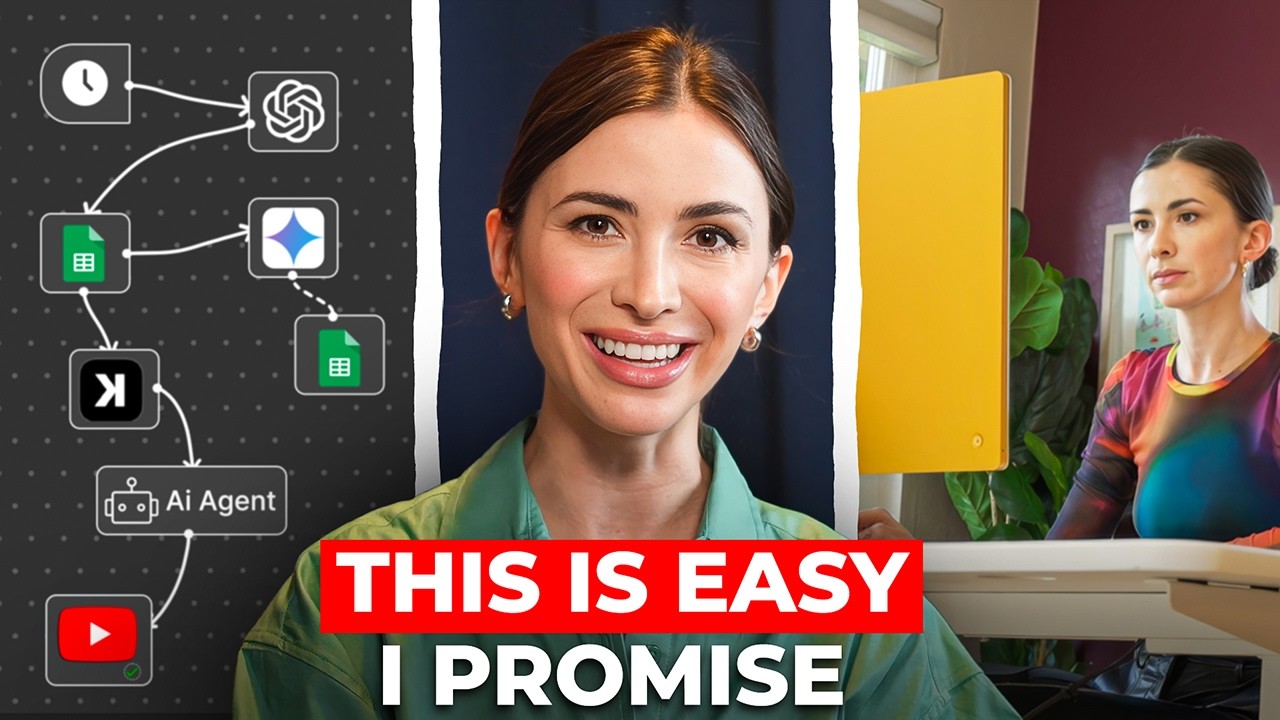
We actually built a process that automated publishing YouTube shorts. We built it using Zapier, a no-code automation platform. So here's how it works: Google Sheets holds links to all of our videos. Zapier pulls the newest videos and sends them to Runway AI, which automatically cuts them into shorts. ChatGPT generates viral titles and descriptions. Zapier then uploads everything straight to YouTube. Result: up to 10 shorts go live every day with zero human involvement. No editors, no managers, no manual uploading, just a chain of tools running in the background. And this is free traffic for my podcast.
And it doesn't stop there. We also use Monica, a Chrome extension with custom GPT agents for drafting emails, summarizing documents, and even writing in my tone of voice.
Now, before we dive into something that I'm super excited about called autonomous decision-making, I wanted to talk to you about something that is just as important as building AI systems—protecting yourself from them. Because here's the flip side of all this innovation. AI doesn't just work for you, it can work against you if your data is exposed.
I had a situation where somebody called me and asked me to be on their podcast and it was an unknown number. I picked it up and I was like, whoa, where'd you get my number? He was like, I Googled it. Oh no. And that made me really look deeper into how I can protect myself online. An AI with even a few data points can trace, combine, and expose everything. And if you've ever Googled yourself and seen your phone number or home address on random people's search sites, that's not by accident. That's a billion-dollar industry. Data brokers pull your information from public records, social media, different apps, and resell it to marketers and recruiters. In a world where AI is automating everything, don't forget to automate your privacy too.
Now let's talk about autonomous decision-making. The second pillar is where most entrepreneurs get scared, but it's actually where the magic happens. MIT research shows that AI adoption follows a J-curve. At the beginning, you're like, "Oh my God, I need to introduce all of these AI tools." Then it starts working for you.
I love studying examples of bigger companies and I've always learned from them. Let's take Klarna. It's a fintech company out of Sweden. Over the last few years, they cut their workforce by about 40% from roughly 5,500 employees down to around 3,300. They automated things like customer service, marketing, and financially, Klarna is thriving. In Q1 2025, revenues rose 15% year-over-year to 700 million. And the most important thing—I don't know if you track this in your company, we do—it's called the metric revenue per employee. They boosted it by 152%, driving productivity. And it's just so cool. They estimate that Klarna is going to make around 1 million per employee. That's really high.
When I look at companies, I'm like, how do we learn? What can we learn from that? One of the things that we do in our company is that our AI systems draft contracts and even pre-screen job applicants using ChatGPT and ChatPDF. At first, we just used it to summarize documents and flag red flags. Now we upload all of the job applicants into a Google spreadsheet. It analyzes who's better. It reviews all the answers. It suggests who we should interview. It creates questions for the interview. And this is what experts call progressive autonomy. You start small. AI makes minor decisions. You review and then you give AI more authority as it proves itself.
And the next step is where these systems start learning by themselves. It basically separates amateur AI implementations from professional ones. According to Forbes research, companies using AI agents report 72% of workers feeling very productive compared to traditional automation. Because these systems learn from every interaction, the process changes by itself.
For example, we use Otter and Copilot to record and analyze every team meeting, generate actionable follow-ups, and surface missed opportunities. It's not just transcribing. It's a system that helps our team learn and improve continuously without adding extra meetings.
One of my favorite cases of how we used AI this summer with my team—it's not an automation yet, we're actually building automation on top of it—but we're able to get millions of impressions from just one conference because I was wearing my Apple Watch during Google I/O. Apple Watch recorded every session I attended. Apple Watch was connected to my phone. I used Otter to transcribe everything and send the text versions to different people in my team and they just uploaded them to their ChatGPTs that talk and act like me. And we were able to create X posts, LinkedIn posts, email newsletters. Of course, I filmed, and this is how we're able to do like millions of views in a day. That was super cool.
All right, enough theory. Let's build something. I'm going to walk you through creating your first AI system that could save you 10 plus hours per week. The first thing: identify your highest value bottleneck. The mistake that a lot of founders make is they try to automate everything at once or they try to do everything by themselves at once. Start with a high-value process, the one that eats up time but doesn't require your unique genius. Stanford research shows that employees are most eager to automate repetitive low-skilled tasks, but they want to keep oversight on important decisions, and that's where you start.
For us, that was repurposing long videos into shorts for multiple YouTube channels. I talk to a lot of cool podcasters and they all run maybe like five or six separate channels just for shorts to drive traffic to the main podcast. So that was something we automated. Other good starting points are email management and responses, lead qualification, follow-up. My salespeople automated everything. Content creation scheduling, customer support can be very frustrating. And the goal is not to fix your entire business one weekend because that could be quite daunting.
I like what Tim Ferriss said. He said he only tries to improve not more than two things in his life at the same time. Because if it's more than two, then you feel like your whole life is falling apart because you're focused on things that are not working. And it's just bad to focus on so many things that are not working. Just do one or two things at once, not more.
Then after you decide what you're automating, you choose your AI stack. For example, for workflows, I've already mentioned Zapier. That's perfect for customization, but it's more advanced. You can also try something easier. For example, Make.com or Zapier—you can use them to connect different apps and in this way you create a workflow. Then for intelligence, you have ChatGPT or Claude for your general reasoning. Depending on what you're working on, I encourage you to look at specific tools like Easy Gen for LinkedIn, it's perfect, or Poppy AI for content factories. But again, there are so many tools right now or you can build your own because every tool that you're going to encounter on the market is basically a layer over ChatGPT. It's a layer of prompts, maybe it's ChatGPT plus Claude plus something else, but it's always a layer of prompts. So if you're not satisfied with the result and if you're a little bit technical, feel free to build something by yourself. This is what we're doing as well.
For example, we use ElevenLabs and HeyGen to create my avatar. Because sometimes I'm in the studio and then I travel and I need to re-record something. So we use footage from the studio, generated voice by ElevenLabs, and we replace some fragments if I made a mistake or maybe a brand sponsoring this video requested a change. Really helps us.
Then introduce something that's called progressive autonomy into your workflow. Level one is when AI suggests and you approve. Level two is when AI acts and you review. Level three is when AI operates independently within your rules. And level four is when AI approves those rules itself. Think of it like training a new team member. You don't hand them the keys on day one, but over time they can run whole parts of your business. And then you repeat for the next process.
This really reminds me of hiring. You identify what you're bad at and things that you don't like doing. You document the process, you feed it to AI, and then you delegate it. But in this case, you do not delegate it to a person. You delegate it to AI.
We live in exciting times. Things are changing constantly. Let me know down in the comments below what tools you love using.
So remember how we started this video. Everyone is going to become an entrepreneur. I want you to start learning now because the key function of an entrepreneur is not only to come up with a problem and solve it. It's also like when you listen to Steve Jobs's talks later in his life, he said my job—like 70% of his time he was just interviewing people. I think if he lived now in the age of AI, a lot of his time would go into thinking how they can automate things at Apple with AI, and of course they're doing that right now.
I want you to implement this mindset into everything you do. What can I automate today? What can I delegate today? And this is what makes you an entrepreneur in 2025.
I remember 10 years ago when I started my YouTube channels, I remember thinking that my goal is to help everyone become an entrepreneur within their workplace, like even if they are an editor, I want them to be able to hire help. I want them to be able to use different tools. And this is what's happening to the whole world now. And I'm excited that I've been on this mission for several years. And I'm super grateful if you're watching these videos. Thank you so much. And I'll see you on this channel. Bye.