Interview·July 4, 2025·38 min
How to Build a Viral Brand Online ft. @blogilates
TopicsCreator economy and personal brandLeadership and mindset
In this episode
Cassey Ho joins Marina Mogilko to discuss how she built two multi-million dollar apparel brands — Pop Flex and Blogilates (exclusive to Target) — starting from YouTube workout videos for 40 people. They cover her dual-brand strategy, launching 1.1 million units at 1,800 Target stores, AI theft of her content, burnout, and why over 99% of her revenue now comes from apparel rather than ads or brand deals. The conversation offers a candid behind-the-scenes look at what it takes to build a lasting creator-founded brand in 2025.
Key takeaways
- Launching at Target with Blogilates actually increased Pop Flex revenue rather than cannibalizing it — with 90% of inventory in 3 key styles selling out within 3 days of launch.
- Over 99% of Cassey's business revenue comes from apparel sales; less than 1% comes from ad revenue or brand deals, a dramatic shift from a typical creator monetization model.
- Pop Flex serves as the innovation lab — new products are tested there first, then redesigned at a lower price point for the Target/Blogilates line, creating a clear two-tier product strategy.
- To fulfill the Target launch, Cassey's team had to manufacture 1.1 million units in under a year with no prior experience at that scale, which she describes as 'winning the retail Super Bowl.'
- AI-driven content theft is a serious ongoing issue for Cassey — bad actors have stolen her videos and used AI to replace her face, prompting her to commit to fighting these violations on principle regardless of cost.
Chapters
- 00:00In this video...
- 01:16From fitness YouTube to fashion DTC: Blogilates vs Popflex
- 02:35How pricing & product strategy works across both brands
- 04:52Revenue breakdown: why she quit brand deals
- 05:41The role of email, content & storytelling in sales
- 07:42What works in marketing: organic content, community & behind-the-scenes
- 11:37How one micro-creator boosted sales overnight
- 12:56The Taylor Swift viral moment — behind the scenes
- 15:05Burnout, hiring, and the emotional load of leading a lean team
- 17:01Why she hates AI
- 19:16Dealing with copycats, dupes & big retailers
- 23:40How online hate shaped her journey — and why she left fitness content
- 27:35Dealing with online hate
- 30:10Advice to creators facing online hate
- 31:36Why content drives 70% of her revenue
- 33:05UGC fatigue & what actually performs now
- 34:22Adapting with the algorithm — and staying resilient
- 36:30Advice for everyone who starts a business in 2025
Transcript
Marina Mogilko: Every day there is a new fire, a new problem, problems on problems, and like you think you're going to explode, but it looks like you were dealing with a lot of online hate, people just shaming you, etc. People sent me the video of her wearing the Pure Wet score. I went numb. I couldn't even feel anything. Swifties just started coming over. They found it. And then we get like 16,000 pre-orders for that one score in that color. I absolutely hate AI. There have been instances where my videos are just stolen off of my page. They've used AI to actually change my face. I'm going to keep fighting because it's not right. I can't work for free for somebody else. As a principle, I will never stop fighting.
Hello everyone. Welcome to Silicon Valley Girl. I have Cassey Ho today. I am so happy that you're here. We met in 2022, I think at the creator summit. I remember you were doing this Pilates thing in the morning, which is amazing, and I still have your mat. Oh good, which is a huge business for you. So I'm excited to chat about AI taking over everything, and I'd love your take on what it's like to run a business in 2025 as a creator and also a woman. So welcome, welcome to Silicon Valley Girl.
Cassey Ho: Thank you. I'm so excited to be here. So there's two brands. There's Blogotties, which is the retail exclusive to Target brand. And just at the top of this year, we launched apparel at Target for the very first time. It was all at all 1,800 stores in the very front gateway, which was so cool because it really felt like winning the retail Super Bowl. Like you just don't get those opportunities. So that was fully manufactured by our team. We're the vendor. That was such a crazy thing to pull off because in under a year we had to figure out how to produce 1.1 million units. Yeah. And we had never done anything like that before.
The Poplex brand is my DTOC brand that we mostly sell online. And that one is at a higher price point and really focused on innovation and performance and also just like testing all sorts of things. I would say the Target one is more activewear, whereas Poplex started out with activewear and then has now evolved into swimwear and underwear and casual dresses and stuff. So I'm having a lot of fun playing around with innovation over there.
Marina Mogilko: That's amazing that you have kind of two similar but at the same time different brands. How does it work when you think about launching a new product? Which brand does it go to?
Cassey Ho: Poplex is where the innovation begins, where I get to have fun. Nobody tells me what I have to do or can't do. Well, actually, no. The customers tell me what I have to do. And so I love going into the comments and figuring out, hey, what are they looking for? What problems do they need solving with? But with Poplex, we innovate, we product develop, we try it out. And then with Target, pretty much the playbook right now is that we take what works really well with Poplex and I redesign it so that it can hit a lower price point for the target audience, which has been really great because one of the biggest complaints we get about Poplex is it's too expensive. I can't afford it, and like specifically please launch at Target.
And so when that happened this past January, it worked. I was afraid though because here's the thing: you launch with a brand at a higher price point, and then my next question was, is launching a brand at half the price point going to cannibalize my original brand? Right. And this was really just up in the air. We didn't know. But the weird thing is when we launched at Target for Blogotties, it actually helped increase revenue for Poplex, which is crazy. But if you think about it, it was like marketing being in front of the store. Everyone got to see it. Things sold out so quick. There were like three specific styles that 90% of the inventory sold out within three days. It was insane.
But then on the tag, it tells a little bit of a story about me and it says CEO and head designer of Poplex and Blogotties. And so people can go and figure out, oh, maybe there's more if I can't get it here. So I think it was really, really great for legitimacy as a brand and as a designer.
Marina Mogilko: And how do the margins work? So with Target, you get a licensing fee or you get like, how does it work in general?
Cassey Ho: Okay, that's a really good question. So with the apparel, it wasn't licensing. That was fully like we are the vendor. So essentially we are selling wholesale to Target and then they mark up how they decide to mark up in the front. However, there is a fitness section where you see the yoga mats and the dumbbells and things that is a licensing deal, and so I get paid a percent royalty on that. But the apparel is all manufactured by us.
Marina Mogilko: Got it. In terms of revenue split, what does your business look like these days?
Cassey Ho: Okay, so this is a really interesting question because us both coming from the creator space, from the YouTube space, it is not what most people would think it is. Not like Google AdSense. But I had just talked to my husband who's also the CEO of the company. I was like, "Oh, wait. Let's like look at these numbers again." It's actually less than 1% of our revenue comes from anything related to like ads or pre-rolls or anything like that or brand deals because I do not do brand deals anymore. And let me tell you, I'm so happy about that because honestly any tension that came between me and my husband were like about stick to the brand deal guidelines and they told you to do this but I'm like but I did do that and he's like but legal says and it was like so much like I hate that.
So yeah, over 99% of our revenue comes from the apparel businesses. I really loved what Cassey said right here. You do not grow a brand like Poplex or Blogotties without being truly authentic. You have to be connected to your audience and you have to be telling them stories all the time through different mediums. And that brings us something I talk a lot about in our business, email marketing. For us, email marketing has been historically generating around 20% of all the sales when it comes to Lingua Trip, when it comes to my school where I'm helping international creators build their businesses. And this is where we tell our stories in text and keeping that channel strong is non-negotiable.
Marina Mogilko: In terms of marketing, what works these days?
Cassey Ho: For marketing, it's organic, which is also very different than a traditional DTOC online brand who from what I hear, they rely heavily on, you know, Meta ads and things like that. So, luckily for me, because I do come from a content creator background, I really enjoy making content. And so you probably have seen some of these videos where I'm talking about the design, the why, where it came from, what problem we're solving. I show them the actual sketch throughout the development, some samples, things that didn't work out. And taking people on the journey behind a product is really interesting. And I didn't think it would be, but people are really interested.
And what's crazy is that what is a fun piece of content for me to film, edit, voice over, and by the way, I still do all of that myself, which is kind of crazy. Wow. I know. I know. I know. It's like really unconventional. It's really hard. It's too much going on at once, but like one 60-second video takes about 9 hours to make. And I am literally the one editing in CapCut and InShot on my phone. But I choose to do this. Everyone's like, "Cassey, you need to get an editor." And I had that life before. I had the life of horizontal content, long form fitness videos. We had an editor. We'd come back, you know, you go in, I forget what that program is, but you know, put the notes and everything, but that I lost the joy in all that.
And being able to talk about the product and the design because each design feels like my baby has brought the joy back into editing for me.
Marina Mogilko: How many videos a week?
Cassey Ho: I'm averaging one right now, but sometimes I feel like I can do like two, but it's a lot because it's like I'm part content creator, part CEO and head designer. And so like during the normal workday, I have the normal meetings and product development calls and fittings and things like that. And it's only after hours when I can like sit in the corner of the couch and edit for like seven hours straight until my hands cramp.
But anyway, what I was trying to say is that the organic videos, they work and they sell. Like sometimes a video goes viral the thing can sell out within a few hours, which is insane. So that's working for us, which is very atypical of a DTOC business. Now that's the Blogotties, and this is where it gets confusing. So I started out on YouTube with the screen name Blogotties. So essentially these days I think if people started out it'd be like Cassey Ho or something. So anyway, Blogotties is my channels across the board. So I make my content for my pages. Nobody touches that.
However, I will say that there is a Poplex IG and YouTube and TikTok and that is a separate marketing team. So we have videos go over there too. And I will say both organic videos on both sides really do sell really well. And one type of organic video that sells well on the Poplex side is what we produce at what we call a content house. And so we reach out to women in our community, sizes extra extra small all the way to 3X. So that's nine different sizes. And we put the girls in like the same baby doll dress or something and they all get to walk out, model, and now people get to see, oh, this is what someone like me might look like. Okay, that's a medium, that's a 1X, that's a size small. And it's really fun to like create with our community. So that also sells.
Marina Mogilko: And how does it work? So you just DM your customers like, "Hey, do you want to be in the video or?"
Cassey Ho: So we do an open casting call. We do an open casting call. People have to send in videos because honestly it's not just even about like the modeling, it's about the personality, the charisma, like what shows through the screen, right? And also the girls having a good time with each other because they're all nice and kind. And so luckily the ones that we have put on, everyone is just so excited to be there. Of course they get compensated through pay, but also they get to keep all the clothes that they get that day that haven't been released. So that's super exciting for them too.
Marina Mogilko: Yeah. So on the organic side, that is what's working for Blogotties and then for Poplex. But I will say something really interesting we should talk about is TikTok lives. Yeah, that's a huge thing these days, right?
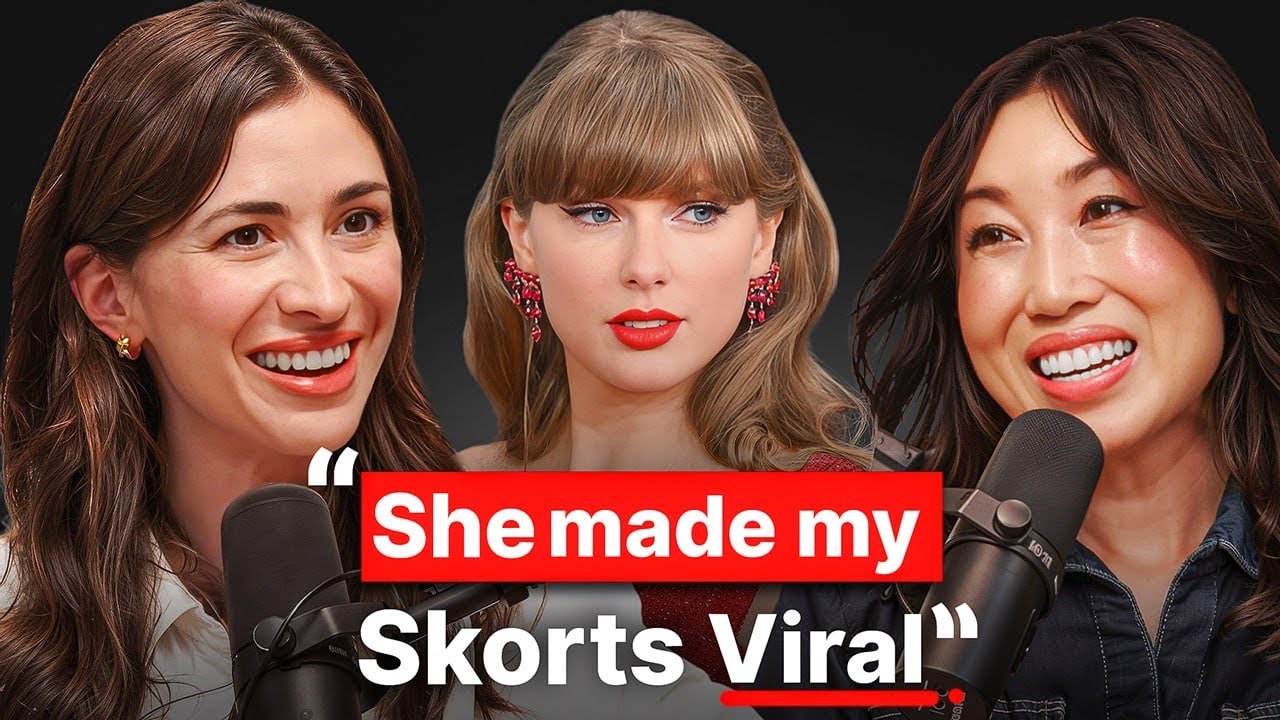
Cassey Ho: Huge. Oh my god. Okay, so this was wild. Sam and I were on a little weekend trip and we were just checking like Shopify sales and we're like, whoa, did someone just mention something? Like what's going on? We started seeing like all these Pure Wet skorts, which is the skirt that Taylor Swift wore and my patented skirt just like for whatever reason it was just going like up and we're like what's going on? We couldn't figure it out.
So we go on Slack. We're messaging everyone like, "Hey, did look, did something happen? Did someone mention us?" And we find out there's this girl with 1,900 followers on TikTok. So she's not like really a big content creator at all or creator at all. She has gone live for like five or six hours and she's just showing the skort that she's wearing and answering questions and she brought a huge spike that day. Oh, wow. It was insane. There's something about like, I don't know, like this is also another conversation but like I feel like as the influencer industry has evolved it's like consumers have lost trust in it because it's become almost like this fancy pedestal like thing whereas a normal girl with 1,900 followers she's going to tell you the truth like or at least that's the perception right and she sold some skorts so that was crazy.
Marina Mogilko: Talk to me about Taylor. How did that happen?
Cassey Ho: Oh my god. Okay, so I am a huge Taylor Swift fan. I've been listening to her music since 2008, "Teardrops on My Guitar," and she's honestly like my favorite musician, singer, songwriter, and honestly businesswoman. So when on April 19th of last year, people sent me the video of her wearing the Pure Wet skort, I went numb. I like couldn't even believe it. I couldn't even feel anything because I was feeling everything. Do you know what I'm saying? Like I basically died and it was insane.
One because that was like ultimate dream fulfilled. Like out of any celebrity in the world, if there was one person that I wanted to wear Poplex, it would be her and it happened, which is so crazy.
Marina Mogilko: Did you send it to her or No?
Cassey Ho: No, no, no, no, no. People ask me all the time, "Oh, did you send it to her?" Like, no. Like Taylor Swift was a billionaire. She can buy whatever she wants, right? And also, she's very intentional with what she buys. So sometimes I wonder, did she know all the stuff I was going through fighting for the rights to protect my design in the same way that she protects her music? Or did she just see it on TikTok and she liked it and she bought it? I will never know.
Marina Mogilko: What happened to sales?
Cassey Ho: Oh yeah. Okay. So that digital lavender Pure Wet skort sold out within one hour on the website. Like Swifties just started coming over. They found it and when Taylor Swift styled the Instagram account like confirmed it, that's when the sales started coming in like wild. And then within two hours, every single color of that skort, it started selling out.
And then we're like, uh, okay, well, what do we do, right? Because we're getting all this traffic and we got to do something. And we usually never do a pre-sale, but we're like, okay, maybe it's time to do a pre-sale. I don't know. So immediately we put a pre-sale up that night. And then we get like 16,000 pre-orders for that one skort in that color. Wow. Yeah. Which was insane. And then we had to work really hard to get that reorder up and going because, you know, we've got to weave the fabric, dye the fabric, cut and sew. Like, it's a whole process. And people eventually got it a few months later. And I'm just so happy.
Marina Mogilko: That's amazing. Such a cool moment. Okay, with all the crazy things that you're telling me, have you ever had thoughts of like let just Sam, your husband, handle everything and I will just enjoy life. You know?
Cassey Ho: What Sam says that to me all the time. He is often tired and he's like, "What if we just like chilled out for a second? What if all this growth was enough?" You know, like what if we just sailed? But like it's the way my parents raised me. I'm just like nothing's ever good enough and like we must keep growing and to be honest like it's fun but at the same time I do feel especially this year, you know, writing two different brands, I am exhausted. I'm exhausted mentally and often emotionally too because not only am I dealing with bigger problems with the business as we grow our team, I'm now taking on the emotional toll of what my team's going through. So if they're tired then I'm tired for them.
And so yeah, it's extremely exhausting. And I think what is not helpful, but maybe helpful is that this way in which we hire is I think it's different than how other businesses may hire. I hire slowly because I've been through toxic employee periods and I'm terrified. I'm terrified of that because that can crumble everything and it almost did in like 2017, 2018 times. And so any fractures that we're seeing right now, they're stress fractures and it's coming from our growth is outpacing the pace at which I'm hiring. And so that's something that I'm trying to deal with right now. Like I know there are good people out there, but it's not just about the skill, it's about the culture fit. And what we have on the team right now is so good, and I'm just terrified of breaking what we have.
Marina Mogilko: How many people do you have?
Cassey Ho: So we have 30 people right now.
Marina Mogilko: And that's so cool. That's a really lean team.
Cassey Ho: Very lean. Very lean for what we do. I think that's why we're all really tired.
Marina Mogilko: Yeah. What do you think is going to happen with AI? What is your take? Are you automating things? What apps are you using?
Cassey Ho: So my husband is a fan of ChatGPT. But me coming from more of a designer artist background, I absolutely hate AI when it comes to stealing from original artwork because AI would not be able to do what it's doing without pulling from previous work. So in that aspect, I absolutely hate it. I think there needs to be some type of royalty built in or something so that if you are taking inspiration from whoever artist and you have to type in that person's name to get that look then just based on that alone, okay, 5% needs to go back to original artist or 10% or whatever. I think that needs to be in place. Then I think people would be less mad. But right now it's like totally wild west with AI, that's how I feel on that front.
But in terms of like, you know, travel plans, fans and like fun little searches here and there, it's helpful. I'm warming up to it. But like on the artist side, I absolutely hate it.
Marina Mogilko: But do you see it helping you stay lean with your team like because you're utilizing more AI tools or it's not there yet?
Cassey Ho: No, right now I don't really see, at least with on the apparel and product development side. I don't really see how it can help us right now. I think we've dabbled in a little bit of it with the copy on our website. There probably are different areas we could start using it. I think there could be because what I'm seeing right now as we're growing our design and development team, there seems to be like this lack of new young people in the technical designer space because I think everyone wants to be a fashion designer, a graphic designer, but like technical design is really like architecture of clothing. It's very mathematical, very science. And I just wonder that's probably a good area for AI to like begin helping, especially if the young people don't want to get into that field. Like I'm actually having a lot of trouble hiring in that specific role.
Marina Mogilko: Interesting. Yeah. So maybe someone will come up with something to help with pattern making.
Cassey Ho: Yeah. Yeah. That makes it easier. And I know that's probably different than how more of the techy people feel about it, but it's just because I've been so burned and taken advantage of, just even without AI, or no actually with AI in terms of my patented products too and like, you know, they've been duped by the scene, multiple vendors on Amazon, TikTok shop and these days the big American retailers have gotten in on the game, which is insane.
Right now I'm dealing with Nordstrom Rack, TJ Maxx, Kohl's, J.C. Penney, just recently VS Pink, as in Victoria's Secret. And these are patented products. And what I'm dealing with right now is that, you know, I pay thousands of dollars to get my design patent approved. And obviously it doesn't automatically get approved. You have to prove a lot of different things. Anyway, I pay thousands of dollars, the US PTO issues me a design patent. You would think that's enforceable. And for the most part, it kind of is, but when you get to the stage of having to deal with big billion dollar corporations, it's now a money game because do I have any type of police helping me enforce this patent? No. Actually, it's me paying thousands of dollars an hour for my lawyers to talk to their lawyers.
And this is kind of where I am right now. And it's extremely frustrating because, you know, it's my artwork, my work for free, them capitalizing off of work that they've stolen from me. So that's how I feel about that. And in terms of AI, there have been instances where my videos are just stolen off of my page. They've used AI to actually change my face.
Marina Mogilko: Oh, yeah. Happens to me all the time.
Cassey Ho: And you promote a scam with your face.
Marina Mogilko: Yeah. Oh my god. No. It's crazy. And they can't do anything the platforms cuz they just—
Cassey Ho: Yeah. So what happens when bigger companies they steal your patent, you try to sue them or talk to them? Have you ever been able to win something or it just goes like that?
Marina Mogilko: Well, right now my immediate goal is get it off the website or get it off the platform. And it's completely a game of whack-a-mole. And what the problem is that the platform puts it on the small business, the creator, whatever, because they're hands off. So you fill out this form. It's such a long form, but you fill it out like multiple times a day. Like just for example, the other week, just on that Pure Wet skort that I was talking about, the one that Taylor wore, I think there were what was it like 233 or 433? I should look again. Dupes, separate dupe listings of that one skort on TikTok shop alone. I'm not even talking about Amazon, okay? I'm not talking about Temu. I'm not talking about AliExpress. That was just TikTok shop.
And my frustration with it is, okay, sure, we could be losing, you know, money from whatever that we could have made from the real thing. However, my bigger fear is that it cheapens the design. You see it now everywhere. It's no longer special. And then confusion. I mean, I've even had fans DM me and be like, "Oh, do you also run this subbrand?" Because they've not only copied the designs, they copied my marketing, too. Even the angles of where I film, hiring a model with my body type and my skin color. Like, it gets so deep and so confusing that it ends up hurting the brand reputation.
And I've actually had people, what I think, bought from one of these fake videos, right? It links over to their stupid dropship website. They buy it and the pictures are my model pictures, my description, whatever. So they're completely duped. Then they'll receive the product and then come back to my page and blame me for slow shipping, bad quality, like things they call it that like is not even on the real product. Like that's the level of confusion that is so dangerous and tarnishing to a brand.
Marina Mogilko: But it feels like at this point it became part of the culture and there's, I don't know if you can do anything for like Louis Vuitton bags, the fake ones are everywhere and you're like just accept it.
Cassey Ho: Have you ever thought of like, no, no, I can't accept it. I'm going to keep fighting. I'm going to keep fighting because it's not right. I can't work for free for somebody else. I just, I as a principle, I will never stop fighting. I can't.
Marina Mogilko: Yeah. And talk to me about that because you also stopped posting right, the long form? And from what I've read it looks like you were dealing with a lot of online hate and like people just shaming you, etc. Yeah. Do you think you stopped because of that or was there any other reason?
Cassey Ho: That was a big part of it. So I've never really talked about this officially. So I'm glad you brought it up. I used to make long form fitness videos since 2009 as a Pilates instructor. That is crazy though. Yeah, 2009. Isn't that insane? Yeah.
So I did that because I wanted to stay connected with my real life students and it was meant for 40 people. I put up a video for them because I was moving from LA to Boston for my first job and that's it. I wasn't planning to start a YouTube channel. I wasn't starting a brand, nothing like that. You couldn't even make money on YouTube back then. And then that video ended up getting thousands of views and hundreds of comments and Blogotties became like this fitness channel and community.
And what I didn't expect, because this never happens in real life, was for people to say something negative about my body. Because if anything, I'll tell you, I was afraid to be like, "Oh, she's not pointing her toes enough. Her legs aren't straight enough. Her form is bad." Never got any of those comments. The first mean comments I got were, "Ugh, why is she so fat? Why is her butt so flat? Why does she look like that?" And having grown up chubby and having to deal with my own body insecurities, that just hit me so deep in a place that I wasn't ready to, like I was barely even healing from it inside. And now I'm having to heal, or not even heal, but just like deal with it head on in front of millions of people.
And so that was just a constant thing that was happening in the background. But that wasn't why I stopped everything. If I'm being completely honest, I was no longer feeling emotionally and mentally challenged with my content. And just as the person that I am, and content being an extension of who I am, not just something that I do, I want to find the joy in it. And towards the end when I posted my last long form video, which is probably like 2021, I wanted to show people more of the other things I was doing. Like yes, I was doing the fitness videos that you saw, but in the background I was running an apparel business and I wanted to show people that side of me.
And so my first short form video was just showing people like, oh, the science behind camel toe, like why does that happen? And I was honestly really surprised that it did well. And I was like, oh, maybe I can try to make more of these. And they ended up working. They ended up selling the product and they ended up helping me show a different side of myself. And like I said at the top of this interview, it brought the joy back into the editing for me. And so I also switched my content for me so that I could feel happy with what I was producing and also challenged with what I was producing.
Marina Mogilko: But have you ever feared that going back will not generate as much views as it used to or you're never going back to one form?
Cassey Ho: Well, here's the thing. I've never made an official announcement because who knows? Maybe I will one day want to be like, "Oh, let's just like do a squat challenge or something." Like that's still there. In this moment right now, I'm just so in love with product development, design, that that's the content that I want to make. And should I go back? Let's see. I think the other day, not the other day, the other month when I was launching the Blogotties for Target brand, I taught a fitness class in front of a group of people, which I haven't done in a long time, and it was super fun. Like that part of me will always be here because I've been teaching since like 2006. So that group fitness instructor Cassey will never go away. I love fitness. I work out every single morning. That's part of my routine. I just really needed a break from that.
But I will say too, the moment that I switched from fitness content to fashion content, not one person has said one negative thing about my body, which made me realize, oh man, I was dealing with a lot of toxic negativity for a long time. Feeling so bad about my body for a long time. And it was like I was in the wrong industry.
Marina Mogilko: Yeah. Yeah. And I just, I didn't look like the other girls. You probably get negative comments still, right? Probably now about your business.
Cassey Ho: Yeah, it's like here's the thing. They don't attack my body, which is like, but they might attack, yeah. They might attack like, "Oh, your skorts are too short." Like, okay, like I can deal with that. What I can't deal with though is some one, this is the worst one. I remember they attacked, this is back in the fitness days, one of the comments was, "Oh, if you cared more about your career, you would lose some weight." And that one hurt so much because not only did it attack my body, it attacked my work ethic and nobody attacks my work ethic because I work so hard.
And so if any comment today, you know, say what you want about the apparel, everyone is subjective and it has their own, you know, likes and stuff, but say anything about my work ethic and that really hurts because it's just untrue. But you know, with the negative comments from back in the day, there was a video that I made, forget when it was, like probably 2015 or 2016, where I honestly could not take it anymore because it was coming from every angle. And I really was crumbling on the inside.
And so what I did was I took all these negative comments and I produced this video called "The Perfect Body" where I photoshopped on camera how these comments wanted me to look: thinner waist, bigger boobs, bigger butt, bigger eyes even, right? And that for me was something I needed to do for myself to heal because when I heal, I like taking the negative energy, turning it on its head, and turning it into something positive. So I put that video out for me. What I didn't expect was for it to go crazy viral. I think that was like my first crazy viral video that got on like Good Morning America on like every single news outlet. Like it was insane. And I got messages from fathers telling me they shared it with their daughters and their wives and it had like this profound impact.
And around 2016 was also like the body positive movement. And so I think during that time that's kind of just what everyone needed. So there was good that came out of those negative comments but man they really hurt.
Marina Mogilko: Can you give advice to girls or anyone going online these days trying to make something and getting all this hate and maybe they're thinking of stopping doing what they're doing because of that?
Cassey Ho: Here's the thing. If you really believe in what you're doing and you're not hurting anyone and you're having a fun time, just do it, right? Like at the core of all of this, we can't keep going unless we're having fun, right? Because we're the content creator. But in these comments, some of them are hateful, but some of them can have a little bit of truth. So I read all my comments all the time.
Marina Mogilko: Oh, you still do? Oh my god. Yes. Do you not?
Cassey Ho: I read them for the first couple hours because I know these are my loyal subscribers watching, but then when the video goes viral, like I don't really care.
Marina Mogilko: Yeah. It's too much. It's too much. I agree on the first few hours like reading everything in and writing back because it's fun because you get these are your friends really. This is your community. But then if it starts getting more traction than average and all of these people come in and like start commenting on my age, whatever. Oh my god.
Cassey Ho: Well, when it gets to the wrong side of the internet, it's bad. But when it's viral, when it's viral, it's viral. No, I know, I know, I know, I know. But yeah, I mean, look, I think there's truth in some comments and there can be self-reflection, but look, if you're having fun and it's working, like just keep going because your content will find the right people.
Marina Mogilko: Yeah. So if you stop making your short videos today, how would that affect your sales?
Cassey Ho: I think that would affect the sales because right now around I think 70% of the revenue is brought in by organic videos. Yeah. Whether it's organic videos by me, by Blogotties like me, or by the Poplex organic videos, but mostly by Blogotties videos.
Marina Mogilko: Oh that is huge. Yeah. 70%. Yeah that's a lot.
Cassey Ho: I know it's very very different than normal DTC brands that rely on the ads. Yeah. Yeah. So it's good but also again if I stopped, I look, I think there would be an impact but I don't think the brand would die because our SMS as well as our newsletter does really really well. Like the clickthrough and the open rate are really high. People love it. Honestly, what's been really cool to see is that sometimes people might follow Poplex but not follow me or like they might know Poplex but not know me. And I really like that because that's showing that this is a brand beyond, you know, any influencer influence or just, you know, anything that has to do with Cassey Ho because my goal is for Poplex to become a legacy brand that lives on for hundreds of years after I die.
And that foundation for this type of brand and this type of product needs to start now while I'm still alive, right? So yeah, but if I did stop, it would make an impact.